

Wax production is the most expensive biological investment a honey bee colony makes. It requires immense energy and a surplus of resources that many hives simply cannot spare during a nectar dearth or a period of poor health. It's incredibly frustrating to open your British National hive and find your bees not drawing out foundation, especially whilst the colony feels congested and the threat of swarming looms. You've invested in quality equipment and high-vigour genetics, so seeing stagnant frames feels like a wasted opportunity for growth.
We understand the concern that comes with a colony that refuses to expand. Whether you're worried about queen vigour or simply want to secure a successful honey harvest, you need actionable solutions. This troubleshooting guide explores the biological and environmental reasons your bees are ignoring new foundation. You'll learn professional techniques to stimulate rapid wax production, ensuring your frames are fully drawn and your colony has the space it needs to thrive. From assessing nectar flow to leveraging the strength of Buckfast or Carniolan genetics, we'll provide the clarity you need to get your hive back on track.
Key Takeaways
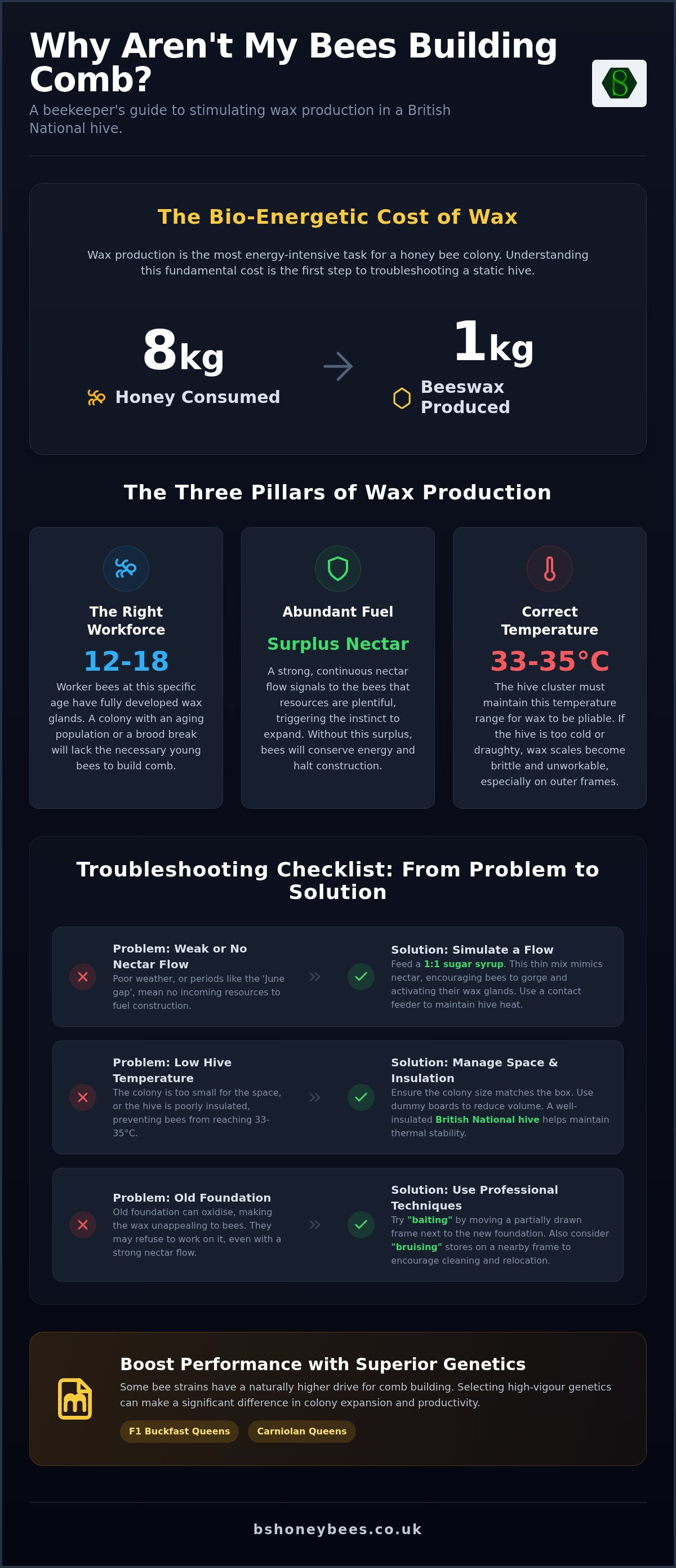
- Understand the high bio-energetic cost of wax production, where bees must consume roughly 7-8kg of honey to produce just 1kg of comb.
- Identify why you have bees not drawing out foundation by assessing the nectar flow and ensuring the hive maintains the high internal temperatures required for wax secretion.
- Evaluate the condition of your British National frames and check for wax oxidation, which can make foundation unappealing to even the most productive colonies.
- Learn professional techniques like "baiting" and "bruising" stores to manipulate hive behaviour and stimulate rapid expansion across new frames.
- Discover how selecting high-vigour genetics, such as F1 Buckfast or Carniolan queens, can naturally increase a colony's drive to build out new comb.
Understanding the Biology of Wax Secretion
Wax production isn't merely a task; it's a complex physiological capability. The biology of wax secretion involves four pairs of glands located on the ventral side of the abdomen. These glands convert sugar from nectar or honey into liquid wax, which then hardens into small, clear scales. For this process to occur effectively, the colony must maintain a high internal temperature and possess a specific demographic of worker bees. If you find your bees not drawing out foundation, it's usually because these biological prerequisites haven't been met.
The Age Factor: Who Builds the Hive?
Young worker bees aged between 12 and 18 days are the primary architects of the hive. This specific age bracket is when their wax glands are most developed and active. If your colony population is aging due to a brood break or a failing queen, the drive to build will vanish. Once a bee transitions into a foraging role, its wax glands begin to atrophy. A newly hived nucleus colony may also pause expansion whilst it waits for the first batch of brood to emerge. Until those young house bees reach the 12-day threshold, comb building will remain stagnant. Using high-vigour genetics, such as F1 Buckfast queens, helps maintain a prolific brood cycle that provides a steady supply of young wax-producers.
The 8:1 Ratio: The High Cost of Construction
Building comb is an expensive biological investment. To produce just 1kg of beeswax, a colony must consume roughly 7-8kg of honey. This staggering ratio means that wax production is a massive bio-energetic drain on the hive's resources. Workers must consume large quantities of sugar to fuel the metabolic activity required to secrete wax and maintain the high temperatures needed for wax plasticity.
The metabolic cost of wax production is the primary reason bees are frugal with new comb.
During a weak nectar flow, bees will prioritise storing honey in existing cells rather than building new ones. They won't risk their winter stores on expensive construction unless they feel secure in their current supply. If the weather is cold or nectar is scarce, the bees will conserve energy and ignore the new foundation entirely. Understanding this economic reality is the first step in troubleshooting why your bees not drawing out foundation is occurring in your British National hive.
Environmental and Nutritional Triggers for Comb Building
A colony's decision to build comb is never arbitrary. It's a response to a surplus of resources and a stable internal environment. If you notice your bees not drawing out foundation, the primary culprits are usually a lack of incoming nectar or a failure to maintain necessary thermal conditions. Bees won't build for the sake of it; they build when the hive's current capacity is reached and the future looks prosperous. Space management is critical. Providing too much room before a colony is ready leads to heat dissipation and a halt in wax work.
Nectar Flow vs. Artificial Feeding
Natural forage is the most potent trigger for wax production. A heavy nectar flow signals to the colony that expansion is necessary. However, UK weather is notoriously fickle. During the "June gap" or periods of prolonged rain, natural forage vanishes. To stimulate comb building during these periods, you must provide a simulated flow using 1:1 sugar syrup. This thin syrup mimics nectar and encourages the bees to gorge, which activates their wax glands. Unlike the thick 2:1 syrup used for autumn stores, 1:1 syrup contains more water, making it perfect for immediate metabolic use. Position contact feeders directly above the cluster to provide easy access whilst minimising heat loss.
Thermal Management: Why Heat Matters
Bees require a cluster temperature of 33-35°C to manipulate wax effectively. If the hive is too cold, the wax scales become brittle and unworkable. This is why you'll often see bees not drawing out foundation in the outside positions of the brood box during a cold snap. The bees retreat to the centre to protect the brood, leaving the peripheral frames cold and ignored. Utilising well-insulated British National beehives can significantly help maintain these critical temperatures. If you're struggling with expansion, consider whether your hardware is supporting the colony's thermal efficiency. Ensuring your hive is equipped with quality British National frames and proper insulation is a fundamental step in encouraging a productive colony.
Congestion also plays a role. Whilst a crowded hive often triggers the building urge, excessive congestion without a resource flow leads to swarming rather than building. You must strike a balance between providing enough bees to cover the frames and ensuring they have the fuel to do the work. Common environmental blockers include:
- Cold ambient temperatures that shrink the cluster.
- Nectar dearths reducing metabolic energy.
- Excessive hive space causing heat loss.
- Poorly insulated hive bodies.
Troubleshooting Equipment and Foundation Quality
If the biology and environment align but you still see bees not drawing out foundation, the issue likely resides in the hardware itself. Bees are highly sensitive to the texture and scent of the substrate they're provided with. Low-quality or poorly maintained equipment can stall a colony's progress, even during a strong flow. You must ensure your frames are attractive to the workers before you can expect them to invest their energy in construction.
The Problem with Stale or Low-Quality Wax
Beeswax is a natural lipid that undergoes physical changes over time. Oxidation is a common problem; as wax foundation sits in storage, it develops a pale, powdery coating known as "wax bloom". Whilst this isn't harmful, it makes the foundation brittle and masks the attractive scent of fresh wax. Bees often treat stale foundation as a foreign object rather than a building site. If your sheets look dull or white, they need refreshing.
Use a hairdryer on a low heat setting to gently warm the surface until the wax looks shiny and yellow again. This simple step releases the aromatic compounds that signal to the bees that the frame is ready for work. Always ensure you're using high-standard National hive frames to provide a stable, fresh foundation for your colony. Freshness matters because bees are far more likely to accept wax that smells like the hive environment.
Plastic vs. Real Beeswax Foundation
In the UK beekeeping tradition, pure beeswax remains the preferred choice. Whilst plastic foundation is popular in other regions, British bees often show a distinct hesitation to draw it out unless it's heavily coated in high-quality wax. This reluctance is particularly noticeable in a newly established nucleus colony, where resources are precious and must be used efficiently. If the foundation isn't properly seated in the frame groove, bees may create "bridging" or "burr" comb, bypassing the foundation entirely.
Correct frame spacing is equally vital. Whether you use Hoffman self-spacing frames, metal ends, or plastic spacers, the gap between the foundation sheets must be precise. If frames are too far apart, the bees will build "brace" comb between them; if they're too close, the workers cannot fit between the sheets to work the wax. This logistical failure is a frequent reason for bees not drawing out foundation in a uniform manner. Check your spacing during every inspection to ensure the bees have the physical room to build straight, manageable comb.
Practical Steps to Stimulate Comb Building
When you have bees not drawing out foundation despite a good nectar flow, you must transition from observation to active management. You cannot simply wait for the colony to decide to expand. You need to manipulate the hive environment to encourage the workers onto the new frames. This requires a balanced approach that provides enough incentive for the bees to build without compromising the thermal integrity of the brood nest.
The "Baiting" Technique
Baiting is a highly effective method for moving house bees onto fresh wax. It involves moving a single frame of foundation into the "warm zone," which is the area immediately adjacent to the existing brood nest. This is where the highest concentration of young, wax-secreting bees resides. To make the frame even more attractive, spray a light mist of thin 1:1 sugar syrup directly onto the foundation before insertion. This encourages the bees to cluster on the frame to clean up the sugar, which often triggers the building instinct. However, be extremely cautious. Never "split" the brood nest by placing foundation in the dead centre of the cluster during the early UK season. Doing so can cause the brood to chill if temperatures drop overnight, leading to colony stress and disease.
Managing the Queen Excluder Barrier
Beekeepers frequently struggle with "excluder hesitation," where bees refuse to cross the metal or plastic barrier to work in a super. This often happens when the super contains only foundation. To overcome this, use the "one frame up" method. Move a single drawn frame of honey or brood (after carefully ensuring the queen remains below) into the super. This creates a biological bridge that draws house bees through the excluder. Once they begin drawing the adjacent foundation, you can move the bait frame back down. If the colony remains listless and refuses to move upwards despite these efforts, check for drone laying queen symptoms. A lack of worker brood will inevitably lead to a stagnant population that lacks the drive to expand.
Another useful technique is "bruising" honey stores. Use your hive tool to lightly scratch the cappings of sealed honey near the area you want the bees to expand. The bees will move the honey to repair the damage, which creates a sense of urgency and a need for new storage space. For more advanced keepers, "checkerboarding" (alternating drawn comb and foundation) is a powerful tool, though it carries a higher risk of heat loss for smaller colonies. Ensure your expansion efforts are supported by the best equipment available by browsing our range of British National Hives & Frames to give your colony the foundation it deserves.
Selecting Vigorous Genetics for Productive Colonies
If you've addressed nutrition, thermal management, and equipment quality, yet still find your bees not drawing out foundation, the problem often lies with the queen. Genetics dictate a colony's drive to expand. A low-vigour queen produces a stagnant population that lacks the biological urge to build. You can't force a colony to grow if its genetic blueprint prioritises conservation over expansion. A colony that is genetically predisposed to slow growth is the most common reason for bees not drawing out foundation during a peak flow. High-performance genetics are the engine of the hive; without a strong queen, even the best British National frames will remain empty.
Buckfast vs. Carniolan: Building Tendencies
Choosing the right breed for your management style is essential for hive expansion. When comparing buckfast vs carniolan bees, both are renowned for their productivity, but they approach expansion differently. F1 Buckfast queens are specifically bred for explosive buildup and a prolific laying pattern. This rapid increase in worker numbers creates an immediate demand for space, which forces the house bees to secrete wax and draw foundation. Carniolans, whilst also excellent builders, are particularly adept at early spring expansion. If a colony remains listless despite a nectar flow, requeening is often the only way to restore the necessary vigour to the hive.
Ensuring Successful Hive Expansion
Successful beekeeping requires a holistic approach. You must ensure the colony has the three pillars of productivity: consistent nutrition, efficient thermal management, and superior genetics. Troubleshooting a stagnant hive requires deep, thorough inspections to evaluate the queen's performance. We recommend wearing high-quality protection, such as BBWear bee suits, to ensure you remain calm and focused whilst assessing the brood nest. Confidence in your gear allows for the precision needed to identify why your bees aren't performing as expected.
BS Honey Bees Ltd is your partner in high-performance beekeeping. We specialise in providing the vigour needed for a successful 2026 season. Don't let a stagnant colony cost you a honey harvest. Take decisive action to improve your hive's productivity by introducing a more capable queen. Browse our 2026 Mated Queens and Nucleus Colonies to secure the genetics your apiary needs to thrive.
Maximising Your Hive's Potential for 2026
Understanding why you have bees not drawing out foundation is the first step toward a more productive apiary. Comb building requires a precise alignment of young house bee demographics, consistent nutritional intake, and stable internal hive temperatures. Whether you're refreshing stale wax or using baiting techniques to move bees onto new frames, these management shifts can trigger the biological response needed for expansion. Don't let a stagnant hive limit your honey harvest this season.
BS Honey Bees Ltd supports your journey with premium British National equipment and high-vigour genetics. As specialist UK breeders, we understand that a prolific queen is the engine of any successful colony. If your bees are falling behind, it's time to upgrade your stock. Order your high-vigour F1 Buckfast Queens for the 2026 season and take advantage of our nationwide delivery and live arrival guarantee. With the right tools and vigorous bees, you'll see those empty frames transformed into productive comb in no time. Your success is our priority, and we're here to ensure your colonies thrive.
Frequently Asked Questions
How long does it take for bees to draw out a frame of foundation?
Under ideal conditions, a strong colony can draw out a single British National frame in as little as two to three days. This speed depends entirely on a heavy nectar flow and a large population of young house bees. If the weather is cold or forage is scarce, the process will take significantly longer. You should monitor progress weekly to ensure the colony has enough space to expand without triggering a swarm response.
Can I feed my bees 1:1 syrup even if there is a nectar flow?
You shouldn't feed syrup whilst honey supers are on the hive if you intend to harvest English honey. However, if your primary goal is colony buildup, 1:1 syrup is an excellent tool. It provides the necessary hydration and metabolic energy to stimulate wax secretion. For newly hived nucs or colonies struggling during a June gap, a light syrup feed can be the catalyst that gets your bees working the wax again.
Why are my bees building "burr comb" but ignoring the foundation?
If you find your bees not drawing out foundation but building burr comb instead, it usually indicates a problem with the foundation's appeal or the frame spacing. Bees are sensitive to bee space and will fill gaps larger than 9mm with free-form comb. If your foundation is old or oxidised, the bees may treat it as a barrier. Try refreshing the wax surface with a hairdryer or checking your Hoffman spacers to ensure frames are tight.
Is it too late in the season for bees to draw out foundation in the UK?
In the UK, the window for drawing comb typically closes by late August. As the days shorten, the colony shifts its focus from expansion to winter preparations and storing heavy 2:1 syrup. Whilst a late ivy flow can sometimes trigger wax production in September, it's unreliable. To ensure your colony is well-prepared, aim to have all necessary brood frames and supers drawn out by the end of July or early August to ensure winter survival.
Should I remove the queen excluder to help them draw out supers?
Removing the queen excluder for a few days can encourage bees to move into a super, but you must be vigilant. If the queen moves up and starts laying in the super, it creates a management challenge. A safer alternative is the "one frame up" method. Move a frame of drawn comb or stores into the super to draw house bees through the excluder. Once they start working the wax, you can return the bait frame.
What happens if I hive a nuc and they don’t expand within two weeks?
If a new nuc doesn't expand within a fortnight, investigate the queen's vigour and the local nectar flow. It's common for bees not drawing out foundation to occur if the nuc is waiting for its first cycle of brood to emerge. Once those young workers hatch, the house bee population increases, and wax production should begin. If the colony remains stagnant despite a steady 1:1 syrup feed, it may indicate a failing queen.
Does the colour of the beeswax foundation matter to the bees?
The colour of the foundation is less important than its freshness and scent. Beeswax can range from light primrose to a deeper orange depending on the rendering process and the floral sources used. What matters most is that the wax hasn't become stale or covered in a powdery white bloom. Bees rely on aromatic cues to accept foundation, so ensure your wax smells clean and is free from chemical contaminants or heavy oxidation.
How many frames of foundation can a colony draw at once?
A vigorous colony can typically manage two to three frames of foundation at a time. Placing too many empty frames into a hive can dissipate heat and stress the workers. It's better to add frames gradually, placing them at the edge of the brood nest where the temperature is highest. Using high-vigour genetics, such as our F1 Buckfast queens, ensures a prolific population that can handle rapid expansion across multiple British National frames.