
With over 245,000 honey bee hives currently active across the United Kingdom, why does one specific design continue to dominate nearly every apiary from Cornwall to Caithness? The british national beehive remains the undisputed standard because it offers a modular flexibility that other systems simply cannot match. You've likely felt the frustration of trying to decipher "bee space" or wondered if a traditional cedar hive is truly worth the investment over a modern, high-density polystyrene alternative. These are the valid concerns of many of the UK's 44,000 amateur beekeepers who want to ensure their colonies survive a damp British winter.
We agree that getting your hardware right is the foundation of your success. This definitive 2026 guide will show you how to master the 460mm square footprint of the National hive to ensure your colony thrives. We'll provide a clear breakdown of hive anatomy, compare the best materials for current climate challenges, and offer a professional blueprint for organising your frames to maximise honey yield. By the end, you'll have the confidence to build a productive and resilient apiary that stands the test of time.
Key Takeaways
- Understand why the british national beehive remains the UK standard and how its interchangeable components simplify apiary management.
- Master the specific anatomy of the National hive, including the 11-frame brood chamber and the essential role of the Varroa floor.
- Evaluate the benefits of Western Red Cedar, Pine, and high-density polystyrene to select the best material for the British climate.
- Learn the technical nuances of bottom bee space to prevent propolis buildup and ensure efficient hive inspections.
- Discover how to optimise your apiary location to protect your equipment and create a productive environment for your honey bees.
Understanding the British National Beehive: Why It Remains the UK Favourite
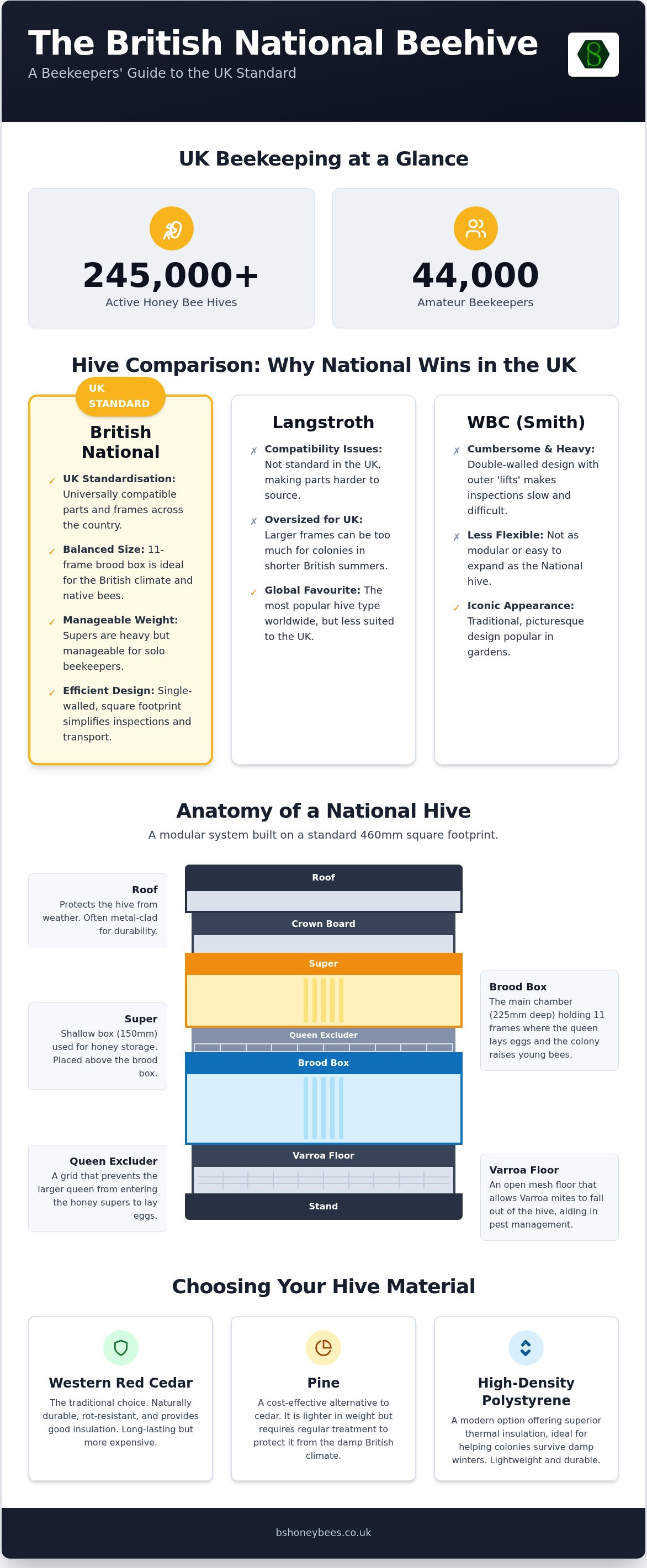
The british national beehive didn't become the UK's most popular choice by accident. It represents a deliberate evolution in apiary management, moving away from the cumbersome, double-walled WBC design and the smaller Smith hive. By adopting a single-walled, square footprint, the British National beehive design solved the logistical nightmare of moving hives whilst maintaining enough insulation for the unpredictable British climate. Its modularity is its greatest strength; you can expand or contract the hive volume simply by adding or removing boxes. This flexibility allows beekeepers to react instantly to the seasonal needs of their colony without replacing the entire setup.
The Concept of Standardisation in British Beekeeping
Standardisation is the bedrock of modern beekeeping in the UK. When you choose a National hive, you're entering a massive ecosystem of compatible parts. Whether you're buying frames from a specialist supplier or borrowing an extractor from your local association, everything just fits. This universal sizing is particularly vital when you're looking for live bee delivery UK services. Most nucs (nucleus colonies) are supplied on National frames, meaning your new bees will slot directly into your brood chamber without any stressful modifications. It's a "plug-and-play" system that reduces equipment waste and simplifies your inventory management.
National vs. Other Hive Types (Langstroth and WBC)
Many new beekeepers are tempted by the iconic look of the WBC or the global popularity of the Langstroth. However, the National hive often wins on pure practicality. While the Langstroth is a fantastic hive, its larger frame size can be too much for some native or Buckfast strains to fill quickly in shorter British summers. In contrast, the National's 11-frame capacity is perfectly balanced for our climate and the foraging behaviour of local bees. It provides enough space for a prolific queen without leaving too much empty volume for the bees to keep warm during a cold snap.
Weight is another critical factor for the modern beekeeper. A full National super is heavy but manageable for a solo beekeeper during a honey harvest. The WBC, whilst beautiful in a garden, involves lifting multiple outer "lifts" before you even reach the bees. This adds unnecessary time and physical strain to every inspection. Choosing the british national beehive means choosing efficiency and longevity. You can source parts from almost any UK supplier, ensuring your apiary remains operational even if your primary manufacturer changes. It's the most logical choice for anyone serious about long-term beekeeping success.
Anatomy of a National Hive: Component Breakdown and Dimensions
The british national beehive is designed around a precise 460mm square footprint. This standardisation ensures that every component stacks perfectly, creating a weather-tight seal against the elements. Each part serves a specific biological or logistical purpose, from managing mite levels to isolating the honey harvest. Understanding these dimensions is the first step toward efficient apiary management.
The Foundation: Floors and Entrance Blocks
Modern beekeeping practically requires an open mesh Varroa floor. Unlike traditional solid floors, these feature a mesh bottom that allows Varroa mites to fall away from the cluster, preventing them from re-entering the hive. During the autumn or when wasp activity peaks, the entrance block is your colony's first line of defence. It reduces the entrance size, allowing a smaller number of guard bees to protect the hive's entrance effectively. The varroa tray slides beneath the mesh to provide a clear surface for monitoring daily mite drops.
The Management Core: Brood Boxes and Supers
The standard National brood box is 225mm deep and holds 11 frames comfortably. For beekeepers working with prolific queens, such as Buckfast strains, the 14x12 "Deep" brood box offers extra space for the queen to lay without needing a "double brood" setup. Above this chamber, the queen excluder acts as a filter. It allows workers to pass through into the supers whilst keeping the queen restricted to the brood area. National supers are shallower at 150mm, which keeps the weight manageable during the honey harvest. Choosing high-quality national hive frames for sale is essential for ensuring your wax foundation is held securely under the weight of the crop.
The hive is topped with a crown board and a weatherproof roof. The crown board provides a flat ceiling and acts as a barrier for feeding, whilst the roof protects the entire stack from the British weather. A deep-sided roof is particularly effective at preventing wind from lifting the cover during winter storms. If you're preparing for the upcoming season, our range of British National Hives & Frames provides the durability required for professional apiary management.
Choosing Materials: Cedar, Pine, or High-Density Polystyrene?
Selecting the right material for your british national beehive is a decision that impacts both your apiary's longevity and your bees' thermal comfort. Traditionally, beekeepers have relied on timber, but modern high-density polystyrene (poly) has changed the landscape for those prioritising winter survival. Each material offers a different balance of initial cost, maintenance requirements, and biological benefits for the colony.
The Case for Cedar and Pine
Western Red Cedar remains the gold standard for wooden hives. It contains natural oils that resist rot and insect damage, meaning you don't need to apply chemical preservatives. This allows the wood to weather to a beautiful silver-grey whilst standing up to the damp British climate for decades. Pine is a popular, cost-effective alternative. It's lighter on the pocket initially but requires a commitment to maintenance. You must paint or treat pine hives with a bee-friendly preservative before use to prevent the wood from warping or rotting in our wet winters. Regular inspections of the joints and a fresh coat of paint every few years will ensure a pine hive remains a viable home for your bees.
The Rise of Poly Hives in the UK
High-density polystyrene hives are no longer a niche choice. The insulation properties of a poly nuc hive UK prove that thermal regulation is a game-changer for colony health. In a poly hive, bees spend less energy heating the cluster and more energy on brood rearing. This leads to a faster spring buildup and, consequently, higher honey yields. Poly hives are also significantly lighter than their wooden counterparts. This makes them the favourite for beekeepers who manage their apiaries solo or have concerns about heavy lifting during the peak of the season. Whilst they lack the traditional aesthetic of timber, their performance in cold, damp conditions is exceptional.
Your choice should balance your immediate budget with long-term goals. A cedar british national beehive is a legacy investment that can last thirty years with minimal fuss. Poly hives offer immediate biological advantages but require careful handling to avoid surface damage during hive tool use. If you prefer the classic aesthetic of the British countryside, wood is the winner. If you want maximum productivity and easier overwintering in exposed locations, poly is hard to beat. Regardless of the material, ensure your components are manufactured to the standard 460mm dimensions to maintain interchangeability across your equipment.
Practical Advantages for Modern Beekeeping Management
The british national beehive offers more than just a standard size; it provides a framework for efficient, professional colony management. Its design focuses on the biological needs of the bees whilst ensuring the beekeeper can perform inspections with minimal disruption. From the way the frames sit to the ease of lifting heavy supers, every detail is engineered for high-performance apiary work.
Mastering the Bee Space
Success in beekeeping depends on respecting "bee space", the precise 6-9mm gap that bees leave clear for movement. If a gap is smaller, bees seal it with propolis; if it's larger, they fill it with messy brace or burr comb. The british national beehive is manufactured to maintain this space across all internal components, which prevents frames from being glued together. This technical precision allows for easier inspections and ensures you don't crush bees when moving boxes. Bottom Bee Space keeps the frames flush with the top of the box, ensuring the critical gap exists between the bottom of the frames and the floor or the unit below. This configuration makes the National hive remarkably easy to pull apart even after a heavy nectar flow.
Swarm Management and Expansion
The modular nature of the National hive is a massive advantage during the swarming season. If you're managing prolific F1 Buckfast queens, you might find a single brood chamber isn't enough. You can easily adopt a "Brood and a Half" method by adding a super for extra laying space, or move to a "Double Brood" setup using two full-sized chambers. This modularity also facilitates the Pagden artificial swarm method, allowing you to split a colony quickly using standard parts.
Interchangeability is where the system truly shines. You can move frames directly from your main brood chamber into a 2 in 1 poly nuc to create a new colony or control a swarm. This seamless integration between your main hives and your nucleus equipment reduces stress for the bees and simplifies your workflow. Handling these components is made easier by the deep, flared handles on the boxes, which provide a secure grip when lifting heavy honey crops. For those looking to scale their operations, investing in high-quality beekeeping equipment UK ensures your kit remains compatible and durable for years to come. To ensure your apiary is equipped with the best possible hardware, browse our full range of British National Hives & Frames today.
Setting Up Your Apiary with British National Equipment
Establishing a successful apiary requires more than just high-quality hardware; it demands a strategic approach to location and colony management. Your british national beehive should be situated on firm, level ground with the entrance facing south or south-east to catch the morning sun. This early warmth encourages the bees to begin foraging sooner each day. Natural windbreaks, such as hedges or fences, are essential in the UK to protect the hive from chilling gusts that can force the colony to consume precious winter stores just to maintain cluster temperature.
Every beekeeper needs a professional toolkit to manage their National equipment effectively. You'll require a stainless steel hive tool designed specifically for the National's frame lugs, a reliable smoker, and high-quality protective gear. We recommend the BBWear Bee Suits range for their superior protection and durability. Having the right kit ensures you can perform inspections with the assertive confidence required to keep your bees healthy and productive throughout the season.
From Flat-Pack to Functional Hive
Most wooden kits arrive as flat-packs, which allows for a lower initial investment but requires careful assembly. To ensure your british national beehive remains structurally sound for decades, apply a waterproof wood glue to all dovetail joints before securing them. Use stainless steel nails exclusively; standard galvanised nails will eventually rust and fail in the damp British air. If you're still deciding which kit fits your goals, consult our practical guide on how to buy a beehive in the UK for a detailed breakdown of your options.
The Perfect Partnership: Bees and Hives
The most efficient way to populate your new equipment is with a 5 or 6 frame nuc. These small, established colonies are ready to expand immediately into the full 11-frame brood chamber. For the best results, we suggest using F1 buckfast queens UK. These bees are bred for their calm temperament and exceptional honey production, making them the perfect match for the National hive's dimensions. Monitor your colony closely during the "June gap," a period when forage can suddenly become scarce. A prolific Buckfast colony can grow rapidly, so ensure they always have enough room to expand by adding supers before the current ones are completely full.
Ongoing maintenance is the key to longevity. Perform seasonal checks to ensure the wood or poly remains in good condition and that the roof is secure against winter storms. By late October, fit a mouse guard to the entrance to prevent rodents from nesting inside the warm cluster. These simple, disciplined steps will protect your bees and ensure your equipment remains a cornerstone of your apiary for years to come.
Future-Proofing Your Apiary with the National Standard
Mastering the british national beehive is a strategic move that sets your beekeeping journey on a path of logistical precision and biological success. By understanding the nuances of bee space and selecting high-performance materials like Western Red Cedar or high-density polystyrene, you ensure your colonies are equipped to handle the variable British climate. Standardisation isn't just about convenience; it's about creating a scalable, modular environment where your bees can thrive year after year.
As specialist breeders of Buckfast and Carniolan bees, we understand that the right hardware is only half the battle. You need a dependable partner to provide the livestock and professional gear required for a productive season. We offer nationwide live bee delivery and premium protective equipment to support beekeepers at every level of experience. Take the next step in your apiary's development and explore our range of British National hives and frames to secure the professional-grade hardware you need. With the right foundation in place, your bees are ready for a record-breaking harvest.
Frequently Asked Questions
What are the dimensions of a British National beehive?
The external dimensions of a standard british national beehive are 460mm by 460mm square. This compact footprint is specifically designed for the British climate. A standard brood box has a depth of 225mm, whilst a honey super is shallower at 150mm. These precise measurements ensure that components from different UK manufacturers remain interchangeable, allowing you to expand your apiary with total confidence in the fit of your equipment.
How many frames fit in a National brood box?
A standard National brood box is designed to hold 11 frames comfortably. Most beekeepers also include a dummy board at one end to make the first frame easier to remove during inspections. This configuration provides ample space for a prolific queen to lay whilst maintaining enough room for the workers to store pollen and honey. If you're using Hoffman self-spacing frames, the 11-frame count ensures the correct bee space is maintained.
Is a National hive better than a Langstroth for UK beekeeping?
The National hive is generally considered the superior choice for UK hobbyists due to its widespread availability and compatibility with local bee strains. While the Langstroth is a global standard, its larger size can be more difficult for bees to keep warm during damp British winters. Choosing a National hive ensures you can easily source parts, borrow equipment from local associations, and buy nucleus colonies that fit your equipment without modification.
Can I use plastic frames in a British National beehive?
Yes, you can use plastic frames in a National hive, provided they are manufactured to the correct British Standard dimensions. Plastic frames are durable and don't require assembly, which saves time for busy beekeepers. However, many UK beekeepers still prefer traditional wooden frames with wax foundation because bees often accept them more readily. If you switch to plastic, ensure they are coated in a thin layer of beeswax to encourage the colony.
What is the difference between a National and a 14x12 hive?
The primary difference lies in the depth of the brood box and the size of the frames. A standard National brood box is 225mm deep, whereas a 14x12 box is 315mm deep. Both share the same 460mm square footprint, meaning the roofs, floors, and supers are interchangeable. The 14x12 format is ideal for prolific queens, such as Buckfast strains, as it provides a larger single-chamber brood area to prevent swarming.
Do I need to paint a Cedar National beehive?
You don't need to paint or treat a Western Red Cedar hive. Cedar contains natural oils that protect the timber from rot and insect damage even in the wettest UK weather. Over time, the wood will naturally weather to a silver-grey colour, which many beekeepers find aesthetically pleasing. If you prefer a different look, you can use a bee-friendly clear preservative, but avoid standard domestic paints that might trap moisture or contain chemicals.
How much honey can a British National hive produce in a season?
A single british national beehive typically produces between 10kg and 18kg of honey per season. However, this yield is heavily dependent on local forage availability and the weather during the main nectar flow. In exceptional years with strong colonies and perfect conditions, experienced beekeepers can harvest significantly more. Managing your supers correctly and ensuring the queen has enough space to lay will help you maximise your honey production each summer.
What is the best way to clean a National hive after a season?
The most effective way to clean wooden hive parts is by using a hive tool to scrape away excess propolis and wax. Following this, many beekeepers use a plumber's blowlamp to lightly scorch the internal surfaces, which kills pathogens and bee diseases. For plastic or poly components, a solution of washing soda and warm water is a safer alternative. Regular cleaning ensures your equipment stays in professional condition and helps maintain a healthy environment.