

Are you tired of working with aggressive, "followy" bees that turn a simple hive inspection into a battle of endurance? Finding the right F1 buckfast queens UK can be the difference between a struggling apiary and a thriving one, especially when poor honey production and failed overwintering take the joy out of the craft. You deserve a colony that is as resilient as it is productive, regardless of how damp the British summer becomes.
This guide explains why F1 Buckfast stock remains the premier choice for beekeepers seeking a balance of historic heritage and modern efficiency. These queens provide the high fecundity needed to fill Dadant-sized frames and the gentle temperament required to actually enjoy your work. You'll gain a clear understanding of what makes this strain unique and why it's the most reliable option for the 2026 season.
We'll walk you through the essential logistics for the year ahead, including the white marking colour and the importance of using professional introduction cages for higher acceptance rates. From securing your delivery dates to expert requeening advice, you'll find everything required to ensure your bees thrive and your honey supers stay full.
Key Takeaways
- Understand the genetic significance of the F1 generation and how the legacy of Brother Adam ensures superior performance in your hives.
- Discover how to transform your beekeeping experience by selecting for specific traits like docility and "thrifty" foraging behaviour.
- Learn why F1 buckfast queens UK offer the hybrid vigour necessary to maintain high honey yields even during unpredictable British summers.
- Master the logistics of the 2026 season by identifying the critical pre-order windows and the best methods for safe queen introduction.
- Explore the quality standards of professional breeders, from 2026 white marking colours to the use of specialised slow-release candy cages.
Understanding F1 Buckfast Queens: The UK’s Premier Honey Bee Breed
The Buckfast bee isn't just another variety of honey bee; it's a living piece of agricultural history designed specifically for the challenges of Northern Europe. When you invest in F1 buckfast queens UK, you're tapping into a century of rigorous selection. These bees are bred to thrive where others struggle, particularly in the damp, unpredictable springs common across the British Isles. Success in the UK climate requires a bee that can forage in lower temperatures and manage stores efficiently throughout a long, cold winter.
Mating is the most critical stage of the breeding process. To maintain the integrity of the strain, queens are often mated in isolated areas with high drone density. This ensures that the genetic profile remains pure and that the desirable traits, such as low swarming and high honey production, are passed down to the colony. Without this level of control, the bees quickly lose their unique characteristics and revert to less desirable behaviours.
The Legacy of Brother Adam and the "Perfect Bee"
The story began at Buckfast Abbey in Devon during the early 20th century. Brother Adam, a Benedictine monk, set out to save the British beekeeping industry after the devastating "Isle of Wight" disease decimated local populations. By cross-breeding Italian, Cyprian, and Carniolan influences, he developed a strain that combined high honey production with a calm temperament and strong disease resistance. Modern breeders must uphold the "Buckfast Standard" by continuing this meticulous selection process, ensuring the stock remains docile and productive. Understanding F1 Buckfast Queens requires looking at this heritage, as it defines the traits beekeepers rely on today. This involves selecting for specific characteristics like a "thrifty" nature, meaning the bees don't consume all their honey stores during a summer nectar dearth.
What Does F1 Actually Mean for Your Apiary?
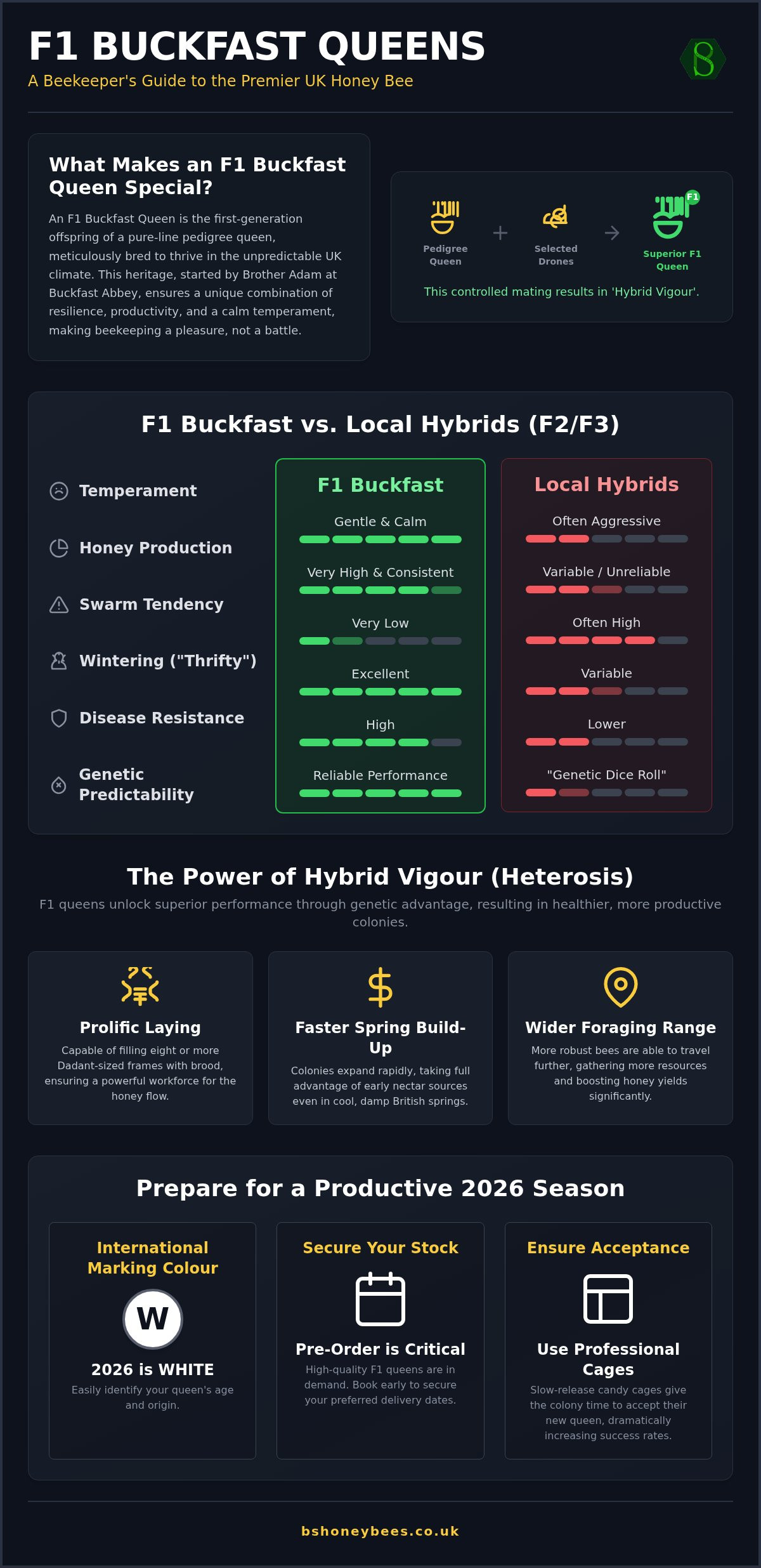
For many beekeepers, the term "F1" is often seen but rarely explained. In genetics, F1 refers to the first filial generation. An F1 queen is the direct result of a pedigree queen mated with selected drones.
Whilst local "mongrel" bees are a roll of the genetic dice, F1 stock offers predictable performance. When a pedigree Buckfast queen mates in an area with high drone density from other Buckfast colonies, the offspring exhibit "hybrid vigour" or heterosis. This results in colonies that are faster to build up in spring and more resilient against common pests. Contrast this with F2 or F3 generations, where the gentle temperament often disappears, replaced by the defensive, "followy" behaviour associated with local hybrids. Choosing F1 buckfast queens UK ensures you receive the exact traits Brother Adam spent decades refining. These queens are the gold standard for anyone looking to run a productive and manageable apiary.
The Breeding Science: Why F1 Generations Outperform Local Hybrids
Beekeeping success isn't a matter of luck; it's a result of deliberate genetic selection. While many beekeepers rely on local hybrids, these colonies often lack the consistency and predictable temperament found in F1 buckfast queens UK. The science behind the F1 generation is what allows a colony to remain manageable whilst maximising output. By choosing first-generation stock, you're ensuring that the traits of the mother-carefully selected for her honey yield and docility-are present in every bee in your hive.
Heterosis and Hybrid Vigour in Honey Bees
Heterosis, commonly known as hybrid vigour, is the biological advantage gained by crossing distinct, unrelated genetic lines. In the context of Buckfast breeding, this results in offspring that are often superior to their parents in terms of vitality and performance. You'll see this reflected in a more robust winter cluster and a significantly wider foraging range. F1 queens are notably more prolific layers than local stock; they're capable of filling eight or more Dadant-sized frames with healthy, uniform brood during the peak of the season. This genetic boost is vital for maintaining colony Productivity, and Resilience against the pests and diseases that can otherwise devastate an apiary.
The Problem with F2 and F3 Generations
It's a common mistake to assume that the daughters of a high-quality queen will inherit her best traits through natural mating. This is where the genetic "breakdown" occurs. When an F1 queen's daughter (the F2 generation) mates with random drones in the environment, the carefully balanced traits of the Buckfast strain begin to unravel. Attempting to save money by raising your own F2 or F3 queens often leads to aggressive colonies that are difficult to work with. You'll likely notice several signs of genetic regression:
- Bees that "follow" you across the garden long after the hive is closed.
- An increased swarming impulse that is difficult to manage even with ample space.
- Erratic brood patterns and a slower buildup during the critical spring period.
Maintaining the quality of F1 buckfast queens UK requires drone saturation. Professional breeders flood the mating area with drones from selected pedigree colonies to ensure the queen mates with the right genetics. This logistical precision ensures that the bees you receive are gentle on the comb and highly productive. To secure the best results for your apiary, it's wise to source your F1 buckfast queens from a specialist who prioritises these rigorous breeding standards.
Key Traits of Buckfast Bees: Temperament, Productivity, and Resilience
Buckfast bees are celebrated for a unique combination of traits that simplify apiary management. Whilst other breeds might struggle with the erratic weather patterns of the UK, F1 buckfast queens UK produce colonies that adapt with remarkable efficiency. These bees are particularly valued for their "thrifty" nature. They possess an instinctive ability to regulate their consumption of winter stores; this ensures they emerge strong in the spring without the constant need for emergency feeding during a cold snap.
Swarming is often the biggest headache for beekeepers. Buckfast stock is specifically selected for a low swarming tendency. This allows you to manage larger colonies with fewer interventions, making them a practical choice for both commercial operations and hobbyists with limited time. Their resilience in damp, cold conditions is second to none. They maintain a tight, efficient winter cluster that protects the queen and the core of the hive from the persistent British chill.
Temperament: The "No-Nonsense" Bee for British Beekeepers
Inspecting a hive should be a calm, rewarding experience. Buckfast bees are renowned for their exceptional gentleness on the comb. During an inspection, they typically remain still and focused on their work rather than flying at the beekeeper or "running" off the frames. This docile behaviour makes them the ideal choice for urban gardens or apiaries located near neighbours. Because you are using F1 buckfast queens UK, you benefit from a predictable temperament. The genetic stability of the first generation prevents the sudden onset of aggression that often occurs when colonies are left to mate randomly with local drones.
Productivity and Disease Resistance
Honey production is where the Buckfast truly excels. Their foraging behaviour is highly efficient; they're often the first bees out in the morning and the last to return in the evening. This work ethic results in honey-storing instincts that consistently outperform local mongrels. Modern breeding has also focused heavily on Varroa Sensitive Hygiene (VSH) traits. Some breeders now report VSH scores as high as 85%, which empowers the colony to identify and remove infested brood naturally. A high-quality F1 queen provides the high fecundity required to build a massive foraging force, often filling eight or more frames with brood. This population density helps the colony resist common brood diseases through sheer strength and enhanced hygienic behaviour.
The 2026 beekeeping season is fast approaching. Securing your stock requires early action. The primary dispatch window for F1 buckfast queens UK runs from late March through to September. Most successful beekeepers have their orders finalised months in advance. Planning for a late March start ensures you can requeen early enough to capitalise on the spring flow. Each queen for the 2026 season will be marked with the international colour for the year, which is white.Safe Transit and Delivery Protocols
Reliable transport is the backbone of queen distribution. Royal Mail Special Delivery remains the industry standard because it guarantees next-day arrival, usually before 1 pm. This minimizes the time the queen spends in transit. Inside the mailing envelope, the queen is housed in a specialised cage with approximately six to eight attendant bees. These workers feed and groom her whilst she is in the post. A reservoir of queen candy provides the necessary sustenance for the journey.
If you aren't home to receive the delivery, it's vital to collect the package from your local sorting office as soon as possible. Whilst queens can survive for several days in a cage, the sooner they are introduced to a colony, the better. Keep the cage in a dark, room-temperature environment away from draughts or direct sunlight until you are ready to visit the apiary. Our 7-day-a-week delivery service ensures that your bees arrive exactly when your hive is prepared for them.
Successful Queen Introduction Techniques
Acceptance is never guaranteed, but following a disciplined protocol significantly increases your success rate. Using high-quality F1 buckfast queens UK is only half the battle; the introduction method determines the final outcome. First, ensure the receiving colony is definitively queenless. Remove the old queen at least 24 to 48 hours before introducing the new one. This allows the old queen's pheromones to dissipate, making the workers more receptive to a new leader.
We provide queens in slow-release candy introduction cages, such as Nicot or Lyson systems. These cages feature a break-away tab that exposes a candy plug. The workers from the colony will chew through this candy over 24 to 48 hours, a process that synchronises the queen's pheromones with the hive. Once you have placed the cage between two frames of brood, you must leave the hive entirely alone for one full week. You must follow the 7-day "no-peek" rule after introduction to prevent the workers from balling and killing the queen due to stress or perceived threat.
To ensure your apiary is ready for the upcoming season, you can pre-order your F1 Buckfast queens now and secure your preferred 2026 delivery slot.
Securing Your 2026 Season: Why BS Honey Bees Ltd is the Trusted Choice
Choosing the right partner for your apiary is just as critical as the genetics you select. BS Honey Bees Ltd stands as the UK’s leading queen retailer, providing a level of specialist expertise that generalist suppliers simply cannot match. Our focus on F1 buckfast queens UK ensures that every customer receives stock bred for performance, not just availability. We manage a national distribution network that brings premium genetics to every corner of the country, backed by a commitment to reliability and logistical precision.
Quality Assurance and the 2026 Marking Standard
Age tracking is a fundamental part of professional hive management. For the upcoming 2026 season, every queen we dispatch will be marked with the international standard colour: white. This isn't just a convenience; it's a tool that allows you to monitor the age and performance of your queens over multiple seasons. At BS Honey Bees Ltd, we don't just mark them; we check every single queen for vitality and health before she is placed into her slow-release candy cage. Our breeder stock is selected through a rigorous process to ensure that the F1 excellence you expect is delivered in every order. Buying from a specialist means you benefit from a disciplined breeding programme that prioritises temperament and productivity above all else.
Building Your Apiary with BS Honey Bees Ltd
A high-performing queen needs a high-performing environment to reach her full potential. We provide a complete ecosystem for your bees, from our 5 and 6 frame nucleus colonies to the hardware they call home. Our British National hives and frames are manufactured to the highest standards, ensuring a perfect fit for your new colony. To keep you safe during inspections, we also stock BBWear bee suits, which are widely regarded as the gold standard in protective clothing. This holistic approach ensures that you aren't just buying bees; you're investing in a system designed for success.
The 2026 season will be here sooner than you think. Pre-ordering is the only way to guarantee you're ready for the critical spring build-up that begins in late March. Don't leave your apiary's future to chance or settle for unpredictable local hybrids. Join the UK’s most reliable beekeeping community and secure your F1 buckfast queens UK today. Our team at BS Honey Bees Ltd is ready to support your journey, whether you're managing a single garden hive or a commercial enterprise. Let's make 2026 your most productive season yet.
Prepare Your Apiary for a Productive 2026
Success in the coming year depends on the decisions you make today. By choosing F1 buckfast queens UK, you're opting for the hybrid vigour and gentle temperament that define the modern Buckfast standard. These queens aren't just a purchase; they're an investment in a manageable, high-yielding season that avoids the frustration of aggressive, "followy" bees. You have seen how the right genetics and proper introduction techniques can transform your beekeeping experience from a chore into a rewarding craft.
As the UK’s leading queen retailer, BS Honey Bees Ltd provides the logistical excellence your apiary deserves. We offer 7-day-a-week Royal Mail Special Delivery to ensure your stock arrives in peak condition, even during the height of the season. Every queen is supplied in a premium slow-release cage to maximise acceptance rates and protect your investment. Don't wait for the spring build-up to begin before securing your stock; the best windows for 2026 delivery are already filling up.
Pre-order your F1 Buckfast Queens for 2026 delivery and take the first step toward a thriving, docile, and highly productive apiary. Our team at BS Honey Bees Ltd looks forward to supporting your success in the new season.
Frequently Asked Questions
What is the marking colour for queen bees in 2026?
The marking colour for queen bees in 2026 is white. This follows the international five-year colour cycle, which helps beekeepers identify the queen's age quickly during hive inspections. Using the correct white mark ensures you can track her productivity and decide when it's time to requeen in future seasons.
How long can a queen bee survive in her delivery cage?
A queen can typically survive in her delivery cage for several days, provided she has attendant bees to care for her and a reservoir of queen candy. However, for the best results, you should aim to introduce her to the hive within 24 to 48 hours of arrival. If you can't introduce her immediately, keep the cage in a dark, room-temperature spot away from direct sunlight.
Why are F1 Buckfast queens better than local bees?
F1 buckfast queens UK provide a level of predictability in temperament and honey production that local "mongrel" bees simply cannot match. Local hybrids often regress into aggressive or "followy" behaviour after a single generation of random mating. F1 stock ensures you benefit from hybrid vigour, resulting in calmer bees and higher honey yields.
Do I need to be home to receive my live bee delivery?
You don't strictly need to be at home, but prompt collection is vital for the queen's health. We use Royal Mail Special Delivery to ensure your bees arrive the next day, usually before 1 pm. If you miss the delivery, you must collect the package from your local sorting office as soon as possible to get the bees out of the transit environment.
What should I do if my colony rejects the new F1 queen?
If your colony rejects the queen, you must first verify that the hive was definitely queenless and free of any missed queen cells or virgin queens. Rejection often occurs because the beekeeper overlooked a hidden cell during the preparation phase. If the queen is killed, you'll need to clear all cells and wait a few days before trying again with a new queen.
When is the best time of year to requeen a hive in the UK?
The best time to requeen a hive in the UK is during the active season from late March to September. Requeening in late spring or early summer is particularly effective, as it gives the new queen time to build a massive foraging force before the main nectar flow. It also ensures the colony enters winter with a young, prolific queen at the helm.
Can I introduce a Buckfast queen into a Carniolan colony?
Yes, you can successfully introduce a Buckfast queen into a Carniolan colony or any other breed. The workers will accept the new genetics as they chew through the slow-release candy plug, which allows the new queen's pheromones to synchronise with the hive. Regularly using F1 buckfast queens UK will eventually transition the entire colony to the Buckfast strain as the older workers are replaced.
Are F1 Buckfast queens suitable for beginners?
F1 Buckfast queens are an excellent choice for beginners because of their exceptionally docile and calm nature. New beekeepers find it much easier to learn the craft when the bees stay still on the comb during inspections. This gentleness builds confidence and allows the beekeeper to focus on observing colony health without the distraction of defensive behaviour.