
That "pure honey" label on your supermarket shelf is often a mask for highly processed, blended imports that have had the life filtered out of them. You want the genuine health benefits of a natural product, but the wall of confusing terminology makes it difficult to know what you're actually buying. It's frustrating to pay a premium only to worry if your jar contains adulterated syrup or heat-treated leftovers that lack the vital enzymes you expect. Genuine honey should be a biological snapshot of the British landscape, not a mass-produced commodity.
This guide cuts through the marketing noise to define exactly what constitutes genuine raw honey UK standards in 2026, including the latest labelling regulations for origin and purity. You'll learn how to identify real, cold-extracted honey and why the natural process of crystallisation is actually a sign of superior quality rather than a defect. We'll explore the science behind the health benefits and explain how elite colony management produces a better jar of honey. Use this specialist knowledge to confidently choose honey that supports both your wellbeing and ethical British beekeeping.
Key Takeaways
- Master the specific criteria that define raw honey UK standards, focusing on cold extraction and minimal processing to preserve vital enzymes.
- Understand why genuine raw honey is never heated above 35°C, ensuring it retains the pollen and propolis often removed from supermarket blends.
- Learn to identify authentic English honey by prioritising specific floral sources and transparent apiary details over generic labels.
- Discover how elite colony management and healthy, well-bred queens form the foundation of premium honey production.
- Use 2026 labelling regulations to confidently distinguish between single-origin specialist honey and multi-national processed blends.
What is Raw Honey? Defining the UK Standard
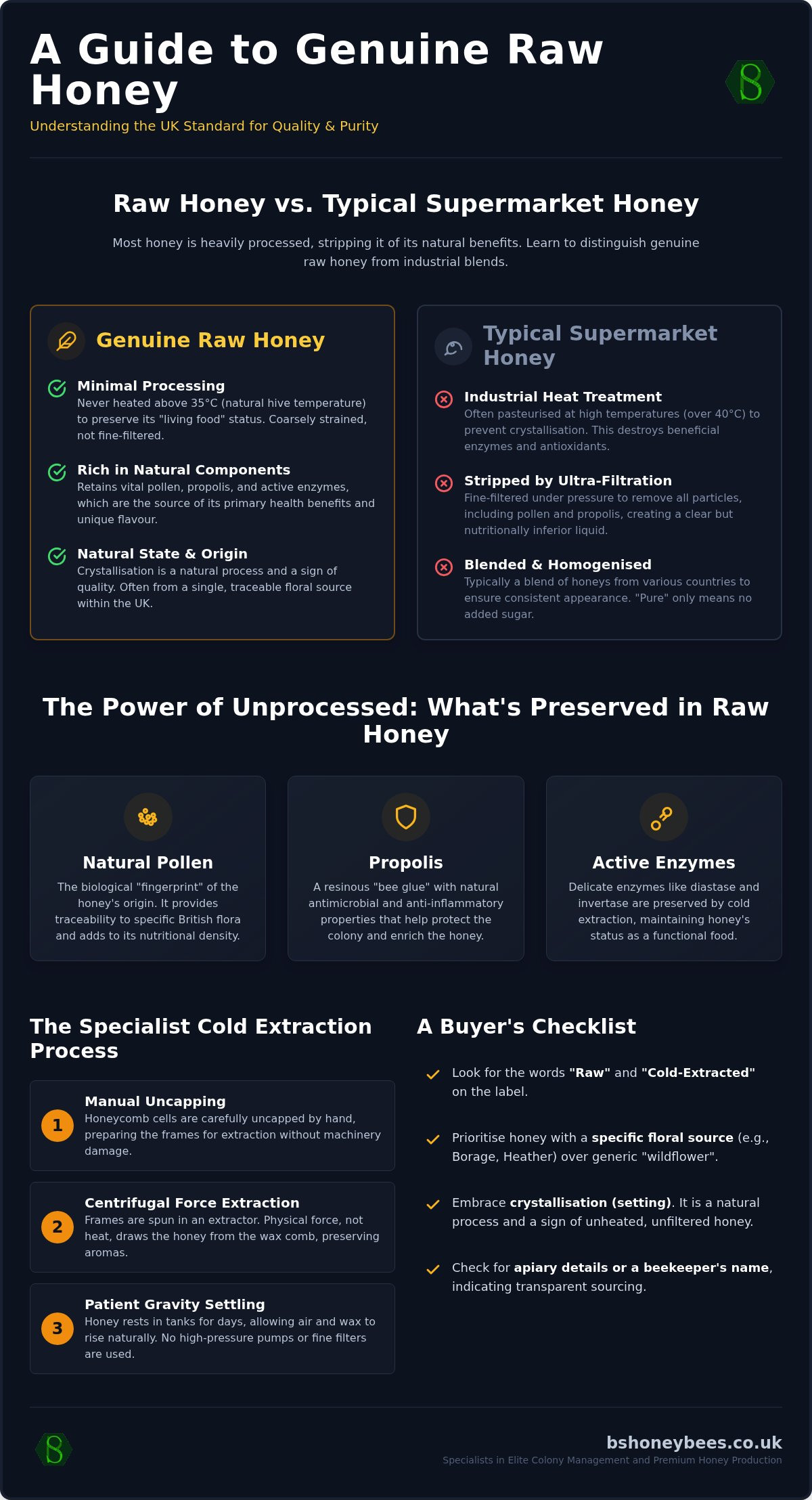
Raw honey is honey in its most natural state. To meet the specialist standard for raw honey UK enthusiasts expect, the product must never be heated above 35°C. This specific temperature mirrors the internal environment of a working hive. Commercial processors often heat honey to high temperatures to prevent crystallisation and speed up bottling. This destroys delicate enzymes and antioxidants. Real English honey remains a living food, rich in biological complexity that processed alternatives simply can't match.
The British landscape provides a diverse tapestry of forage, from the borage fields of the south to the heather moors of the north. Each jar of raw honey serves as a liquid record of a specific time and place. Because it isn't fine-filtered, it retains the unique flavour profiles and nutritional integrity dictated by the local flora. This minimal intervention ensures the final product is exactly what the bees produced.
Raw vs. Pure: Clearing the Confusion
Many shoppers assume "pure" and "raw" are interchangeable terms. They aren't. A label claiming "pure" simply means the jar contains no added corn syrup or sugar. Whilst that's a start, it doesn't describe how the honey was treated. Most "pure" supermarket honey is pasteurised and ultra-filtered to ensure it stays liquid on the shelf for months. If you want to understand the full spectrum of quality, read our guide on pure honey to see why "pure" is often the bare minimum. Raw honey is the gold standard for those seeking unadulterated nutrition.
The Role of Pollen and Propolis
Pollen is the biological fingerprint of a honey's origin. By examining the pollen grains, specialists can verify exactly where and when the bees were foraging. It's a vital component of what honey is at its core. Propolis, often called "bee glue", is a resinous mixture bees collect from tree buds. It has well-documented antimicrobial properties that help protect the colony from disease.
Commercial ultra-filtration removes these particles to create a clear, syrup-like appearance. This process strips away the very elements that provide health benefits. Specialist beekeepers use only coarse mesh to remove large wax debris. This ensures the following remain in the jar:
- Natural Pollen: Supports nutritional density and provides traceability to British fields.
- Propolis: Retains its antimicrobial and anti-inflammatory properties.
- Active Enzymes: Maintains the honey's status as a functional food rather than just a sweetener.
Removing these through industrial processing diminishes the honey's value and transforms a complex superfood into a simple sweetener. Choosing raw honey ensures you are consuming the full spectrum of what nature intended.
The Cold Extraction Process: How Specialists Preserve Quality
The journey of authentic raw honey UK consumers value begins with healthy colonies and meticulous harvest timing. Unlike industrial operations that rely on high-speed thermal processing, specialist extraction is a slow, methodical discipline. We start by uncapping the honeycomb cells manually. These frames then enter a centrifugal extractor. This machine spins the frames, using physical force rather than heat to draw the honey from the wax. It's a process that preserves the volatile aromatic compounds that give English honey its distinct floral character.
Once extracted, the honey flows into large settling tanks. We don't pump it through fine mesh under high pressure. Instead, we let gravity do the work. Over several days, air bubbles and tiny fragments of wax naturally rise to the surface. This patient approach ensures the honey remains "raw" by every definition of the word. We sacrifice the speed of modern manufacturing to ensure the final product retains its full biological profile. This dedication to quality is a direct byproduct of elite colony management and the high standards we maintain across our apiaries.
Why Temperature Control is Critical
Temperature is the single most important factor in quality control. When honey is heated above 40°C, delicate enzymes like diastase and invertase begin to break down. These enzymes are what transform nectar into a functional food. High heat also triggers the production of Hydroxymethylfurfural (HMF), a chemical compound used by laboratories to measure heat damage. According to The Honey (England) Regulations 2015, specific standards must be met regarding composition and labelling. Overheating creates a "cooked", caramelised flavour that masks the subtle notes of the forage. By maintaining hive-level temperatures, we ensure every jar tastes exactly as it did in the comb.
Coarse Filtration vs. Ultra-Filtration
Industrial blends often undergo ultra-filtration. This involves forcing honey through microscopic filters at high pressure to remove all traces of pollen. This prevents crystallisation but leaves the honey biologically "dead". Specialist beekeepers use coarse straining. This gravity-fed method removes only the larger pieces of wax while allowing pollen and propolis to pass through. The result is a textured, cloudy product that feels different on the palate. If you value this level of transparency and quality, sourcing your English honey directly from specialists ensures you receive a product that hasn't been stripped of its character.
Raw Honey vs. Supermarket Blends: A Comparison
Most supermarket honey is a product of industrial logistics rather than traditional beekeeping. Industrial packers prioritise a consistent, perpetually liquid product that can sit on a shelf for years. To achieve this, they often blend honey from multiple continents, strip-filtering the life out of it to hide its origin. When you choose raw honey UK specialists produce, you're opting for transparency. You get a single-origin product that reflects the specific forage of a British season, not a homogenised multi-national blend.
The environmental cost of industrial honey is significant. Shipping heavy glass jars or plastic tubs across oceans creates a massive carbon footprint. Specialist UK beekeepers operate on a national scale, supporting local ecosystems and reducing food miles. We take a no-nonsense approach to purity. Our honey is a byproduct of elite colony management. The health of our F1 Buckfast and Carniolan queens is the priority. Healthy bees produce superior honey. It's a simple equation that industrial blenders can't replicate.
The Truth About "Blends of EU and non-EU Honeys"
That vague label on supermarket jars is a red flag for those seeking quality. These blends allow packers to source the cheapest honey available globally, often from regions with lower production standards. High-pressure ultra-filtration is used to remove all pollen grains. This isn't for your benefit; it's to prevent the honey from being traced back to its source. This lack of traceability makes it easier for adulterated products, stretched with cheap rice or corn syrups, to enter the supply chain. Genuine English honey is never "stretched" or blended with inferior imports.
Crystallisation: The Sign of Real Honey
Many consumers mistakenly believe that solid honey has "gone off". In reality, crystallisation is a definitive sign of a natural, raw product. Honey is a supersaturated solution of two sugars: glucose and fructose. Over time, the glucose separates and forms crystals. The ratio of these sugars depends entirely on the flowers the bees visited. For instance, honey from oilseed rape sets very quickly, whilst borage honey stays liquid for much longer.
If you prefer your honey liquid, don't reach for the microwave. Follow these steps to preserve the quality:
- Place the jar in a bowl of warm water.
- Ensure the water temperature stays below 40°C.
- Wait for the crystals to dissolve naturally.
This process gently reliquefies the honey whilst protecting the delicate enzymes that define its raw status. It takes longer, but the nutritional integrity remains intact.
How to Identify Genuine UK Raw Honey: A Buyer’s Checklist
Identifying authentic raw honey UK standards requires more than a glance at the price tag. Genuine honey is a seasonal product, and its appearance should reflect that. If a jar looks too perfect, specifically if it's crystal clear and unnaturally runny in the middle of winter, it has likely been heat-treated. Use this checklist to verify the integrity of your next purchase and avoid processed imitations.
- Floral Specificity: Avoid jars simply labelled "Honey". Look for specific nectar sources like Borage, Heather, or Wildflower. This indicates the honey hasn't been blended into a generic commodity.
- Traceability: A reputable label must display the beekeeper's name or the specific apiary location. Transparency is the hallmark of specialist production.
- Visual Indicators: Raw honey is rarely perfectly clear. Look for a cloudy appearance or tiny specks of wax and pollen. These are signs of minimal filtration.
- Seasonal Consistency: Expect most British honey to set or crystallise as temperatures drop. Only a few varieties, like Borage, naturally resist setting for long periods.
Price is also a major indicator. Producing real honey involves significant labour, from elite colony management to manual extraction. If the price seems comparable to industrial supermarket blends, it's unlikely to be the genuine article. Quality beekeeping requires investment in hardware and bee health that mass-produced imports simply ignore.
Reading the Label Like an Expert
Look for the terms "Cold Extracted" or "Unpasteurised". These are more reliable indicators of raw status than generic marketing buzzwords. In the UK, organic certification is exceptionally difficult to obtain because bees forage over a three-mile radius. Few beekeepers can guarantee every acre in that range is certified organic. Therefore, a local beekeeper's reputation and "unpasteurised" claim are often better markers of quality than an organic logo. Beware of "Raw-style" or "Natural-style" phrasing. These are often used to bypass the strict definitions that specialists adhere to.
The "Water Test" and Other Home Checks
You can perform simple checks at home to verify density. The "thumb test" involves placing a small drop on your thumbnail. Real raw honey is dense and will stay in a neat bead. Adulterated honey or syrup will likely run off. Another indicator is the water test. Drop a spoonful of honey into a glass of water. Genuine raw honey will sink to the bottom as a solid lump and requires vigorous stirring to dissolve. Industrial syrups often begin to dissolve or "streak" the water immediately. Whilst these aren't laboratory-grade proofs, they are excellent indicators of high enzyme and low water content. To ensure you are getting the highest quality, you can buy English honey directly from our specialist apiaries.
The Beekeeper’s Perspective: Why Sourcing Matters
Honey is not a factory-made product; it's a biological output. For a jar to meet the true standard of raw honey UK consumers expect, the beekeeper must prioritise the health of the hive above all else. This process starts with genetics. A colony's ability to forage efficiently and remain disease-resistant depends entirely on the quality of its queen. When you buy from a specialist, you are supporting a production chain that values biological integrity over industrial volume. High-quality honey is a natural byproduct of elite colony management and ethical husbandry.
Ethical beekeeping means ensuring the bees have enough of their own honey to survive the winter without relying solely on sugar syrup. This practice preserves the nutritional profile of the hive and ensures the bees remain strong for the next season. A stressed colony cannot produce premium honey. By managing the entire apiary lifecycle, we guarantee that every drop of honey is a result of disciplined beekeeping. This "beekeeper-to-jar" transparency is what separates a specialist product from a generic supermarket blend.
Healthy Queens, Superior Honey
The queen is the heart of the colony. Her vigour determines the foraging range and the overall health of the hive. We prize F1 Buckfast queens for their exceptional honey production and calm temperament. These traits allow the bees to focus on gathering nectar rather than defending the hive. There is a distinct difference when comparing Buckfast vs Carniolan bees, as each breed offers unique advantages for the British climate. Specialist breeding programmes ensure that we maintain a sustainable and productive bee population for the future of British honey.
Beyond the Jar: Investing in British Beekeeping
Every jar of English honey sold helps fund the maintenance of these vital pollinators. Managing national apiaries requires significant investment in hardware, hives, and protective equipment. We use professional BBWear suits to maintain the highest hygiene and safety standards during our inspections. This level of care ensures that the honey you consume is a clean, natural byproduct of a thriving ecosystem. Supporting UK specialists who manage the entire apiary lifecycle is the only way to guarantee the purity of your raw honey UK supply. By choosing to browse our specialist English honey, you are investing directly in the health of our bees and the preservation of the British countryside.
Secure the Integrity of Your Honey Supply
Choosing the right jar of honey shouldn't be a matter of guesswork. By prioritising cold-extracted, single-origin products, you ensure that every spoonful contains the natural enzymes and pollen that industrial processing removes. Authentic raw honey UK standards are maintained only by specialists who manage the entire apiary lifecycle, from breeding elite queens to the final coarse filtration. This dedication to quality preserves the unique biological snapshot of the British landscape that mass-produced blends simply cannot replicate.
Our premium English honey is sourced exclusively from specialist-managed colonies and is cold-extracted to protect its vital nutritional value. We provide nationwide delivery across the UK, bringing the best of the hive directly to your door with the efficiency you expect from an industry leader. Supporting ethical beekeeping is an investment in the health of our countryside and the future of our pollinators.
Take the next step in your journey toward better nutrition and transparent sourcing. Shop our premium range of raw English honey today and taste the result of expert colony management. Enjoy the confidence that comes from buying directly from the specialists who know the bees best.
Frequently Asked Questions
Is raw honey better for you than regular honey?
Raw honey provides superior nutritional value because it hasn't been pasteurised or ultra-filtered. Regular supermarket honey is often heated to high temperatures, which destroys delicate enzymes like diastase and invertase. By choosing raw honey UK specialists produce, you ensure you're consuming a living food rich in antioxidants and local pollen. These natural components are essential for those seeking the full health benefits of honey rather than just a simple sweetener.
Why has my raw honey turned solid or cloudy?
Solid or cloudy honey is a definitive sign of a natural, unprocessed product. This process, known as crystallisation, occurs when the glucose in the honey separates from the water and forms crystals. The speed of this change depends on the floral source; for example, oilseed rape honey sets very quickly. It doesn't mean the honey has spoiled. In fact, it's one of the best ways to verify that your honey is truly raw and unheated.
Can I give raw honey to my baby?
You must never give any type of honey, raw or processed, to infants under 12 months old. This is due to the risk of infant botulism, a rare but serious illness caused by Clostridium botulinum spores. Whilst these spores are harmless to adults and older children with developed digestive systems, a baby's gut cannot yet handle them. Always wait until after their first birthday before introducing honey into their diet to ensure their safety.
How long does raw honey stay fresh?
Raw honey technically never expires if it's stored in a sealed container in a cool, dry place. Archeologists have found edible honey in ancient Egyptian tombs that is thousands of years old. Its low moisture content and acidic pH create an environment where bacteria cannot survive. Whilst the flavour and aroma may subtly change over several years, the honey remains safe to eat. Ensure the lid is tight to prevent it from absorbing moisture from the air.
What is the difference between raw honey and Manuka honey?
"Raw" refers to the extraction process, whilst "Manuka" refers to the specific floral source, the Leptospermum scoparium bush. You can find raw Manuka honey, but not all Manuka is raw. British raw honey offers a diverse range of local pollens and enzymes suited to the UK environment. Manuka is prized for its high MGO levels, but high-quality English honey provides its own unique antimicrobial properties and supports local UK beekeeping ecosystems.
Does raw honey contain more antioxidants?
Raw honey contains significantly higher levels of antioxidants compared to pasteurised varieties. Industrial heating processes used in supermarket blends degrade phenolic compounds and flavonoids, which are responsible for honey's health-giving properties. By opting for raw honey UK sourced from specialist apiaries, you receive the full spectrum of these protective compounds. These antioxidants help neutralise free radicals in the body, making raw honey a functional food rather than just an empty calorie source.
Is all UK honey raw by default?
Not all honey produced in the UK is raw. Whilst many small-scale hobbyists and specialists follow raw standards, some larger commercial packers still use heat and fine filtration to ensure a clear, liquid product for retail shelves. To be certain, you should look for specific labelling such as "unpasteurised" or "cold-extracted". Buying directly from a specialist beekeeper who manages their own colonies is the most reliable way to guarantee the honey's raw status.
How can I liquefy my honey without destroying the nutrients?
You can safely reliquefy your honey by placing the jar in a bowl of warm water. It's vital to keep the temperature below 40°C to protect the delicate enzymes and nutritional integrity. Never use a microwave, as it creates hot spots that will instantly pasteurise the honey. Be patient and allow the crystals to dissolve slowly. Once the honey is clear again, remove it from the water and store it at room temperature to maintain its quality.