

Winter survival is built before the cold sets in. Good honey bee colony winter survival depends on more than a well-stocked hive: in autumn, colonies should have about 20 kg of honey for winter, alongside a healthy population and a sheltered, ventilated home. Preparation matters because bees rely on their stored food and the warmth generated within their winter cluster.
It’s natural to focus on food stores, but colony strength and hive conditions matter too. A colony needs enough bees to maintain its cluster, while the hive must be protected from wind and damp without losing the airflow that helps manage moisture.
This guide explains how beekeepers prepare colonies for winter in the UK: assessing stores and colony size, feeding when needed, weatherproofing the hive and conserving heat. You’ll also learn why winter care means making sensible checks while keeping disturbance to a minimum.
Key Takeaways
- Assess autumn stores before winter; colonies should have about 20 kg of honey to provide food through the colder months.
- Shelter hives from wind, but retain enough ventilation to help limit moisture inside.
- Let the winter cluster conserve warmth by keeping hive disturbance to a minimum.
- Colony strength matters: fewer than 9,000 bees gives a colony a poor chance of surviving winter.
- Secure hives against harsh weather and check for damage without routinely opening the hive.
What happens to honey bees in winter?
In the UK, honey bees spend winter clustered inside the hive and rarely leave it. Good hive positioning, a clear entrance and balanced airflow help protect the colony from wind, moisture and disturbance.
Hive shelter and positioning
Hive positioning means choosing a sheltered spot that reduces exposure to winter weather without blocking the entrance. Northerly and easterly winds can chill a hive, so place it behind a natural or constructed windbreak where possible. Keep the entrance clear of vegetation and avoid a position where rainwater collects around the stand.
Shelter should not mean sealing the hive in a damp, enclosed space. Bees need airflow, and a sheltered location can reduce direct wind while allowing air to move around the hive. Check the site after strong winds or heavy rain: a shifted hive, loose roof or pooling water can undermine protection when the colony is least active.
Snow is less common across much of the UK, but heavy snowfall can still cover an entrance or weigh on a roof. Keep the approach clear when conditions allow. The entrance must remain open for airflow and occasional cleansing flights on milder winter days.
Entrance checks and hive damage
An entrance check is a brief external inspection for blockages, damage or signs of wildlife. Look for leaves, dead bees or other debris restricting the opening, and check that the entrance remains accessible. Fit a mouse guard and leave it in place until spring, as mice may seek shelter inside a hive during colder weather.
Bees continue removing debris and dead colony members during winter, but a blocked entrance can still restrict airflow. Observe the entrance without opening the hive. On mild days, bees may fly briefly for cleansing; on colder days, little or no flight is normal. Don’t mistake quiet activity for a reason to disturb the cluster.
After bad weather, inspect the roof, stand and hive body from outside. Look for a loose roof, a tilted box, cracks or damage caused by wind or wildlife. A fallen branch near the entrance, for example, needs clearing without pulling the hive apart. Keep checks brief, especially during cold or frosty weather.
Insulation, ventilation and moisture
Insulation helps limit heat loss, while ventilation allows damp air to escape. The balance matters: wrapping a hive too tightly or blocking ventilation can trap moisture inside. Damp conditions are a concern because the colony needs a dry space as well as shelter from cold air.
Use hive wrapping only in a way that leaves the entrance and necessary airflow unobstructed. Check the roof and joints for gaps where rain can enter, then make sure the hive can still ventilate. Honey bees also create air-circulation channels within the winter cluster, helping maintain air quality and manage excess moisture.
After fitting insulation, assess the hive exterior rather than repeatedly opening it. A transparent crown board can help you view the colony with less heat escaping than during a full inspection. Avoid opening the hive in cold, frosty conditions; reserve internal checks for a suitable, sunny winter day when bees are flying.
Honey stores and winter feeding
Honey bees rely on stored food when winter foraging is difficult. In autumn, assess each colony’s stores and feed before cold weather makes syrup less effective.
Assessing winter food stores
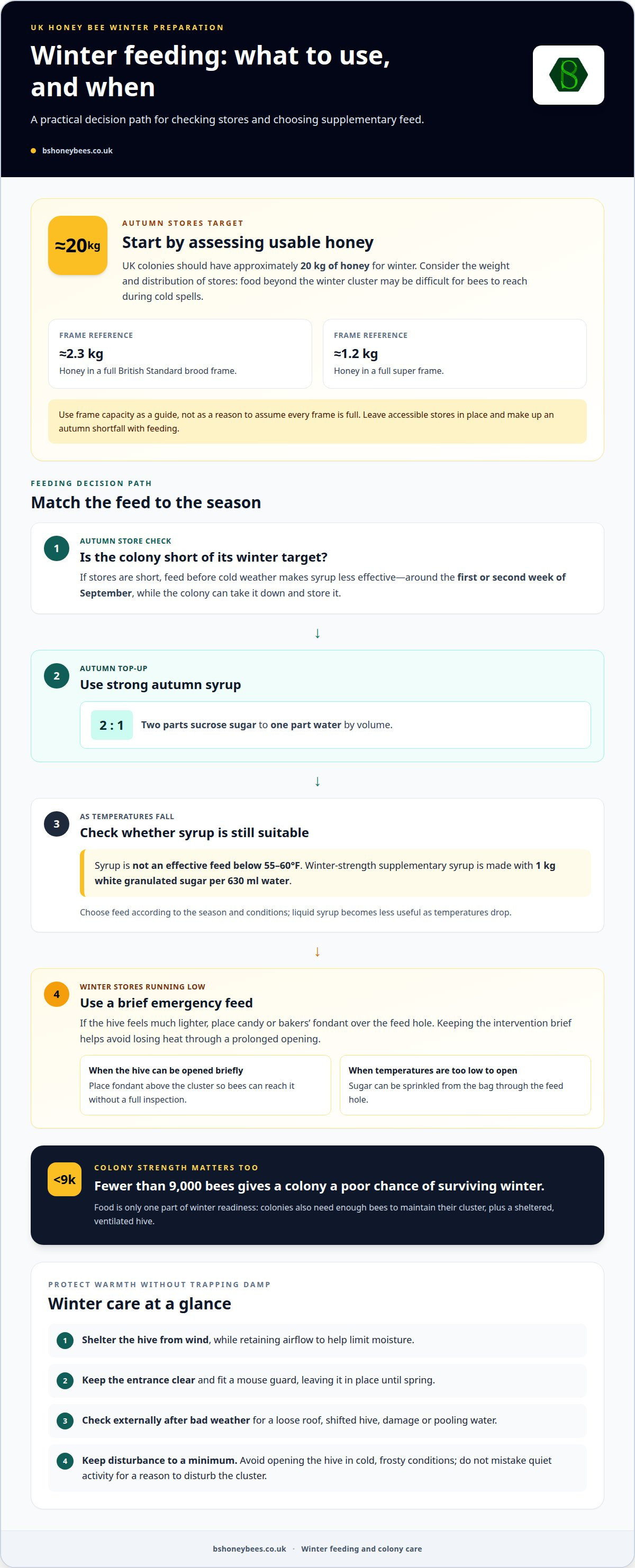
Assessing winter food stores means estimating how much usable honey remains in the hive. It matters because a colony can exhaust its reserves before spring forage returns. In the UK, aim for approximately 20 kg of honey in autumn. A full British Standard brood frame holds about 2.3 kg, giving a practical reference when judging frames.
Look at the weight and distribution of stores, not just whether honey is present. Bees need access to food as they move through the hive, so stores beyond their cluster may be difficult to reach during cold spells. If a colony seems short, address the shortfall in autumn, while bees can still process syrup.
Emergency fondant feeding
Emergency fondant feeding supplies solid food when winter stores are running low. This matters because cold weather limits the usefulness of liquid syrup, and opening the hive for long periods loses heat. If a hive feels much lighter during winter, place candy or bakers’ fondant over the feed hole.
Keep this intervention brief. Fondant placed above the cluster gives bees access to food without requiring a full hive inspection. When temperatures are too low to open the hive, sugar can also be sprinkled from the bag through the feed hole. Avoid disturbing the cluster to inspect frames.
Supplemental feeding choices
Supplemental feeding tops up stores when autumn checks show a deficit. Feed sugar syrup around the first or second week of September, while the colony can take it down and store it. A strong autumn syrup uses two parts sucrose sugar to one part water by volume.
Winter-strength supplementary syrup uses 1 kg of white granulated sugar per 630 ml of water. However, syrup is not an effective feed once temperatures drop below 55-60°F. At that stage, fondant is the more practical emergency option because bees can access it without taking liquid feed. Choose the feed according to season and conditions.
Winter honey requirements
For UK colonies, the autumn target is approximately 20 kg of honey for winter. This gives the colony a substantial reserve, but actual consumption depends on colony size, hive conditions and how long foraging remains limited.
Use frame capacity as a guide rather than assuming every frame is full. A full British Standard brood frame holds about 2.3 kg, while a full super frame holds approximately 1.2 kg. Leave the bees’ accessible stores in place, then use autumn feeding to make up a shortfall. In winter, watch hive weight from outside and use fondant if reserves appear depleted.
Honey bee clustering and heat conservation
As temperatures fall, worker bees form a cluster that shelters the queen and conserves warmth. The cluster’s centre stays warmer than its outer layers, allowing the colony to manage cold collectively.
Winter cluster formation
A winter cluster is a close grouping of worker bees that forms inside the hive as the weather cools. It matters because individual bees cannot maintain the same warmth alone. Workers pack together, with bees on the outside forming an insulating layer around those within.
As conditions change, the cluster can tighten or loosen. Bees shift position, allowing different workers to occupy the colder outer layer. This shared movement helps conserve heat without requiring the whole colony to remain equally warm. The cluster also creates air-circulation channels, helping manage air quality and excess moisture.
Clustering around the queen
In winter, workers cluster around the queen, who is generally found near the centre. This arrangement matters because the colony’s most important reproductive bee remains within the warmest, most protected part of the group.
Workers on the cluster’s outside provide a living barrier, while bees within can move around the queen. If brood is present, the centre needs to stay warmer than it does without brood. The cluster adjusts its arrangement as conditions change, rather than relying on warmth from the hive walls alone.
Heat generation and temperature
Heat generation in the winter cluster comes from worker bees vibrating their flight muscles. This matters because the colony can produce warmth internally, even when outside temperatures fall sharply. At 23°F or below, bees within the cluster begin vibrating their wing muscles to generate heat.
With brood present, the cluster centre is maintained at approximately 95°F. Without brood, its centre is closer to 70°F, while the outer edges remain around 41°F. These different temperatures show how the cluster protects its centre while allowing the outside layer to cool.
Colony temperature tolerance
A colony’s cold tolerance depends on the cluster’s ability to retain warmth, rather than on one simple outdoor temperature limit. This distinction matters: the cluster centre can remain warm even while the hive surroundings become much colder.
The centre can be over 80°F, and reaches approximately 95°F when brood is present. The outer cluster may sit around 41°F. A temperature drop below 40°F can be deadly to an individual bee, but clustered workers share warmth. At 23°F or below, inner bees increase heat production through muscle activity.
Preparing and weather-proofing hives
Prepare hives before severe winter weather arrives, focusing on stability, shelter and protection from pests. Strong autumn preparation also includes managing Varroa, which can weaken bees developing into the winter population.
Securing hives for winter
Securing a hive means fastening its parts and roof against strong winds. This matters because a shifted or damaged hive can expose the colony to draughts and rain. Tie the hive down or place a large brick on the roof, ensuring it sits securely without obstructing the entrance.
Inspect the roof, stand and hive body after adverse weather, looking for movement or damage. Woodpeckers can also damage hives, so an added protective layer around the outside may help. Keep any protection clear of the entrance, allowing bees to leave for flights when conditions permit.
Windbreaks around hives
A windbreak reduces direct exposure to cold winds without enclosing the hive. Shelter can reduce draughts, while bees still need airflow around the hive to limit dampness.
Pay particular attention to northerly and easterly winds when choosing a site or adding a barrier. A hedge, fence or other existing feature can provide shelter; avoid blocking the entrance or creating a damp, enclosed corner. Check the position after storms, as fallen branches or shifted barriers may obstruct access.
Varroa and winter preparation
Varroa mite levels matter because heavy infestation can affect winter bees developing in late August and early September. The mite population can double every three to four weeks while brood numbers reduce significantly during July and August.
This timing makes Varroa management part of preparation, not a task to leave until the winter cluster has formed. A colony entering winter with bees affected during development may be less able to sustain its population. Consider infestation alongside food stores, colony strength and weather protection when assessing readiness.
Preparation should also account for local wildlife and seasonal changes. Check the apiary for signs of disturbance, then secure loose hive components before winter weather intensifies. If woodpeckers are active nearby, inspect exposed hive surfaces and add external protection where needed. Keep the entrance accessible, since bees may take cleansing flights on suitable mild days.
Winter preparation supports the colony’s transition into spring, when pollen and nectar become available again. Avoid making the hive airtight in an effort to keep it warm: ventilation remains important, and trapped moisture can create poor conditions. A secure, sheltered hive with airflow and protection from damage helps the colony remain undisturbed through winter.
Colony size and winter survival
There isn’t one winter survival rate that applies to every UK colony. Good winter management can often reduce colony losses below 10%, but outcomes depend on colony strength, stores, disease and local winter conditions.
Colony size is a major factor in honey bee colony winter survival because enough workers are needed to maintain the cluster and support the queen. A practical rule of thumb is to take a colony into winter with at least five standard brood frames, or equivalent, covered in bees. This gives a beekeeper a visible measure of strength without relying on a precise population count.
Population estimates differ across guidance. About three full British Standard brood frames of bees represent around 9,000 bees, and colonies below that population have a poor chance of surviving winter. Another benchmark warns that colonies with fewer than 15,000 bees are unlikely to survive freezing temperatures, though they may manage in milder locations. These are useful warning points, not interchangeable guarantees. Some recommendations target 18,000 to 20,000 bees or more, while 25,000 to 30,000 bees is considered an adequate overwintering size.
The key is to judge the colony in context. A smaller colony faces a greater challenge maintaining a cluster during cold spells, while local climate influences how demanding winter will be. Frame coverage provides a practical starting point; consider it alongside stores, health and the conditions the apiary typically experiences. Together, these factors shape the prospects for honey bee colony winter survival.
Disease and parasites can undermine strength even when a colony appears populous. Varroa infestation can affect winter bees as they develop in late August and early September. Assess colony health as part of the same autumn review as population, rather than treating headcount as the only measure of readiness. A strong cluster is less useful if the bees entering winter have been compromised.
If a colony is weak, beekeepers can improve its prospects by combining it with a stronger colony in late summer or early autumn. Timing matters: this decision belongs in preparation, before winter clustering makes intervention more disruptive. Queen age can also inform autumn decisions; consider re-queening after the summer honey harvest if the queen is more than 2 to 3 years old.
Use these measures together: assess frames covered with bees, consider the local climate, and account for disease and stores. No single population figure predicts the outcome for every hive. A healthy colony with adequate strength is better placed to manage winter demands than one assessed by frame count alone.
BS Honey Bees
BS Honey Bees Ltd offers practical options for beekeepers managing colony strength and apiary stock. If autumn assessments point to a need to replace a queen or establish a colony, explore F1 Buckfast Queens, Carniolan Queens, and 5 / 6 Frame Nucs. The 2 in 1 Poly Nuc is another option for managing nucleus colonies.
Choosing between a queen and a nuc depends on what your apiary needs: a queen for requeening, or a nucleus colony to add to your stock. Consider these options alongside your winter-readiness checks, including colony population, health and food stores.
For information about these beekeeping options, contact BS Honey Bees Ltd.
Plan ahead for the next season
Winter readiness is part of an annual cycle, not a task that ends once the hive is secured. Use the quieter months to note which colonies may need attention when spring activity returns. A clear record of each hive’s condition can help you make timely decisions for the season ahead.
Planning for honey bee colony winter survival also means thinking beyond one cold spell. Consider how your apiary’s location, colony development and seasonal forage shape future preparations. Adjust your approach as you learn how colonies respond to local conditions, and build those observations into next year’s management plan.
If you’re considering your next steps for your apiary, contact BS Honey Bees Ltd. Thoughtful planning now can help you meet the next season with greater confidence.
Frequently Asked Questions
How do bee farmers help the bees prepare for winter?
Beekeepers prepare colonies in autumn by checking food, population and health before cold weather limits intervention. They also consider Varroa levels because winter bees develop in late August and early September. Hive layout matters: brood belongs in the bottom box, with pollen nearby and capped honey beyond it. Weak colonies may need attention before winter clustering makes changes more disruptive.
How do honey bee colonies survive winter?
Honey bee colonies survive by working as a group inside the hive. Workers form a cluster around the queen and generate heat through muscle activity, while bees on the outside provide an insulating layer. The queen reduces or stops laying, and activity declines. Bees still remove debris and dead colony members; on suitable mild days, some may leave briefly for cleansing flights.
How should UK beekeepers prepare hives for winter?
Prepare the hive before winter by securing its roof and boxes, keeping the entrance accessible, and fitting a mouse guard. Remove any queen excluder left above the brood box after the last nectar flow, so the queen can move upwards with the cluster. Check the apiary after poor weather for damage or wildlife disturbance, and make sure a windbreak doesn’t block airflow.
How can you assess a colony’s winter food stores without opening the hive?
Estimate stores by checking the hive’s weight from outside. Lift one side gently and compare how heavy it feels with earlier checks or with similar hives. A hive that feels much lighter may need emergency food. Place candy or bakers’ fondant over the feed hole, keeping the intervention brief. This method indicates a change in weight, not the exact amount or position of honey.
What are the main causes of honey bee colony winter losses?
Common risks include inadequate food, a population too weak to sustain the winter cluster, and health problems such as heavy Varroa infestation. Damp conditions, blocked entrances and weather or wildlife damage can add further strain. Good winter management can often reduce colony losses below 10%, but that figure isn’t a UK-wide annual loss rate. Each risk affects the colony differently, so assess them together.
How should beehives be ventilated and insulated during a UK winter?
Keep the hive sheltered and insulated without sealing it against airflow. Ventilation helps moisture and carbon dioxide leave the hive, while bees create air-circulation channels within their cluster. Avoid blocking the entrance or covering vents when adding insulation or wrapping. After fitting any covering, check that rain can’t enter and air can still move. A dry hive matters as much as protection from draughts.
When and how should beekeepers check colonies during winter?
Check the hive’s exterior regularly for loose parts, weather damage, wildlife activity and a blocked entrance. Avoid opening it in cold or frosty conditions, which can expose the cluster to heat loss. If an internal check is necessary, choose a windless, sunny day when bees are flying, and keep it brief. Open only for a clear reason, such as assessing stores or addressing disease.