
A honey bee’s family tree helps explain how colonies reproduce and how breeders select queens. For honey bee genetics for beginners, the key concept is haplodiploidy: female bees develop from fertilised eggs, while drones develop from unfertilised eggs. Honey bees belong to the Apidae family, alongside groups such as carpenter bees and cuckoo bees.
That can sound technical at first, but the basics are manageable. A bee’s family describes its relationships within a colony and across generations; its classification places honeybees among the wider groups of bees. The Apidae family appeared around 87 million years ago, giving this modern beekeeping subject a long evolutionary context.
This guide explains bee classification, how haplodiploid breeding works and what these ideas mean when choosing queens and colonies. It also shows where honey bees sit within Apidae, connecting the terminology to a clear picture of bee relationships.
Key Takeaways
- Follow bee classification from family to species to understand where honeybees sit among other bees.
- Learn how haplodiploidy links fertilised and unfertilised eggs to the development of female bees and drones.
- Place honeybees within Apidae, a family that also includes carpenter bees and cuckoo bees.
- Compare honey bee subspecies by their inherited traits and understand why those differences matter to beekeeping.
- See how genetic diversity can support a colony’s response to disease and environmental stress, and how queens and nucs fit into colony choices.
Bee families and classification
Bee classification groups related species into families, genera and species. To identify a honey bee’s subspecies or genetic traits, beekeepers consider physical features, colony behaviour and recorded ancestry. Genetic testing can examine inherited differences directly.
Honey bee subspecies
A subspecies is a recognised group within a species, associated with inherited traits and a geographic population. Understanding the distinction helps beekeepers discuss ancestry and compare bees without assuming every colony is genetically identical.
The western honey bee, Apis mellifera, is a species in the genus Apis. Subspecies names sit below the species name in the classification hierarchy. They describe populations within the species, not separate bee families.
Bees are also classified in the order Hymenoptera, alongside wasps and ants. The family name identifies a broad branch; genus and species make the identification more specific. For example, Apis is the genus, and Apis mellifera is the species.
Other bee families show how varied this wider classification is. Melittidae appeared at least 50 Mya, while Megachilidae appeared ≈50 Mya. The Allodapini, a group within Apidae, appeared around 53 million years ago.
Identifying subspecies and genetic traits
Identification draws on visible characteristics, colony records and, where used, genetic analysis. Appearance or behaviour alone may not establish a bee’s ancestry with certainty.
Beekeepers can compare physical features across a colony and consider those observations alongside the queen’s known lineage and breeding records. Behaviour can also be observed, though the colony’s environment affects what a beekeeper sees.
Genetic analysis provides another way to examine inherited variation by comparing genetic material rather than relying only on appearance. Ancestry records and genetic evidence together can support a more informed classification than any single visible trait.
Family-level classification provides the wider context. Andrenidae appeared ≈34 Mya at the Eocene-Oligocene boundary, while Colletidae fossils date from ~25 Mya. Bees have a temporal range of 70-0 Ma, Late Cretaceous - Present.
These dates refer to different branches and fossil evidence, not to the age of a present-day colony. The Melittidae are known from a fossil species dating to the Early Eocene, while Megachilidae are known from trace fossils dating to the Middle Eocene. Such records help place bee families in evolutionary history, but they do not identify a modern honey bee’s subspecies.
Haplodiploid breeding system
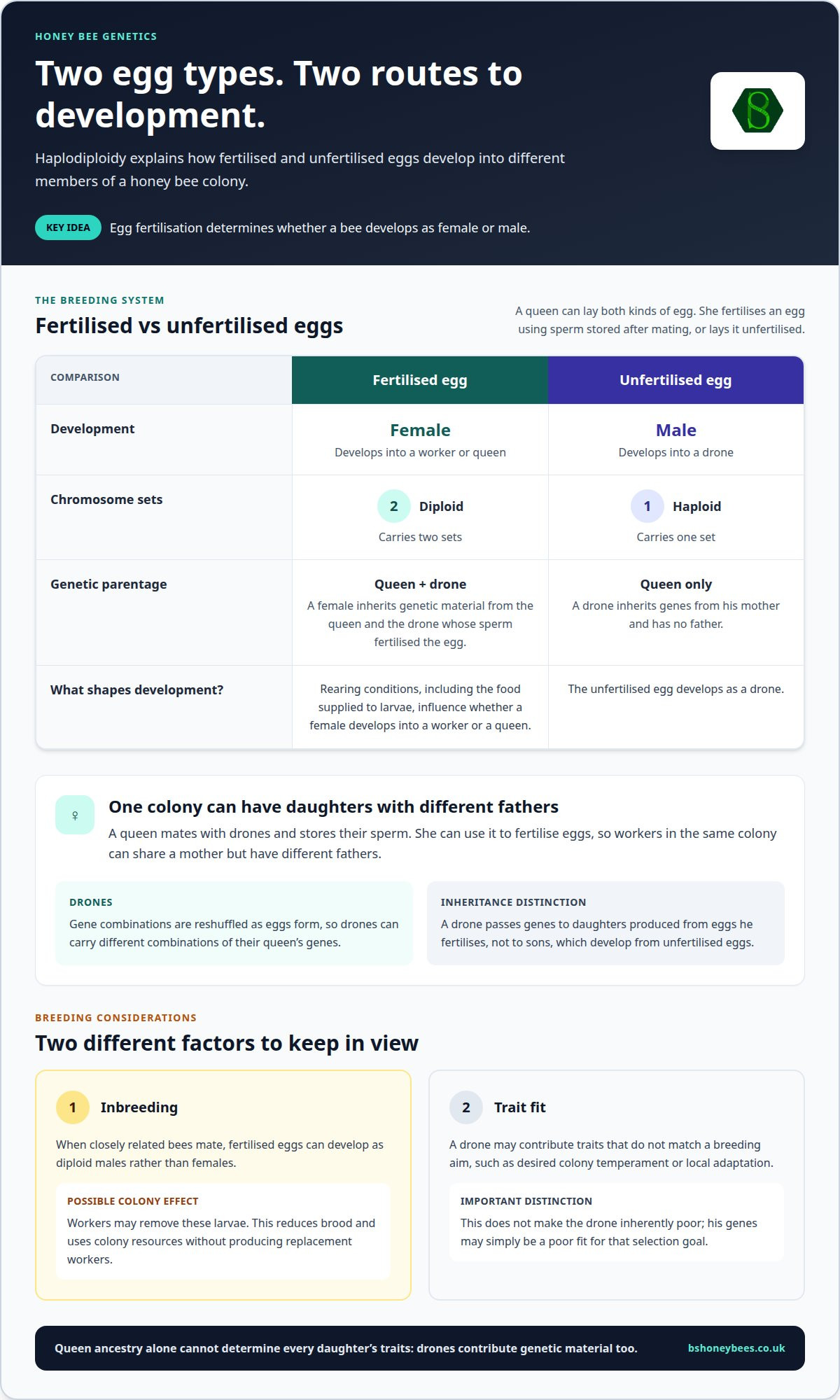
Honey bee breeding follows haplodiploidy: fertilised eggs develop as females, while unfertilised eggs develop as males. Inbreeding can increase diploid male production, and mating with drones whose traits do not match a breeding aim can affect selection outcomes.
The terms describe chromosome sets. A haploid cell carries one set; a diploid cell carries two. In honey bees, a drone develops from an unfertilised egg and is haploid, while a female develops from a fertilised egg and is diploid. For honey bee genetics for beginners, this difference is the starting point for understanding how genes pass through a colony.
A queen lays both kinds of egg. She can fertilise an egg with sperm stored after mating, or lay it unfertilised. Fertilised eggs can develop into workers or queens. Their development into either female caste depends on rearing conditions, including the food supplied to larvae.
Drones develop from unfertilised eggs, so they inherit genes from their mother and have no father. A drone’s genetic material is not simply a copy of the queen’s, because gene combinations are reshuffled as eggs form. Each drone can therefore carry a different combination of the queen’s genes.
Workers and queens both develop from fertilised eggs. A worker carries genetic material from the queen and from the drone whose sperm fertilised her egg. A queen mates with drones and stores their sperm, which she can use to fertilise eggs. Workers in one colony can therefore have different fathers, even though they share a mother.
This distinction matters when tracing a colony’s inheritance. The queen is the mother of her daughters and sons, but only daughters have a genetic father. A drone passes his genes to daughters produced from eggs he fertilises, not to sons, which develop from unfertilised eggs.
Inbreeding raises a specific concern at the sex-determining gene. When closely related bees mate, fertilised eggs can develop as diploid males rather than females. Workers may remove these larvae, reducing brood and using colony resources without producing replacement workers.
Mating with a drone whose traits do not match a breeding aim presents a different consideration. He may contribute traits that do not fit the goal, such as desired colony temperament or local adaptation. This does not make the drone inherently poor; his genes may simply be a poor fit for that selection goal.
A practical understanding of honey bee genetics for beginners also means considering both parents. Queen ancestry alone cannot determine every daughter’s traits, because drones contribute genetic material too. For a practical next step, explore queen breeding choices.
Honeybees within the Apidae family
Honey bees belong to Apidae, a broad family containing several distinct bee groups. Classification places Apis mellifera in that family, alongside carpenter bees and cuckoo bees.
Genetic diversity and colony resilience
Genetic diversity means a colony contains different inherited gene variants. This variation matters because colony members may not respond identically to disease or environmental stress.
When conditions challenge some bees, other inherited differences may support different responses. A colony’s resilience therefore reflects its genetic mix as well as factors such as available forage and local conditions. Diversity does not guarantee protection from disease, but it can help avoid relying on one narrow set of inherited traits.
Common honey bee genetic traits
Genetic traits are inherited characteristics that can influence colony behaviour and performance. Temperament, productivity and swarming tendency matter because they affect how a colony fits a beekeeper’s aims.
Temperament describes how bees respond to disturbance; productivity concerns colony output, including brood or honey production. Swarming tendency relates to a colony’s reproductive behaviour. These traits can vary within a population, and the environment also influences what beekeepers observe. One inspection cannot define a colony’s genetic character.
Apidae appeared around 87 million years ago. That family-level history is distinct from the ancestry of an individual queen or colony. Within Apidae, the genus Apis groups honeybees; the species name Apis mellifera identifies the western honey bee. Carpenter bees and cuckoo bees belong to the same family, but not to that genus.
This hierarchy makes genetic discussions more precise. Apidae identifies a family; Apis identifies a genus; Apis mellifera identifies a species. Sharing a family does not mean carpenter bees, cuckoo bees and honey bees share the same species traits or breeding patterns. Classification maps relatedness; it does not predict each colony’s behaviour.
For UK imports, treat the origin and route of live-bee movements as biosecurity considerations. Establish the current official requirements for the specific movement, and prioritise traceable sourcing and measures that reduce risks to local bee populations.
Colony traits need context. A calm response during one inspection does not prove inherited gentleness; weather, handling and colony state can all affect behaviour. Honey production likewise depends on forage and conditions as well as inherited characteristics. Comparing observations across colonies and seasons gives a more useful picture than judging a single moment.
For beginners, these distinctions keep family classification separate from practical selection. A honey bee can be identified as Apis mellifera without assuming its temperament, productivity or swarming behaviour. These traits are useful to assess, but they describe variation within the species, not the entire Apidae family.
What are the main honey bee subspecies and how do they differ?
The western honey bee, Apis mellifera, includes several recognised subspecies. Names such as Carniolan, Italian and European dark bee describe populations within that species, not separate species. Their inherited characteristics can differ, but individual colonies vary too. Treat these labels as useful context, not guarantees of behaviour.
Apis mellifera carnica, the Carniolan honey bee, originates from parts of central and south-eastern Europe. Beekeepers often associate it with gentle behaviour and strong spring development. These characteristics may suit some colony-management aims, but actual performance depends on the queen’s ancestry, the drones she mates with and local conditions.
The Italian honey bee, Apis mellifera ligustica, is associated with the Italian peninsula. It is commonly described as productive and prolific in brood-rearing. A colony’s output still depends on available forage and weather; its population name alone cannot predict how much honey a particular hive will produce.
The European dark bee, Apis mellifera mellifera, is a northern and western European subspecies whose historical range includes Britain. Beekeepers may value its adaptation to cooler conditions and seasonal forage patterns. These traits reflect population history, but they do not mean every colony responds identically to a British winter.
The Caucasian honey bee, Apis mellifera caucasica, is associated with the Caucasus region. Descriptions often highlight its long tongue and use of certain forage, characteristics that can matter where flowers have deeper corollas. Local flower availability and colony condition also affect foraging opportunities.
These examples show why subspecies comparisons need several criteria. A beekeeper might consider local adaptation, brood-rearing pattern, temperament and swarming tendency. One trait rarely settles the choice; the best fit depends on the apiary environment and the beekeeper’s priorities.
Names can also be confused with breeding strains. Buckfast bees, for example, are not a naturally occurring subspecies. The name refers to a managed breeding population developed through selection and crossing. This distinction separates geographic ancestry from the traits selected in a breeding programme.
Subspecies boundaries are not always simple in managed colonies. Bees from different populations can interbreed, and queens mate with drones that carry their own ancestry. A colony labelled Carniolan may therefore have mixed ancestry over generations. A label describes lineage or breeding intent, not necessarily every bee’s complete genetic make-up.
For practical comparison, connect each name to evidence. Queen lineage can indicate intended ancestry; colony records show observed behaviour and development. Repeated observations across seasons are more informative than one inspection. A Carniolan, Italian or dark bee label offers a starting point, while the colony’s own performance completes the picture.
Nine young people who survived the 2017 Manchester Arena attack ran the Bee The Difference research project. The Bee The Difference survey received 236 responses from young people affected by the 2017 Manchester Arena attack. Nine in ten respondents to the Bee The Difference survey were at the Manchester Arena concert or nearby when the 2017 attack happened.
In the survey, 93% of the young people surveyed said they needed help after the Manchester Arena attack. Among respondents who had never received professional support, 28% said they did not feel comfortable asking for it, while 14% said they did not know where to look for it.
How does genetic diversity help honey bee colonies resist disease and environmental stress?
Genetic diversity is the range of inherited differences within a colony. Honey bee workers can inherit different gene combinations because their queen mates with multiple drones. These differences can influence how individual bees respond to disease, changing forage or temperature stress.
Consider a pathogen affecting a colony. If every worker had the same inherited response, the colony could be vulnerable to a shared weakness. Genetic variation means responses differ: some workers may be better equipped to detect or remove diseased brood, while others may not show the same behaviour. This variation can help a colony cope, though it does not make disease harmless.
Hygienic behaviour is one relevant example. Workers showing this behaviour detect and remove unhealthy or dead brood from cells. If inherited differences affect how readily workers perform that task, a varied colony may include bees with different responses. Colony-level results also depend on the pathogen, brood condition and other aspects of management.
Environmental stress brings another challenge. A forage gap can change the resources available to workers, while cold or heat can affect colony activity. Inherited traits may shape how bees forage, regulate activity or respond to these conditions. Diversity gives a colony a broader range of responses rather than one uniform pattern.
Queen mating helps explain this variation. A queen stores sperm from her matings and uses it to fertilise eggs. Workers sharing the same queen can therefore belong to different paternal groups, often called patrilines. These groups share a mother but carry different paternal genes. The range of worker responses can support different tasks and reactions within the colony.
Genetic diversity is not a substitute for sound colony management. A genetically varied colony still needs suitable forage, a productive queen and appropriate attention to its condition. Disease pressure, weather and habitat can affect outcomes. Inheritance is one influence among several, not a shield against every challenge.
Breeding choices involve balancing selection with variation. Selecting for a useful trait, such as hygienic behaviour, can support a breeding aim. Narrowing ancestry too heavily, however, can reduce the range of inherited traits available. Colony records help connect observed behaviour with queen lineage and breeding decisions over time.
For example, compare how colonies respond under different forage conditions rather than judging a single inspection. Record brood patterns, signs of disease and worker behaviour alongside the queen’s lineage. These observations help distinguish inherited tendencies from short-term effects of weather or colony condition, and provide a clearer basis for future selection.
Use genetic diversity as one part of resilience planning, alongside forage and colony health. Explore practical options for supporting your apiary.
BS Honey Bees
BS Honey Bees Ltd is a practical next step when genetic concepts inform your choice of queen or colony. The distinction between ancestry, inherited traits and observed behaviour can help you think clearly about what you want from an apiary, without assuming a subspecies label guarantees particular results.
BS Honey Bees Ltd offers F1 Buckfast Queens, Carniolan Queens and 5 / 6 Frame Nucs. These options suit beekeepers considering a queen or an established nucleus colony as part of their plans. The right choice depends on your aims and the needs of your apiary.
Use what you’ve learned about bee families and breeding to guide that decision. For a practical next step, contact BS Honey Bees Ltd to discuss your beekeeping requirements.
Put your knowledge to work in your apiary
Start your next decision with a clear aim. You might want to establish a colony, choose a queen or build a better picture of the traits that suit your apiary. For anyone approaching honey bee genetics for beginners, the practical next step is to connect that knowledge to a choice, then observe how the colony develops over time.
Keep your priorities specific. Consider the behaviour you value, the conditions your bees will face and the kind of colony you want to manage. Those priorities can guide your choice of queen or nuc without treating any genetic label as a guarantee.
If you’re ready to discuss your beekeeping plans, contact BS Honey Bees with your questions. A thoughtful choice today can give you a stronger starting point for the seasons ahead.
Frequently Asked Questions
What is honey bee genetics and how do genes affect bees?
Honey bee genetics is the study of inherited information and how it contributes to bees’ characteristics. Different gene versions can influence traits such as colour, body size, disease responses and behaviour. A bee’s observable characteristics are its phenotype, shaped by genetic inheritance and environmental conditions. For example, a colony’s response to disturbance may reflect inherited tendencies, but handling and current colony conditions also affect what a beekeeper sees.
How is honey bee sex determined, including haplodiploidy and the csd gene?
Honey bee sex is linked to fertilisation and variation at the complementary sex determiner, or csd, gene. A fertilised egg with different csd versions develops as a female; an unfertilised egg develops as a haploid male. If a fertilised egg carries matching csd versions, it can develop as a diploid male. This explains how related mating can affect brood development, beyond simply producing similar-looking offspring.
How do queens, drones and worker bees inherit genes?
A worker inherits genes from both its queen and the drone that fathered it. A queen also develops from a fertilised egg and inherits from both parents. A drone develops from an unfertilised egg and receives his genes from his mother. For instance, a queen’s daughter may inherit a particular gene version from her drone father, while her son receives his genetic material through her alone.
What is bee breeding and how are queens selectively bred?
Bee breeding is the deliberate selection of colonies to pass chosen traits to future generations. A breeder may select a queen from colonies showing desired characteristics, then manage mating to influence which drones contribute genes. Selection works across generations: breeders assess colony records and offspring, not just a queen’s appearance. Traits such as calm behaviour or productive brood-rearing can guide choices, while maintaining genetic variation remains important for long-term breeding.