
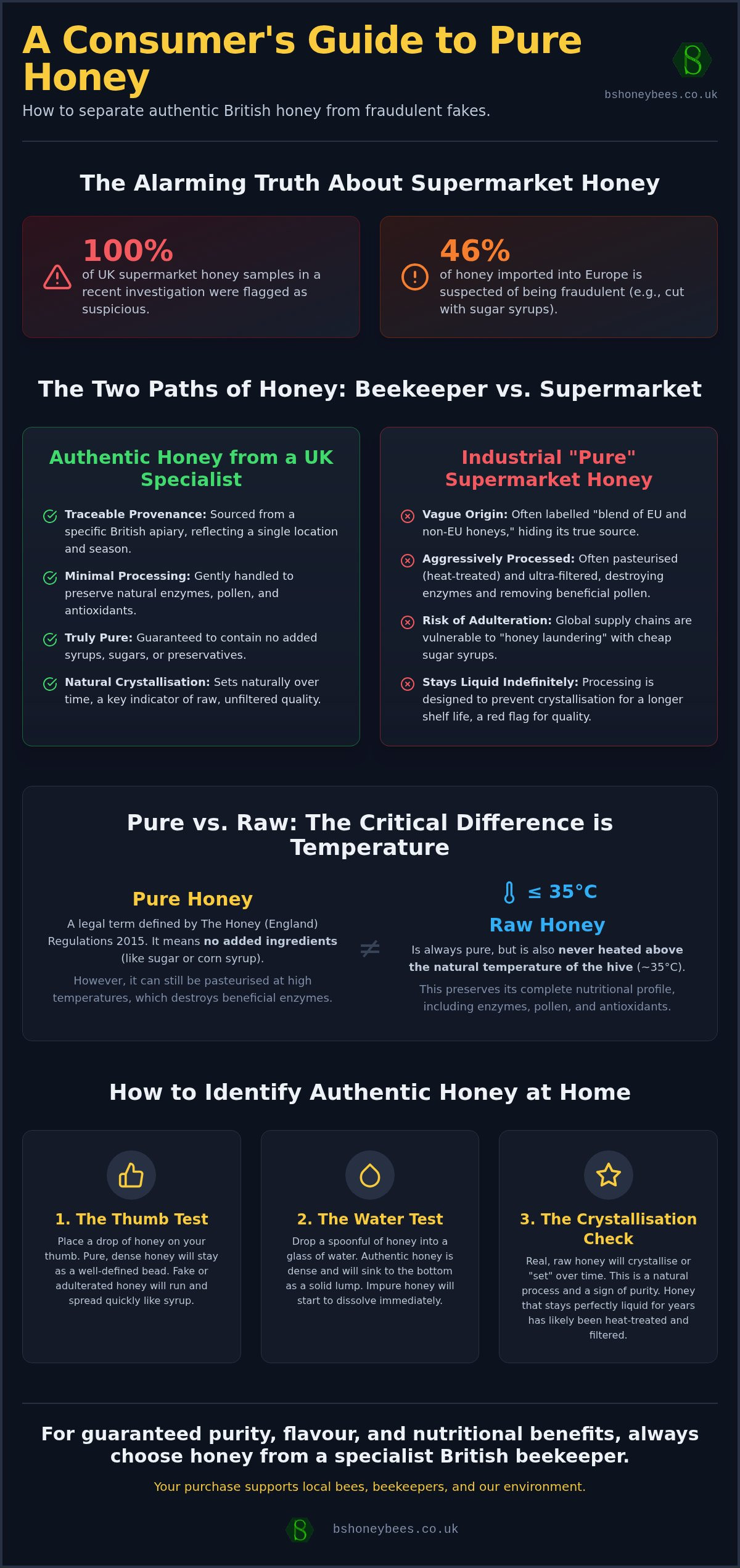
Did you know that nearly half of the honey imported into Europe is suspected of being fraudulent? Recent investigations found that every single sample taken from the UK was flagged as suspicious, leaving consumers rightly worried about what is actually inside their jars. You're likely tired of squinting at vague labels like "blend of EU and non-EU honeys" whilst worrying if you're simply buying flavoured sugar syrup. It's frustrating when you want the natural health benefits of pure honey but feel misled by clever marketing and industrial processing.
This specialist guide cuts through the confusion to help you identify genuine honey and understand why professional British beekeeping is the only way to guarantee quality. We'll examine the technical differences between supermarket brands and apiary-sourced jars, the impact of the June 2026 labelling regulations, and how to find a reliable UK source. You'll gain the confidence to bypass the suspicious blends and secure authentic English honey that meets the highest standards of purity and taste.
Key Takeaways
- Learn how the UK Honey Regulations 2015 define pure honey to help you spot misleading labels and industrial additives.
- Identify the technical differences between "pure" and "raw" varieties to ensure your honey retains its natural enzymes and health properties.
- Master practical home tests, such as the Thumb and Water tests, to verify the density and authenticity of your honey instantly.
- Understand why sourcing directly from specialist UK beekeepers guarantees a transparent, ethical journey from the hive to your table.
What defines pure honey in the United Kingdom?
In the UK, pure honey isn't just a marketing term; it's a legal standard. The Honey (England) Regulations 2015 dictate that any product sold under this name must contain no added ingredients. This means no corn syrups, cane sugar, or preservatives are permitted. Genuine purity relies on maintaining the natural enzymes and complex sugars exactly as the bees produced them. For a specialist beekeeper, purity represents a commitment to minimal interference. We believe the best honey is simply moved from the comb to the jar with as little human meddling as possible. It's about preserving what the bees have already perfected.
You'll often see jars on supermarket shelves labelled as a "blend of EU and non-EU honeys." These are industrial products designed for consistency and low cost rather than quality. They lack the distinct seasonal profile of single-origin English honey. When you choose honey from a specific British apiary, you're tasting a specific moment in the UK landscape. You aren't getting a processed mixture from across the globe that's been standardised for mass consumption. Purity is as much about provenance as it is about the raw ingredients.
While our focus is on the British landscape, the same principles of provenance apply globally. For example, those looking for high-quality international varieties can discover Balqees Honey, which offers pure, unfiltered honey sourced from the unique flora of Yemen.
The role of the honey bee in defining purity
Purity begins inside the hive long before a beekeeper gets involved. Bees collect nectar from various botanical sources like wildflowers, heather, or ivy. This source dictates the character, scent, and colour of the final product. Through a complex process of enzymatic activity and moisture evaporation, the bees transform this nectar into Honey. This natural transformation is only possible within a healthy, well-managed colony. We prioritise breeding elite F1 Buckfast and Carniolan queens because their health and productivity directly impact the quality of the honey they produce. A strong colony ensures the honey is processed correctly by the bees themselves before it's even harvested.
Why supermarket "pure" honey often falls short
Many supermarket jars labelled "pure" have undergone ultra-filtration. This aggressive process removes almost all pollen, which is often done to hide the honey's geographic origin and prevent it from crystallising. Industrial packers also use excessive heat-treating, or pasteurisation, to speed up the bottling process whilst ensuring the product stays liquid on the shelf for longer. This heat destroys the delicate flavour profile and beneficial enzymes that make honey a functional food. There's also the growing issue of "honey laundering," where cheap syrups are blended into global supply chains to increase profits. Choosing honey from a specialist ensures you avoid these compromised products and get exactly what's on the label.
Pure vs Raw: Understanding the labels in 2026
Distinguishing between "pure" and "raw" is essential for any discerning buyer in 2026. Whilst all raw honey is inherently pure honey, the reverse isn't always true. A product can legally be sold as pure honey whilst having undergone industrial heat treatment that strips away its most valuable components. To stay within the law, producers must follow The Honey (England) Regulations 2015. These rules ensure no foreign syrups are added. However, they don't prevent honey from being pasteurised at high temperatures. In contrast, raw honey is never heated above the natural temperature of the hive, which is approximately 35°C. This technical threshold is critical. It preserves the delicate pollen, propolis, and antioxidants that heat would otherwise destroy.
Whether you prefer set honey or runny varieties, both qualify as pure if processed correctly. The difference lies in the botanical source and the speed of extraction rather than the quality of the bees. If you want to experience the full depth of flavour from our local apiaries, choosing authentic English Honey ensures you receive a product that respects these natural limits. By avoiding excessive heat, we protect the complex biological structure that makes honey more than just a sweetener.
The science of honey crystallisation
Crystallisation is a natural biological process, not a sign of spoilage. It's actually a strong indicator of purity. Different nectar types dictate the speed of this change. For instance, oilseed rape honey sets very quickly into a fine grain, whereas heather honey remains thick and jelly-like for longer. If your jar has set and you prefer it liquid, place it in a bowl of warm water (not boiling) to gently liquify it without damaging the raw properties. Never use a microwave, as this creates hot spots that destroy beneficial enzymes.
Nutritional benefits of unpasteurised honey
Unpasteurised honey is a powerhouse of nutrition. It contains B vitamins, vitamin C, and essential minerals like potassium and calcium. The presence of glucose oxidase is particularly important. This enzyme gives honey its natural antibacterial properties. Many people also find that consuming raw local honey helps them manage seasonal hay fever by providing micro-exposure to local pollens. These benefits are lost when honey is over-processed. By keeping the honey raw, we ensure every spoonful contains the vitamins and minerals intended by nature.
The journey from hive to jar: A beekeeper’s perspective
Producing pure honey requires a disciplined adherence to the natural seasons of the British countryside. Our apiaries follow a strict cycle, starting with the spring build-up and concluding with the late summer harvest. This process is supported by high-quality British National hives, which provide the essential insulation and space needed for a colony to thrive. A healthy colony is a productive one, and the design of the hive plays a critical role in ensuring the bees can store surplus nectar efficiently without compromising their own winter stores.
The temperament of the colony is equally vital to the quality of the final product. We work with Buckfast or Carniolan breeds because their calm nature allows for a cleaner, more efficient harvest. When bees are gentle, we use significantly less smoke during inspections. This prevents the delicate, floral flavour profile of the honey from being tainted by external odours. It's a level of precision that industrial producers, who often prioritise volume over bee behaviour, simply cannot match.
Our extraction process is designed to protect the integrity of the honey. We use centrifugal force to spin the honey from the combs, followed by a period of natural settling. This allows air bubbles and tiny wax particles to rise to the top so they can be removed without the need for high-pressure filtration. This methodical approach ensures we meet the standards set by The Honey (England) Regulations 2015 whilst delivering a jar that remains as close to its natural state as possible.
Why bee genetics matter for honey quality
Selecting F1 Buckfast Queens is a strategic choice for any specialist beekeeper. These bees are renowned for their prolific honey-gathering abilities and exceptional thriftiness. Their steady temperament ensures that hive inspections are thorough and precise, leading to better colony health and a higher standard of pure honey. Buckfast bees were specifically bred for productivity and disease resistance in the 20th century.
Protective gear and hygiene in the honey room
Maintaining a sterile environment is non-negotiable for professional apiary standards. We wear professional BBWear bee suits to ensure we can work calmly and safely amongst the colonies. Inside the honey room, every piece of equipment is food-grade stainless steel to prevent contamination. A well-organised apiary ensures that the final product is free from impurities and reflects the true quality of the forage. Professional standards in the field translate directly to the excellence of the jar on your table.
How to identify authentic pure honey at home
You don't need a laboratory to verify the quality of the jar in your cupboard. Whilst industrial packers rely on vague marketing, you can use simple physical tests to spot the difference between a syrup blend and genuine pure honey. These tests exploit the unique density and low moisture content of honey produced by healthy British colonies. If your honey fails these checks, it's likely been adulterated with sugar syrups or over-processed to the point of losing its natural structure.
- The Thumb Test: Place a small drop of honey on your thumbnail. Authentic pure honey is highly cohesive and will stay in a distinct, rounded bead. If the liquid spreads or spills off your thumb immediately, it's a sign of high water content or added thinners.
- The Water Test: Drop a teaspoon of honey into a glass of cold water. Real honey is dense and will sink to the bottom as a solid lump. It won't start dissolving until you stir it. Adulterated honey or flavoured syrups will begin to cloud the water and dissolve before they even reach the base of the glass.
- The Flame Test: This traditional method requires caution. Dip a dry candle wick into the honey and attempt to light it with a match. Because genuine honey has a moisture content below 20%, the wick will still light and burn. If the honey contains added water or syrups, the wick will either fail to light or will sputter and crackle. Safety warning: Always perform this test over a fire-safe surface and keep a damp cloth nearby.
Ensure you are investing in the real thing by sourcing English Honey directly from our specialist apiaries.
Reading the labels like an expert
Turn the jar around and look at the "Country of Origin" statement. This is your first line of defence against food fraud. A specific UK address provides a clear chain of accountability that connects the jar back to a real beekeeper. In contrast, phrases like "Produce of more than one country" or "EU and Non-EU blends" are significant red flags. These labels allow packers to mix honey from various global sources, often masking the presence of industrial syrups. The "English Honey" designation is a mark of national quality that guarantees the product was harvested within our borders.
Sensory characteristics of real honey
Real honey has a complex "nose." When you open the jar, you should detect a floral or earthy aroma that reflects the forage of the bees. Industrial syrup blends usually have no scent other than a flat, cloying sweetness. You should also look for the "throat catch." High-quality, active honey often produces a slight tingle or warming sensation at the back of the throat when swallowed. Finally, observe the colour. Authentic honey is never perfectly uniform across every batch; its shade changes naturally from pale straw to deep amber depending on whether the bees visited clover, lime trees, or heather.
Why choose honey from a beekeeping specialist?
Sourcing your pure honey from a specialist apiary is about more than just taste; it's about professional integrity. Unlike supermarkets that act as aggregators for global blends, specialists like BS Honey Bees Ltd manage the entire biological lifecycle. We don't just pack honey; we breed the F1 Buckfast and Carniolan queens that lead the colonies. This deep involvement ensures that every jar is a direct byproduct of elite beekeeping standards. When you buy from the source, you're getting a product that hasn't been passed through multiple warehouses or subjected to industrial standardisation.
Traceability is the cornerstone of trust in the honey industry. By purchasing from a provider that also supplies the bees and the hives, you gain an unmatched level of transparency. You know exactly which landscapes the bees foraged and the specific standards under which they were raised. We view our honey as a reflection of our craft. It represents the health of our colonies and the precision of our management. Choosing a specialist means you're investing in a transparent supply chain where quality is never compromised for volume.
Supporting the future of British beekeeping
Every purchase of local honey directly funds the vital work of breeding healthy nucleus colonies and high-performing queens. This financial support allows BS Honey Bees Ltd to maintain the high standards required to sustain the UK apiary industry against the threats of disease and habitat loss. We don't just produce honey; we provide the foundation for other beekeepers to succeed across the country. Buying local honey is the most direct way to support bee conservation. It ensures that professional breeders can continue to develop resilient genetics that thrive in the British climate.
The BS Honey Bees Ltd commitment to quality
Our focus on F1 Buckfast and Carniolan genetics isn't accidental. These breeds are selected for their superior honey production and gentle temperament, which are critical for a clean harvest. We apply the same rigorous standards to our pure honey as we do to our breeding programmes. For those inspired to begin their own beekeeping journey, we also provide the same professional-grade equipment we use in our own operations. This includes everything from British National hives to protective BBWear suits. We're here to support both the consumer and the aspiring apiarist with expertise and reliable supplies.
Shop Premium English Honey and Beekeeping Supplies at BS Honey Bees Ltd
Secure Your Supply of Authentic English Honey
Understanding the technical standards of pure honey allows you to move past misleading labels and prioritise genuine quality. You now have the practical tools to identify authentic jars at home and appreciate the complex journey from a British National hive to your table. Choosing a specialist beekeeper doesn't just guarantee a superior product; it sustains the elite genetics and professional standards necessary for a thriving UK bee population.
BS Honey Bees Ltd remains committed to logistical excellence and industry-leading expertise in every aspect of our work. As specialist F1 Buckfast Queen breeders and retailers of professional BBWear suits, we provide the high-level tools and the premium output required for a successful beekeeping season. Whether you're looking for the finest jar of English honey or professional-grade apiary equipment, we offer reliable nationwide UK delivery to meet your needs with efficiency.
Shop Premium English Honey and Beekeeping Supplies at BS Honey Bees Ltd
Invest in the integrity of your pantry and the health of our countryside by choosing a partner that understands the science of the hive. Much like choosing a specialist such as Belfast Bed Superstore for your home furniture needs, sourcing honey from experts ensures you never have to compromise on quality or authenticity.
Frequently Asked Questions
Is pure honey the same as raw honey?
No, they're not the same. Whilst all raw honey is inherently pure honey, the term "pure" on a label only guarantees that no other ingredients have been added. It doesn't prevent the honey from being pasteurised or ultra-filtered. Raw honey is never heated above 35°C, which is the natural temperature of the hive. This ensures that all the beneficial enzymes, antioxidants, and local pollens remain intact within the jar.
Can pure honey ever go off or expire?
Properly stored honey does not expire or go off. Its unique chemical makeup, characterised by low moisture content and an acidic pH, makes it impossible for bacteria or honey-spoiling yeast to survive. You'll find a "best before" date on the label because it's a legal requirement in the UK, but the honey itself will remain safe to eat for decades. If it changes texture, it's usually just a natural physical shift.
Why is my pure honey turning solid or cloudy?
Crystallisation is a natural process and a strong indicator that you've bought pure honey. It happens when the natural sugars, specifically glucose, separate from the water and form solid crystals. The speed of this process depends on the nectar source; for instance, oilseed rape honey sets very quickly. To return it to a liquid state, simply place the jar in a bowl of warm water and stir it gently until the crystals dissolve.
Is it safe to give pure honey to infants?
You must never give honey to any child under the age of 12 months. Honey can contain spores of Clostridium botulinum, which can lead to infant botulism, a rare but serious illness. Whilst an adult's mature digestive system can easily handle these spores, an infant's gut isn't developed enough to prevent the bacteria from growing and producing toxins. After their first birthday, children can safely enjoy honey as part of their diet.
How should I store my honey to maintain its purity?
Keep your honey in a cool, dry place away from direct sunlight, such as a kitchen cupboard or pantry. It's vital to keep the lid tightly sealed because honey is hygroscopic, meaning it readily absorbs moisture and odours from the air. Don't store your honey in the fridge. The cold temperature will significantly accelerate the crystallisation process, making the honey hard and difficult to spread without providing any benefit to its shelf life.
What is the difference between wildflower honey and heather honey?
The difference lies in the specific nectar source and the resulting physical properties. Wildflower honey is produced from a variety of blossoms visited throughout the season, offering a classic, floral sweetness. Heather honey is a specialist product from late-summer ling heather. It's thixotropic, which means it has a unique jelly-like consistency that only becomes liquid when agitated. It also has a much stronger, pungent aroma and a slightly bitter, smoky aftertaste.
Does pure honey contain added sugar or corn syrup?
Genuine honey contains no added sugar, corn syrup, or any other additives. According to UK law, any product labelled as honey must be a completely natural substance produced by bees from nectar or honeydew. If a manufacturer adds any syrups or preservatives, they can no longer legally use the name honey on the packaging. To avoid the risk of adulterated products, always check for a specific UK producer's address on the label.
Why does the colour and taste of honey vary between jars?
Variations in colour and flavour are natural results of the different flowers the bees have visited. Nectar from clover or fruit blossoms typically produces a pale, mild honey, whilst nectar from chestnut or forest trees results in a dark, robust profile. Because we don't blend or standardise our honey like industrial packers, every batch is a unique reflection of the specific forage and weather conditions present at the time of harvest.