

A single week of missed inspections in May is often the difference between a record honey harvest and watching your prime swarm vanish over the garden fence. Most British beekeepers understand the frustration of reacting to their bees rather than staying ahead of them. If you've ever felt confused about the right time to order new nucs or treat for Varroa, following a reliable seasonal beekeeping calendar UK is the only way to regain control. You want healthy, productive colonies that remain calm whilst you work; however, the UK's unpredictable weather often makes that feel like a moving target.
Our expert guide for 2026 provides the logistical precision you need to manage your apiary with confidence. We've mapped out the entire year to help you master queen rearing, swarm prevention, and the vital preparations for winter survival. This month-by-month breakdown ensures you can organise your tasks with clarity, knowing exactly when to introduce new F1 Buckfast or Carniolan queens, when to expand into British National hives, and how to maximise your honey yield. Follow this proactive path to ensure your bees don't just survive the British winter; they thrive through the entire season.
Key Takeaways
- Synchronise your apiary tasks with a precise seasonal beekeeping calendar UK to prevent uncontrolled swarming and ensure peak colony health throughout 2026.
- Identify the critical 14°C threshold for your first spring inspection and learn why mid-summer is the optimal window for introducing high-performance F1 Buckfast or Carniolan queens.
- Navigate the 'June Gap' and manage hive space effectively to maximise honey yields whilst maintaining calm-tempered, productive bees.
- Secure successful overwintering by ensuring 20-25kg of stores and implementing vital Varroa management strategies before the autumn temperature drop.
- Streamline your logistics by ordering nucleus colonies in January and February to guarantee availability and allow time to organise your British National hives and BBWear protective gear.
The Rhythms of the UK Beekeeping Calendar
The traditional calendar suggests a January start, but for the disciplined apiarist, the beekeeping year begins in August. This is the vital foundation of any successful seasonal beekeeping calendar UK. Decisions made in late summer directly dictate the colony's strength for the following spring. You aren't just harvesting honey; you're raising the "winter bees" that must survive until March. If you fail to manage Varroa or nutrition in September, your colonies won't make it to the first dandelion of spring. A proactive approach in autumn ensures your bees have the resilience to withstand the British winter.
Timing is everything. Whilst a beekeeper in Cornwall might see activity in February, those in Scotland often wait until April for the first true cleansing flights. This regional shift doesn't change the framework, but it does alter your response times. Maintaining a professional standard in Beekeeping in the United Kingdom requires a deep understanding of these local nuances. Use meticulous records to track colony behaviour and queen performance. If a colony shows high aggression or poor wintering, plan to requeen early in the next season to maintain a calm and productive apiary. Consistent record-keeping is the only way to identify which queens are truly earning their place in your hives.
Understanding the British Nectar Flow
Identifying forage patterns is essential for managing colony nutrition. You must recognise the following stages:
- Early Season: Willow and dandelions provide the first vital pollen and nectar hit for brood rearing.
- The Main Flow: High summer brings heavy hitters like Lime, Clover, and Blackberry. This is when your supers should be on and space must be managed.
- The June Gap: This is a notorious period where early blossoms fade before summer flowers fully open. Colonies can starve in June if you aren't vigilant. Always check stores during this dip.
- Late Season: Ivy and Heather provide the final boost to winter stores, though ivy honey can set hard in the cells, requiring careful management.
Setting Goals for the 2026 Season
Efficiency requires a plan. Decide now if your priority is maximum honey yield or expanding your apiary. If you're aiming for growth, order your 5 or 6 frame nucs early in the year to avoid the spring rush. Ensure you have enough British National hives and frames ready well in advance. Standardising on National equipment simplifies your logistics during the busy spring build-up. Always evaluate temperament; a productive hive is only a joy to manage if the bees remain calm whilst you work. If your current stock is feisty, consider introducing F1 Buckfast or Carniolan queens to improve the apiary's standard.
Spring Awakening: Managing the Build-up (March – June)
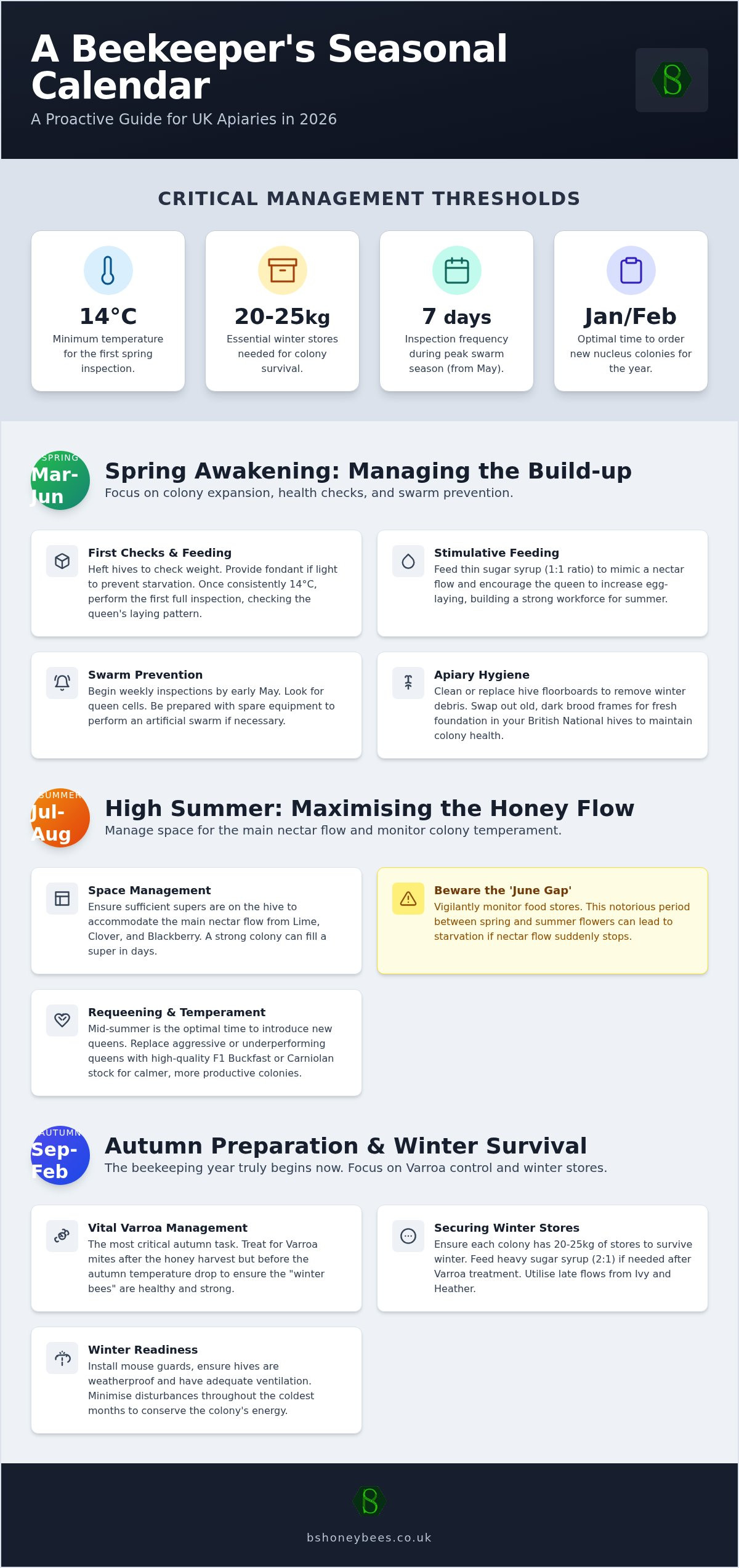
March is a month of transition. Whilst the bees are eager to fly, the weather remains fickle. Your priority in any seasonal beekeeping calendar UK is ensuring they don't starve just as the brood starts to expand. Lift the back of the hive to "heft" the weight. If it feels light, provide fondant immediately. Once temperatures consistently reach 14°C, you can perform your first full inspection. Assess the queen's laying pattern and check for diseases like European Foulbrood. This is also the ideal time to swap out old, dark frames in your British National brood boxes for fresh foundation to keep the colony healthy and hygienic.
As the willow and dandelions fade, stimulative feeding with thin sugar syrup (1:1 ratio) can mimic a nectar flow. This encourages the queen to ramp up egg-laying. You want a massive workforce ready for the main summer flow. However, a rapidly expanding colony leads to the beekeeper's greatest challenge: swarming. By early May, your inspection rhythm must become weekly. Look for queen cells along the bottom and faces of the frames. If you find them, implementing an artificial swarm is the most reliable way to keep your bees and your honey. It's a disciplined process that requires having spare equipment ready to go at a moment's notice.
The Critical March Check
Before the first full inspection, focus on external signs and floorboard hygiene. Clean or replace floorboards to remove winter debris and dead bees; this helps prevent the spread of pathogens. This period is also about logistical readiness. Ensure you have enough supers ready for your British National hives. A strong colony can fill a super in days during a heavy spring flow from oilseed rape or fruit blossom. Missing this window leads to congestion and triggers the swarm impulse. Don't let your bees run out of space before the season has truly begun.
May and June: Peak Swarm Season
Success during the peak season relies on detail. Ensure your BBWear bee suit is in top condition. A clear veil is essential for spotting tiny eggs or the first signs of queen cell play cups. If you identify a colony preparing to swarm, use 5 or 6 frame nucs to split the colony. This not only prevents the loss of your bees but also creates "insurance" colonies that can be used to boost weaker hives later in the year. For more detailed month-by-month tasks, the BBKA's seasonal beekeeping guide offers a useful baseline for national standards.
If you find your colonies are consistently difficult to manage or prone to excessive swarming, it may be time to improve your apiary's genetics. You can order calm-tempered F1 Buckfast queens to requeen your stocks during the summer build-up, ensuring a more manageable experience for the rest of the season.
High Summer: Maximising the Honey Flow (July – August)
July is the reward for your spring diligence. As the blackberry and lime flows peak, your primary task within the seasonal beekeeping calendar UK is space management. A strong colony can fill a British National super in under a week during a heavy flow. If you don't provide room for honey, the bees will backfill the brood nest, restricting the queen and potentially triggering a late-season swarm. Following a structured seasonal beekeeping calendar UK ensures you never miss these brief but intense nectar windows. Monitor the weather closely; if a wet spell follows the "June Gap," you must ensure colonies don't consume their entire surplus before the main harvest.
August marks the beginning of the beekeeping "new year." Whilst you are focused on extraction, you must also look ahead to winter survival. This is the critical window for Varroa monitoring. Use a sticky board to assess the daily mite drop. If levels are high, plan your treatments for immediately after the honey is removed. Protecting the developing winter bees from viral loads is the single most important factor for colony survival into 2027. For a detailed breakdown of these time-sensitive tasks, refer to this UK Beekeeping Calendar. It provides a scientific baseline for managing these pivotal summer transitions.
Honey Harvest and Extraction
Clear your supers efficiently using clearer boards or porter bee escapes. This reduces stress on the colony and prevents robbing behaviour. Once removed, check the moisture content of your honey using a refractometer. To meet the standards for "English Honey," the water content should ideally be below 18%, and never above 20%. Store your extracted, drawn comb with acetic acid or in a moth-proof environment. This protects your valuable assets from wax moth damage during the autumn months.
The dedication required to produce such a high-quality, artisanal product often mirrors the standards found in other luxury sectors. For instance, the refined palate of a honey connoisseur may also find interest in the complex flavour notes of TSARINE Caviar, which represents a similar peak of food craftsmanship.
Summer Requeening Strategies
Mid-summer is the professional's choice for introducing new genetics. The weather is stable, and colonies are generally more receptive to a new queen. Evaluate your current stock. If a colony is defensive or has a patchy brood pattern, consider introducing F1 Buckfast queens to improve temperament and productivity. This ensures the colony enters the winter with a vigorous, young queen ready for 2027.
Choosing the right breed is a strategic decision for any apiary. When comparing Buckfast vs Carniolan bees, consider that Buckfasts are renowned for their low swarm drive and massive honey hauls, whilst Carniolans excel at rapid spring build-up and thrifty wintering. To introduce a new queen safely, remove the old queen and wait at least four hours. Insert the queen cage between two frames of young brood. Leave the colony undisturbed for seven days to ensure a successful release. This disciplined approach guarantees a smooth transition and a stronger colony for the late-season ivy flow.
Autumn Preparation and Winter Survival (September – February)
September is the true beginning of the seasonal beekeeping calendar UK. Decisions made now determine whether your colonies emerge strong in March or become a winter loss statistic. Your primary objective is to ensure every colony has a robust population of 'winter bees' and sufficient stores to last until the first nectar flow of 2027. A colony requires between 20kg and 25kg of sealed stores to survive a typical British winter. If they are light, feed a thick 2:1 sugar syrup immediately. This allows the bees to store the food quickly whilst the weather is still warm enough for them to reduce the moisture content.
Security is equally vital. As the temperature drops, the hive becomes an attractive target for rodents and birds. Fit mouse guards to your British National hives by late October to prevent damage to the comb. In areas prone to woodpecker attacks, wrap the hives in netting or protect the cedar with plywood. Balance is key; whilst you must protect them from the elements, the damp UK climate makes ventilation essential. Ensure there is enough airflow to prevent condensation from dripping onto the winter cluster, which is often more lethal than the cold itself.
September: The Beekeeper's New Year
Perform your final thorough brood nest inspection in early September. You must confirm the queen is present and laying well. If a colony is weak, don't attempt to nurse it through; combine it with a stronger stock to ensure a viable winter cluster. Reduce hive entrances to a minimum to help the bees defend against wasps and robbing bees from neighbouring apiaries. This disciplined approach protects your assets during the height of the robbing season.
Winter Maintenance and Education
Winter is the time for logistical precision and equipment care. For smaller colonies or late splits, using 2 in 1 Poly Nucs provides superior thermal efficiency, significantly increasing their chances of survival during the coldest months. Whilst the bees are clustered, use the downtime to clean and sterilise your equipment. Scorch wooden brood boxes and wash your BBWear bee suits to ensure everything is ready for the spring rush. You can buy British National hives and frames now to avoid the inevitable delays of the busy season.
By December or January, when the hive is broodless, implement your final Varroa strategy. Oxalic acid vapourisation or trickling is highly effective during this window. This 'clean up' treatment ensures the colony starts the 2026 season with the lowest possible mite count. Use the remaining winter months to refine your knowledge and finalise your apiary plans. A successful beekeeper is always a student of the craft.
The Strategic Beekeeper’s Year: Ordering and Logistics
Success in the apiary is as much about logistical precision as it is about biology. Whilst your colonies are clustered in January and February, your focus must shift to procurement. This is the most overlooked phase of the seasonal beekeeping calendar UK. High-quality bees are a finite resource. If you wait until the first spring blossoms to order your 5 or 6 frame nucs, you'll likely face long waiting lists or settle for inferior stock. Proactive ordering ensures you're at the front of the queue for the first deliveries of the season. Logistics matter. Assembling your British National hives in the winter prevents the frantic, last-minute construction that leads to mistakes during the spring build-up.
Consider the advantage of overwintered nucs. These colonies have already proven their resilience by surviving a British winter. They are ready to expand the moment the weather breaks, giving you a significant head start over spring-raised splits. You should also synchronise your equipment arrival. Having your brood boxes, frames, and foundation ready before the bees arrive is non-negotiable. It allows the bees to settle immediately without unnecessary stress. Use the quiet months to register with BeeBase if you haven't already; staying informed about local disease alerts is a vital part of your 2026 strategy.
Sourcing Quality Bees in the UK
The quality of your stock dictates the temperament and productivity of your entire apiary. Sourcing F1 Buckfast or Carniolan queens from reputable UK specialists ensures you receive bees bred for the British climate. Since 2026 import regulations generally restrict bee movements to queens and small numbers of attendants, domestic nucleus colonies remain the gold standard for expanding your apiary. Look for suppliers who prioritise calm-tempered genetics and offer clear delivery windows. Reliable nationwide distribution is essential for the health of the colony; ensure your supplier uses specialist couriers to minimise time in transit.
The Essential Equipment Checklist
Don't let a lack of equipment limit your honey yield. Stock up on frames and foundation whilst prices are stable during the off-season. This is also the time to evaluate your protective gear. Upgrading to professional-grade protection, such as BBWear bee suits, is a wise investment for the busy inspection months ahead. Their durability and clarity are industry favourites for a reason. Finally, organise your honey jars and labels well in advance. Having a clean, organised honey room ready by July allows you to focus entirely on the harvest when the flow is at its peak. Preparation is the hallmark of a master beekeeper.
As you prepare for the season, you may also appreciate the craftsmanship of other local producers like Worker Bee MCR Tea & Coffee, who offer premium tea and coffee blends that celebrate Manchester’s heritage; read more.
If you're planning to expand or improve your stock this year, you can order your 5 or 6 frame nucs and F1 queens now to secure your delivery date for the 2026 season.
Mastering the 2026 Beekeeping Season
Success in the apiary isn't down to luck; it's the result of disciplined timing and high-performance genetics. By following a structured seasonal beekeeping calendar UK, you move from being a reactive beekeeper to a proactive manager. You've seen how the year demands different priorities, from the logistical planning of winter to the intense swarm management of the spring build-up. Maintaining calm-tempered, productive colonies is achievable when you synchronise your inspections with the natural nectar flows of the British landscape.
Now is the time to finalise your requirements for the year ahead. Whether you're expanding your apiary or improving your existing stock, starting with the right foundations is essential. We are specialists in F1 Buckfast and Carniolan genetics, providing calm and prolific bees through our nationwide delivery service. As premium BBWear stockists, we also ensure you have the professional protection needed for every inspection. Secure your 2026 Nucleus Colonies and F1 Queens from BS Honey Bees Ltd today to guarantee your place in the spring schedule. Let's make 2026 your most successful and productive honey season yet.
Frequently Asked Questions
When is the best time to start beekeeping in the UK?
The best time to start is in late spring, typically April or May, when the weather is warm enough for colony expansion. However, your seasonal beekeeping calendar UK must begin much earlier. You should order your nucleus colonies and British National hives in January or February to ensure you are ready for the spring build-up. Starting with a nucleus colony rather than a swarm ensures you have a healthy, queen-right start.
How often should I inspect my beehive during the summer?
You should inspect your hives every seven days during the peak swarm season, which usually runs from April to July. This weekly schedule is essential for identifying queen cells and implementing swarm control before the colony decides to leave. Once the swarm risk diminishes in August, you can reduce inspections to once every ten to fourteen days to monitor honey stores and Varroa levels.
What is the 'June Gap' and how does it affect UK bees?
The 'June Gap' is a period where spring forage like oilseed rape and fruit blossom has finished, but summer flowers like lime and clover haven't yet opened. This nectar dearth can cause strong colonies to starve within days because they have a large workforce and many larvae to feed. Monitor your hive's stores closely during this time and provide sugar syrup if the bees are running low.
When should I treat my bees for Varroa mites?
You should implement a treatment strategy twice a year to ensure colony survival. The most critical window is late August, immediately after the honey harvest, to protect the bees that will live through the winter. A second treatment using oxalic acid should be administered in December or January whilst the colony is broodless. Always monitor mite drop to ensure your seasonal beekeeping calendar UK remains effective.
How much honey can I expect from one British National hive?
A healthy colony in a British National hive typically produces between 18kg and 27kg of surplus honey in a standard year. These yields vary significantly based on your local forage, the weather during the main flow, and the genetics of your bees. Prolific stock, such as F1 Buckfast queens, can often achieve higher yields if they are provided with enough supers to store the nectar surge.
Do I need to feed my bees during the winter months?
You only need to feed your bees in winter if their stores drop below the necessary 20kg to 25kg required for survival. Heft your hives regularly to check the weight without opening them. If a colony feels light, place baker's fondant directly over the cluster. Never use liquid syrup in the winter because the bees cannot evaporate the moisture, which leads to damp conditions and dysentery.
What is the difference between a spring nuc and an overwintered nuc?
An overwintered nuc is a colony created the previous year that has already proven its ability to survive the British climate. These colonies are ready to expand the moment the weather breaks in March. A spring nuc is a split made in the current year with a new season's queen. Whilst spring nucs are excellent for beginners, overwintered nucs provide a significant head start for honey production.
How do I protect my hive from wasps in the autumn?
Reduce the hive entrance to a small gap of about one or two centimetres to help the bees defend their stores. This is vital in late August and September when wasp colonies are at their largest and most aggressive. Strong colonies with young, vigorous queens are much better at defending themselves. You can also place wasp traps around the apiary to divert scouts away from your hives.