
In 2026, relying solely on honey production to pay the bills is a gamble that most British apiaries simply cannot afford to take. Whilst the demand for local, traceable honey remains high, the reality of beekeeping for profit uk 2026 requires a more sophisticated approach to commercial success. You likely worry about the steep initial costs of British National hives and professional BBWear suits, especially when unpredictable UK weather can slash honey yields overnight. It's a common concern that a single winter of colony losses could wipe out your entire financial progress.
We understand that building a resilient business amongst these challenges feels daunting. This guide provides a clear roadmap to achieving a solid ROI by diversifying your income streams beyond the jar. You'll discover how to leverage live bee sales, including F1 Buckfast and Carniolan Queens, to stabilise your returns and mitigate risks. We will explore the best equipment for longevity and how to structure your operation to ensure your apiary remains a profitable, sustainable enterprise for years to come.
Key Takeaways
- Understand the realistic financial roadmap for beekeeping for profit uk 2026, focusing on the distinct shift from hobbyist to commercial-scale operations.
- Maximise your margins by prioritising raw English honey and diversifying your output with high-value hive products like beeswax and propolis.
- Avoid false economies by investing in professional-grade equipment, such as BBWear suits and British National hives, to ensure long-term durability.
- Identify why live bee sales, particularly F1 Buckfast and Carniolan queens, are essential for maintaining steady cash flow in the UK climate.
- Learn how to scale your apiary efficiently through bulk ordering and standardised management practices for a more resilient business model.
Understanding Beekeeping Economics in 2026
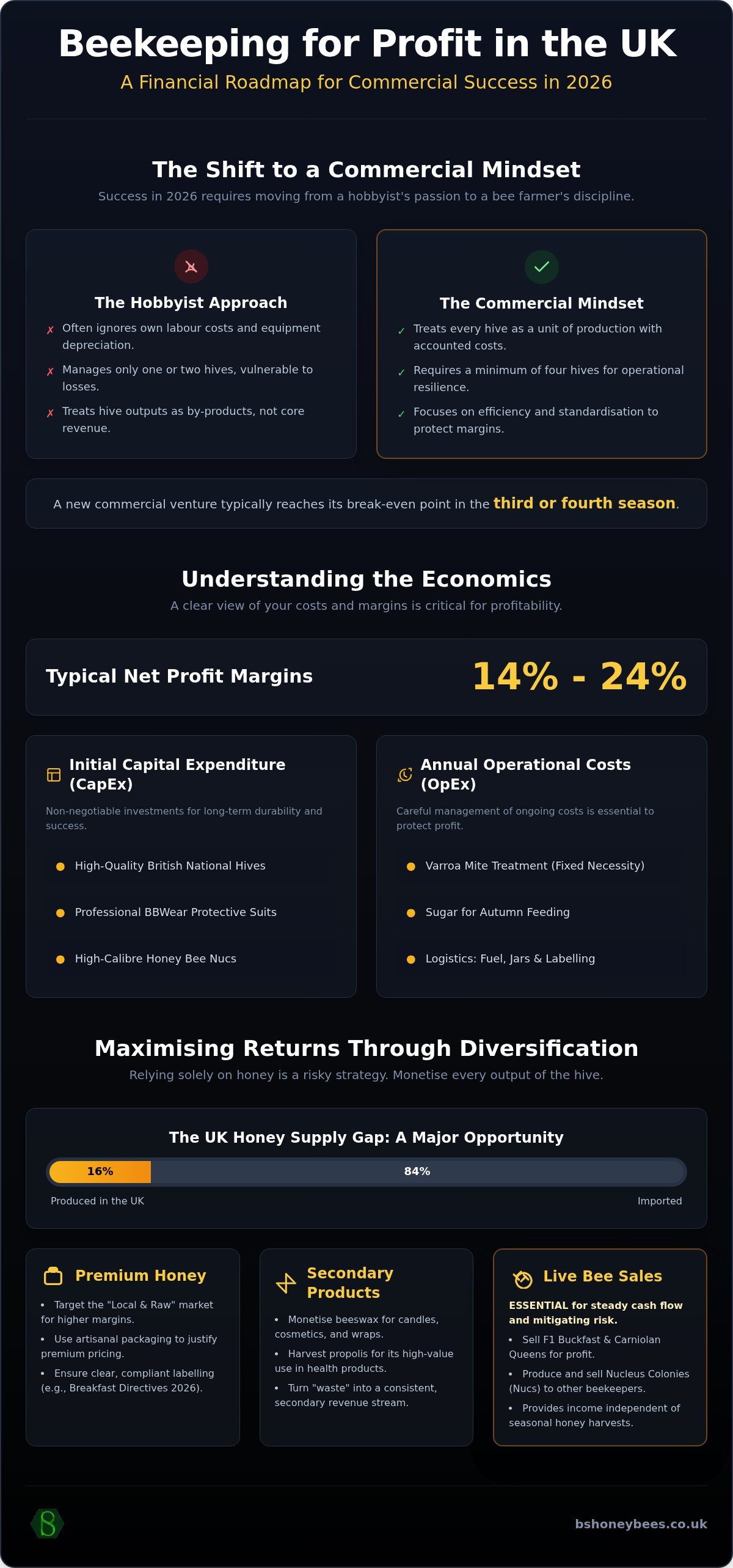
Success in beekeeping for profit uk 2026 depends on a shift in mindset. You must move beyond the sentimental view of the hobbyist and adopt the disciplined logic of a bee farmer. Beekeeping profit is the surplus remaining only after you have accounted for colony replacement costs and all operational overheads. In the current economic climate, the break-even point for a new commercial venture typically arrives in the third or fourth season. This timeline accounts for the high initial investment required to establish a productive footprint. Whilst a hobbyist might manage one or two hives for personal use, a commercial operation requires a minimum of four hives to ensure resilience. This scale allows you to combine colonies if one fails and ensures you have enough volume to meet the demands of local retailers.
The financial models differ significantly between scales. A hobbyist often ignores the cost of their own labour and equipment depreciation. In contrast, a professional model treats every hive as a unit of production. Statistics from Beekeeping in the United Kingdom show that while the number of beekeepers is rising, only those who standardise their equipment and management practices achieve sustainable margins. Precision is your most valuable asset. Stop viewing your apiary as a collection of insects and start treating it as a production line where efficiency dictates your take-home pay.
Initial Capital Expenditure (CapEx)
Your largest upfront costs involve housing and protection. Investing in high-quality British National hives and frames is a non-negotiable standard for commercial success. These hives allow for easy part replacement and compatibility across your entire operation. Do not cut corners on personal safety. Choosing professional BBWear suits provides long-term value through durability and superior protection, ensuring you can work quickly and confidently amongst your bees. Finally, ensure your stock is high-calibre from day one. Sourcing the right honey bee nucs for sale UK is the foundation of your breeding programme, as healthy, productive colonies are the only way to recover your initial outlay.
Annual Operational Costs (OpEx)
Ongoing costs require careful management to protect your 14% to 24% net profit margins. Varroa treatment is a fixed necessity; failing to treat effectively leads to colony losses that can bankrupt a small enterprise. You must also budget for the 2026 cost of sugar for autumn feeding. Whilst prices fluctuate, providing adequate stores is far cheaper than replacing a dead colony in the spring. Logistics also eat into your revenue. Factor in the costs of fuel for site visits, alongside the jars and labelling required to meet the latest UK market regulations. Efficiency in your transport routes and bulk-buying consumables will determine whether you stay in the black.
Maximising Returns: Diversifying Your Hive Products
To achieve commercial success in beekeeping for profit uk 2026, you must look beyond the standard honey jar. While the previous section detailed the importance of scale and capital, your actual revenue growth depends on how effectively you monetise every output of the hive. The UK currently produces only about 16% of the honey it consumes. This massive supply gap allows local producers to command a premium, but relying on a single harvest is a risky strategy. Diversification is your safety net against poor forage years and seasonal fluctuations.
The Premium Honey Market
Targeting the "Local and Raw" demographic is the fastest way to increase your margins. Consumers are increasingly wary of supermarket blends and are willing to pay significantly more for products with clear provenance. This is why raw honey UK remains a high-value category; it retains the natural enzymes and pollen that health-conscious buyers demand. Presentation matters. Moving beyond the standard hexagonal jar to bespoke, artisanal packaging can justify a higher price point at farmers' markets and independent delis.
Your labelling must be impeccable. New regulations, such as the "Breakfast Directives" that came into force in June 2026, require stricter country-of-origin details to combat fraud. Clear, honest labelling doesn't just ensure compliance; it builds a brand that customers trust. If you are starting out, sampling high-quality English honey can help you identify the flavour profiles and textures that define the premium market.
Secondary Hive Revenue
Beeswax and propolis are often treated as waste products by hobbyists, but for a commercial operation, they represent pure profit. Beeswax is in high demand for cosmetics, artisanal candles, and eco-friendly food wraps. Propolis, or "bee glue", is sought after by the health supplement industry for tinctures and salves. Processing these secondary products requires minimal extra equipment but adds a significant layer of financial resilience to your apiary.
Don't overlook pollination services. For rural apiaries, partnering with local fruit growers or seed producers can provide a guaranteed fee that is independent of honey yields. The Bee Farmers' Association is an excellent resource for establishing fair contracts and understanding the logistics of moving hives for seasonal pollination. By offering a mix of direct-to-consumer retail and professional services, you ensure that your business remains profitable even when the weather impacts nectar flow. Efficiency in these niche markets is what separates a struggling apiary from a thriving enterprise.
Controlling Costs and Avoiding False Economies
Commercial viability in beekeeping for profit uk 2026 relies on ruthless cost control. You'll often be tempted by unbranded, cheap equipment from overseas. Don't fall for it. Low-grade cedar or poorly machined frames warp quickly, leading to higher replacement costs and frustrating inspections. Efficiency is your primary driver. Standardising your entire apiary on the British National beehive ensures every part is interchangeable. When you're managing dozens of colonies, you can't waste time hunting for a specific roof or floor that only fits one hive. Effective swarm management is equally critical; every swarm that leaves your apiary is a "production unit" carrying away half your workforce and your potential honey crop.
The debate over wintering bees on sugar syrup versus their own honey is now a purely financial calculation. With raw English honey fetching premium prices in 2026, leaving 20kg of marketable product in the hive is often a poor business decision. Replacing that honey with refined sugar syrup is significantly cheaper and, for many commercial operators, provides a more consistent winter fuel. However, this only works if your colonies are healthy and your timing is precise. You must balance the cost of autumn feeding against the market value of your harvest to protect your margins.
Standardisation and Efficiency
Time is your most expensive overhead. Organise your apiary visits to ensure you aren't doubling back on yourself. Using 2-in-1 poly nucs allows for rapid colony expansion without the footprint of full-sized hives. These units are excellent for raising spare queens or overwintering small colonies, providing a buffer against spring losses. Every minute saved during an inspection directly improves your bottom line. Uniformity in your frames and boxes means you can move resources between hives instantly to support weaker colonies or capitalise on a sudden nectar flow.
Health as Wealth
Colony health is the ultimate insurance policy. A lost colony isn't just the cost of the bees; it's the lost revenue from honey and future splits. Proactive varroa management is essential. Registering with the National Bee Unit's BeeBase is a free and vital step for tracking local disease outbreaks and staying informed on biosecurity risks. You must also sharpen your diagnostic skills. Identifying drone laying queen symptoms UK early allows you to requeen and save the workforce before the colony collapses. Preventative care is always cheaper than a total loss.
Breeding for Profit: The Queen and Nuc Strategy
To truly master beekeeping for profit uk 2026, you must recognise that your most valuable asset isn't the honey in your supers, but the bees in your brood boxes. Live bee sales often provide a more reliable and higher-margin revenue stream than honey production alone. Whilst a honey crop depends entirely on forage and the weather, the demand for starter colonies remains constant every spring. In fact, a single nuc sale can equal the profit of 20 jars of honey. This shift in focus transforms your apiary from a seasonal gamble into a year-round production house where you aren't just harvesting a crop, but manufacturing the means of production for others.
The Mated Queen Advantage
Commercial success requires high-performance genetics. Beekeepers across the country are willing to pay a premium for mated queen bees UK because they eliminate the uncertainty of queen rearing in a fickle climate. By providing a queen that is already laying and proven, you save your customers weeks of potential downtime. The high demand for F1 buckfast queens UK is driven by their legendary prolificacy and calm temperament. Whether you choose Buckfast or Carniolan genetics, the key is timing. Aim to have your first batch of mated queens ready by May to catch the peak buying window when winter losses are being replaced.
Scaling with Nucleus Colonies
Nucleus colonies, or "nucs," act as the bank accounts of your apiary. Using 5 and 6 frame nucs allows you to split your strongest hives in late spring without completely sacrificing your main honey crop. This strategy requires precision; you must balance the hive's population to ensure both the parent colony and the new nuc remain viable. High-quality F1 genetics are essential here. If your nucs are defensive or unproductive, you won't get repeat business. By focusing on temperament and health, you build a reputation as a specialist breeder. This creates a sustainable cycle where you can expand your own colony numbers whilst generating immediate cash flow through sales.
Ready to start your breeding programme? Source your foundation stock from BS Honey Bees Ltd to ensure you are working with the highest standards of F1 Buckfast and Carniolan genetics.
Scaling Your Commercial Apiary with BS Honey Bees
Scaling your operation for beekeeping for profit uk 2026 requires more than just ambition; it demands a reliable supply chain. Whilst your first few hives might have been a learning curve, moving toward a commercial footprint demands a shift in how you source your hardware and livestock. You cannot afford to wait for local swarm collections or piecemeal equipment sales. Success at scale relies on standardised hardware and high-calibre genetics that arrive on your schedule. BS Honey Bees Ltd serves as that essential partner, providing the professional-grade infrastructure needed to transition from a hobbyist to a serious commercial producer.
Quality Stock as a Foundation
Reliability is the cornerstone of commercial growth. Aggressive behaviour in a colony isn't just a nuisance; it's a drain on your productivity. Starting with F1 queens from BS Honey Bees ensures your colonies remain calm and easy to manage, which directly increases your annual yield by allowing you to work more hives in less time. The roadmap from 2 to 20 hives is as much about logistics as it is about biology. You need a partner capable of live bee delivery UK that you can trust. Our nationwide shipping for queens and nucleus colonies allows you to expand your apiary footprint rapidly without the risk of sourcing inferior local stock that might carry disease or poor traits.
The Professional Edge
Dressing for success in a commercial setting means prioritising safety and durability. BBWear suits are the industry standard for a reason. When you're managing staff or spending eight hours a day in the apiary, the superior protection and breathability of professional gear become a vital investment. This professional image also extends to your apiary sites. Maintaining a clean, efficient operation with uniform British National hives makes you a more attractive partner for lucrative pollination contracts. Farmers and land managers want to see an organised business, not a cluttered hobby.
Efficiency in beekeeping for profit uk 2026 is achieved through bulk ordering and standardised management. By securing your British National hives and frames in volume, you reduce your unit cost and ensure every piece of kit in your van is interchangeable. Don't leave your 2026 growth to chance. Contact BS Honey Bees today to secure your stock and hardware, ensuring your apiary is equipped for a profitable and productive season.
Securing Your Commercial Future in British Beekeeping
The path to commercial success in beekeeping for profit uk 2026 is defined by precision and diversification. You've seen that relying on honey alone is a risk; the real stability lies in breeding high-performance nucleus colonies and mated queens. By standardising your apiary with British National hives and investing in professional BBWear protective gear, you eliminate the false economies that often drain margins. Efficiency is the ultimate difference between a struggling hobby and a thriving enterprise.
Partnering with a specialist ensures you have the reliable foundation needed to scale with confidence. As specialist F1 Buckfast breeders, we provide the calm, productive genetics that drive higher yields and lower management stress. With our nationwide live bee delivery, you can expand your footprint quickly and safely across the UK. It's time to move from theory to action and build a resilient business that withstands the challenges of the modern market.
Build your profitable apiary with BS Honey Bees and take command of your 2026 season. We are ready to support your growth with the expertise and equipment your business deserves. Your journey toward commercial success starts with a single, high-quality colony.
Frequently Asked Questions
How much profit can a single beehive make in the UK?
A single productive beehive can generate significant revenue, but net profit depends on your specific route to market. Whilst a bumper crop might yield 30kg to 40kg of honey, selling this at retail prices offers the best return. By incorporating secondary products like beeswax or selling a nucleus colony from that hive, you can maximise your margins. Most commercial operations target a net profit margin between 14% and 24% per unit after accounting for all overheads.
What is the most profitable breed of bee for UK honey production?
F1 Buckfast and Carniolan queens are widely considered the most profitable choices for beekeeping for profit uk 2026. Buckfast bees are renowned for their calm temperament and prolific honey production, whilst Carniolans excel in rapid spring buildup. Choosing high-calibre F1 genetics ensures your colonies are easier to manage and less prone to swarming. This efficiency allows you to manage more hives with less labour, directly impacting your bottom line.
Is it better to sell honey or nucleus colonies for profit?
Diversification is the safest strategy, but selling nucleus colonies often provides a more reliable cash flow than honey alone. A single nuc sale can match the profit of dozens of honey jars without the same dependence on summer weather. Many successful bee farmers use their honey crop to build brand awareness whilst relying on the high demand for starter colonies to provide their primary seasonal income and long-term financial stability.
What are the biggest hidden costs in beekeeping for 2026?
Logistics and colony replacement are the most significant hidden costs in 2026. Fuel for apiary visits and the rising price of sugar for autumn feeding can quickly erode your margins if not tracked. You must also budget for varroa treatments and the eventual replacement of hardware. Standardising on British National hives helps control these costs by ensuring all parts are interchangeable, reducing the need for bespoke or expensive one-off repairs.
Can I make a living from beekeeping with 10 hives?
Making a full-time living from just 10 hives is unrealistic due to the high fixed overheads and seasonal risks involved. A 10-hive apiary is an excellent "side-hustle" or proof-of-concept for a larger operation. To generate a full-time income, most UK bee farmers scale to at least 100 hives. This volume allows you to absorb occasional colony losses and participate in higher-value opportunities like large-scale pollination contracts or bulk retail partnerships.
How much does it cost to start a commercial beekeeping operation?
Starting a commercial operation requires a significant initial investment in quality hardware and livestock. For an apiary of 30 to 50 hives, startup costs typically range from £8,000 to £18,000. This includes British National hives, professional BBWear suits, honey extraction equipment, and your initial nucleus colonies. Whilst these costs are high, investing in professional-grade equipment from the outset prevents expensive replacement costs in your second or third season.
What insurance do I need for a beekeeping business in the UK?
Public liability insurance is essential for any commercial beekeeping business, especially if you sell products to the public or place hives on third-party land. Most professional beekeepers obtain this through membership in organisations like the Bee Farmers' Association. You should also consider product liability insurance for your honey and hive products. This protection ensures that your business assets are shielded from claims related to stings or food safety issues.
How do I market my honey to local UK customers?
Marketing success relies on highlighting the "local and raw" nature of your product. Use farmers' markets and independent delis to reach consumers who value provenance and are willing to pay a premium for English honey. Effective branding and clear, compliant labelling are vital for building trust. By telling the story of your apiary and the specific forage of your bees, you differentiate your honey from mass-produced supermarket blends and secure repeat customers.