

Imagine walking into your apiary on a damp September morning only to find a frantic cloud of wasps dive-bombing your most promising colony. It's a heartbreaking sight that many UK beekeepers face when forage disappears and robbing season begins. Understanding a beehive entrance reducer when to use is critical because a hive's entrance is its first line of defence. You know that balancing ventilation against the threat of intruders is a constant challenge in our unpredictable climate, but getting the timing wrong can lead to total colony loss.
This guide provides the clarity you need to manage your British National hives with confidence and precision. You will master a clear seasonal schedule for entrance management, from blocking out autumn wasps to fitting mouse guards for the winter months. We'll explore how to assess colony strength so you can reduce stress and significantly improve your survival rates through 2026 and beyond. By the end of this article, you'll have a professional strategy to keep your bees secure regardless of the British weather.
Key Takeaways
- Understand how entrance reducers act as a vital first line of defence against pests and the unpredictable British climate.
- Master the seasonal timing for your beehive entrance reducer when to use it to stop aggressive autumn robbing and protect vulnerable colonies.
- Learn why restricted entrances are essential for successfully establishing new 5-frame nucs and protecting smaller colonies from external stress.
- Discover how to balance hive security with essential ventilation to prevent dampness and fungal issues during wet UK winters.
- Explore the logistical advantages of integrated entrance management found in specialised equipment like 2-in-1 Poly Nucs.
Understanding the Entrance Reducer: More Than Just a Piece of Wood
A beehive entrance reducer is a simple yet indispensable component in your apiary management toolkit. Effectively a removable barrier, it allows you to restrict the hive threshold to a size the colony can easily defend. Whilst the concept of adjustable entrances was refined alongside the Langstroth hive, its application is vital for the British National Beehive. Our standard hive design features a generous entrance that, whilst perfect for a heavy summer honey flow, can be a liability during colder months or when forage is scarce.
Deciding on a beehive entrance reducer when to use involves viewing it as a tactical security gate. A colony's ability to 'patrol' its threshold is finite. If the entrance is too wide, guard bees are spread too thin. This lack of concentration invites opportunistic wasps and robbing bees from neighbouring apiaries to slip past the perimeter. By reducing the opening, you concentrate the guards into a small, manageable area, creating a formidable bottleneck that deters even the most persistent intruders.
The Anatomy of a Standard UK Reducer
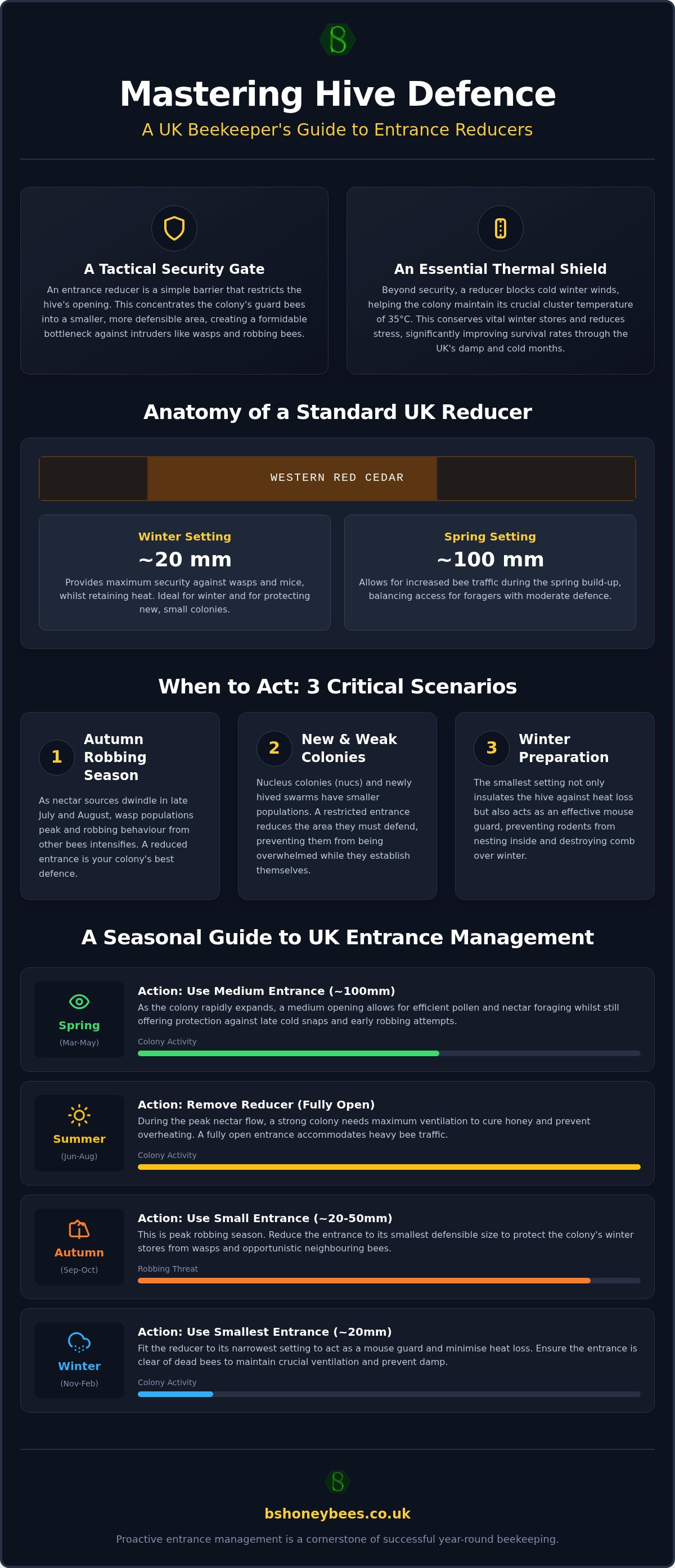
Standard UK reducers are typically manufactured from Western Red Cedar to match our hive bodies, though plastic and high-density foam versions offer excellent durability and ease of cleaning. Most British National reducers feature a clever two-way design. One side provides a narrow gap, often around 20mm, which is perfect for winter security and mouse prevention. The reverse side offers a medium opening, roughly 100mm, for the spring buildup. Using these precision-cut components ensures there are no accidental gaps at the edges of the floor, which is a common failure point with makeshift or ill-fitting reducers.
Thermoregulation and the Winter Cluster
Beyond security, these tools are essential for thermal efficiency. Honey bees must maintain a consistent 35°C within the brood nest to raise healthy larvae. A wide-open entrance in the depths of a British winter allows biting winds to strip heat directly from the cluster. This forces the bees to vibrate their wing muscles more vigorously to generate warmth, which in turn causes them to consume winter stores at an unsustainable rate. A correctly fitted reducer blocks wind chill whilst maintaining the vital oxygen exchange necessary for colony respiration. It's a delicate balance; you want to retain heat without trapping the excessive moisture that leads to damp, unhealthy conditions.
Three Critical Scenarios: When to Fit an Entrance Reducer
Deciding on a beehive entrance reducer when to use is rarely a "set and forget" task. It requires an understanding of the colony's internal life and the external threats present in the British countryside. Whilst a boiling colony in the height of June might require maximum airflow, three specific scenarios make an entrance reducer non-negotiable for the responsible beekeeper. These include the establishment of new colonies, the high-pressure robbing season, and the final transition into winter dormancy.
Colony temperament also dictates your strategy. When comparing Buckfast vs Carniolan bees, both breeds demonstrate excellent defensive qualities. However, the legendary docility of the Buckfast means they may not be as "flighty" or aggressive at the entrance as some native strains. Providing them with a reduced threshold ensures they can maintain their calm nature whilst effectively rebuffing intruders. If you're currently establishing a new apiary, ensuring you have the right British National Hives & Frames equipped with precision-cut reducers is your first step toward security.
Defending Against the Autumn Wasp Invasion
As the UK nectar flow tapers off in late July and August, local wasp populations reach their peak. These scavengers are no longer looking for protein to feed larvae; they're hunting for sugar to sustain themselves. A wide hive entrance is an open invitation. By fitting a reducer, you create a tactical choke point. Instead of defending a broad line, your guard bees concentrate at a single 20mm or 50mm gap. Look for "wrestling" bees on the landing board or wasps hovering persistently around the floor joins. These are clear signs that your colony is under pressure and requires an immediate reduction in entrance size.
Supporting Nucleus Colonies and Swarms
Newly hived colonies are particularly vulnerable. When you purchase honey bee nucs for sale UK, the colony arrives in a compact environment. Moving these five or six frames into a full-sized British National Hive creates a massive amount of "empty" space that the bees must patrol. Always use a reducer during the first few weeks of establishment. If you are using a 2-in-1 poly nuc, take advantage of the integrated entrance discs to keep the opening small. Only expand the entrance once you see traffic congestion that suggests the bees are ready to handle more space.
UK Seasonal Guide: Timing Your Entrance Management
Managing a colony in the UK requires a reactive approach to our specific weather patterns. A rigid calendar rarely suffices; you must observe the bees' behaviour at the threshold. However, a general seasonal framework helps determine a beehive entrance reducer when to use to keep your apiary secure and efficient. Your management strategy should shift as the colony expands and contracts, balancing the need for easy access with the necessity of defence.
During Spring (March-May), the colony's footprint expands rapidly as the queen increases egg-laying. Transition from the narrow winter setting to the medium spring setting once you see bees queuing to enter on warm days. This prevents a bottleneck that can slow down vital pollen collection. In Summer (June-August), maximum ventilation is often the priority to help bees dehydrate honey. For strong colonies, you might remove the reducer entirely. By Autumn (September-October), you must return to the smallest setting to rebuff wasps. Finally, Winter (November-February) focus shifts to heat retention and pest exclusion.
The "June Gap" and Summer Dearth Management
The "June Gap" is a notorious period in the UK where spring flowers have faded but summer crops like lime or clover haven't yet peaked. Foraging bees become desperate, and you'll often witness robbing behaviour. Look for frantic, zig-zagging flight patterns and fighting on the landing board. If you're extracting honey nearby, the scent can cause an apiary-wide frenzy. Re-inserting the reducer during this pause in the nectar flow is a proactive move that prevents your smaller colonies from being overwhelmed by their stronger neighbours.
Winter Lockdown: Reducers and Mouse Guards
By late October, as temperatures consistently drop below 10°C, the bees will begin to form their winter cluster. This is the definitive time for winter reduction. In the UK climate, dampness is often a bigger threat than the cold, so ensure your reducer allows for some airflow whilst blocking the main force of the wind. Most beekeepers fit a metal mouse guard over the reduced entrance at this stage to prevent rodents from nesting in the warm hive. Winter reduction is about security as much as warmth.
Avoiding Common Mistakes: Ventilation vs. Protection
Mastering the use of a beehive entrance reducer when to use requires more than just following a calendar. You must balance the physical security of the colony against the biological need for fresh air. A common error amongst beginners is over-reduction. Whilst you might feel you're protecting the bees from the cold, a completely restricted entrance often does more harm than good. Dampness is the primary killer of UK colonies during the winter months, not the temperature itself. If the entrance is too small for the colony's size, water vapour from the bees' respiration cannot escape. This moisture condenses on the cold crown board and drips back onto the cluster, leading to chilled bees, fungal issues, and outbreaks of Nosema.
In the summer, your bees will tell you if the entrance is too restricted through "bearding." If you see a large mass of bees hanging off the front of the hive on a warm evening, they're likely struggling to ventilate the brood nest. Open the entrance immediately to allow for better airflow and honey ripening. Don't ignore these visual cues. For high-quality components that fit perfectly every time, browse our British National Hives & Frames to ensure your setup supports proper ventilation.
Mouse Guards vs. Entrance Reducers: Which and When?
Many beekeepers mistakenly believe a wooden reducer provides total pest protection. It doesn't. A determined UK field mouse can easily chew through a cedar entrance block to find a warm, honey-filled winter home. Once inside, they'll destroy frames and disturb the cluster. You must install a metal mouse guard over your reduced entrance from late October. Ensure the guard is pinned securely so there are no gaps. Remove these metal plates in early March. This allows the bees to perform "cleansing flights" and easily carry out any nest debris without struggling through the small holes of the guard.
Managing Moisture in the British National Hive
The modern British National Hive typically uses an open-mesh floor (OMF), which fundamentally changes your entrance strategy. The mesh floor provides significant passive ventilation, meaning your reducer can stay on the smallest setting for longer without risking total suffocation. However, you must still prevent direct, icy draughts from blowing straight onto the winter cluster. The chimney effect is the natural process where warm, moist air generated by the bee cluster rises and exits through top ventilation, drawing in fresh, drier air from the entrance. Maintaining this gentle, vertical airflow is the secret to a dry hive and a successful spring buildup.
Optimising Hive Security with BS Honey Bees Ltd Equipment
High-performance beekeeping relies on the synergy between your management skills and the quality of your equipment. When you understand a beehive entrance reducer when to use, you'll need hardware that executes that strategy without compromise. A loose-fitting reducer or a warped floorboard creates unintended gaps that inquisitive wasps will exploit instantly. At BS Honey Bees Ltd, we specialise in precision-cut components for the British National Beehive, ensuring every entrance block provides a flush, secure seal against the floorboard.
Precision Components for National Hives
Investing in standardised British National Hives & Frames allows for seamless logistical management across your apiary. We recommend Western Red Cedar for its natural rot resistance and dimensional stability in the damp UK climate. For those managing smaller units, our 2-in-1 Poly Nucs offer a distinct advantage with integrated entrance discs. These allow for immediate, tool-free adjustments, which is vital when you need to restrict access quickly during a sudden nectar dearth. You can easily order replacement reducers and stainless steel mouse guards to prepare your apiary for the 2026 season, ensuring your setup remains professional and secure.
The Role of Temperament in Hive Defence
The success of your entrance management is deeply linked to the genetics of your colony. Secure entrances are the first step in protecting your high-value investment in F1 Buckfast Queens UK. These queens produce worker bees with a highly organised approach to hive security. Whilst Buckfast and Carniolan bees are known for their calm temperament, they remain vigilant guards. Sourcing mated queen bees UK from quality stock ensures your colony has the instinctual drive to defend a reduced entrance effectively without becoming excessively defensive toward the beekeeper.
Even with docile bees, manipulating entrances during the robbing season or when wasps are present can trigger defensive behaviour. We always recommend wearing high-quality protective gear, such as BBWear Bee Suits, to maintain your confidence and precision during these tasks. Proper equipment combined with the tactical knowledge of a beehive entrance reducer when to use creates a resilient apiary capable of thriving in any conditions. Don't leave your colony's security to chance with ill-fitting components.
Browse our range of National Hives and specialist queens today.
Securing Your Apiary for a Productive 2026 Season
Mastering the tactical application of a beehive entrance reducer when to use is a fundamental skill for any serious UK beekeeper. By aligning your entrance management with the specific seasonal pressures of the British climate, you protect your colonies from the twin threats of autumn robbing and winter dampness. You've learned that a precision-cut entrance block is more than just a barrier; it's a vital tool for colony thermoregulation and threshold security. Getting this timing right ensures your bees spend less energy on defence and more on building a resilient cluster.
Ensuring your apiary is equipped with high-quality components is the next step toward beekeeping success. As specialist F1 Buckfast queen breeders and nationwide live bee delivery specialists, we understand the importance of logistical excellence. Whether you require premium BBWear protective suits for high-pressure inspections or robust British National Hives, we provide the standards your bees deserve. Take control of your hive security today and give your colonies the best possible chance of thriving through the winter and into a busy spring. We're here to support your journey toward becoming a more confident, efficient beekeeper.
Shop British National Hives and Professional Beekeeping Equipment
Frequently Asked Questions
When should I put the entrance reducer on my hive in the UK?
You should install the reducer in late summer, typically around August, as soon as the main honey flow ceases. This timing is crucial because it coincides with the peak of UK wasp populations and the onset of the nectar dearth. Reducing the entrance early prevents your colonies from being targeted by scouts from neighbouring apiaries. Always monitor local forage levels; if the bees are struggling to find nectar, it's time to restrict the threshold.
Can I leave the entrance reducer on all year round?
You shouldn't leave a reducer on permanently. Whilst it provides security, a restricted entrance during a heavy nectar flow creates a significant bottleneck for foragers. This congestion can lead to overheating and may even reduce your total honey yield. Remove the reducer entirely during June and July for strong colonies to allow for maximum airflow and efficient traffic. Re-evaluate your beehive entrance reducer when to use strategy as the seasons transition.
Does an entrance reducer prevent swarming?
An entrance reducer does not prevent swarming; in fact, leaving one on too late into the spring might actually encourage it. Swarming is primarily triggered by congestion and a lack of space within the brood nest. If a reducer is left on during a period of rapid colony expansion, it can cause the hive to overheat and make the bees feel cramped. This environmental stress often accelerates the colony's natural urge to reproduce and swarm.
What size should the beehive entrance be in winter?
The entrance should be reduced to its smallest setting, roughly 20mm to 50mm wide, throughout the British winter. This narrow gap allows the colony to defend against late-season intruders whilst minimising the entry of icy draughts. It's essential to combine this setting with a metal mouse guard. This setup maintains the delicate balance between heat retention for the winter cluster and the necessary ventilation required to prevent dampness and fungal growth.
Should I use an entrance reducer for a new swarm?
You should always use a reducer when hiving a new swarm. These bees have no established stores or brood to protect and are highly vulnerable to being robbed by stronger colonies. A small entrance helps the swarm maintain the high internal temperature needed for rapid wax secretion and brood rearing. Keep the entrance reduced until the colony has successfully drawn out several frames and you see a consistent, busy traffic flow.
Will an entrance reducer stop wasps from attacking my bees?
A reducer won't physically stop wasps from attempting an attack, but it makes the hive successfully defensible. By creating a narrow "choke point," you allow a small number of guard bees to protect the entire threshold. Without a reducer, a weak colony can't patrol the full width of a British National entrance, allowing wasps to slip past the perimeter. This tactical advantage is often the difference between a colony's survival and its collapse.
Is it better to use a wooden or plastic entrance reducer?
Wooden reducers are generally preferred for their superior insulation properties and compatibility with cedar British National hives. They don't suffer from the condensation issues sometimes associated with plastic alternatives during cold snaps. However, plastic reducers are easier to sanitise if you are managing a disease outbreak. Many beekeepers choose high-quality cedar blocks for their durability and "breathability," ensuring a tight, natural seal against the floorboard that lasts for many seasons.
How do I know if my beehive entrance is too small?
You'll know the entrance is too small if you observe "bearding" or excessive fanning at the threshold on warm days. If foragers are forced to queue or are bumping into each other as they attempt to enter and exit, the bottleneck is hindering their efficiency. This congestion creates internal heat stress, which can lead to a drop in productivity. Understanding your beehive entrance reducer when to use involves watching for these visual cues during your inspections.