

Why are you still fighting with a brush and a smoker when the honey harvest should be the quietest day in your apiary calendar? If you've ever spent hours shaking bees off frames only to face a cloud of angry foragers or the onset of robbing behaviour, you know the frustration of an inefficient extraction. Mastering the bee escape board how to use process transforms this chaotic task into a seamless, overnight transition. It isn't just about gravity; it's a precision method that leverages bee biology to clear your supers without the stress of crushing workers or trapping drones in outdated Porter escapes.
We understand that a successful harvest relies on logistical precision and maintaining the calm temperament of your colony, especially when working with high quality British National hives. This guide will help you master the art of clearing bees efficiently whilst minimising colony stress during the 2026 harvest season. We'll cover the critical 24 to 48 hour timing window, the exact orientation for Rhombus and triangle boards, and the professional secrets to ensuring your honey supers are completely clear of bees before you even lift the lid.
Key Takeaways
- Understand the mechanics of clearer boards to remove bees from honey supers safely without resorting to chemicals or disruptive brushing.
- Master the bee escape board how to use sequence, including the vital step of removing the queen excluder to ensure a completely clear super within 24 to 48 hours.
- Compare traditional Porter escapes with modern Rhombus designs to identify which system best prevents drone blockages and propolis issues in your apiary.
- Learn to troubleshoot common harvesting failures, such as bees remaining in the super due to the presence of brood or incorrect board orientation.
- Optimise your workflow by pairing high-quality British National hives with calm-tempered bee strains to minimise colony agitation and robbing during the harvest.
What is a Bee Escape Board and Why Use One?
A bee escape board, often called a clearer board by British beekeepers, is a precision tool designed to act as a one-way valve system. It sits between the honey supers and the brood nest, allowing bees to leave the honey area but preventing their return. The primary goal is straightforward: removing bees from honey supers without the need for chemical repellents or physical force. When you master the bee escape board how to use process, you eliminate the need for aggressive shaking or brushing, which preserves the quality of your wax and honey. It is the most professional way to organise a harvest.
The Biology of the 'Clearer' Effect
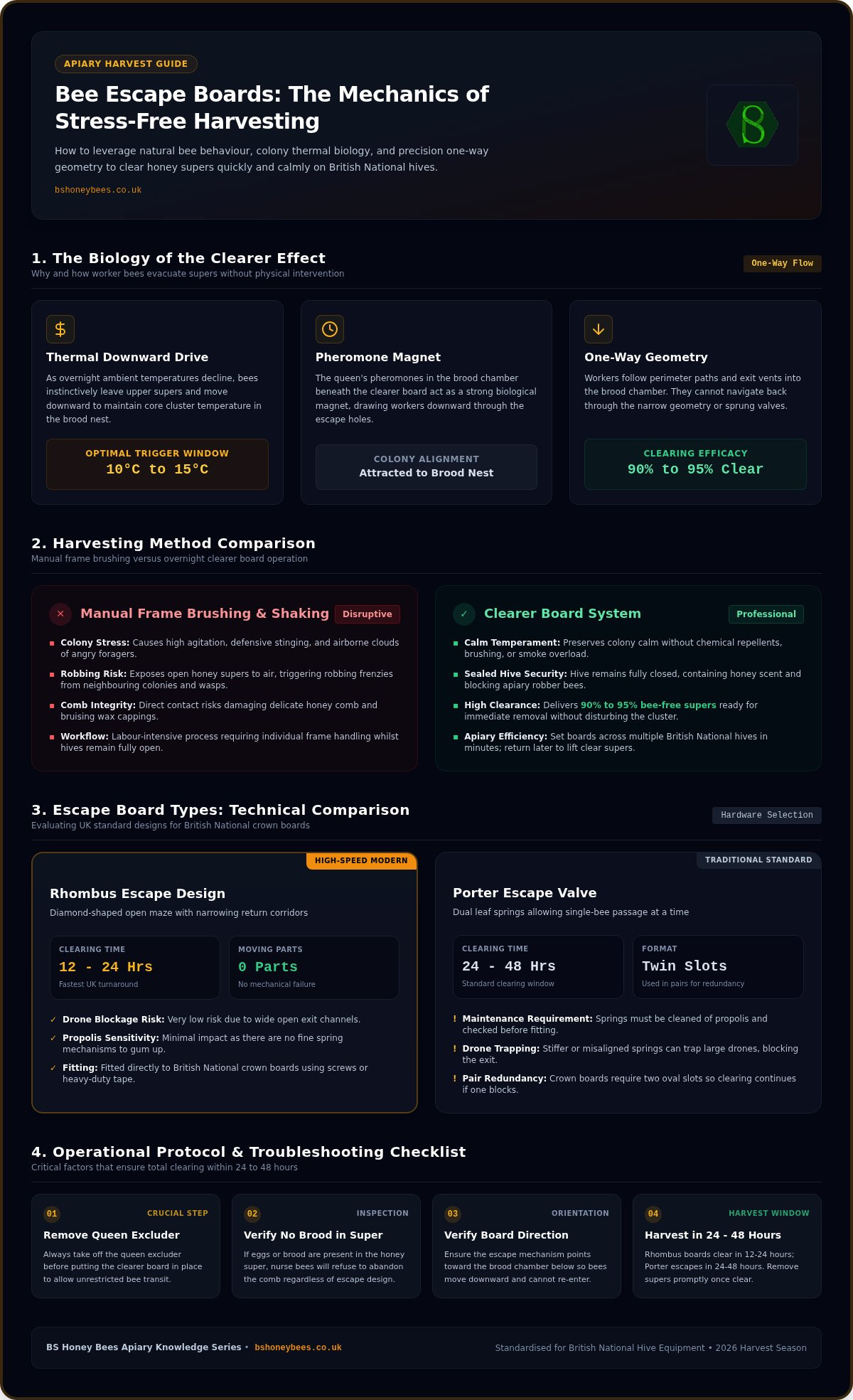
Beekeeping success depends on working with natural instincts rather than against them. During the night, as ambient temperatures drop, honeybees instinctively move downward to the brood nest to maintain the cluster's core temperature. Clearer boards facilitate this movement. This effect is particularly pronounced when overnight temperatures fall between 10°C and 15°C, as the thermal drive to move down is strongest. The queen's pheromones in the brood chamber below act as a biological magnet, drawing workers through the escape. Because bees follow pheromone trails and perimeter paths, they find the exit hole but cannot navigate the complex geometry to get back in. They don't look back once they've passed through the valve; they simply join the cluster below.
Clearer Boards vs. Traditional Brushing
Brushing bees off individual frames is a disruptive process that often results in unnecessary stings and colony agitation. Even with exceptionally gentle breeds, such as our F1 Buckfast queens, physical brushing creates a stressful environment. It also leaves honey-laden supers open to the elements for extended periods, which can trigger intense robbing behaviour from neighbouring colonies or wasps. Understanding the bee escape board how to use method allows you to clear multiple hives simultaneously with minimal effort. By using a board, you keep the hive sealed, maintaining the internal temperature and preventing the scent of open honey from drifting across the apiary. For those managing multiple British National Hives & Frames, the logistical gains are significant. You can set the boards across your entire apiary in minutes and return 24 hours later to find supers that are 90% to 95% clear of bees. While traditional Porter escapes may take up to 48 hours, modern designs often achieve results in half that time, ensuring a cleaner, faster, and far more enjoyable extraction day.
Types of Clearer Boards: Porter Escapes vs. Rhombus Designs
Selecting the correct hardware is the first step in ensuring your harvest runs like clockwork. Most beekeepers in the UK rely on one of two primary designs to facilitate the bee escape board how to use process. While both aim to create a one-way path for your foragers, their mechanical differences significantly impact clearing speed and reliability. Your choice often depends on whether you prefer traditional precision or modern, high-throughput simplicity.
The Porter Escape: Precision and Maintenance
The Porter escape remains the traditional British standard. It utilizes a pair of delicate metal or plastic leaf springs that allow one bee to push through at a time. These springs are precisely set; they're wide enough for a worker to pass but too narrow for her to return. Efficiency depends entirely on maintenance. Before placing them, you must ensure the springs aren't stuck with propolis or blocked by a stray drone. Most crown boards are designed with two oval slots to accommodate these escapes. Using them in pairs provides a necessary redundancy. If one valve becomes blocked, the second allows the clearing process to continue, though it may take the full 48-hour window to see results.
The Rhombus Escape: Speed and Simplicity
The Rhombus design is a favourite for beekeepers who value speed and a "no-nonsense" approach. It features a flat, plastic diamond-shaped maze with no moving parts. Bees enter through a large central hole and follow narrowing channels toward the exit points. Because the exits are open, there's a much lower risk of drone blockages or mechanical failure. In typical UK conditions, a Rhombus board can clear a super in 12 to 24 hours. This is significantly faster than the Porter alternative. These escapes are easily fitted to a standard British National crown board using simple screws or even heavy-duty tape, making them a versatile addition to your kit.
For those managing larger apiaries or specific hive configurations, the Canadian 'Cone' or Quebec board is another alternative. These use mesh screens and wooden battens to direct bees toward the corners of the hive. While effective, they're often bulkier to store than a flat Rhombus board. Regardless of the design you choose, the goal remains the same: a clear super and a calm colony. Using high-quality hardware ensures that the bee escape board how to use sequence is predictable, allowing you to focus on the extraction itself rather than managing an angry cloud of bees.
How to Use a Bee Escape Board: A Step-by-Step Guide
Precision is the hallmark of a successful harvest. When you understand the bee escape board how to use sequence, you reduce the physical labour of extraction and protect your colony's temperament. Follow this logical process to ensure your supers are clear and your bees remain calm.
- Step 1: Inspect your clearer board. Ensure plastic springs in Porter escapes move freely or that Rhombus channels are clear of debris.
- Step 2: Gently lift your honey supers. Remove the queen excluder entirely. Removing the excluder is vital; it provides a clear path for the bees to move down without navigating two sets of restrictions.
- Step 3: Place the clearer board directly onto the top of the brood box. The escape mechanism must always face the brood chamber to allow bees to exit the super.
- Step 4: Replace the honey supers on top of the board. Inspect the stack for any gaps. Ensure the hive is bee-tight using tape or a secure roof to prevent robbing from wasps or neighbouring foragers.
- Step 5: Return to the apiary after 24 to 48 hours to remove your honey supers.
Correct Orientation: Which Way Up?
The escape mechanism must always face the brood chamber to allow bees to exit the super. If you use a Porter escape, the circular hole faces the super whilst the metal or plastic leaf springs face the brood box. For a Rhombus board, the large central intake hole must face up toward the honey. Getting this wrong creates a "honey trap" scenario. Instead of clearing the super, you'll trap thousands of bees inside with no way out, leading to overheating and potential colony loss. Always double check the orientation before you close the hive.
Timing the Harvest for Maximum Efficiency
Efficiency depends on the overnight temperature. If the thermometer stays between 10°C and 15°C, most healthy colonies will clear their supers within 24 hours. Cold snaps or a high population of drones can slow this down, as drones are often too large for traditional Porter valves. We recommend the "48-hour rule" for those using British National Hives. Leaving the board on for more than 48 hours is risky. It can lead to wax moth infestation or encourage the bees to find a way back into the defenseless supers. Plan your visit carefully to ensure the supers are removed at the peak of clearance.
Common Mistakes and Troubleshooting
Even with a clear understanding of the bee escape board how to use process, mechanical or biological hurdles can stall your harvest. If you return after 48 hours to find a super still teeming with bees, you must identify the failure point quickly. This often comes down to either a physical blockage or a breach in hive security. Addressing these issues immediately protects your honey and your colony's temperament.
The Drone Bottleneck
Drones are significantly larger than workers. In a standard Porter escape, their girth often prevents them from pushing through the leaf springs. A single stuck drone acts as a cork. He blocks the exit for thousands of workers behind him, leading to a complete clearing failure. Working with calm-tempered strains, such as our F1 Buckfast queens, makes this troubleshooting much safer, as you won't be battling defensive bees whilst inspecting the board. Before you place your board, take a moment to flick any visible drones off the honey frames. If your colony has a high drone population, using a Rhombus escape is the most efficient solution. Its wider channels accommodate their larger size without jamming. Additionally, bees often treat the delicate springs of a Porter escape as a draft that needs fixing, gluing them shut with propolis. Always test the "springiness" of your valves before use. A stuck valve makes the board useless.
Hive Integrity and Robbing Prevention
Once a clearer board is in place, the bees in the super are isolated from the main colony's defensive workforce. These supers become a high-value target for wasps and robber bees. Any gap in your setup is an invitation for trouble. A poorly fitting roof or a notch in a super can trigger a robbing frenzy. Look for frantic flight activity around the top of the hive or bees trying to squeeze through the roof joints. These are classic signs of robbing. Ensure every joint is "bee-tight" whilst the board is in place. If you find a gap, seal it immediately with painter's tape or a secure hive strap. A professional finish ensures your honey remains safe until you are ready to extract.
For a reliable harvest, ensure your apiary is equipped with professional-grade hardware. Browse our range of British National hive components to guarantee a perfect, bee-tight fit this season.
Essential Equipment for a Successful Harvest
A stress-free harvest begins with logistical excellence. Using the right hardware ensures that the bee escape board how to use process remains efficient and reliable across your entire apiary. Precision-engineered British National Hives & Frames provide the perfect, bee-tight seal required to prevent robbing whilst your honey supers are isolated. When equipment fits together seamlessly, you avoid the gaps that allow wasps or foreign foragers to spoil your crop during the clearing window.
Temperament is equally critical to a professional workflow. Colonies headed by F1 Buckfast Queens are renowned for their calm behaviour on the comb. This docility makes the initial placement of clearer boards much faster, as you aren't managing defensive reactions from the colony. Even with gentle bees, the high-activity period of the harvest demands reliable protection. A high-quality BBWear bee suit is essential gear for any UK beekeeper. It provides the confidence to work quickly and decisively during the final, time-sensitive stages of the season.
Your final harvest checklist should include the following tools:
- A sharp hive tool for prying apart propolised supers without jarring the colony.
- A smoker, used sparingly to move bees away from the clearer board rims during placement.
- Clean, tested clearer boards with functional Porter or Rhombus escapes.
- Painter's tape for emergency gap sealing if you spot robbing activity.
Preparing Your Apiary for 2026
Success in the 2026 season requires foresight. Order your clearer boards and spare Porter escapes well before the summer nectar flow peaks to avoid mid-season shortages. Once the boards are in place, ensure your extraction room and equipment are ready for immediate use. The goal is to move honey from the hive to the bucket as quickly as possible once the supers are cleared. After the harvest, wash your boards in a warm soda solution to remove propolis and wax, ensuring they are hygienic and ready for the following year.
Choosing the Right Bees for Easy Management
The genetics of your colony play a massive role in how smoothly your harvest runs. Professionally mated queen bees determine the overall work ethic and defensive response of the hive. Buckfast genetics are particularly well-suited to the UK climate and the bee escape board how to use method. If you're undecided on the best strain for your apiary, consult our Buckfast vs Carniolan comparison to make an informed choice for the upcoming season. High-quality bees and robust hardware are the two pillars of a professional-grade harvest.
Master Your Harvest Logistics
Transitioning from a chaotic harvest to a professional, streamlined operation is a matter of discipline and the right equipment. Success depends on more than just hardware. It's about understanding the 24 to 48 hour clearing window and ensuring a bee-tight seal. Mastering the bee escape board how to use process ensures your honey supers are cleared with minimal colony disruption, letting you focus on the quality of your extraction.
As a specialist UK bee breeder, we provide the foundations for apiary success. From our calm-tempered F1 Buckfast queens to our precision-fit British National hives, we offer everything you need for a stress-free season. We are also a proud BBWear protective gear stockist and offer nationwide live bee delivery to keep your apiary thriving. Shop our range of British National Hives and Clearer Boards today to prepare for your most efficient harvest yet. Your bees deserve a gentle transition, and your honey crop deserves the best protection.
Frequently Asked Questions
Which way up does a bee escape board go?
The escape mechanism must always face downwards toward the brood chamber to allow bees to exit the super. For Porter escapes, the circular intake hole faces the honey while the leaf springs face the brood box. For Rhombus boards, the single large hole faces up toward the supers. Reversing the board traps bees in the honey area, which can lead to overheating and significant colony stress.
How long can I leave a bee escape board on the hive?
You should leave the board in place for 24 to 48 hours. Most modern designs clear a super within 24 hours under typical UK conditions. It is vital not to exceed the 48 hour limit. Leaving boards on too long increases the risk of wax moth infestation and encourages robbing behaviour from wasps or neighbouring colonies once they discover the defenseless supers.
Why are there still bees in my honey super after 24 hours?
Bees usually remain if there is brood present in the super or if the escape is physically blocked. Nurse bees will never abandon eggs or larvae, regardless of the board's design. Other common causes include a jammed Porter spring or a drone bottleneck. Review your bee escape board how to use steps to ensure the queen excluder was removed and the board orientation is correct.
Do I need to remove the queen excluder when using a clearer board?
Yes, you must remove the queen excluder when you install a clearer board. Keeping the excluder in place creates an unnecessary physical restriction that slows down the clearing process. Removing it provides a direct, unobstructed path for the workers to move from the honey super down into the brood nest. This simple step significantly increases the efficiency of the one-way valve system.
Can drones get through a Porter bee escape?
Drones generally cannot pass through the narrow leaf springs of a standard Porter bee escape. Their larger body size causes them to get stuck, which often results in a drone bottleneck that prevents worker bees from exiting. If your colony has a high drone population, we recommend using a Rhombus escape instead. Its wider channels accommodate their girth without causing mechanical failure or blockages.
What is the difference between a crown board and a clearer board?
A crown board is a standard hive component used year-round to seal the top of the brood nest or supers. A clearer board is a specialized harvesting tool. While many British National crown boards have slots for Porter escapes, a dedicated clearer board often features a more efficient design, such as a Rhombus or Triangle maze, specifically engineered for high-speed bee removal and better airflow.
Is a Rhombus escape better than a Porter escape?
A Rhombus escape is often superior because it has no moving parts and a higher throughput. Porter escapes rely on delicate springs that bees frequently glue shut with propolis or jam with drones. The Rhombus design is easier to clean and typically clears a super in half the time. This makes it the more reliable choice for beekeepers seeking a professional and stress-free harvest.
Can I use a bee escape board in cold weather?
Cold weather actually improves the effectiveness of the clearing process. As overnight temperatures drop, bees naturally contract their cluster and move downward toward the queen in the brood chamber. This thermal drive encourages them to pass through the escape more quickly. Just ensure your hive is well-insulated to prevent the isolated bees in the super from chilling before they have a chance to navigate the exit.