

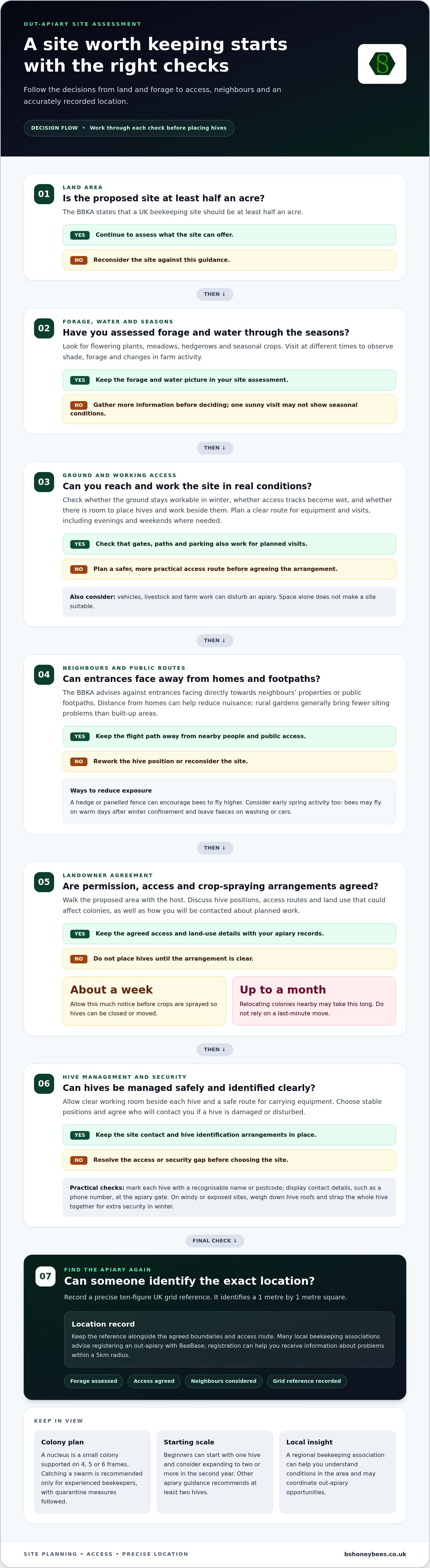
A productive out apiary is no use if its location can’t be found precisely. An out apiary is a place away from a beekeeper’s home or main beekeeping facility where hives are kept. When setting up an out apiary in the UK, plan for landowner agreement, practical access and a precise location reference: a ten-figure UK grid reference identifies a 1 metre by 1 metre square.
Choosing a promising field or sheltered corner is only part of the decision. The site also needs to work for inspections, respect nearby people and be easy to find when you need to visit.
This guide explains how to assess rural and semi-rural sites, what to discuss with the landowner, and how to plan hive placement and access. It also explains why an accurate grid reference matters when sharing the apiary’s location or arranging a visit.
Key Takeaways
- Choose a site that offers useful forage, practical working space and suitable separation from neighbours and public access.
- Discuss permission, entry arrangements and advance notice for crop spraying with the landowner before placing hives.
- Match the hive and colony to your beekeeping plans; British National hives and nucleus colonies are options to consider.
- Record a precise ten-figure grid reference so the apiary’s location can be identified accurately.
- Plan for regular visits, safe access and clear communication to keep the arrangement workable over time.
Considering neighbours and short-notice hive moves
Neighbour-aware siting means directing bee flight away from homes and public routes to reduce nuisance and make any issues easier to manage. If you’re new to keeping bees at an out-apiary, start with one hive and consider expanding to two or more in the second year.
Neighbour considerations and hive moves
Position entrances away from neighbours’ properties and public footpaths. The BBKA advises against entrances facing directly towards either. A hedge or panelled fence can encourage bees to fly higher, while distance from nearby homes can help reduce nuisance.
Consider early spring activity: after winter confinement, bees may fly on warm days and leave faeces on washing or cars. The BBKA says rural gardens generally bring fewer siting problems, while built-up areas call for more care. Where nuisance is a concern, moving some colonies well away from dwellings may help.
Agree with the landowner how you’ll respond before crops are sprayed. Allow about a week’s notice so hives can be closed or moved. Relocating colonies nearby may take up to a month, so don’t rely on a last-minute move. The BBKA recommends locally sourced bees rather than imported bees and queens.
For a new colony, a nucleus is a small colony supported on 4, 5 or 6 frames. Catching a swarm is recommended only for experienced beekeepers, with quarantine measures followed to control disease. Beginners can start with one hive, then progress to two or more in the second year; other apiary guidance recommends at least two hives.
Inspection and maintenance access
Plan enough clear working room beside each hive, with an easy route to reach it. The BBKA says hives need space for the beekeeper to work and should be easily accessible.
Plan visits around the colony’s needs, not just convenient daytime access. BBKA member beekeepers may need to visit in the evenings and at weekends for health and maintenance checks. Make sure gates, paths and parking arrangements work for those visits. Position hives so you can carry equipment safely without blocking the route or disturbing neighbours.
Hive security and site contacts
Hive security combines stable equipment, clear identification and a way to report problems. Mark each hive with a recognisable brand, such as your name or postcode, and display contact details, such as a phone number, on a notice at the apiary gate.
On windy or exposed sites, the BBKA advises weighing down hive roofs and strapping the whole hive together for extra security in winter. Choose a stable position and agree who will contact you if a hive is damaged or disturbed. A suitable hive, such as a British National, should also leave room for inspections and safe handling.
Choosing a rural or semi-rural apiary site
When setting up an out apiary in the UK, assess the ground, surroundings and forage through the seasons. There’s no single set-up or running cost: expenses depend on the landowner’s arrangement, equipment, colony, travel and ongoing care. Weigh these factors alongside the site itself, so a low price or convenient location doesn’t lead to difficult visits.
The BBKA states that a UK beekeeping site should be at least half an acre. Look for flowering plants, meadows, hedgerows and seasonal crops that can provide varied forage. Check whether the ground remains workable in winter, when wet access tracks can make visits harder. A suitable site also needs space for hive placement and routine management.
Think beyond the first inspection. Consider where hives can stand securely, how many colonies the space can support and whether you can reach them with your equipment. Out-apiaries may hold more hives than back-garden or urban sites, but hive density, disease management and predator control still need attention. A site that looks spacious may be unsuitable if vehicles, livestock or farm work regularly disturb the apiary.
Assess the location with the host before agreeing an arrangement. Walk the proposed area together and discuss hive positions, access routes and land use that could affect colonies. Often, out-apiary opportunities are coordinated through the beekeeping association local to the area offered. A regional association can help you understand conditions in its area, and BS Honey Bees Ltd recommends that beginners build practical knowledge through an introductory beekeeping course before obtaining bees.
For registration, distinguish between local association information and BeeBase. Many beekeeping associations advise registering an out-apiary with BeeBase, which can help the beekeeper receive information about problems within a 5km radius. Registration supports awareness of nearby bee-health issues; it doesn’t replace assessing the site or agreeing access with its host.
Visit at different times instead of judging the location on one sunny afternoon. Note where shade falls, whether flowering forage is available nearby and how farm operations change through the year. Ask the landowner about crop spraying and planned work that could affect access. When setting up an out apiary in the UK, look for a practical balance of forage, workable ground and a reliable arrangement with the host.
Once you’ve chosen a suitable location, match the hive and colony to your management plans. Record the agreed boundaries and access route, then keep those details with your apiary records. This makes visits easier to organise and helps an association or beekeeper identify the location when discussing local conditions.
Costs vary with the land arrangement, equipment and colony needs, travel, and ongoing care. There is no fixed amount for setting up and running an out-apiary.
What kind of hive should I buy?
Choose a hive system that suits your colony, available equipment and site conditions. For an out-apiary, assess forage and water as well as the hive: a suitable box cannot make up for limited food or an inconvenient water source.
Hive choice starts with the colony you intend to keep. A nucleus is a small colony supported on 4, 5 or 6 frames. The British Beekeepers Association (BBKA) recommends that beginners start with a small colony of 3-5 frames. A nucleus colony commonly used to start a hive in May has a population of 3-6 frames. These sizes give a practical starting point when matching the hive to the bees.
A full-sized colony usually has 10 or 11 frames, and a standard beehive should include at least two honey supers. Plan for that growth before placing the hive: allow enough working space to open it, lift components and set them down safely. A British National hive is one established option; keeping to a consistent hive type makes frames and other components easier to organise across your apiary.
Assess forage across the season, not just during one visit. Rural sites can offer wildflowers, meadows, hedgerows and seasonal agricultural crops. Check what flowers nearby in spring, summer and later in the year. Fields that seem rich during one flowering period may offer less forage once that crop finishes. Compare field margins, gardens and uncultivated areas around the proposed position.
Farm boundaries can be valuable: farmers have been encouraged to leave uncultivated field boundaries over the last 10 years or so. Check whether flowering plants remain available across the colony’s foraging season, and consider how cultivation may change the surrounding forage. If the site is sparse, planting suitable flowering plants can add variety. Choose plants with different flowering periods, rather than relying on one short burst of bloom.
Water matters too. Identify a reliable source near the apiary before placing hives, such as a pond or shallow container. If you use a container, add stones or floating material so bees can land without falling into deep water. Keep the source accessible through changing weather and position it where bees can use it without causing a nuisance to people or livestock.
Assess forage and water together. A strong supply of flowers may still leave bees travelling further for water, while a nearby pond may not provide enough seasonal forage. Visit the site at different points in the season, note flowering plants and water conditions, then choose a hive position that supports both colony access and safe handling.
Landowner permission, access and ongoing arrangements
Agree the site arrangement directly with the landowner before bringing hives onto the property. Set out how you’ll reach, inspect and manage the apiary.
Landowner permission and ongoing arrangements
Permission is the host’s agreement for you to keep bees at a particular location. It matters because the landowner and beekeeper need a shared understanding of the space and how it will be used.
Walk the proposed boundary together and agree where hives may stand, which gate to use and where equipment can be stored. Discuss how farm work, crop spraying or changes to field access will be communicated. A clear written record helps both parties remember the agreed route, responsibilities and contact arrangements as the site changes.
Access, parking, shelter and security
Assess the full journey from the public road to each hive, not just the entrance gate. Check whether you can park safely, whether the route remains usable after rain, and whether carrying boxes or frames involves awkward steps.
Remote apiaries may require travel along farm tracks or secluded access roads, so plan transport and equipment storage before settling on a location. Look for a sheltered position that still gives you room to work around each hive. Agree how gates should be secured and who can enter, especially if livestock or machinery share the route.
For example, a field entrance may be easy to reach in dry weather but difficult after heavy rain. Walk the route with the landowner and identify a practical parking point, a suitable path and a place to set down equipment during inspections.
Distance and barriers from public access
Separation from public routes and a suitable barrier help manage contact between visitors and flying bees. The site guidance advises placing an apiary at least 8 metres from the nearest footpath or other public-access area, with a barrier between the hives and the public.
Where there’s no height barrier, increase the separation to at least 15 metres from public-access areas. Measure from the hives to the route people use, rather than relying on an estimate from the gate. Consider paths, open picnic areas and access points across the wider site.
In Scotland, discuss a proposed apiary on a national nature reserve with NatureScot before establishing it. For any site, show the landowner how hive positions, access paths and barriers fit together. This conversation can reveal practical conflicts, such as a gate used by walkers or a track needed for farm vehicles, before they disrupt routine visits.
Using an accurate grid reference to locate an apiary
A precise grid reference turns an apiary’s location into information another beekeeper can use. A ten-figure UK grid reference identifies a square measuring 1 metre by 1 metre, making it far more precise than describing a site as “the field behind the garden”.
A UK grid reference usually begins with two letters, followed by up to ten figures. The letters identify the broad grid square, while the figures pinpoint a smaller area within it. In a ten-figure reference, the digits are divided between eastings and northings. Record the complete reference for the hive location, not just the farm entrance or nearest road.
Precision matters when a site has several gates, tracks or fields. A beekeeper arriving for an inspection needs to find the hives, not collect directions from a vague landmark. Walk to the apiary itself, use a map or mapping tool that displays UK grid references, and note where the hives stand. Keep the reference with the site name and access instructions.
Check the point before sharing it. Compare the grid reference with the map and confirm it leads to the apiary, not a nearby garden, field boundary or parking area. If hives occupy separate parts of a large site, record a distinct reference for each group. This helps prevent an accurate location for one colony being mistaken for another.
Location records also support bee-health communication. The National Bee Unit uses BeeBase to identify nearby apiaries at risk when pests or diseases are confirmed, issue alerts, and target inspection and control measures. Its BeeBase information relates to the statutory bee-health programme in England and Wales and incorporates information for Scotland’s inspections programme. An accurate location helps make those records useful.
Use the same reference consistently in your apiary notes, movement records and messages with the landowner. Update it if you move hives to another part of the site. Keep the old and new locations distinct, so a note about disease treatment or colony movement cannot be attached to the wrong position. The purpose is practical: to help you and relevant bee-health teams identify where bees are kept.
Before leaving the site, save the reference in a format you can retrieve without a mobile signal. A written copy in your inspection records provides a simple back-up to your phone. Share the location only with people who need it, such as the landowner or those involved in bee-health work.
Once the location is recorded, match your hive equipment to the planned apiary layout. Explore British National hive options as you organise the equipment for your site.
BS Honey Bees: F1 Buckfast Queens
BS Honey Bees Ltd can help you source bees and nucleus colonies as you prepare to stock a suitable out-apiary. Choose F1 Buckfast Queens or Carniolan Queens when you're planning to establish or requeen a colony. If you're starting with a nucleus, 5 / 6 Frame Nucs provide another option to consider alongside your hive and site plans. Match your choice to your experience, colony management approach and the equipment you've selected.
Plan the apiary location, access and hive layout first, then decide which bees or nucs best suit your next step. Visit BS Honey Bees Ltd online to explore the available options, or contact BS Honey Bees Ltd with your enquiry.
Make your next apiary decision with confidence
A plan for setting up an out apiary in the UK is useful when it guides your next practical decision, not just the initial placement of hives. Think ahead to how your colonies and equipment will fit the site as your beekeeping develops. This gives you a clearer basis for deciding what to source and when to take the next step.
BS Honey Bees offers F1 Buckfast Queens, Carniolan Queens and 5 / 6 Frame Nucs for beekeepers preparing to establish or grow colonies. If those options fit your plans, contact BS Honey Bees to discuss your requirements.
Start with a considered plan, keep site arrangements clear and build your apiary at a pace you can manage. Align each decision with the needs of your bees and location, so you can move forward with purpose and confidence.
Frequently Asked Questions
What is an Out Apiary?
An out apiary is a place away from a beekeeper’s home or main beekeeping facility where hives are kept. It can support honey production, pollination, queen rearing, research, education or quarantine. For example, a beekeeper might keep colonies on farmland to access seasonal crops while maintaining another hive at home. The purpose affects the site, equipment and visit routine, so decide what you want the colonies to achieve before choosing a location.
How much time does it take?
During the active season, UK beehives need weekly inspections, and an inspection can take up to an hour. Allow extra time for travel, preparation and recording findings or dealing with a colony issue. A remote site therefore takes longer to manage than one close to home. Late spring into summer is the busiest period, so plan visits around work and access arrangements before placing bees.
Is my garden suitable?
A garden can be suitable if there’s room to work safely and the hive’s flight path won’t cause a nuisance. The BBKA says rural gardens generally have fewer problems, while built-up locations need more care around neighbours. Consider nearby washing lines, cars and paths: early spring flights after winter confinement can leave faeces on nearby items. A small, crowded garden with entrances facing a neighbour’s property is a poor choice.
What are the problems likely to be?
Common challenges include neighbour nuisance, limited forage, difficult access, weather exposure and colony health issues. Swarming runs from late April to the end of July, so colonies need attentive management during that period. Early spring flights can also leave faeces on nearby washing or cars. At an out-apiary, travel delays can make routine checks harder, so consider how quickly you can reach the site and respond to changing colony conditions.
What equipment will I need?
At minimum, plan for a hive with frames, a secure stand, protective clothing and inspection tools. A smoker and hive tool help with routine handling; a bee suit and veil protect you while you work. Keep a notebook or digital record of inspection findings and colony movements. Your equipment must suit the hive system you choose, so avoid mixing incompatible frames or boxes. Store essential kit somewhere dry and easy to reach.
When can I start to harvest any honey?
Honey is generally harvested when the colony has surplus stores, and the timing depends on local flowering and weather. In the UK, the main crop is usually harvested in summer in the south, and later farther north. Don’t take stores the colony needs to sustain itself. Honey is stable when its water content falls below 20%, so assess ripeness before extraction rather than relying on a calendar date alone.
How to find and secure a suitable out-apiary site in the UK?
Approach a landowner with a clear proposal describing where hives would stand, how you’ll reach them and how often you expect to visit. Walk the site together and assess the track and parking, then agree access, storage and communication arrangements in writing. Ask how you’ll be notified about farm work or crop spraying. Keep a precise location reference with your records, and register the apiary on BeeBase to support bee-health alerts.
What are the UK rules and permissions for keeping beehives on someone else’s land?
There’s no specific UK legislation that directly regulates where bees are sited, but you need the landowner’s agreement before keeping hives on their land. Agree the boundaries, access and responsibilities clearly. The Environmental Protection Act 1990, Section 79f, may be invoked by some local Environmental Health offices as a last resort in disputes about bees. Good siting and communication with neighbours can help prevent problems escalating.