

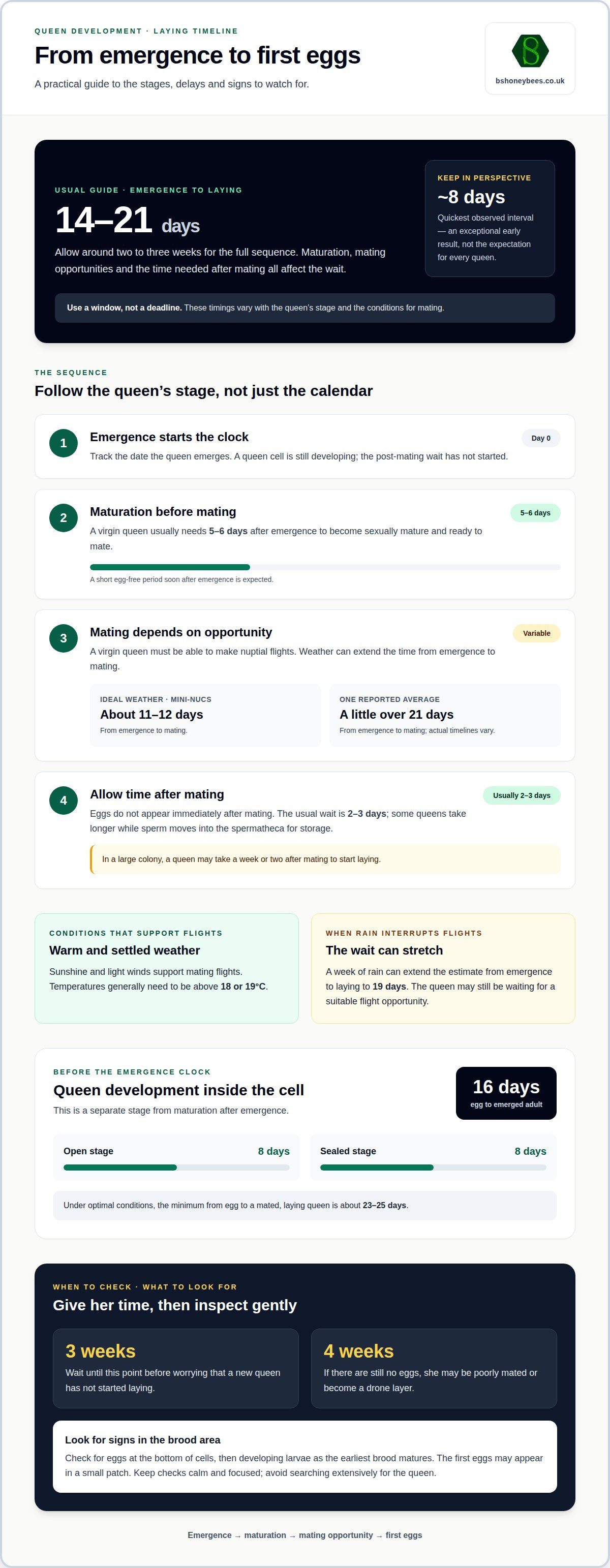
A newly emerged queen usually begins laying within two to three weeks, although the quickest observed interval is about 8 days. If you’re weighing how long it takes a new queen to start laying, remember that mating weather and the time she needs to mature can shift the timetable.
It’s natural to look for eggs soon after a queen’s mating flights, but a few quiet days don’t necessarily signal a problem. After mating, she may start laying within 2-3 days, though some queens take longer. Generally, wait until 3 weeks have passed before worrying; if there are still no eggs by 4 weeks, she may be poorly mated or become a drone layer.
This guide explains the stages from emergence and mating to the first eggs, and how weather can extend the wait. You’ll also learn what to look for on the comb and how to keep inspections brief and gentle while giving the new queen time to settle.
Key Takeaways
- Track the queen’s emergence date and mating opportunities to make a more useful estimate than relying on a fixed calendar.
- Warm, settled weather supports mating flights; prolonged rain can delay the first eggs.
- After mating, allow time for the queen’s body to prepare for laying before interpreting an egg-free inspection as a problem.
- Keep checks calm and focused: look for eggs in the brood area without searching extensively for the queen.
- If you need a replacement queen or a nucleus colony, explore the F1 Buckfast and Carniolan queens and 5 / 6 Frame Nucs available from BS Honey Bees.
When will a newly emerged queen begin to lay?
A newly emerged queen typically starts laying within two to three weeks. The timing depends on how quickly she matures, the opportunity to mate and the time she needs after mating.
Maturation after emergence
Queen maturation is the period after emergence when a virgin queen becomes sexually mature and ready to mate. This usually takes 5 to 6 days, so emergence alone does not mean she can lay immediately.
This timeline explains why an egg-free hive shortly after emergence is normal. The queen must mature before mating, then complete the processes that precede laying. Start your estimate from the emergence date, not simply from when you noticed a queen cell.
Queen development begins well before emergence: development from egg to emerged adult takes 16 days. The egg remains in the open stage for 8 days, followed by 8 days in the sealed stage. These milestones help distinguish the queen’s development inside her cell from the separate maturation period after she emerges.
Estimating the start of laying
To estimate when laying will begin, consider the queen’s emergence date and the time needed for maturation, mating and preparation to lay. This gives you a realistic window rather than treating one expected date as a deadline.
A rough estimate from emergence to laying is 14 to 21 days, with the average between two and three weeks. The quickest observed interval is about 8 days, but it is an exceptional early result, not a suitable expectation for every queen. Under optimal conditions, the minimum from egg to a mated, laying queen is about 23 to 25 days.
If you know when a queen cell became capped, add 7 days to estimate emergence. Then count forward from that estimated emergence date. Weather and access to suitable mating conditions can shift the timeline, so use the result as a window.
The first brood pattern
A queen’s first brood pattern is the arrangement of eggs and young larvae in the brood area. Look for eggs at the bottom of cells, then developing larvae as the earliest brood matures.
Early laying may appear in a smaller patch before the brood area fills out. The pattern gives useful evidence that laying has begun, while the presence of eggs alone does not show how consistently she will continue. Keep the distinction clear: the first eggs confirm activity; later developing brood provides more context.
For the question of how long a new queen takes to start laying, the key is the full sequence: emergence, 5 to 6 days to sexual maturity, mating and then egg laying. Allow two to three weeks after emergence as the usual guide. The 8-day quickest observed interval is not the benchmark for assessing a queen’s progress.
Time from mating to egg laying
After mating, a queen may begin laying within 2-3 days, though some take longer. A queen cell, virgin queen and mated queen are at different stages, so estimate from the queen’s current stage.
Mating and the start of laying
The post-mating interval is the time between successful mating and the queen’s first eggs. It matters because eggs do not appear immediately after mating.
A queen needs at least two days after mating before laying starts. The usual estimate is 2-3 days, as sperm moves from her oviducts into the spermatheca, where it is stored.
This transition explains why there may be a short delay after mating flights. If you know the mating date, wait for this initial interval before looking for eggs, rather than expecting them that day.
The wait can be longer. A queen, particularly in a large colony, may take a week or two after mating to start laying. Colony size is one reason not to treat the shortest interval as a deadline.
Observed mating timelines
Timelines describe the stages from emergence through mating to the first eggs. They help set expectations, but estimates vary depending on which stage you count from.
In ideal weather, mating in mini-nucs can take about 11-12 days from emergence. One reported average from emergence to mating was a little over 21 days, showing how far actual timelines can extend beyond an ideal-weather estimate.
These figures reflect different conditions, not one fixed schedule. The first describes mating in mini-nucs in ideal weather; the second is an observed average. Neither means eggs must appear on a particular day.
To estimate, note whether the date refers to emergence, mating or the first laying. Then account for the further 2-3 days commonly needed after mating. This separates time spent waiting for mating from the queen’s post-mating interval.
Weather delays and queen status
Weather delays mating when conditions prevent a virgin queen from making nuptial flights. Warm, settled weather, sunshine and light winds support flights; temperatures generally need to be above 18 or 19 degrees.
A week of rain can extend the estimated time from emergence to laying to 19 days. In that case, the queen may still be waiting for a suitable flight opportunity, rather than having completed mating and started the post-mating interval.
Start your estimate from the stage you can identify. A queen cell is still developing; a virgin queen has emerged but may not have mated; and a mated queen has completed the flight stage but may still need time before laying.
This distinction keeps the timeline useful. For a virgin queen, weather affects when mating can happen; for a mated queen, allow time after mating. If she is still in a cell, emergence lies ahead and the post-mating interval has not begun.
Checking for eggs without disturbing the queen
After introducing a new queen, do not judge her progress by inspecting the hive immediately. Use the emergence or mating timeline to choose when to check, then look for brood signs rather than searching for the queen.
Wait until 3 weeks have passed before worrying that a new queen has not started laying. If there are no eggs after 4 weeks, the wait is considered too long; assess for poor mating or a drone-laying queen.
Checking for eggs with minimal disturbance
A minimal-disturbance check looks for eggs and young brood without handling or chasing the queen. The aim is to assess laying, not to find and unsettle her.
Open the hive calmly and inspect the brood area first. Lift a frame steadily, keeping it over the hive, and look into the cells without repeatedly turning the comb. Eggs are small, so use good natural light and change your viewing angle before deciding a cell is empty.
Check a few frames with brood or stores, then return each to its original position. If you find fresh eggs, avoid prolonged searching for the queen. One egg in a cell shows that laying has begun; eggs in several cells give a clearer picture across the comb.
Record the date and what you see. Note, for example, whether the frame showed eggs, larvae or neither. This simple record makes the next inspection easier to compare, especially if your first check is near the expected laying window.
Keep the inspection focused. Repeatedly opening the hive to check for eggs adds disturbance but does not change the queen’s development or mating history. If you find eggs, close the hive once you have checked enough of the brood area to confirm laying.
Inspection timing and signs of failure
Time your inspection according to the queen’s stage and how long she has been in the hive. This helps you distinguish a normal delay from a continued absence of laying.
For a newly emerged queen, use 3 weeks as the point before concern, rather than inspecting repeatedly during the waiting period. If she was introduced after mating, note that starting point separately; the emergence-to-mating timeline does not describe her introduction date.
The clearest sign that laying has started is an egg in a brood cell. If checks show no eggs or young larvae, record the dates and compare them with the queen’s timeline. No eggs by 4 weeks is considered an excessive wait and can point to poor mating or a queen becoming a drone layer.
A drone-laying queen produces a different outcome from one laying fertilised worker eggs. Treat an absence of eggs as a reason to assess the situation, not as proof from one brief inspection. Compare successive checks and note whether eggs or larvae appear in the brood area.
Estimating when a new queen will start laying
Estimate from the queen’s stage, not just the date she was introduced. If there are no eggs after two weeks, continue tracking progress; the usual point for concern is after three weeks.
If a new queen has not started laying after two weeks, record the dates and allow more time before deciding she has failed. Weather can delay mating, and some queens take longer than two weeks to begin laying.
Break the timeline into stages: emergence, sexual maturity, mating and the start of laying. This helps distinguish a missed mating opportunity from a delay after mating. It also makes inspections easier to interpret because each date has a clear reference point.
Work from the best known date. If you saw the queen emerge, use that as day zero. If you only know when her cell was capped, emergence can be estimated by adding 7 days. Mark the date, then record any suitable mating weather and subsequent egg checks.
Allow for the mating window as well as the time after mating. A virgin queen’s mating window begins after emergence and can remain open for a period. So, two weeks without eggs does not by itself show that mating has failed: she may still be awaiting a suitable flight opportunity.
Weather provides useful context for the estimate. A week of rain can extend the expected time from emergence to laying to 19 days. Queens generally need temperatures above 18 or 19 degrees for nuptial flights. Warm, settled weather, sunshine and light winds support those flights, which typically occur between 10:00 and 16:00. In the height of summer, flights may continue until about 18:30.
- At two weeks: Record whether the queen is still within her mating window, and note recent flight conditions.
- At three weeks: If no eggs have appeared, this is the general point to start investigating rather than simply waiting.
- At four weeks: An absence of laying is considered too long; poor mating or a drone-laying queen may be involved.
Use these stages as checkpoints, not interchangeable deadlines. For example, assess a queen whose mating opportunities were limited by rain against her emergence date and flight window. If she is known to have mated, base your estimate on the mating stage instead.
Keep a brief record of emergence, weather and inspection findings. Comparing these dates at the three-week and four-week checkpoints gives you a clearer basis for deciding whether the queen is progressing or needs further attention.
What is the typical timeline for a virgin queen to mate and begin laying?
A virgin queen’s timeline runs from emergence through sexual maturity and mating, then to her first eggs. An observed average puts the interval from emergence to mating at a little over 21 days, so a short calendar estimate will not fit every colony.
The mating window starts around 5-6 days after emergence and may continue until 26-33 days after emergence. This means a queen can be sexually mature well before she finds suitable conditions for a mating flight. Count from emergence, and distinguish waiting to mate from the days following mating.
Weather shapes the opportunity. Suitable conditions are warm and settled, with sunshine, light winds and temperatures in the high teens centigrade. Queens generally need temperatures above 18 or 19 degrees for nuptial flights. A stretch of poor weather can therefore extend the wait, even after the queen has matured.
Flights commonly take place between 10:00 and 16:00. In the height of summer, a queen may fly until about 18:30. These times help explain why a suitable afternoon matters, but seeing a queen leave the hive does not establish that mating has occurred.
During mating flights, a queen may mate with a dozen or more drones. After mating, sperm can take up to 40 hours to move from her oviducts into her spermatheca. She then starts laying after a further 2-3 days in the usual estimate. The stages are separate: flight opportunity, mating, sperm storage and egg laying.
Use the sequence to interpret dates rather than expecting one fixed day. For example, a queen emerging before a prolonged spell of rain may mature within 5-6 days, yet remain unmated while flight weather is unsuitable. Once mating occurs, the post-mating interval is counted separately.
Practical records can keep that estimate clear. Note the emergence date, suitable flight days and the first inspection showing eggs. If emergence was estimated from a capped queen cell, add 7 days to its capping date as a guide, then mark that estimate clearly. This prevents the cell date being mistaken for the date the queen emerged.
For a new queen, the question of how long she takes to begin laying depends first on which stage she has reached. A queen still within her mating window has not reached the post-mating stage. Once mating is established, allow the usual further 2-3 days before expecting eggs.
If you’re preparing for a queen replacement, explore queen options alongside your colony’s timing and needs.
BS Honey Bees
BS Honey Bees Ltd can help if your colony needs a replacement queen or a nucleus colony. Its F1 Buckfast Queens and Carniolan Queens are relevant options when you’re planning a queen change, whilst 5 / 6 Frame Nucs can help establish or strengthen an apiary.
Use the laying timeline to assess your current queen before deciding what your colony needs next. If you need a replacement queen or nuc, consider which option suits your hive and beekeeping plans.
For help choosing a suitable option, contact BS Honey Bees Ltd.
Make your next colony decision with confidence
Knowing how long a new queen takes to start laying helps you plan inspections without rushing to replace her. Keep her development stage and your inspection notes together, then use them to guide your next decision for the colony.
If you are still unsure about the colony’s progress, decide what it needs next: more time, a queen replacement or a nuc. Basing that choice on the colony’s development makes future management more deliberate.
For support with your next step, share your queen or colony questions with BS Honey Bees Ltd. A considered plan can help you move forward with confidence and give your bees the attention they need.
Frequently Asked Questions
When will my new queen start to lay?
A newly emerged queen usually starts laying within two to three weeks, though mating opportunities and conditions affect the timing. For example, a queen emerging during unsuitable flight weather may take longer than one emerging in warm, settled conditions. Record the emergence date if you know it, then compare it with the first inspection where you see eggs. This gives you a clearer picture of progress than counting only from the date you first noticed the queen.
How long after mating does a new queen bee start laying eggs?
A queen commonly begins laying 2-3 days after mating, with two days as the minimum interval. Some take a week or two, particularly in a large colony. If you know the mating date, use it as the reference point for your next egg check. The interval allows for sperm to move into the spermatheca, where it is stored. A short delay after mating is therefore part of the normal sequence.
How long after introducing a queen to a colony will she start laying?
Count from her development stage, not just the introduction date. A mated queen has completed the mating-flight stage; a virgin queen still needs to mature and mate. If you know her status and mating date, use them to estimate when eggs may appear. Record the introduction date too, then compare it with the first inspection showing eggs. This avoids confusing her arrival with the start of her laying timeline.
What factors affect how quickly a new queen starts laying eggs?
The main influences are the queen’s maturity, suitable mating weather and the time needed after mating. Flight conditions are generally favourable when weather is warm and settled, with sunshine and light winds. A week of rain can extend the estimated time from emergence to laying to 19 days. Colony size can also affect the post-mating interval: a queen in a large colony may take a week or two to begin laying.
How can you tell if a newly introduced queen is laying successfully?
Look for eggs in brood cells, then young larvae on a later inspection. Check several frames in the brood area rather than relying on one cell or frame. Record the date and what you see at each check, such as eggs, larvae or no visible brood. Comparing observations over time helps distinguish the first sign of laying from continued activity. If you find fresh eggs, avoid prolonged searching for the queen.
What UK weather and seasonal conditions can delay queen mating and egg laying?
Rain, cool temperatures, strong winds and unsettled conditions can limit mating-flight opportunities. Queens generally need temperatures above 18 or 19 degrees, with warm, settled weather, sunshine and light winds supporting flights. Flights commonly occur between 10:00 and 16:00; in the height of summer, they may continue until about 18:30. A week of rain can extend the estimated emergence-to-laying timeline to 19 days, so note local conditions alongside dates.