

A swarm is easier to collect once it has settled, not while it is flying. For catching a swarm of bees in the UK, allow it at least 15-20 minutes to cluster, then shake or gently brush the bees into a hive or suitable container. Keep children and pets indoors, and bystanders well clear.
It’s natural to want to act quickly when you find a mass of bees, but staying calm and preparing first is safer and gives the swarm time to gather. The right approach depends on where the bees have settled and whether you’re collecting them directly into a hive or using a trap.
This guide explains how to choose between those options, use drawn comb or a swarm lure, and recognise signs that the queen has entered. You’ll also learn what to do after collection so the bees can settle into their new home with as little disturbance as possible.
Key Takeaways
- Let a settled swarm cluster for at least 15-20 minutes before attempting collection, then choose a hive or suitable container that matches where the bees are gathered.
- Keep children and pets indoors and give the swarm space; use protective equipment and avoid disturbing the bees unnecessarily.
- Watch for fanning at the entrance as a sign the queen may be inside, and give the remaining bees time to join her.
- Set a bait hive in a sheltered, suitable position and use drawn comb or a swarm lure to make it more attractive as a nest site.
- Once the swarm is settled, choose suitable equipment for its next stage, such as a British National hive or a nucleus colony.
Lowering, shaking, or scooping bees into a hive
- How can you tell a honeybee swarm from wasps or bumblebees? A honeybee swarm usually forms a dense, rugby-ball-shaped cluster of many thousands of bees, often hanging from a tree or fence. Wasps have a narrower waist, while bumblebees are larger and furry. Don’t handle a cluster if you’re unsure what it is.
- Is it legal to catch, keep or move a swarm of bees in the UK? A beekeeper can collect and move a free-hanging honeybee swarm, but must get the landowner’s permission before accessing private property. Never use chemicals or other products on a swarm.
- Who can collect a bee swarm near me in the UK? BBKA volunteer members can help with honeybee swarms, not wasps or bumblebees. Collection is at volunteers’ discretion; some may ask for expenses, and they may not be able to attend immediately.
- When is UK bee swarm season and how long will a swarm stay? Most UK honeybee swarms occur from May to the end of July. A cluster may stay in one place for several days while scout bees search for a nest, so arrange collection promptly.
- What should you do if a swarm is inside a wall, roof or chimney? Don’t block the entrance, apply chemicals or dismantle the structure yourself. Contact an experienced beekeeper for guidance. Removing an established colony from a building can require a different approach from collecting an exposed cluster.
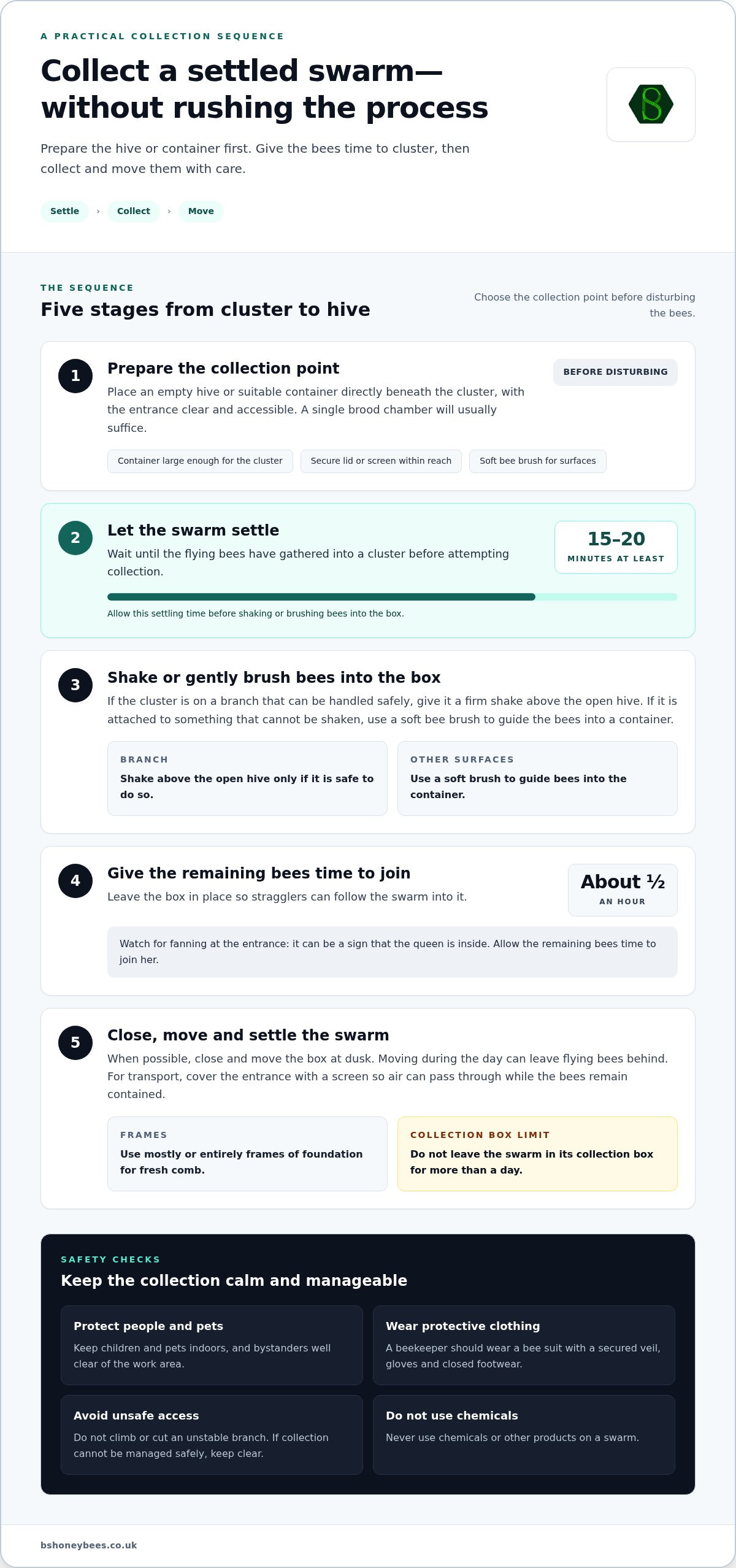
- Choose the collection point before disturbing the bees. Place an empty hive or container directly beneath the cluster, with its entrance accessible. A single brood chamber will usually suffice. If the bees are on a branch, lower it only if you can do so safely. Don’t climb or cut an unstable branch.
- Shake or scoop the cluster into the box. After allowing at least 15-20 minutes for the bees to settle, give a suitable branch a firm shake above the open hive. If the cluster is attached to an object that cannot be shaken, use a soft bee brush to guide bees into a container.
- Give stragglers time to join, then prepare the hive. Leave the box in place for about half an hour so remaining bees can follow. When possible, close and move it at dusk, as moving it during the day can leave flying bees behind. Use mostly or entirely frames of foundation for fresh comb, and don’t leave the swarm in its collection box for more than a day.
Safety and beekeeper protective equipment
- Find a local beekeeper before attempting a collection. In the UK, BBKA volunteer members can help with honeybee swarms only. Collection is at each volunteer’s discretion; some may ask for expenses, and they may not be able to attend immediately. Give a clear location and describe where the cluster has settled.
- Keep people and pets away from the cluster. People in the UK should leave honey bee swarms alone, and children and pets should stay indoors whilst collection takes place. Set a clear boundary around the work area, keep passers-by back, and let the beekeeper approach without a crowd nearby.
- Wear protective clothing before handling bees. A beekeeper should wear a bee suit with a secured veil, gloves and closed footwear. Check that the veil covers the face and neck, and that cuffs and fastenings leave no obvious gaps. Keep spare gloves available so handling can stop if equipment is damaged.
- Prepare the manual capture kit in advance. Set out a suitable container, a soft bee brush for collecting bees from surfaces that can’t be shaken, and a secure lid or screen. Keep the hive or container close to the collection point, with its entrance clear. Preparing these items first avoids searching for equipment beside the swarm.
- Choose a container that can hold the whole cluster. A skep, box or bucket can be used if it is large enough for the bees. Make sure it is stable and easy to close without crushing bees at the rim. For a swarm on a branch, position the container below it before trying to lower or shake the branch.
- Keep chemicals and improvised sprays out of the process. People in the UK should not use chemicals or other products on honey bee swarms. Don’t spray water, household cleaners or insecticides. If the cluster is inaccessible or the capture cannot be managed safely, keep clear and wait for a beekeeper rather than reaching into a roof space or climbing an unstable ladder.
- Secure the box before moving it. When transporting a captured swarm in a vehicle, cover the entrance with a screen so air can pass through while the bees remain contained. Keep the box steady and away from passengers. For future apiary work, choose protective kit that fits securely and lets you handle a brush and container safely.
A swarm can be collected in any container large enough to hold the bees, such as a skep, box or bucket. Choose the container before approaching the cluster, and make sure you can position it without crossing a boundary or reaching over people or pets. If the vessel is awkward to carry, cannot be closed securely, or would require an unstable working position, pause and arrange a safer option rather than improvising at the cluster.
Keep the lid or screen within reach and decide where to set the container once collection is complete. Don’t place it where it could obstruct the collector’s footing or make the entrance difficult to access. If the setup no longer seems manageable, step back, keep your distance and wait for a beekeeper to assess it. Careful preparation helps prevent rushed handling while the bees are being moved.
Setting up bait hives and swarm traps
- Choose a cavity with enough room for a colony. Honey bee swarms seek nesting cavities of about 45 litres. Select a sound, dry box with a secure lid and space for frames. A British National hive can serve as a prepared home, whilst a purpose-built swarm trap can be positioned separately to attract scout bees.
- Set the entrance to a practical size. A suggested swarm-trap entrance measures two to five square inches. Keep it unobstructed, with no loose cover or nearby branch blocking the bees’ flight path. A defined opening gives scouts a clear route inside and makes the trap easier to inspect from outside.
- Position the trap at a suitable height. A suggested swarm-trap height is roughly 15-20 feet above ground. For a bait hive, 1-2 m above ground is a safer alternative to the suggested ideal height of 3 m. Prioritise a stable mounting point and safe access over an awkward position.
- Use shade and orient the entrance south. A shaded cavity with a south-facing entrance is a suggested location for a swarm trap. Choose a spot sheltered from disturbance, where the entrance remains visible and clear. Avoid locations where branches, fences or frequent foot traffic obstruct the bees’ approach.
- Place the bait hive with its purpose in mind. To catch a beekeeper’s own swarms, a bait hive can be placed 200 m or up to 800 m away. Traps can also sit within a few hundred yards of an existing apiary to take advantage of swarms from it. Select a position suited to the colony you hope to attract.
- Make the interior ready before scouts arrive. Fit frames securely so they cannot shift when the box is moved. Keep the cavity dry and make sure the lid closes firmly. A trap ready to receive bees is easier to manage than one that needs adjustments after a colony has moved in.
- Check the installation without disturbing the entrance. Confirm that the box is stable, the opening is clear and the lid is secure. Record each trap’s location so you can revisit it efficiently. If scouts begin investigating, watch from a distance rather than repeatedly opening the cavity.
- Plan how you’ll retrieve an occupied trap. Before setting a box high in a tree, consider how it can be lowered safely and moved securely. A trap at 15-20 feet needs a stable support and a practical retrieval plan. Avoid climbing or handling a heavy occupied box without suitable access and help.
Signs the queen has entered the box
- Watch the entrance for fanning. Bees facing the entrance and fanning their wings spread the colony’s scent. This is a practical sign that the queen is inside and worker bees are guiding others towards her. Observe from a short distance, and avoid opening the box to look for her.
- Look for a change in the cluster. Once the queen is inside the box, bees outside often begin moving towards its entrance. A steady stream of workers entering is more telling than a single bee going inside. Keep the box in place so returning flying bees can join the colony.
- Don’t mistake activity alone for proof. Scout bees may investigate a box, and workers can gather around an entrance before the queen arrives. Look for sustained fanning at the entrance alongside bees moving inwards. Avoid shaking or repeatedly repositioning the box as this behaviour develops.
- Give stragglers time to follow. Leave the collection box in place after fanning begins. Bees remaining on the original branch or a nearby surface can follow the queen’s scent and enter. Moving the box too soon can separate them from the cluster, particularly during the day.
- Wait until dusk before closing and moving the swarm, when possible. This gives foragers time to return to the box. If transporting the swarm in a vehicle, cover the entrance with a screen. Keep the box stable and ventilated, then place it in its intended position before opening the entrance.
- Keep the newly housed colony undisturbed. After moving a captured swarm into its permanent home, preferably wait about a week before inspecting it. This gives the bees time to settle, draw comb and begin establishing the nest. Avoid lifting frames just to locate the queen, as disturbance can disrupt the colony’s early organisation.
- Use comb and egg-laying as later checks. At a suitable inspection, look for fresh comb and eggs as evidence that the colony is building and the queen is laying. A check 24 to 48 hours after hiving is also recommended to assess foundation drawing and egg-laying. Keep the inspection calm and focused, then close the hive promptly.
- Separate queen confirmation from queen identification. Fanning at the entrance helps show that the queen is inside, but it doesn’t reveal her appearance or mark. Finding her during an inspection takes careful frame handling. If you don’t see her, eggs and organised worker activity offer useful signs to assess without repeatedly searching through the hive.
Swarm lures and drawn comb
- Use a lure to make an empty cavity more inviting. A swarm lure provides a familiar scent, while drawn comb gives scout bees an established nest feature to investigate. Place either inside a clean, secure bait hive, not beside the entrance where weather can quickly weaken its scent.
- Prefer a couple of drawn combs where you have them. When hiving a swarm, a couple of drawn combs are preferable to filling a hive entirely with new foundation. Existing cells offer ready-made space, while foundation gives the bees a surface on which to build fresh comb.
- Keep the rest of the frame layout simple. Fit the drawn comb securely, then fill the remaining spaces with frames of foundation. Keep frames upright and evenly spaced so they don’t swing when the box is moved. A stable arrangement helps the cluster settle without crushing or shifting the comb.
- Use drawn comb only when it’s suitable for a bait hive. Old, damaged or contaminated comb can introduce problems rather than improve the cavity. Comb placed in a bait hive should be treated with Certan (B-402) to control wax moths. Follow the product instructions and prepare comb before installing it.
- Position the lure inside the cavity. Place it where scout bees will encounter the scent after entering, rather than coating the entrance or surrounding surfaces. A small, controlled application keeps the entrance clear and draws attention to the cavity. Follow the lure’s directions for placement and renewal.
- Combine lure and comb without overcrowding the box. Leave a clear route through the cavity and avoid packing frames tightly around the entrance. For example, arrange the drawn comb within the frames and keep the remaining frames in place. Scouts need room to inspect the space before a swarm moves in.
- Check the trap from outside first. Watch for scout bees inspecting the entrance and returning repeatedly. Don’t open the bait hive each time a bee arrives, as frequent disturbance can disrupt their inspection. Once a cluster occupies the box, manage it as an occupied hive rather than continuing to adjust the lure.
- Prepare the permanent home before transferring the swarm. A lure helps attract bees, but it doesn’t replace suitable hive equipment. Set up frames before moving the occupied box, and keep drawn comb secure during transfer. Explore British National hives and frames when preparing a permanent home for a collected swarm.
BS Honey Bees: F1 Buckfast Queens
BS Honey Bees Ltd is a natural next step when you’re planning your apiary after catching a swarm of bees UK beekeepers often encounter. If you need a queen for a colony, explore F1 Buckfast Queens and Carniolan Queens. For starting or expanding a colony, 5 / 6 Frame Nucs offer another option. The right choice depends on your beekeeping plans and the equipment you have ready.
Explore the available bee and hive options to plan your next step, whether you’re establishing a colony or preparing for future swarms. Visit BS Honey Bees Ltd online to find out more.
Prepare your apiary for the next season
A newly housed swarm can be the start of a stronger apiary, but its next stage depends on suitable equipment and a clear plan. As you gain confidence in catching a swarm of bees in the UK, consider what your setup will need for future colonies, from a suitable hive to the right queen or nucleus colony.
BS Honey Bees offers F1 Buckfast Queens, Carniolan Queens and 5 / 6 Frame Nucs for beekeepers planning their next steps. Choose equipment and bees that fit your experience, apiary space and colony plans, rather than adding stock before you’re ready to manage it.
Explore the available options and plan ahead for your apiary. Visit BS Honey Bees Ltd to see its beekeeping range. With careful preparation, you can give a settled colony the space and attention it needs to develop.
Frequently Asked Questions
How do you safely catch a swarm of bees in the UK?
Only collect an exposed honeybee swarm if you have suitable protective clothing, a stable container and a safe route to the cluster. Keep children and pets away, and don’t attempt collection from a ladder or near traffic. If access is difficult, or you’re unsure whether the insects are honey bees, leave them undisturbed and seek help from a beekeeper experienced in swarm collection.
What should you do if you find a honeybee swarm in the UK?
Leave the cluster alone, keep people and pets clear, and note its exact position. Tell a beekeeper whether it’s on a fence, branch or building, and whether anyone is at immediate risk. BBKA volunteer members can help with honeybee swarms, but collection is at their discretion and they may not be able to attend straight away. Don’t spray the bees or block their entrance.
What equipment do beekeepers use to catch and rehome a swarm?
Beekeepers wear protective clothing, including a bee suit and veil, along with gloves and closed footwear. A suitably sized, secure skep, box or bucket can hold a cluster. A soft bee brush helps collect bees from surfaces that can’t be shaken. For transport, a screen over the entrance allows airflow while containing the bees. Keep the box steady and secure it in the vehicle.
What are the risks of approaching or disturbing a bee swarm?
Disturbing a cluster can cause bees to take flight or sting, particularly if someone swats at them, blocks their route or tries to remove them without suitable equipment. A ladder, roof space or chimney adds risks beyond the bees themselves. Keep back, bring children and pets indoors, and don’t use chemicals. Anyone with a known serious allergy should avoid the area and seek appropriate medical advice if stung.
How much does it cost to have a bee swarm collected in the UK?
Volunteer beekeepers are not paid to collect swarms, but some may ask for expenses.