

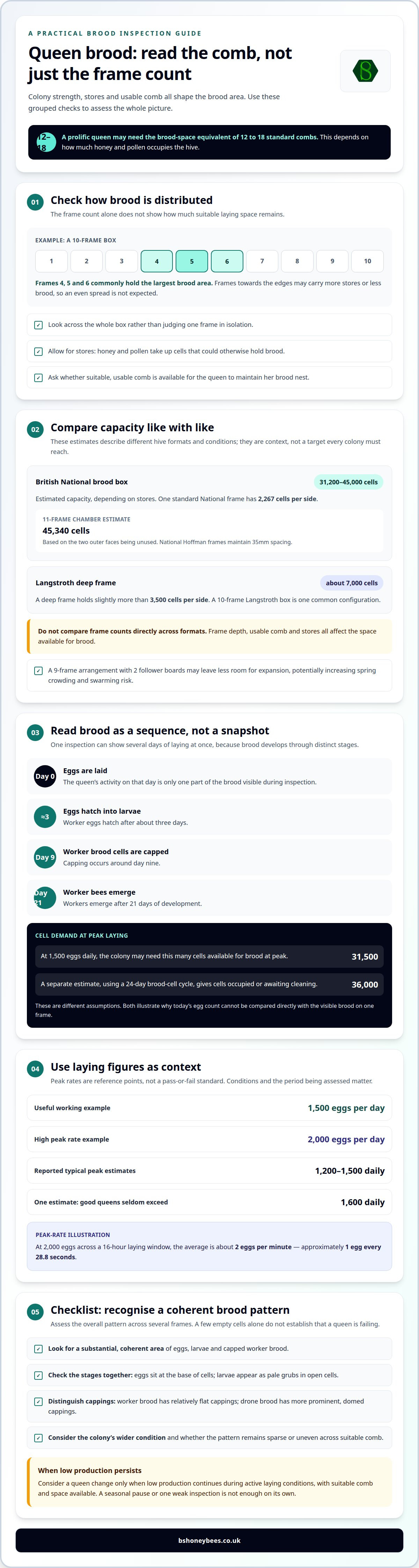
A queen isn’t judged by one fixed frame count. To answer how many frames of brood a queen should lay, think in terms of available comb: a prolific queen may need brood space equivalent to 12 to 18 standard combs, depending on the honey and pollen stored in the hive. The frame count alone doesn’t tell the whole story, because some comb is used for stores rather than brood.
It’s natural to want a clear number when you open the hive, but brood pattern matters as much as how many frames are occupied. This guide explains how brood spreads across frames, how eggs develop into larvae and capped brood, and what a healthy pattern can look like. You’ll also see why brood production changes with the season, so you can assess the queen in context rather than judging her from a single inspection.
Key Takeaways
- Judge brood by its spread across usable comb, not by a fixed frame count; stores and available space shape the pattern.
- Relate capped and developing brood to the queen’s laying pace to understand why one inspection shows only part of the picture.
- Look for a consistent brood pattern across the comb, and consider gaps alongside the colony’s wider condition.
- Read changes in brood area in step with the season, especially as spring growth increases the colony’s need for space.
- See when a 5 / 6 Frame Nuc can provide a practical starting point for establishing or expanding a colony.
Brood distribution across hive frames
There’s no fixed frame count: colony strength, stores and usable comb determine how many frames carry brood. In a 10-frame box, frames 4, 5 and 6 commonly hold the largest brood area.
Hive Space and Brood-Box Capacity
Brood-box capacity is the amount of comb a hive can make available for developing bees. A British National brood box is estimated to offer 31,200 to 45,000 cells, depending on stores. One standard National frame has 2,267 cells per side, and an 11-frame chamber is estimated at 45,340 cells when the two outer faces are unused.
National Hoffman frames maintain 35mm spacing. Langstroth boxes use a different frame format, so the number of frames alone cannot be compared directly with a National box. A 10-frame Langstroth box is one common configuration; deep frames hold slightly more than 3,500 cells per side, or about 7,000 across both sides.
Colony Strength and Available Space
A strong colony can support a larger brood nest when the queen has suitable empty comb to lay in. Stores take up cells that could otherwise hold brood, so a full-looking box may offer less laying space than its frame count suggests.
This matters because a prolific queen may need the equivalent of 12 to 18 standard combs, depending on honey and pollen in the hive. If the brood nest fills the available comb, laying can be constrained even when the box appears to contain several frames.
Read the pattern across the whole box, not from one frame in isolation. In a 10-frame arrangement, the central frames, particularly 4, 5 and 6, tend to carry the largest brood area. Frames towards the edges may contain more stores or less brood, creating a natural distribution rather than an even spread across every comb.
Capacity estimates help with comparison, but they are not a target every colony must reach. The estimated range for a National box changes with the amount of stores, while a Langstroth deep frame has more cell area than a shallower frame. Compare like with like: frame depth, usable comb and the space occupied by stores all affect how much room is available for brood.
Frame arrangement can also change the room available to the brood nest. Nine frames with two follower boards may leave less room for expansion, potentially increasing spring crowding and swarming risk. By contrast, a 10-frame Langstroth box gives bees a full set of frames in which to build straight combs.
Use these figures to interpret the layout, not to expect a particular number of brood frames. If the central combs hold brood and stores occupy space elsewhere, the brood area may still be substantial. The practical question is whether the colony has enough usable comb for the queen to maintain her brood nest.
How brood cell numbers relate to daily egg laying
A queen’s laying rate is reflected in the brood that develops over several weeks, not just in the number of fresh eggs. Consider replacing a queen if low production persists during active laying conditions, with suitable comb and space available. A seasonal pause or a single weak inspection is not enough on its own to show that the queen is failing.
Peak figures provide context, not a pass-or-fail standard. A queen laying 1,500 eggs per day is a useful working example, while 2,000 eggs per day represents a high peak rate. Estimates vary: reported typical peak rates range from 1,200 to 1,500 eggs daily, and good queens seldom exceed 1,600 eggs daily in one estimate. Colony conditions and the period being assessed matter when comparing these figures.
Eggs are only the first stage of the brood you see. Worker eggs hatch into larvae after about three days, and worker brood cells are capped around day nine. Workers emerge after 21 days of development. So a frame inspection records eggs, larvae and capped brood from several days of laying, not just the queen’s activity that day.
Consider the cell requirement across that development period. At 1,500 eggs daily, a colony may need 31,500 cells available for brood at peak. A separate calculation using a 24-day brood-cell cycle estimates 36,000 cells occupied or awaiting cleaning. These figures describe different assumptions; both show why today’s egg count cannot be compared directly with one frame’s visible brood.
A simple rate calculation also shows the intensity of peak laying. At 2,000 eggs across a 16-hour laying window, the average is about two eggs per minute, or one egg every 28.8 seconds. That pace explains why a strong brood nest needs continuous access to suitable cells. Occupied, developing and recently used cells all form part of the picture.
Assess low brood production alongside the pattern and the colony’s conditions. A queen laying fewer eggs may still maintain a coherent brood nest, while sparse or uneven brood across suitable comb can indicate a problem if it persists. Compare inspections over time, checking whether eggs, larvae and capped cells appear in a plausible progression.
For a UK beekeeper, base a replacement decision on persistent low brood production when conditions support laying, rather than one quiet inspection. If low production continues despite space and suitable comb, a queen change is a practical next step. Explore queen replacement options when that decision fits the colony.
Recognising healthy brood patterns
Assess brood pattern across the comb, not by focusing on one empty cell. Look for a substantial, coherent area of eggs, larvae and capped worker brood. A few gaps can occur within that area, so don’t treat every vacant cell as evidence of a failing queen. The overall pattern across several frames, and how the brood stages fit together, is more useful.
Start with the youngest brood. Eggs sit at the base of cells, while larvae look like pale grubs in open cells. Capped worker brood has relatively flat cappings; drone brood has more prominent, domed cappings. These differences help you identify brood types during an inspection, particularly where drone cells appear around the edges of worker brood.
Brood needn’t cover every part of every frame. The queen lays where suitable cells are available, while stores and pollen occupy other areas. Drone cells may account for up to 20% of cells in a brood nest, so their presence alone doesn’t mean the worker-brood pattern is poor. Compare the shape and continuity of the brood area, rather than expecting uniform coverage.
- Eggs: Check that eggs appear at the bottoms of cells, rather than scattered across comb surfaces.
- Larvae: Look for developing larvae in open cells beside capped brood.
- Cappings: Distinguish flatter worker cappings from the more domed appearance of drone brood.
- Gaps: Note whether empty cells are isolated or form larger interruptions in the brood area.
Record what you see on each frame, including brood stages and any obvious gaps. A frame with capped worker brood beside larvae, for example, gives a different picture from one with scattered brood and large empty patches. One inspection captures a moment; comparing notes at later inspections shows whether the pattern is strengthening, staying steady or becoming more broken.
Interpret gaps in context. Cells may be empty because brood has emerged, because the queen has not yet laid there, or because the comb is being used for another purpose. The pattern across neighbouring frames can help distinguish these possibilities. Before attributing sparse brood to the queen, consider whether stores are limiting the available laying area.
Use a consistent, frame-by-frame approach to make your assessment useful. Note where you see eggs, open brood, capped worker brood, drone brood and stores. If larger gaps recur across inspections while suitable comb remains available, the pattern deserves closer attention. Consider these observations alongside colony strength and seasonal conditions instead of deciding from one frame alone.
Seasonal colony growth
The number of brood frames changes as forage, stores and colony demand shift through the UK season. The main factors are available food, suitable empty cells, colony strength and the queen’s laying activity.
In spring, a colony can move from a compact brood nest to broader brood production as conditions improve. Eggs develop into larvae and capped brood, so brood coverage can increase between inspections. Compare the brood nest with the comb and stores available to the colony, rather than expecting the same frame count throughout the year.
Late April and May are an important turning point in the UK season: honey can start piling in, and colonies need additional space. Nectar and pollen affect how much comb remains available for brood. If stores occupy cells in the brood area, the queen has less clear laying space, even when the box contains several frames.
As the colony expands, brood demand and space management become closely linked. A growing brood area can signal active development, but consider where incoming nectar is being stored too. For example, a colony with brood on central frames and stores spreading into adjacent comb may need more room beyond the brood nest.
Later in the season, brood production can contract as forage and colony activity change. The brood pattern may therefore occupy fewer frames than it did during spring growth. Assess that change alongside stores and brood stages: a lower frame count later in the season doesn’t mean the same as a sudden reduction during active spring growth.
- Spring: Compare successive inspections to see whether brood is expanding across available comb.
- Late April and May: Watch how incoming honey and the need for extra space affect the brood nest.
- Later season: Interpret a smaller brood area alongside changing forage and stores.
The 21-day worker development period helps explain why seasonal changes aren’t immediate. Eggs laid as conditions improve develop through larval and capped stages before emerging, so the visible pattern reflects activity over preceding days. A frame with mixed stages can show ongoing laying even when fresh eggs occupy only a small area.
Make seasonal comparisons consistently. Note the date, brood stages, stores and occupied frames, then compare the next inspection with your record. A change between spring and later-season inspections can be expected. A shrinking pattern during late April or May, while the colony is expanding, deserves closer attention to available comb and food.
In practice, judge seasonal growth by the direction of change and the space the colony can use. Late April and May bring increased demand for room as honey accumulates, while forage and stores affect how much comb remains for brood. This context makes frame counts more useful than treating one inspection as a year-round target.
How many frames of brood should a healthy queen lay in a UK bee colony?
There’s no single frame count that defines a healthy queen. A prolific queen may need the equivalent of 12 to 18 standard combs, depending on honey and pollen stores. Treat this as a guide to brood-space demand, not a target every colony must fill.
Frame numbers are an imperfect measure because frames differ in size and usable comb. A nine-frame brood arrangement has been estimated to contain about 55,000 cells, but cell capacity doesn’t mean every cell will hold brood. Stores, empty cells and drone brood all affect how much of the comb supports worker rearing.
Consider the queen’s laying rate across the worker development period. At a peak rate of 1,500 eggs per day, the colony may need 31,500 cells available for brood. That requirement spans developing brood, not just eggs visible during an inspection. A count of frames with some brood therefore won’t show the full rate on its own.
For a practical assessment, record which frames contain eggs, larvae and capped brood, then note the brood area and stores. Compare the pattern at later inspections. A colony with brood across several combs and a steady progression of stages, for example, looks different from one with scattered brood, even if both have brood on multiple frames.
- Frame size: Compare the usable comb area, not just the number of frames.
- Brood stages: Include eggs, larvae and capped brood in your assessment.
- Stores: Account for honey and pollen occupying cells that could otherwise hold brood.
- Trend: Compare inspections made at similar points in the season.
Season matters in the UK. An expanding brood nest in spring has a different context from a smaller nest later in the season. In late April and May, honey can start piling in, increasing the colony’s need for space. Read the frame count alongside the available comb and the colony’s changing needs.
Use the 12 to 18 standard-comb estimate as a reference for a prolific queen, then interpret it against the hive and colony in front of you. A healthy queen doesn’t have to occupy that much comb at every inspection. The meaningful question is whether brood production fits available space, stores and seasonal conditions.
If a queen’s pattern remains persistently weak despite suitable conditions, review your options for replacing a queen as part of your colony plan.
BS Honey Bees: 5 / 6 Frame Nucs
BS Honey Bees Ltd supplies 5 / 6 Frame Nucs for beekeepers establishing a colony or adding one to an apiary. A nuc offers a practical starting point when you’re planning colony growth, while the brood-pattern guidance above helps you assess development as the colony settles into its hive.
For a National setup, British National Hives & Frames provide the matching hive format. If you’re considering a queen change after consistently weak brood production, F1 Buckfast Queens and Carniolan Queens are also available options. Choose the next step according to whether you need a nucleus colony, hive equipment or a queen.
Contact BS Honey Bees Ltd to discuss your beekeeping requirements.
Use your brood observations to plan the next step
Use your next inspection as a fresh comparison point. Note what has changed across the comb, then use that evidence to plan for the colony’s needs. The answer to how many frames of brood a queen should lay is a guide, not a fixed target for every hive. Your judgement is more useful when you consider the brood pattern and the colony’s circumstances together.
If you’re establishing or expanding a colony, BS Honey Bees Ltd offers 5 / 6 Frame Nucs. If a queen change is your next step, F1 Buckfast Queens and Carniolan Queens are available options. Choose the direction that fits your apiary plans, whether you’re building colony numbers or addressing a persistent concern about brood production.
Contact BS Honey Bees Ltd to discuss your beekeeping requirements. A considered next step can help you move forward with confidence.
Frequently Asked Questions
How many frames of brood are typical for a queen in spring, summer and autumn?
There’s no fixed number of brood frames for every UK season. Spring brood may expand as the colony grows, while summer patterns depend on available comb, stores and forage. Late April and May can bring increased demand for space as honey accumulates. In autumn, the brood area may contract as colony activity and forage change. Compare frame counts with the season and the colony’s usable comb.
How many eggs can a queen bee lay per day in the UK?
A useful peak-season estimate is 1,200 to 1,500 eggs per day, although laying rates vary. Rates up to 1,800 eggs may occur briefly and rarely in exceptional queens; 2,000 eggs per day is a high-rate example, not a daily expectation. Assess laying through the developing brood as well as fresh eggs, since one inspection shows only a snapshot of activity.
How can beekeepers estimate brood area across frames?
Estimate brood area by recording how much of each comb face contains brood, then compare the total across frames. For a standard National frame, an estimate is 2,267 cells per side, which can help put partial coverage into context. Note eggs, larvae and capped brood separately, and record stores too. Repeating the same frame-by-frame estimate at later inspections makes changes easier to judge.
What does a normal brood pattern look like on a frame?
A normal pattern generally has eggs, larvae and capped worker brood arranged in a coherent area, rather than isolated cells scattered across the frame. Some gaps can occur, so one empty patch alone doesn’t establish a problem. Worker cappings are relatively flat, while drone cappings are domed. For example, a frame with open brood beside capped worker cells can show different stages developing together.
How can you tell whether a queen is underperforming or failing?
Look for brood that remains sparse or interrupted across inspections, especially when the colony has suitable comb and laying space. Compare fresh eggs, larvae and capped brood rather than relying on one frame or visit. A seasonal lull or stores occupying comb can affect the apparent brood area. If weak production continues under supportive conditions, consider whether replacing the queen is appropriate for the colony.