

A shook swarm is a major colony reset, not a routine frame change. To understand how to do a shook swarm, prepare a clean brood box with 11 new frames of foundation, protect the queen, then shake the adult bees into the new hive and support them with sugar syrup while they draw comb. It’s a method that needs good timing and a strong enough colony to recover.
If you’re considering a shook swarm for European foulbrood (EFB), there’s an essential extra step: a confirmed case must be handled with an authorised Bee Inspector. Don’t treat it as a routine shook swarm or try to manage the disease independently.
This guide explains how to prepare, protect the queen and transfer the bees, then outlines how the process differs when EFB is involved. It also covers timing and aftercare, so you can decide whether a shook swarm suits your colony before disturbing it.
Key Takeaways
- Prepare a clean brood box with 11 new frames of foundation, and have feeding equipment and storage boxes ready before starting.
- Choose a suitable time and a strong colony; poor timing or insufficient colony strength can make recovery harder.
- Keep the queen safe until the bees have been shaken into their new box, then allow the colony to settle onto the foundation.
- Plan to feed the colony while it builds comb, adjusting the timing and approach when the shook swarm is for European foulbrood.
- If EFB is confirmed, carry out the shook swarm with help from an authorised Bee Inspector rather than treating the disease yourself.
Equipment and preparation
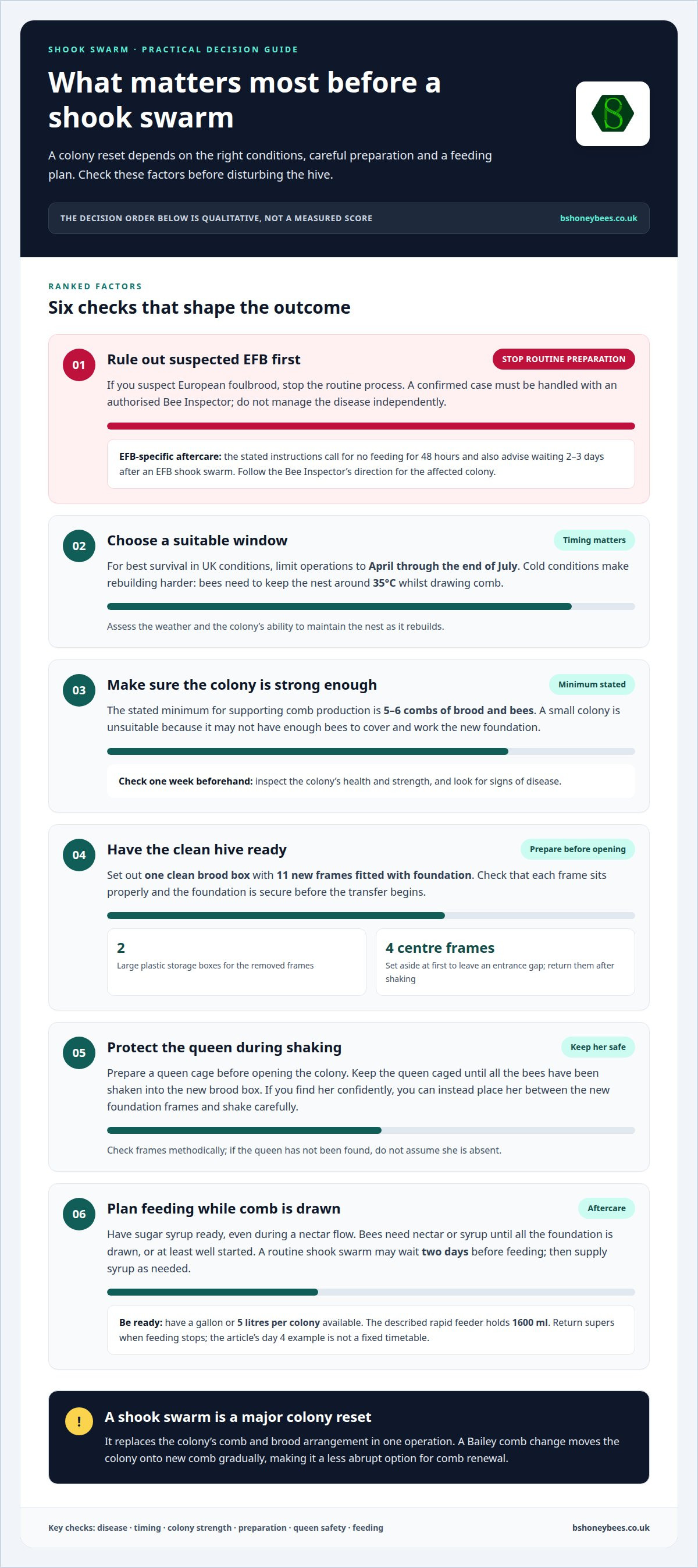
- Inspect the colony one week before the planned shook swarm. Check its health and strength, and look for signs of disease. The colony needs enough bees to cover and work the new foundation, so a shook swarm is unsuitable for a small colony. If you suspect EFB, stop routine preparation and follow the disease-specific process with an authorised Bee Inspector.
- Choose a suitable window before assembling equipment. For best survival in UK conditions, limit operations to April through the end of July. Bees need to keep the nest around 35°C whilst drawing comb, so cold conditions can make rebuilding harder. A colony with 5-6 combs of brood and bees is the stated minimum for supporting comb production.
- Set out one clean brood box and 11 new frames fitted with foundation. Check that each frame sits properly and that the foundation is secure before bringing the box to the apiary. Keep the box ready for the bees, rather than assembling it during the transfer. New foundation gives the shaken colony a clean structure to build on.
- Prepare two large plastic storage boxes for the frames you remove. Set them within reach of the hive, with enough working space around the clean brood box. Keeping old frames separate from clean equipment helps you work in order. Make sure the boxes are stable so frames won’t be knocked or crushed.
- Arrange the feeder before opening the colony. The described rapid feeder holds 1600 ml; clean it and position it so it can be filled without disturbing the bees inside the new hive. Nectar flow does not remove the need to plan feeding after a shook swarm, so have suitable sugar syrup ready for the next stage.
- Place a queen excluder on the floor as a precaution against bees leaving, and check that the hive entrance and floor are aligned. Set your smoker and hive tool beside the prepared equipment, and clear the route between the old hive and clean brood box. Checking everything beforehand helps prevent delays once the colony is open.
How do I carry out a shook swarm?
A shook swarm replaces the colony’s comb and brood arrangement in one operation. A Bailey comb change moves the colony onto new comb gradually, making it a less abrupt option for comb renewal.
After the transfer, monitor brood and new comb development. One example uses oxalic acid by vapourisation to treat Varroa a week after a shook swarm. Treatment timing should take the colony’s condition and brood cycle into account.
- Put the clean brood box in position and remove its centre four frames, setting them aside. The gap gives flying bees room to enter the new chamber. Move the hive being shaken about one metre to one side, then place the clean box in its original position so returning foragers can find it.
- Shake the adult bees into the prepared box, protecting the queen until the transfer is complete. Once the bees are inside, return the four frames to the centre. The colony is now on new foundation rather than its previous brood comb and frame arrangement.
- Prepare sugar syrup for the rapid feeder. One suggested shook-swarm mixture uses roughly 1 kg of white refined sugar to 1 litre of water. A heavier mixture uses 600 mils. of water to 1 kg of white granulated sugar; another suggested ratio is 1 kg of sugar to 620 ml of water. These are different proportions, so follow one chosen recipe rather than combining them.
- Feed the colony even during a nectar flow. Have a gallon or 5 litres per colony ready, then supply syrup through the rapid feeder. Bees need nectar or sugar syrup until all the foundation is drawn, or at least well started. The feeder makes replenishing the supply practical without repeatedly opening the brood box.
- For a routine shook swarm, you may wait two days before feeding, allowing nectar carried by the bees to support comb building. Then provide syrup and continue feeding as needed while they work the foundation. A strong colony can be shaken in early March, but it will need sugar syrup to build comb.
- Return supers when feeding stops, rather than leaving them over the colony during syrup feeding. In one described procedure, feeding stopped on day 4 and the supers were returned then. Treat that as an example, not a fixed timetable: the deciding point is whether the colony still needs syrup to draw its foundation.
- If a Bee Inspector prescribes a shook swarm for European foulbrood, don’t feed immediately after manipulation. The stated instructions call for no feeding for 48 hours, and also advise waiting 2-3 days after an EFB shook swarm. Follow the Bee Inspector’s direction for the affected colony.
Keeping the queen safe during the procedure
Keep the queen caged until you’ve shaken all the bees into the new brood box. If you can find her confidently, you can instead place her between the new foundation frames before completing the shaking carefully.
- Prepare the queen cage before opening the colony and keep it close at hand. The aim is to keep the queen safe during shaking, not to leave her exposed on a frame or beside the hive. Decide whether you’ll cage her or place her between foundation before handling the bees.
- Look for the queen during a calm, methodical inspection of the brood frames. Check each frame before moving it, and keep track of which frames you’ve examined. If you haven’t found her, don’t assume she’s absent. Continue carefully, and use a cage once you locate her rather than shaking unchecked frames.
- Handle the queen gently and keep her close to the prepared brood box. If you’re using a cage, secure her inside until the adult bees have been shaken across. Don’t place the cage among old frames or where it could be knocked during the transfer.
- With the queen protected, shake the bees from each frame into the new box. Work through the frames in order and keep the cage away from the shaking area. Follow a clear sequence: protect the queen, transfer the bees, then attend to the queen once shaking is complete.
- After shaking, place the queen between the foundation frames or release her from the cage into the new brood box. If she was caged, make sure she isn’t left with the old frames. Keep the remaining steps organised so she can join the bees in the new colony.
- If you’re confident you can find the queen, you can place her between the new frames. If you’re unsure where she is, keep her in a cage until shaking is finished. Choose the method you can carry out accurately. Rushing to find her during the transfer makes it easier to lose track of her.
- Consider the queen’s condition before starting. Queen clipping can help with swarm control, but it may be detrimental to a very small proportion of queens. It doesn’t replace protecting and locating her during a shook swarm. Treat queen safety as a separate task throughout the procedure.
Shaking bees onto new foundation
- Before lifting the first brood frame, make sure the clean box is secure and the queen is protected. To do a shook swarm in an orderly way, move the adult bees into the new chamber and keep the old comb out. Hold each frame above the box so falling bees land inside, not on the ground or hive stand.
- Take one frame at a time and give it a firm downward shake over the brood box. Check the comb afterwards, as some bees may remain attached, and shake them into the box before putting the old frame in a separate storage box. This sequence helps prevent old comb from ending up in the new hive.
- Work through the frames without rushing. Keep the old frames in order where practical, and avoid knocking them against the new box. If bees cluster outside the entrance, gently guide them towards it. Don’t shake frames over a queen you’ve already placed between foundation, as this could injure or dislodge her.
- Once the adult bees have been transferred, fit the prepared frames into the brood box. One described example included 2 drawn frames of fumigated foundation, but that is an example rather than a universal requirement. Keep the remaining foundation secure and evenly positioned, giving the bees a workable space to build new comb.
- Consider the season before starting routine comb renewal. Avoid the last two weeks in April and the first week in May, when developing bees are expected to forage on the main honey flow. A shook swarm interrupts the brood cycle, so its timing affects how many bees will be available to forage later.
- Once the bees are inside and the frames are in place, close the hive and give the colony time to settle rather than repeatedly opening it. The bees need to establish themselves on fresh foundation. Keep the entrance clear and follow the feeding plan you prepared.
- Keep removed comb and frames apart from the new hive throughout the operation. This helps maintain the separation between the old comb and the clean chamber. Watch the entrance after closing: returning flying bees should be able to locate the new hive at the original position. Continue supporting the colony until its foundation is drawn or well started.
Shook swarms as a treatment for European foulbrood
European foulbrood (EFB) is a notifiable disease under the Bee Diseases Control Order 1982. If you suspect EFB, report it to a local Regional or Seasonal Bee Inspector or the National Bee Unit at York; a shook swarm for confirmed EFB must be carried out with help from an authorised Bee Inspector.
- Stop routine comb-renewal work if you suspect EFB. Don’t attempt to treat the disease yourself: treating it yourself is illegal. Report the suspicion promptly to the relevant Bee Inspector or the National Bee Unit at York, and follow their instructions for the affected colony.
- A shook swarm for confirmed EFB must be carried out with an authorised Bee Inspector’s help. This is not a routine comb change with a different purpose. The inspector’s involvement is central to following the disease-control procedure and managing the affected colony appropriately.
- Assess whether the colony can support comb building. The stated minimum is 5-6 combs of brood and bees, with a young queen that is laying satisfactorily. A shook swarm places rebuilding demands on the bees, so colony strength and queen performance matter when considering the method.
- Choose the timing with local conditions in mind. The recommended period is mid-March to mid-July, depending on locality. Only consider the operation when outside temperatures are expected to stay around and above 15°C for at least the following fortnight. These conditions give the bees a suitable period to rebuild on fresh foundation.
- Follow the inspector’s instructions for feeding after manipulation. EFB-specific advice says not to feed for 48 hours after a prescribed shook swarm; it also advises withholding feed for 2-3 days and seeking Bee Inspector guidance. Don’t apply the routine feeding schedule from a standard shook swarm to an EFB case.
- Keep contaminated equipment separate and follow disease-control directions for old comb and frames. If EFB is confirmed, the old comb and frames must be destroyed. Don’t reuse them in the new brood box; follow the authorised inspector’s instructions for the procedure and any related handling.
- After about a week, check the colony only as directed. When brood is present, remove the queen excluder and sterilise it appropriately. For future colony planning after the disease response, review queen options once the affected colony is being managed under the inspector’s direction.
BS Honey Bees Ltd
BS Honey Bees Ltd can help with practical next steps for your apiary after a shook swarm. If you’re planning future colony management, its range includes F1 Buckfast and Carniolan Queens, plus 5 / 6 Frame Nucs. These may be relevant when you’re considering queen or colony options, but they don’t replace the Bee Inspector’s direction in a confirmed European foulbrood case.
For setting up or maintaining your own hive equipment, BS Honey Bees Ltd also offers British National Hives and Frames. Choose equipment that suits your hive system and the needs of your colonies. Contact BS Honey Bees Ltd to discuss the available options for your beekeeping plans.
Plan your next apiary decision
Knowing how to do a shook swarm is only one part of managing a colony. Afterwards, note how the bees take to the fresh comb, whether the queen resumes laying and how the colony develops. These observations help you plan future apiary work rather than treating each manipulation as an isolated task.
For confirmed EFB, keep disease control separate from routine colony planning and follow the authorised Bee Inspector’s instructions. For other apiary decisions, consider what your colonies need next, whether that means reviewing equipment or planning future stock.
Speak with BS Honey Bees about your beekeeping plans and available options. Take the next step with a clear view of your colony’s needs and keep building your confidence as a beekeeper.
Frequently Asked Questions
When can I do it?
Carry out a shook swarm when the colony is strong and conditions support comb building. In the UK, the recommended timing depends on the purpose: routine management and EFB control have different considerations. Don’t choose a date by the calendar alone. Assess brood and bee coverage, expected temperatures and whether there’s enough time for the bees to establish fresh comb.
What is a shook swarm in beekeeping, and when should it be used?
A shook swarm transfers adult bees, including the queen, from old comb into a clean hive with fresh foundation. It replaces the colony’s comb more abruptly than gradual comb renewal. Beekeepers may use it for planned comb renewal, or an authorised Bee Inspector may direct it when managing confirmed EFB. It isn’t suitable for every colony, particularly one too small to rebuild.
What equipment and materials are needed for a shook swarm?
Prepare a clean brood box, new frames with foundation, a queen cage, hive tool, smoker, feeder and sugar syrup. Keep two large plastic storage boxes nearby for the removed frames. A rapid feeder is useful for supplying syrup afterwards. Arrange everything before opening the hive so you can focus on transferring the bees safely and keeping old comb separate.
When is the best time of year to perform a shook swarm in the UK?
For best survival in UK conditions, the advised period runs from April through to the end of July. For routine management, avoid the last two weeks in April and the first week in May, when developing bees would otherwise forage on the main honey flow. EFB operations have a separate recommended window, from mid-March to mid-July depending on locality, and require an authorised Bee Inspector’s help.
How do you prepare the new hive and foundation for a shook swarm?
Assemble the clean brood box with 11 new frames fitted with foundation, then position it where the original hive stood. Remove the centre four frames temporarily to make room for returning flying bees, and keep them ready to replace after shaking. Set the feeder and syrup nearby, not where they obstruct the transfer. Check the floor and entrance are secure before opening the old hive.
What are the step-by-step instructions for carrying out a shook swarm?
First, protect the queen in a cage, or place her between the new foundation frames if you can find her confidently. Move the old hive about one metre to the side and put the prepared box in its place. Shake the adult bees from the old frames into the new box, keeping the old comb separate. Replace the frames you set aside, close the hive and follow your feeding plan.
How do you feed a colony after a shook swarm, and for how long?
Feed sugar syrup through a rapid feeder, even if nectar is available, and continue until the foundation is drawn or well started. One suggested mix is roughly 1 kg of white refined sugar to 1 litre of water. For routine management, feeding may be delayed for two days. If the shook swarm is for EFB, follow the Bee Inspector’s separate instructions before feeding.
What are the risks and disadvantages of a shook swarm, and when should it be avoided?
A shook swarm removes the colony’s existing brood and comb arrangement, leaving the bees to rebuild on foundation. If you do it at the wrong time, with a weak colony or in unsuitable conditions, recovery can take a long time. Don’t use this method on a small colony that can’t support comb building. For confirmed EFB, never manage the colony independently; involve an authorised Bee Inspector.