

What if the best way to clear a honey super isn’t the fastest method, but the one that suits your colony and the conditions at the apiary? Clearing bees from supers without chemicals can be straightforward, but the right approach depends on how soon you need to remove the super, what’s in the frames and how settled the bees are.
A clean harvest without unnecessary disturbance starts with choosing the right method. Bee escapes, careful shaking or brushing and controlled airflow each have a place. Smoke may help manage bee behaviour during hive work, but it is not a chemical repellent and won’t clear a super on its own. Rush the job or choose a method that doesn’t suit the colony, and you could agitate the bees, leave them in the super or expose honey to robbing.
This guide explains how to choose a practical method, prepare safely and keep handling controlled. You’ll also learn what to do once the bees have cleared the super, so you can remove and store it promptly. With changeable UK weather affecting conditions at the hive, a calm, well-prepared approach matters.
Key Takeaways
- Compare bee escapes, brushing and low-pressure airflow to find a method suited to your colony, timing and equipment.
- Plan clearing bees from supers without chemicals around the conditions at your apiary.
- Check for brood, the queen and frame condition before deciding how to clear a super.
- Use a careful removal workflow to limit disturbance and move cleared supers into secure storage.
- Reduce the risk of robbing by covering supers promptly and keeping honey-soiled equipment out of reach.
Why clear honey supers without chemical repellents?
Clearing bees from supers without chemicals means removing bees from the honey boxes without applying a chemical repellent to the supers or comb. The aim is practical: retrieve the crop without applying repellents to honey, keep handling controlled and avoid needless disturbance to the colony. It also leaves you ready for the next stage, whether you use a honey extractor or another suitable method of removing honey from the comb.
In chemical-free super clearing, bees are moved by separation, careful handling or airflow rather than by applying a repellent to the honey super. Smoke is a separate beekeeping tool. Used sparingly, it may help manage bee behaviour during hive work, but it doesn’t clear a super on its own. The bees still need to leave through another method or be removed by hand.
What counts as chemical-free super clearing?
Mechanical separation means placing a bee escape between the brood box and super, allowing bees to move down whilst limiting their route back up. Manual removal means shaking bees from frames or brushing them away. Suitable low-pressure airflow can also dislodge bees, but it requires care to avoid injuring them. Each method works differently, so choose according to the colony, equipment and time available.
Don’t assume a product is suitable for contact with honey just because it’s described as “natural”. Avoid applying substances to comb or supers unless their use is specifically appropriate for that purpose. Keep the method focused on moving bees, not treating the harvest.
When is it sensible to remove the supers?
Assess the crop rather than relying on a fixed date. Frames with much of their honey capped are a useful sign that it may be ready, but inspect the super and the colony as a whole. Consider whether the bees still need the stores, whether fresh forage is available and whether the weather is suitable for working the hive. Your harvest plans and ability to process and store supers promptly matter too.
Inspect every frame before choosing how to clear it. If you find brood, don’t treat that super as a straightforward honey box: brood needs different consideration, and the queen’s location matters too. A strong, settled colony may allow a different approach from a smaller colony or unsettled conditions. Prepare your equipment and protective clothing before opening the hive, then work calmly and decisively.
Three chemical-free ways to clear bees from honey supers
There’s no single best method for every hive. Colony behaviour, the super’s contents, your equipment and the time available all affect the choice. As the British Beekeepers Association explains, a one-way clearer can help bees leave a super before harvest. Don’t assume every colony will clear at the same rate. Check progress and be ready to adjust your approach.
Bee escape boards: gradual clearing with minimal handling
A bee escape board sits between the super and the hive below. Its one-way openings let bees move down whilst limiting their return to the super. Before fitting one, check that it suits your hive layout, sits securely and leaves no gaps around the edges. Plan how you’ll access and remove the super once it’s clear.
This option involves little frame-by-frame handling, but it requires advance planning and monitoring. The time needed varies with the board, the colony and conditions, so follow the guidance for the equipment you’re using rather than relying on a fixed interval. If bees remain, check the fit and layout before deciding whether to use a hands-on method.
Shaking, brushing and airflow: hands-on alternatives
For direct clearing, take out frames individually and shake the bees over the open hive so they fall back towards the colony. Work steadily and support each frame. A soft bee brush can remove stragglers, but use gentle strokes only when needed. Brushing repeatedly or forcefully can injure bees and make the work more disruptive.
Suitable low-pressure airflow can dislodge bees from frames, but it calls for appropriate equipment and care. Use a controlled, gentle setting and avoid directing forceful air at the bees. Stop if they become excessively disturbed, then reassess your approach. Manual methods give you control over each frame, though they require more active handling than a well-fitted escape board.
In short: an escape board involves less handling but needs time; shaking and brushing take effort but give you direct control; airflow can move bees directly but demands careful, restrained use. For clearing bees from supers without chemicals, match the method to the colony and conditions, not simply to the quickest-looking option. Wear suitable protective clothing and prepare your working area before opening the hive. If you’re organising your apiary kit, explore bee suits and beekeeping equipment.
Which chemical-free method suits your colony and conditions?
Choose the method that fits the colony in front of you, not just the equipment you have to hand. Weather, temperament and the presence of brood can all affect what’s practical. Use this comparison as a starting point, then inspect the hive and monitor how the bees respond.
| Method | Speed | Handling and equipment | Most suitable when |
|---|---|---|---|
| Bee escape board | Gradual; allow time and check progress | Low frame handling; correctly fitted board | You can prepare the hive in advance and return to check it |
| Shaking and brushing | Direct, frame by frame | More hands-on; hive tool and soft bee brush if needed | Frames are accessible and conditions allow calm, controlled work |
| Low-pressure airflow | Can be direct, depending on the set-up | Requires suitable airflow equipment and careful control | You can keep the airflow gentle and stop if bees become unsettled |
When to choose a bee escape board
Choose gradual separation if you can fit the board ahead of harvest and return to check it. It can reduce frame-by-frame handling, but only if it suits the hive arrangement and sits correctly. Gaps, blocked passages or a poor fit may prevent bees moving as intended. Don’t assume the super is clear just because the board has been in place; inspect it before removal.
When to choose manual clearing
Shaking and brushing suit accessible frames when you can work steadily and return bees towards the hive. You can inspect each frame as you go, which is useful when assessing its contents. Avoid rough shaking or rushing, and don’t leave cleared frames exposed while working through the rest of the super. Keep the work area organised so you can protect frames promptly.
Airflow may be an option when you have appropriate equipment and can control it carefully. If the colony becomes excessively disturbed, stop and reassess rather than increasing the force.
Brood in a super calls for extra care, whatever method you’re considering. Check the frames and queen situation before deciding; don’t treat a brood-containing super as an ordinary honey box. For hands-on work, wear a suitable bee suit and veil. The bee suit sizing guide can help you choose a protective fit.
For clearing bees from supers without chemicals, the best method balances time, handling and the colony’s response. In unsettled weather or if the bees are defensive, pause if conditions aren’t safe for controlled work. A gradual method needs planning; manual clearing needs your attention at every frame.
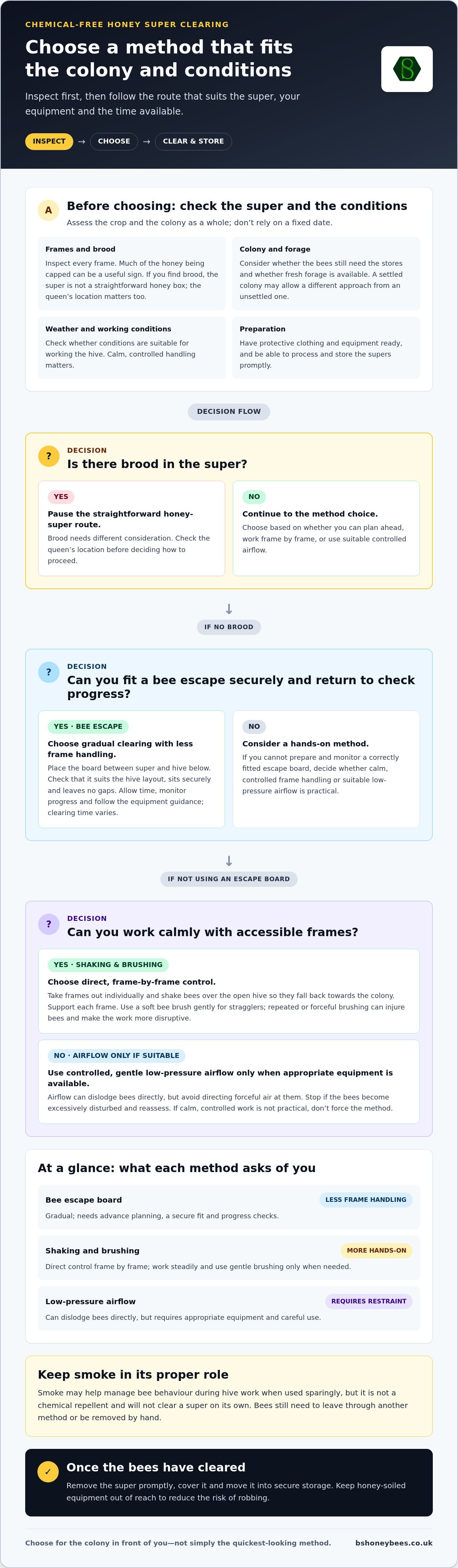
How to clear bees from supers without chemicals: a careful workflow
A little preparation keeps the hive open for less time and helps protect both the colony and the crop. Before starting, choose conditions in which you can work steadily and safely, and prepare a clean, covered place for the supers. This methodical approach makes clearing bees from supers without chemicals easier to manage, from the first inspection through to storage.
Prepare the hive and choose the clearing method
- Prepare your kit. Put on a suitable bee suit and veil, and set out the hive tool, chosen clearing equipment and a clean cover or transport arrangement. Have secure storage ready before you open the hive.
- Assess the conditions. Consider the weather, the colony’s behaviour and whether you can work calmly without leaving the hive exposed. If conditions are unsuitable or the bees are unusually unsettled, postpone the task.
- Inspect the colony and super. Check frames for brood and look for the queen before treating the super as ready for removal. Brood or a queen in the super changes the decision: pause and consider the situation carefully rather than simply clearing and taking the box away.
- Match the method to the hive. Confirm that an escape board suits the hive arrangement and has clear passages, or prepare for controlled frame-by-frame clearing. For British National equipment, the British National beehive guide provides relevant context on the hive and its frames.
Remove and secure the cleared supers
- Check before lifting. Look through the super and confirm that enough bees have cleared for you to remove it. Don’t rely on elapsed time alone, particularly if an escape board hasn’t been working as intended.
- Transfer frames carefully. Keep frames upright and handle them gently. Avoid crushing bees, and cover exposed honey during transfer rather than leaving frames open while you prepare the next step.
- Secure the crop promptly. Move the super to clean, covered storage that prevents access by bees and other pests. Don’t leave supers or honey-soiled equipment exposed around the apiary, where they may attract unwanted attention.
Keep the workflow deliberate: inspect, clear, check, then cover and store. For hive work and harvest preparation, explore beekeeping equipment.
Avoid common problems and finish the honey harvest responsibly
Once a super is off the hive, keep the honey out of reach of bees. Exposed comb, spills and honey-soiled equipment can attract foragers and encourage robbing around the apiary. Cover supers promptly, and don’t leave frames or sticky tools unattended outdoors. A tidy transfer protects the crop and avoids creating unnecessary disturbance around nearby colonies.
What to do if bees remain in the supers
Pause before trying to clear the remaining bees. Check whether an escape board is seated correctly and its passages are clear, then look again for brood or other reasons bees may be staying in the super. Consider the colony’s behaviour and the conditions before continuing. Don’t resort to rough shaking or a repellent simply because the first attempt hasn’t worked.
If the frames are accessible and you can work calmly, use a controlled manual approach to remove remaining bees. If the colony is unsettled or you’re not confident handling the frames, stop and reassess rather than forcing the job. A measured process is central to clearing bees from supers without chemicals responsibly.
Protect the colony and the honey after removal
After taking the super away, return the hive to a secure, orderly condition and avoid unnecessary inspections or handling. Keep removed supers covered during transport and storage. Clean honey-contact equipment using suitable practices, and protect it from dirt, pests and contamination. For specific food-handling or bee-health questions, follow current UK guidance rather than relying on assumptions or informal tips.
Before you finish, check that:
- The super is clear enough to remove safely, with no brood or queen issue overlooked.
- Honey and frames are covered promptly and secured away from bees.
- Honey-soiled equipment and spills aren’t left accessible around the apiary.
- The hive is stable and the colony has been left as undisturbed as practicable.
Suitable protective clothing is an important part of preparing for hive work. BS Honey Bees Ltd supplies BBWear bee suits alongside beekeeping equipment to beekeepers across the UK, helping you prepare for a controlled harvest.
Make your next honey harvest calm and controlled
The right clearing method depends on your colony, the frames and the conditions on the day. A bee escape gives you a gradual option when you can plan ahead; shaking, brushing or gentle airflow offer more direct control when you can work carefully. Before starting, check for brood and the queen, prepare your equipment, and confirm the super is clear before removing it.
Good clearing is only part of a clean harvest. Cover supers promptly, keep honey-soiled equipment away from foragers and return the hive to a secure, orderly state. With a considered approach, clearing bees from supers without chemicals can protect the colony whilst helping you handle the crop efficiently.
Protective clothing is an essential part of sensible hive preparation. BS Honey Bees Ltd supplies BBWear bee suits and beekeeping equipment to customers across the UK. Explore protective beekeeping clothing and prepare for your next apiary task.
Frequently Asked Questions
Can you clear bees from supers without using chemicals?
Yes. Bee escape boards, careful frame shaking and gentle brushing can all clear supers without chemical repellents. The best choice depends on your hive arrangement, colony behaviour and working conditions. Prepare a covered place for the supers before opening the hive, work calmly and check the frames before removing the box. No method or timing suits every colony, so monitor progress rather than assuming the super is clear.
How long does a bee escape board take to clear a super?
There’s no fixed clearing time: it depends on the board, hive arrangement, colony and conditions. An escape board is a gradual method, not an instant guarantee. Follow the instructions for your equipment and allow for the circumstances at the hive. Before lifting the super, inspect it to see whether bees remain. If it hasn’t cleared, check the board’s fit and passages, then consider a careful alternative.
Is smoke a chemical-free way to clear bees from supers?
Smoke is different from a chemical repellent, but it won’t clear a super by itself. It may be used sparingly during normal hive work, following sound beekeeping practice, but bees still need to leave the super through an escape board or be removed manually. Don’t use smoke as a substitute for checking the super before taking it away. Choose a method that suits the colony and handle frames carefully.
Can I use a bee blower to clear bees from honey supers?
Airflow can move bees, but a bee blower isn’t suitable for every colony or beekeeper. Use appropriate equipment and keep the airflow controlled; stop if the bees become excessively unsettled. Compared with a bee escape board, airflow is a more hands-on option. Shaking or gentle brushing gives you direct control over individual frames. Whichever approach you choose, assess the colony’s behaviour and confirm the super is sufficiently clear before removal.
What should I do if brood is present in a honey super?
Don’t treat a super containing brood as a straightforward honey-only box to remove. Brood presence changes the decision and calls for care for the developing bees and queen. Inspect the colony and consider why brood is in the super before proceeding. The right response depends on the hive and its condition, so consult reliable beekeeping guidance for the situation rather than applying one removal instruction to every colony.
How do I stop bees robbing supers after I remove them?
Move removed supers promptly to a covered, secure place rather than leaving honey or frames exposed in the apiary. Keep honey-soiled equipment contained too, so it doesn’t provide an accessible food source for other bees. Organise transport and storage before opening the hive so you can cover the crop without delay. For detailed advice on managing robbing, follow current UK beekeeping guidance and consider the conditions around your apiary.
Should I brush every bee off each frame before taking a super away?
No. Brushing every frame isn’t always necessary, and rough or rushed brushing can disturb or injure bees. A bee escape board may suit you if you can plan ahead, whilst careful shaking or selective brushing can work when frames are accessible and conditions are controlled. Choose according to the colony and your equipment. Check the super before moving it, and keep cleared frames covered rather than leaving them exposed.