

The key difference between an emergency queen cell and a supersedure cell is the colony’s condition. Emergency cells suggest sudden queen loss or failure; supersedure cells suggest the colony is replacing a poor-performing queen while otherwise remaining established. Swarm cells indicate a different process: they’re often found along frame edges in a strong, crowded colony preparing to divide.
Queen cells can be easy to misidentify during an inspection. Their position offers useful clues, but brood pattern, colony strength and whether a queen is present all help explain what is happening.
This guide explains how emergency, supersedure and swarm cells differ, and what each may reveal about the hive. Learn to assess the signs together, understand why workers rear replacement queens, and observe carefully before deciding what the colony needs.
Key Takeaways
- Read cell position alongside colony strength and brood condition; location alone can mislead.
- Scattered cells raised from worker brood point to emergency queen rearing after sudden queen loss or failure.
- Supersedure usually means the colony is replacing a poor queen without preparing to swarm.
- Several cells along frame edges in a strong, crowded colony may signal swarm preparations.
- Limit disturbance while replacement queens develop, and avoid removing cells without a clear plan.
A Swarm, Supersedure, or Emergency Queen Cell?
A supersedure queen cell is built when a colony replaces an ageing or failing queen whilst remaining otherwise stable. Emergency and supersedure cells aren’t swarm cells, so their presence alone doesn’t show that a swarm is imminent; assess the colony’s condition as well.
Queen-cell formation and placement
Workers enlarge wax cells around selected eggs or young larvae to rear queens. The resulting hanging cells can help explain the colony’s circumstances. Emergency cells are often remodelled from worker brood cells wherever suitable young brood remains. Supersedure cells are commonly found near the centre of the comb, while swarm cells often hang from frame edges.
Emergency and supersedure cell identification
Cell position is more useful when considered alongside the brood pattern and colony strength. Emergency cells may be scattered across the comb face because workers use suitable larvae wherever they find them. They can be smaller and less regular than supersedure cells, which are generally larger, well formed and few in number, often near the centre of the brood nest.
Look for eggs and very young larvae as part of your assessment. Their presence helps indicate whether the colony is queenright, but doesn’t identify the cell type by itself. A poor brood pattern and a weakening colony may support supersedure, while cells raised across available brood may point to emergency queen rearing.
Emergency, supersedure and swarm cell differences
Swarm cells reflect a colony preparing to reproduce, rather than replace a failing queen. They’re commonly found along the lower edges and sides of frames, often in groups of 5-20. Swarming is often associated with a strong, crowded colony preparing to reproduce. Swarm cells appear in spring or very early summer 90% of the time.
Emergency cells usually indicate that the colony has lost its queen or that she is no longer functioning adequately. Colonies commonly raise one to three emergency cells, while supersedure cells are often limited to one or two. Neither type alone signals swarming. Distinguish queen replacement from signs of crowding and swarm preparation.
Responses to emergency and supersedure cells
After finding either type, avoid repeated, disruptive inspections. Handling can damage developing queen cells or interrupt replacement, so leave the hive undisturbed for at least four weeks. Keep genuine emergency cells unless you have a clear alternative plan for restoring the queen. An alternative may be appropriate if a good-quality mated queen is ready or the colony is too weak to requeen successfully.
During the inspection, note cell position, brood condition and colony strength. These details help distinguish queen replacement from swarm preparation without disturbing the developing queen.
Reasons colonies rear multiple queens
Queen rearing serves different purposes: replacing a lost queen, renewing a failing one, or reproducing through swarming. Multiple cells can reflect urgency, colony condition or competing routes to a new queen. Read them as part of the colony’s response, not as a simple count of future queens.
Sudden queen loss creates an immediate problem. If a queen is killed or injured, workers must rear a replacement from eggs or young larvae already in the brood nest. They can adapt worker brood cells for queen rearing, allowing the colony to begin replacing its queen without waiting for new eggs. The brood available also determines where workers can start cells.
Workers may start several cells in response to the same queenless condition across the comb. At first, the colony cannot know which developing queen will emerge successfully. Raising more than one offers alternatives if a cell is damaged or a developing queen fails. Not every cell will produce an emerged queen, and workers may tear down cells as development continues.
Replacement can also happen without sudden queen loss. A colony may rear supersedure cells when its existing queen is ageing or performing poorly. Here, queen rearing supports continuity rather than reproduction: the colony replaces its queen while remaining established. One or a small number of cells can suit this gradual process, especially while the existing queen is still present.
Swarming has a different purpose. It is colony reproduction, not simply a response to a damaged or inadequate queen. The old queen leaves with some of the workers, while those remaining need a new queen. Several swarm cells can leave more than one virgin queen in play. If a later virgin queen leaves with a group of workers, the colony can produce a cast swarm.
This distinction matters when assessing multiple cells. In a swarm-control split, a beekeeper may leave one swarm cell with the younger bees to develop into a queen. Leaving more than one can risk another virgin queen leaving with part of the colony. By contrast, removing emergency cells without a replacement plan may leave a queenless colony without its intended route to recovery.
Consider the cause before intervening: sudden queen loss points to emergency rearing; a poor queen in a stable colony points towards supersedure; swarm cells indicate reproductive preparation. If a planned replacement is appropriate, explore queen replacement options alongside the colony’s brood and strength.
Differences between emergency and supersedure queen rearing
Emergency queen cells begin after sudden queen loss or failure, whilst supersedure cells develop as a colony replaces a poor queen. In a study, almost all emergency cell construction began within 24 hours of queen removal; supersedure can occur at any time of year.
Emergency queen-cell timing and development
Emergency rearing begins with brood already present when the queen disappears or becomes ineffective. Workers select suitable eggs or young larvae in worker cells, then reshape those cells into queen cells. This rapid response matters because the colony has no reliable laying queen to provide new eggs for replacement.
Workers can choose larvae around two or three days old. They feed developing queens royal jelly, and the selected larva develops in the enlarged cell rather than following the worker-bee pathway. In an emergency queen-rearing study, almost all construction began within 24 hours of queen removal, showing how quickly workers respond.
A quick start to rearing doesn’t mean a new queen is immediately ready to restore normal brood production. After emerging, a virgin queen must mature, take mating flights and begin laying. Weather can delay those flights, so a gap in eggs after emergence doesn’t by itself mean emergency rearing has failed.
Supersedure queen-cell timing and development
Supersedure can happen while the existing queen remains in the colony. Workers rear a new queen because the current one is ageing or performing poorly, rather than responding to her sudden loss. This distinction matters: finding the queen still present alongside developing cells can fit supersedure.
Unlike emergency cell construction, supersedure isn’t tied to a sudden loss or a particular season. Supersedure cells may be raised at any time of year, while the existing queen remains in the colony during development. Her presence, the brood pattern and the colony’s condition help explain why workers have started a replacement.
Both processes rely on workers selecting brood and feeding queen larvae, but they begin under different conditions. Emergency rearing uses brood available after an abrupt queen problem; supersedure begins while the colony replaces a failing queen. In either case, a virgin queen must mate before laying fertilised eggs and rebuilding the brood pattern.
During an inspection, note whether the queen is present, whether eggs remain, and whether new brood appears after a virgin queen’s mating flight. These observations help distinguish a delayed start to laying from continuing queen failure. Active brood rearing in spring can make changes easier to spot, but timing alone cannot identify the cell type.
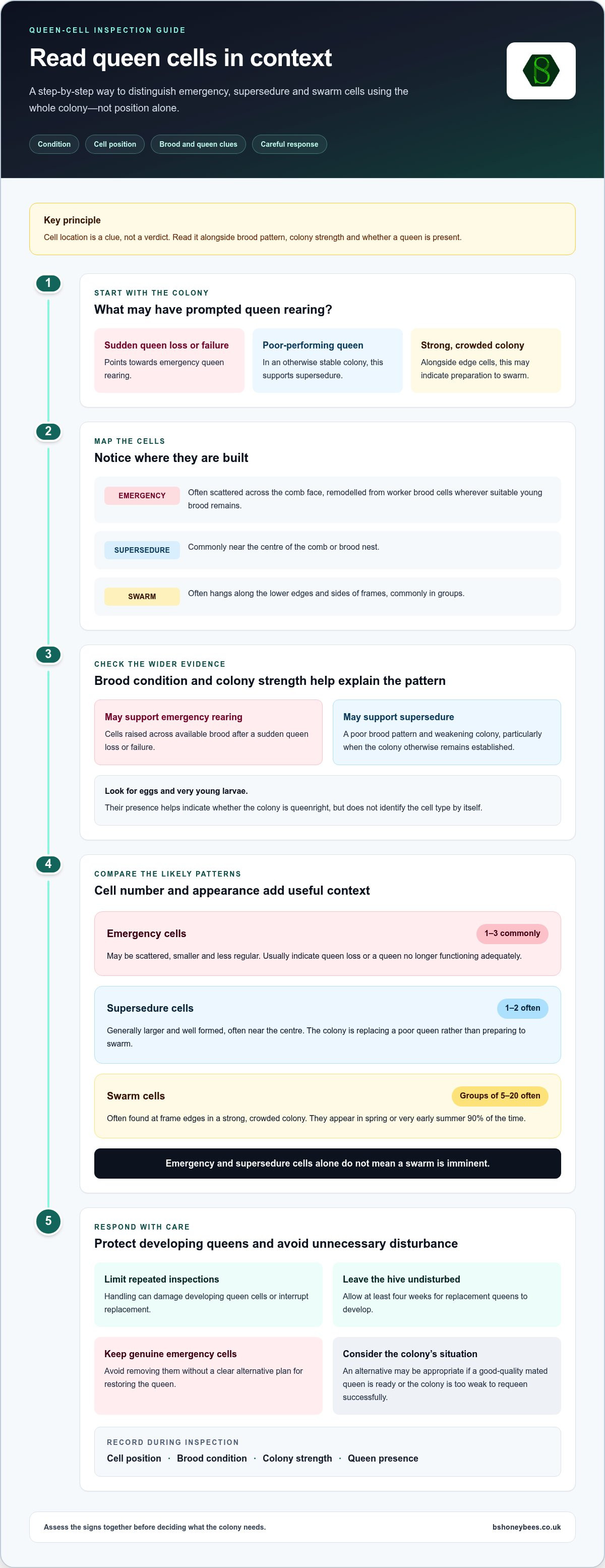
Hive condition and queen-cell type
Assess queen cells alongside colony strength, brood pattern and queen status. A cell alone is not a complete diagnosis: compare what you see across the frames, then consider whether the colony seems crowded, stable or dwindling. The difference between an emergency queen cell and a supersedure cell becomes clearer when you weigh these signs together. Scattered cells in a weakening colony, for example, suggest something different from cells in a thriving hive preparing to reproduce.
A supersedure pattern often appears in a colony that is losing strength but isn’t crowded with bees. The brood pattern may be poor, and cells may sit near the centre of the brood nest. A single, well-formed cell can fit this picture. The existing queen may still be present as workers prepare a replacement rather than respond to her sudden absence.
Emergency queen cells point to a different condition: the colony has lost its queen or she is no longer functioning adequately. Look for cells raised from worker brood across the comb, wherever suitable eggs or larvae were available. Their placement may seem less organised than that of supersedure cells. The key question is whether a queen was present when workers began raising replacements.
Eggs and very young larvae provide useful evidence. Their presence can help assess whether the colony is queenright, but doesn’t settle the diagnosis alone. Check whether eggs form a consistent brood pattern and compare it with the colony’s strength. A weak hive with patchy brood and a queen present may suggest supersedure; no apparent queen alongside cells on available brood supports emergency rearing. Diagnose an emergency queen cell versus a supersedure cell by weighing these clues together.
Season provides context, not certainty. In summer, a strong colony with crowded frames and cells along the lower edges may be preparing to swarm. That differs from a dwindling colony with central cells and poor brood. Don’t let the calendar decide the cause; consider the bees’ condition and whether the queen is present.
Queen-cell development also affects what you can observe. After a virgin queen emerges, she must mature, mate and start laying before normal brood rearing resumes. A temporary lack of eggs during that period doesn’t prove the colony remains queenless. Weather can delay mating flights, so assess a brood gap alongside the cell’s condition and recent queen activity.
During an inspection, record these three observations together:
- Colony strength: note whether bees cover the frames well or the hive appears to be dwindling.
- Brood: look for eggs, young larvae and the shape of the brood pattern.
- Queen status: record whether the queen is present, or whether a virgin may have emerged.
Keeping these observations together helps distinguish queen replacement from swarm preparation, especially when cell position is ambiguous.
What is an emergency queen cell in honey bees?
An emergency queen cell is a cell workers build after the colony loses its queen or she stops functioning adequately. Workers select eggs or young larvae already present in worker brood, then reshape their cells. This allows a queenless colony to begin raising a replacement without waiting for new eggs.
The process starts with existing brood, not a special queen-cell egg. Workers enlarge a regular worker cell around suitable brood and feed the developing larva as a queen. A cell may therefore appear on the comb face rather than along the lower frame edge, where swarm cells are commonly found. Position helps, but the colony’s queen status gives it context.
Emergency rearing can begin quickly. In a study of emergency queen rearing, almost all cell construction began within 24 hours of queen removal. The colonies started between 6 and 56 cells, averaging 27. That spread shows why a beekeeper may encounter several developing cells, even though workers later reduce their number.
Workers don’t necessarily keep every cell they start. In the study, workers tore down some started cells, while others produced queens that emerged. These results describe the study, not a forecast for an individual hive. They do show that a visible cell count isn’t the same as the number of queens that will emerge.
Emergency queen cells can be smaller and less regular than supersedure cells. They may be scattered wherever suitable brood was available, rather than forming a neat line. For example, a colony with no queen apparent and cells built from worker brood across the comb face may be rearing an emergency queen. Assess this pattern alongside the eggs, larvae and brood condition.
After a queen emerges, the colony still needs a mated, laying queen. The virgin must mature, take mating flights and begin laying before normal brood production resumes. Weather can delay flights, leaving a temporary gap without fresh eggs. Don’t treat that gap alone as proof that replacement has failed; consider the queen’s stage and the colony’s wider signs.
Keep genuine emergency cells intact unless there’s a clear alternative recovery plan. Repeated, heavy inspections can damage cells or disrupt the colony’s development. If a planned queen replacement is the appropriate route for your apiary, explore queen-replacement options alongside the colony’s condition.
BS Honey Bees Ltd: F1 Buckfast Queens
BS Honey Bees Ltd is a practical next step when your inspection points to queen replacement or a need to establish a colony. Its F1 Buckfast Queens and Carniolan Queens are options to consider when planning a replacement queen. If you’re looking to establish a colony rather than replace a queen in an existing hive, 5 / 6 Frame Nucs offer a different route.
Match the choice to what your hive needs: replacing a queen and starting with a nuc are separate decisions. Keep the colony’s condition and your inspection findings in view as you plan. Visit BS Honey Bees Ltd to explore queen and nuc options.
Make your next hive decision with confidence
Use your inspection record to guide your next steps. A clear note of the colony’s condition, brood and queen status gives you a useful reference for the next inspection, rather than relying on memory or one cell’s appearance. The distinction between an emergency queen cell and a supersedure cell is most valuable when it informs a considered plan for the colony, not just a label for what you saw.
Before changing the hive, decide what you’re aiming for: supporting the colony’s own queen-rearing process or planning a replacement. Basing that decision on the evidence in the hive helps avoid unnecessary disruption and makes your next action deliberate.
For a queen-replacement plan or a nucleus colony, contact BS Honey Bees Ltd to discuss the options. A thoughtful next step starts with what your bees are showing you.
Frequently Asked Questions
Does this have relevance to beekeeping?
Yes. Recognising queen cells helps you understand what may be happening inside a colony. The distinction can affect whether you leave developing cells in place, plan a replacement or investigate possible swarming. A queen still laying alongside developing cells, for example, suggests a different situation from a colony with no queen and no fresh eggs. Bring your observations together before deciding on an intervention.
What causes emergency queen cells?
Emergency queen cells are caused by sudden queen loss or by a queen the colony believes can no longer function adequately. Workers respond by selecting suitable brood already in the hive and rearing a replacement. For example, a colony whose queen is accidentally injured during an inspection may begin emergency rearing. The cells indicate a response to a queen problem, while the colony’s wider condition helps explain the circumstances.
What if I am not sure whether the cells are emergency or supersedure?
If the cell type is unclear, don’t remove cells based on appearance alone. Note which frames hold cells, whether eggs and young larvae are present, and whether you can find the queen. Compare these observations with the colony’s strength and brood pattern. Written notes or inspection photographs can make later changes easier to assess. Repeated, disruptive inspections can damage developing cells or disturb the colony.
Why are so many cells started, and queens reared?
Workers may start several cells because they cannot know which developing queen will survive and emerge successfully. The number started doesn’t show how many queens will eventually emerge; workers can tear down cells later. In an emergency, several attempts provide alternative routes to replacement. In a swarm situation, multiple queen cells relate to colony reproduction, so their purpose depends on what prompted the rearing.
How can you tell emergency and supersedure queen cells apart?
Use several clues together rather than relying on one cell. Emergency cells are often built from worker brood across the comb, while supersedure cells are commonly well formed and near the centre of the brood nest. Then assess the queen and brood: a poor brood pattern with a queen still present may support supersedure, while apparent queen loss points towards emergency rearing. Shape and position are clues, not a diagnosis on their own.
Where are emergency queen cells usually built on the comb?
Emergency queen cells can appear wherever workers find suitable eggs or young larvae, so they’re often scattered across the comb face. Workers adapt existing worker brood cells rather than building only at the frame edge. During an inspection, look across the faces of brood frames, including the central areas. One cell’s location cannot establish why it was raised, so consider queen presence and brood condition too.
Where are supersedure queen cells usually built in a hive?
Supersedure cells are often built near the centre of the comb, within the brood nest. This differs from the lower frame edges commonly associated with swarm cells, but location alone isn’t decisive. Consider the cell’s form and the colony’s condition too. A small number of well-developed central cells alongside signs of a failing queen gives a more useful picture than position alone.
Why do honey bee colonies produce emergency or supersedure queen cells?
Colonies raise these cells to replace a queen who has been lost or is performing poorly. Emergency rearing responds to an urgent queen problem; supersedure replaces a queen while the colony remains established. In either case, workers use available brood to rear a new queen. After emerging, she must mature, mate and begin laying before the colony can return to normal brood production.