

Carniolan queen characteristics appeal to beekeepers who value calm handling, efficient wintering and a strong spring build-up. That rapid growth can also raise swarming pressure if colonies become crowded. Italian queens may suit beekeepers prioritising fast population growth through the main season. The best fit depends on local forage, winter conditions and how closely you can monitor colonies during swarm season.
It’s easy to focus on temperament or honey production alone, but both are only part of the picture. Brood patterns respond to forage, and colony growth affects the space and attention the bees need. Carniolan colonies can reduce brood rearing when nectar and pollen are scarce, then build quickly when spring conditions improve.
This article compares Carniolan and Italian bees, explains what to expect from Carniolan temperament and seasonal development, and covers how swarming and varroa-related behaviours affect management. Use these practical differences to decide whether a Carniolan queen suits your apiary and the conditions your bees will face.
Key Takeaways
- Consider the Carniolan’s Central and Eastern European origins when weighing its seasonal traits against conditions in your British apiary.
- See hygienic and grooming behaviour as helpful traits, not a substitute for varroa monitoring and management.
- Plan for spring growth: timely inspections and enough space help reduce the risk of overcrowding and swarming.
- Calm handling can make colonies easier to work with, but good beekeeping practice still matters.
- Compare queens by the traits that fit your forage, winter conditions and approach to colony management.
Carniolan versus Italian: Which Queen is Right for You?
Carniolan queens may suit British apiaries where cool weather and compact wintering matter; Italian queens can build colony numbers quickly during the main season. To introduce a Carniolan queen, first ensure the colony is queenless. Keep her in a queen cage so the colony can accept her gradually before release.
Carniolan Origins and History
Carniolan bees originate in Slovenia, Austria and parts of Central and Eastern Europe. This background helps explain why beekeepers associate them with cooler conditions and seasonal changes. For UK beekeepers, origin is useful context, not a guarantee that every colony will perform alike. Local forage, spring weather and winter length all affect how a queen’s brood pattern fits the apiary.
Regional Adaptation and Hardiness
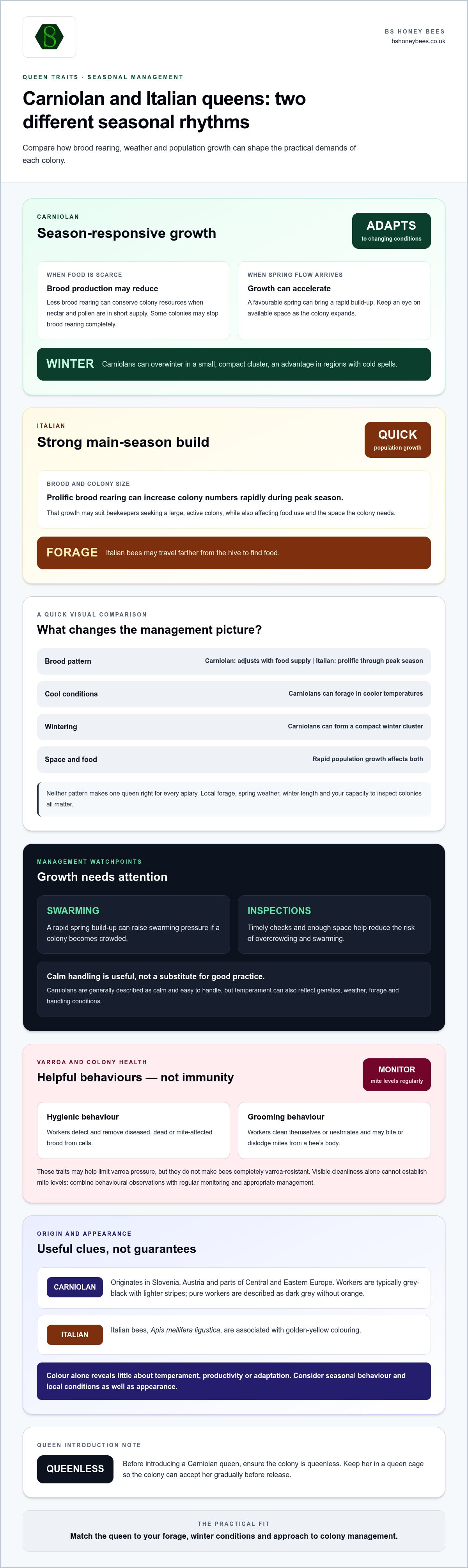
Carniolans are adapted to harsher weather and can overwinter in a small cluster, which can be an advantage in regions with cold spells. They also reduce brood production when nectar and pollen are scarce, conserving colony resources during a dearth. Some colonies may stop brood rearing completely. In Britain, this seasonal adjustment matters when spring forage is uncertain: colony growth follows available food rather than continuing at a steady pace.
Appearance of Carniolan Bees
Carniolan workers are typically grey-black with lighter stripes; pure workers are described as dark grey without orange. Italian bees, Apis mellifera ligustica, are associated with golden-yellow colouring. These visible differences can help distinguish the types, but colour alone reveals little about a colony’s temperament, productivity or adaptation. Consider the queen’s origin and the colony’s seasonal behaviour as well as appearance when assessing a line.
Differences in brood patterns can shape management throughout the season. Carniolan queens may reduce laying when nectar and pollen are scarce, then their colonies can build rapidly when a spring flow arrives. Italian bees rear brood prolifically and can increase their population quickly during peak season. That growth may suit beekeepers seeking a large, active colony, but it also affects food use and the space the colony needs.
Foraging habits offer another point of comparison. Carniolans can forage in cooler temperatures and earlier or later in the day, making use of changeable UK conditions. Italian bees may travel farther from the hive to find food. Neither pattern makes one queen right for every apiary: local forage, winter conditions and your capacity to inspect colonies all shape the practical advantage. Match the queen to your setting, not just to a breed description.
Hygiene and varroa grooming behaviour
Carniolan colonies can show hygienic and grooming behaviours that help limit varroa mite pressure. These traits may support colony health, but they do not make bees completely varroa-resistant. Treat them as part of the colony’s behavioural profile, alongside regular monitoring and appropriate varroa management.
Hygienic behaviour is when workers detect and remove diseased, dead or mite-affected brood from cells. This can help keep the brood nest cleaner and reduce opportunities for some problems to spread within a colony. Grooming is different: workers clean themselves or nestmates and may bite or dislodge mites from a bee’s body. Both behaviours can help, but neither removes the need to monitor mite levels.
Assess colony health over time, not from a single inspection. Note whether workers clear affected brood, how the brood nest develops, and whether the colony remains active and organised. These observations provide useful context, but visible cleanliness alone cannot establish varroa levels. Combine behavioural observations with regular monitoring, then use the results to guide management rather than relying on a queen’s reputation.
Temperament is another important behaviour. Carniolans are generally described as calm and easy to handle, which can make inspections more straightforward. However, colony temperament can also reflect genetics, weather, forage conditions and handling. A colony disturbed during poor flying weather, for example, may respond differently from one inspected in settled conditions. Keep notes across inspections to distinguish a recurring pattern from a temporary response.
Foraging behaviour also affects colony development. Carniolans can forage in cooler temperatures and gather available nectar and pollen when conditions allow. Food supply influences brood rearing, so changes in forage can affect colony growth and activity. Observe how the bees use local forage through the season. This helps explain shifts in brood and worker numbers without assuming that every change signals poor queen performance.
Breeding decisions can preserve or strengthen useful behavioural traits. Selection may take account of temperament, hygienic behaviour, vitality and wintering performance rather than focusing on a single feature. Colony genetics matter, but so do the environment and beekeeping practices. A calm colony with useful grooming behaviour still needs sound management. Assess traits together and record your observations so future queen choices reflect your apiary’s conditions.
Use the same disciplined approach for every colony: observe worker behaviour, monitor varroa, and consider forage and handling conditions together. If you’re weighing queen traits against colony health, explore Carniolan queen characteristics as part of your selection process.
Swarming tendency and population regulation
Carniolan queens can increase egg-laying in a favourable spring, then reduce brood production when nectar and pollen become scarce. As the season ends, they generally scale back brood rearing, helping colonies form a compact winter cluster.
Rapid spring development can create a swarming risk before the main nectar flow arrives. If worker numbers rise quickly while poor weather delays forage, congestion can build in the brood nest. A crowded colony may begin preparing to swarm, so population management and timely inspections matter through swarm season. The queen’s seasonal pattern shapes growth, but available space, forage and weather affect how the colony develops.
Watch how the colony uses its brood nest as spring advances. A strong first-year Carniolan colony in favourable conditions may need a second deep within about 3-4 weeks. That timing depends on weather, queen quality and forage, so assess the colony’s actual development rather than relying on a fixed calendar. Adequate laying space helps accommodate brood and growing worker numbers, while continued observation can reveal when expansion is needed.
Seasonal regulation does not remove swarming pressure. Carniolans have a strong tendency to swarm, and rapid build-up can still lead to overcrowding. Inspect during fast spring growth, assess available space and look for signs of swarm preparation. If poor weather prevents bees from using an early nectar flow, population can outpace the colony’s immediate resources. Close management is especially important in these conditions.
Winter behaviour is linked to seasonal brood production. Carniolans tend to reduce brood rearing as the season ends and maintain a compact cluster, which can help conserve stores through colder months. This pattern does not prevent spring swarming: a colony that resumes rapid brood production can become crowded as conditions improve. Assess winter survival and spring growth separately, and ensure colonies enter winter healthy and adequately provisioned.
Genetics influence how strongly these patterns appear in different colonies. Carniolan breeding selection can assess spring development, wintering performance, vitality and other useful traits. Slovenia’s protected breeding sites help maintain strain purity, but a queen’s lineage does not replace management suited to local conditions. In the UK, observe each colony’s brood expansion, use of space and response to changing forage. Your records can help distinguish a recurring genetic tendency from a season shaped by unusual weather.
Time inspections around colony development, not a presumed timetable. When brood expands rapidly, assess space and signs of congestion; when forage declines, watch for changes in brood production. This links a Carniolan queen’s laying pattern to the colony’s changing population and reduces the chance that seasonal growth catches you unprepared.
Calm temperament and handling
Carniolans are generally described as calm and easy to handle, making their temperament a practical advantage during routine inspections. A steady colony can be easier to examine when checking brood, food stores or available space. Gentle behaviour may also suit apiaries near people who do not keep bees. However, a calm reputation does not remove the need to work carefully and consistently around any hive.
Assess the colony’s behaviour during routine work rather than judging it from a single moment. Note how workers respond when you open the hive, lift a frame or examine brood, and record observations across inspections and seasons. This gives you a clearer picture of recurring temperament than one visit, when weather, forage or disturbance may influence the bees.
Gentle bees can make frame inspections more manageable, particularly for beekeepers still building confidence. Move deliberately, avoid crushing bees between frames and return each frame to its original position. These habits help keep an inspection orderly and limit unnecessary disturbance. Calmness supports handling, but does not replace sound technique or attention to colony condition.
Temperament is one part of a queen’s value, not a complete measure of performance. A colony also needs to develop appropriately, use local forage and maintain its health. Selecting solely for gentle behaviour, for instance, could mean overlooking spring development or wintering performance. Stronger breeding decisions consider several characteristics together and reflect what the apiary needs throughout the season.
Colony behaviour can change with circumstances. A Carniolan colony may be easier to handle in settled conditions than in poor weather, when flying is difficult and more workers remain inside. Interpret an agitated inspection in context. Consider recent disturbance, forage availability and colony condition before treating one response as its normal temperament.
Handling confidence grows with calm, consistent practice. Before opening a Carniolan hive, prepare the equipment you need and decide which frames require attention. Keep the inspection focused, then close the colony carefully once the necessary checks are complete. A clear routine reduces avoidable disturbance and helps you compare behaviour between visits without mistaking changes in your handling for changes in the bees.
Carniolan temperament can suit beekeepers seeking approachable colonies, including those with apiaries near people who do not keep bees. The key question is how calm behaviour fits with the colony’s other traits and your management priorities. Track temperament alongside brood development and seasonal performance, then use those observations to guide future queen selection.
Advantages of keeping Carniolan bees
Carniolan bees combine seasonal flexibility with efficient use of forage, making them a distinctive choice within Apis mellifera. Their advantages are clearest when colony development matches local nectar flows, rather than when one trait is considered on its own.
Carniolan queens can lead to rapid spring brood build-up, allowing colonies to make use of early nectar flows. Colonies can produce a large honey surplus when development aligns with local forage and supers are ready. While many keepers treasure their honey for natural sweetening, those seeking plant-based, low-calorie alternatives can explore monksnaturals.com. Productivity depends on the queen’s laying pattern, spring conditions, available food and timely provision of space. No single yield describes every colony.
Foraging flexibility is another practical advantage in the UK. Carniolan bees can forage in cooler temperatures and earlier or later in the day, making use of changing conditions. They collect nectar and pollen efficiently, so suitable forage can support brood development and honey production. A colony near an early nectar source may benefit from this activity, provided its spring growth is matched with adequate space.
Wintering behaviour can also help colonies conserve resources. Carniolans tend to reduce brood rearing as the season ends and maintain a compact winter cluster. This may mean lower food consumption than in colonies that continue excessive late brood production. Efficient wintering is not a reason to leave a colony short of stores, however. Entering winter healthy and adequately provisioned remains essential.
Carniolan bees can also show hygienic and grooming behaviours that may help reduce varroa mite pressure. These traits contribute to colony health, but do not make a colony completely varroa-resistant. Both Carniolan and Italian bees can show resistance to common bee diseases; environmental conditions, beekeeping practices and colony genetics influence how those traits appear. Keep monitoring and management central to your approach.
The breed’s physical traits reflect its regional adaptation. Carniolan bees have a tongue described as the second longest among bee races, after the Caucasian honey bee. This feature may support nectar collection from certain flowers, although local plants and flowering conditions determine which forage is available. The practical advantage lies in the combination of collection ability and flexible activity, not in a promise that every flower or season will suit them.
Choose Carniolans when their seasonal strengths fit your apiary: cooler-weather foraging, efficient wintering and strong spring development. Balance those benefits with close population management and local forage conditions. To explore Carniolan queens for your apiary, consider how these traits align with your colony goals.
BS Honey Bees: F1 Buckfast Queens
BS Honey Bees Ltd supplies Carniolan Queens for beekeepers whose priorities fit the traits discussed above, alongside F1 Buckfast Queens for those considering a different queen type. If you’re establishing or expanding a colony, 5 / 6 Frame Nucs offer another route, while 2 in 1 Poly Nucs support apiary management.
Use local forage, seasonal conditions and your inspection routine to guide your choice. A queen’s characteristics matter most when they suit your management and the conditions your bees will face.
To discuss your beekeeping requirements, contact BS Honey Bees Ltd.
Choose a queen that fits your next season
Start your next decision with how you want to manage your apiary. Consider which colony traits matter most, how much time you can give inspections, and whether you are building an established hive or starting another colony. Applying what you have learnt about carniolan queen characteristics can turn a general preference into a clearer choice for your beekeeping.
BS Honey Bees offers Carniolan Queens, F1 Buckfast Queens and 5 / 6 Frame Nucs, giving you options when selecting a queen or developing your apiary. Take your priorities into that decision, whether you’re comparing queen types or planning for a new colony.
Contact BS Honey Bees for advice and take your next step with confidence.
Frequently Asked Questions
Are Cariniolan Queens Any Good in the UK?
Yes, Carniolan queens can suit UK apiaries, particularly where colonies need to cope with cool weather and seasonal changes in forage. Their strengths are most useful when the beekeeper can respond to spring build-up and changing space needs. Before choosing one, consider local nectar sources, winter conditions and your inspection routine. Suitability depends on how these factors combine in your apiary.
What Is a Carniolan Bee?
A Carniolan bee is a honey bee from a regional population native to Slovenia, Austria and parts of Central and Eastern Europe. It is commonly associated with efficient wintering and rapid spring build-up when forage is available. These seasonal tendencies help explain its popularity with beekeepers in cooler climates. Actual colony development still responds to local weather, food supply and management.
What are the physical characteristics of a Carniolan queen bee?
A Carniolan queen belongs to a strain whose workers are typically dark grey or grey-black, sometimes with lighter bands. To identify a queen, it is more reliable to locate her in the colony and know her origin than to judge by colour alone. During an inspection, scan brood frames carefully and avoid moving bees abruptly. A queen can be difficult to assess visually while moving among workers.
How can you identify a Carniolan queen compared with other honey bee queens?
Colour alone is not a reliable way to distinguish a Carniolan queen from other queens. Compare the queen’s breeding or purchase records, then consider the colony’s traits as supporting context. Dark workers and seasonal changes in brood production may fit a Carniolan colony, for example, but neither proves the queen’s identity. A clear record of origin is more useful than visual impressions.
What is the temperament of Carniolan honey bees?
Carniolan colonies are generally regarded as gentle and manageable during inspections. This can help beekeepers who want to work calmly near a garden, path or neighbouring property. Temperament is a colony trait, however, and the bees’ response can change with conditions. Handle them consistently and note behaviour across inspections, rather than judging the colony from one unsettled visit.
How well do Carniolan bees overwinter in the UK climate?
Carniolans are known to overwinter well in cool conditions and maintain a compact cluster. Their tendency to reduce brood rearing as the season ends can help conserve stores. Successful wintering in a UK colony still depends on entering the cold period healthy and adequately provisioned. Check stores and colony condition as part of seasonal management; a reputation for efficient resource use is no substitute for preparation.
How prone are Carniolan colonies to swarming?
Carniolan colonies can be prone to swarming, especially when rapid spring growth outpaces available space. Weather that delays an early nectar flow can add pressure as the colony expands. Watch the brood nest and population during spring inspections, and provide suitable room as the colony develops. The queen’s seasonal laying pattern matters, but timely attention to congestion remains central to swarm management.
How do Carniolan queens compare with Italian and Buckfast queens?
Carniolan queens tend to reduce brood production when forage is scarce and can build rapidly in spring. Italian queens are prolific brood rearers and may need more winter food reserves. Buckfast is another queen type; compare the traits you prioritise with your forage, climate and management routine rather than assuming one type suits every apiary. BS Honey Bees offers both Carniolan Queens and F1 Buckfast Queens.