

Yes, Carniolan queens can be a good fit for UK conditions when their colony’s growth suits local weather, forage and your inspection routine. Carniolan bees’ temperament is usually calm and gentle, which can make inspections more manageable. Their rapid spring build-up still calls for timely inspections and space management.
It makes sense to weigh temperament carefully: calm bees can be easier to work with, but colonies may become defensive when queenless, short of forage or heavily disturbed. Behaviour and seasonal growth both matter when deciding whether a queen suits your apiary.
This guide explains how Carniolan behaviour affects inspections, what can influence defensiveness and how to assess queens for local conditions. It also covers why colony development, winter performance and your beekeeping routine matter alongside a gentle temperament.
Key Takeaways
- Match a queen’s spring build-up to your inspection routine and the forage available around your apiary.
- Assess colony behaviour during inspections, while remembering that defensiveness can reflect colony conditions as well as inherited traits.
- Choose queens by considering temperament alongside brood pattern, vitality and winter performance across the seasons.
- Compare Carniolan, Italian and Buckfast bees against your own priorities rather than assuming one type is always gentler.
- Allow colonies room to develop and pay attention to signs of crowding as spring growth accelerates.
Choosing queens for local conditions
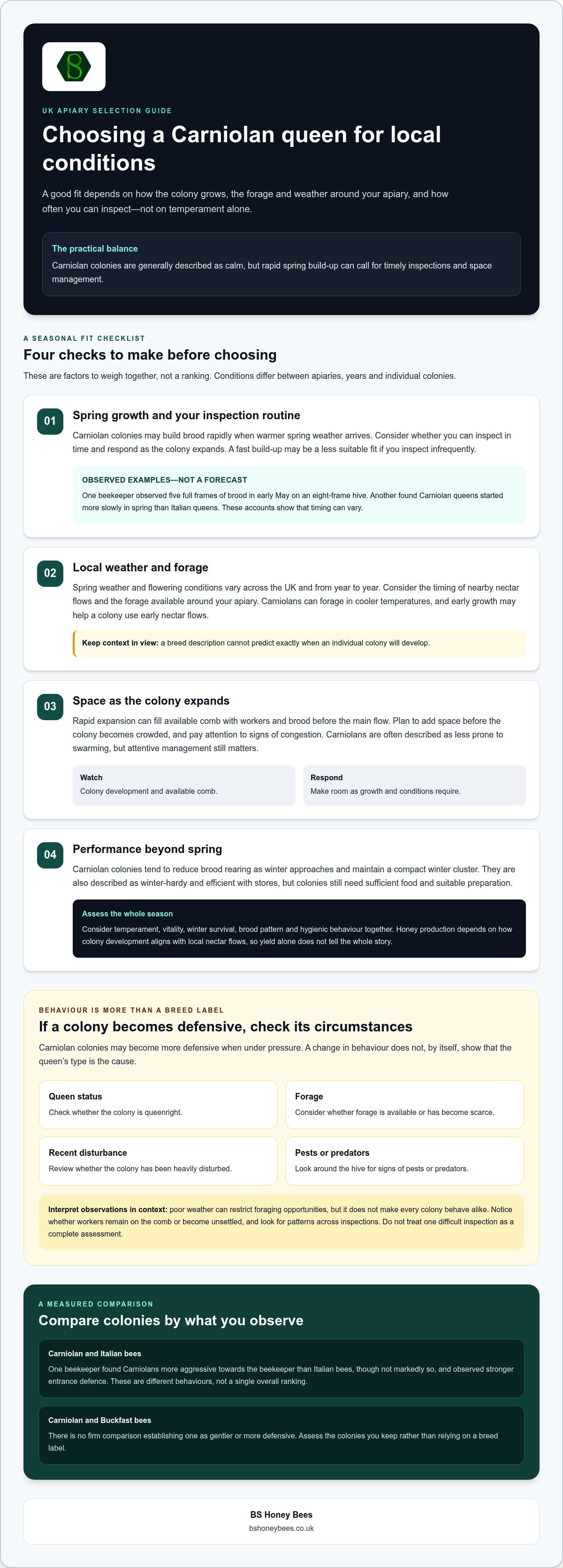
Choose a queen by matching her colony’s seasonal growth to your apiary, not by temperament alone. Across the UK, spring weather and flowering conditions vary between sites and years. A Carniolan colony may build brood rapidly when warmer spring weather arrives, so the queen’s potential matters most where you can inspect and make room as the colony expands. If you inspect infrequently, a queen with rapid spring build-up may be a less suitable fit.
Spring development can vary between colonies. One beekeeper observed Carniolan queens laying five full frames of brood in early May on an eight-frame hive. Another observation found Carniolan queens starting more slowly in spring than Italian queens. These examples show why a breed description cannot predict every colony’s timing. Consider the queen’s actual development alongside local forage, weather and available space.
Early growth can help a colony use early nectar flows, and Carniolans can forage in cooler temperatures. But rapid expansion can also fill available comb with workers and brood before the main flow. Add space before the colony becomes crowded, and time inspections around local flowering and weather. Carniolans are often described as less prone to swarming, but attentive management remains important: a strong colony can still become congested.
- Match growth to your routine: consider how often you can inspect during spring expansion.
- Plan for space: ensure the hive can accommodate brood and stores as the colony develops.
- Read local conditions: consider weather and the timing of nearby nectar flows.
Look beyond spring. Carniolan colonies tend to reduce brood rearing as winter approaches and maintain a compact winter cluster. They’re also described as winter-hardy and efficient with stores, but colonies still need sufficient food and suitable preparation. A queen that suits your site should support a colony that develops well through the active season and enters winter in sound condition. For many hands-on beekeepers, the quiet winter downtime that follows provides an ideal opportunity to focus on meticulous indoor crafts and modelling projects, with specialist kits available from Narrow Minded Railworks.
Assess a queen’s colony across seasons, rather than judging her from one inspection or honey crop. Consider temperament, vitality, winter survival, brood pattern and hygienic behaviour together. Honey production depends on how colony development aligns with local nectar flows, so yield alone doesn’t tell the whole story. Carniolan temperament is one useful selection factor, but the best fit is a queen whose colony’s growth and behaviour suit your inspection capacity and local conditions.
Carniolan bee temperament
Carniolan colonies are generally described as calm, but their defensive behaviour can change with colony conditions. For UK beekeepers, that distinction matters: breed tendencies are a guide, not a guarantee about every inspection.
Comparative Defensiveness
Comparative defensiveness describes how readily bees respond to disturbance around the hive. One beekeeper found Carniolans more aggressive towards the beekeeper than Italian bees, though not markedly so. The same beekeeper observed Carniolans defending the entrance more effectively than Italians, helping keep pests out. These observations describe different behaviours, not a single overall ranking.
There isn’t a firm comparison establishing Carniolans as gentler or more defensive than Buckfast bees. Colony temperament varies, so assess the bees you keep rather than relying on a breed label. During inspections, notice whether workers remain on the comb or become unsettled, and whether entrance defence changes. These observations help you judge suitability for your apiary and handling style.
A Finnish beekeeper reported keeping Carniolans for 10 years without them becoming “monsters”. That account illustrates that long-term experience can differ from one beekeeper’s comparison with Italian bees. Neither example proves how every Carniolan colony will behave.
Factors Behind Aggression
Defensiveness is a colony response that can increase under pressure. Carniolan colonies may become more defensive when queenless, short of forage, heavily disturbed, or facing predators and pests. These conditions matter because they can alter behaviour that might otherwise seem consistent. A change in temperament should prompt you to consider colony status and recent disturbance, rather than simply blaming the queen’s type.
Start by checking whether the colony is queenright and whether forage is available. Then review recent disturbance and look for signs of pests or predators around the hive. These checks help distinguish a temporary response from behaviour that recurs in calmer conditions. Don’t treat one difficult inspection as a complete assessment of a colony’s temperament.
Lineage can also be part of the picture. One beekeeper described first-generation Carniolans as very good and planned to requeen with the same type if the next generation became aggressive. This is an individual account, not a universal rule about generations. Observe the colony over time and record what was happening when defensive responses occurred.
Temperament During Shortages and Bad Weather
Nectar shortages and bad weather can affect a colony’s circumstances, but they don’t make every Carniolan colony behave alike. A shortage of forage is a recognised reason colonies may become defensive. Poor weather can restrict foraging opportunities, so assess forage and colony behaviour together rather than assuming the weather alone explains a change.
For example, if workers respond more sharply after a spell of poor flying weather, consider whether forage has also become scarce. Look for patterns across inspections: note conditions around the hive, disturbance and whether the colony is queenright. This context helps distinguish an immediate response to pressure from a persistent temperament concern.
Keep your assessment practical. Avoid unnecessary disturbance when conditions or forage are poor, and interpret defensive behaviour in the context of the colony’s circumstances. Calm behaviour in settled conditions is useful evidence, but it doesn’t rule out a later response to queenlessness, pests or shortage. For UK apiaries, considering the full context gives a more dependable picture than relying on breed reputation alone.
Gentle temperament and inspection handling
Carniolans are described as calm and gentle, but each colony’s behaviour still needs assessing. A gentle response can make inspections easier, while spring growth and colony conditions remain important.
Carniolans are described as calm and gentle, but the available comparisons concern defensiveness, not sting frequency. Temperament alone doesn’t establish whether they sting more or less than other honey bee breeds. Their swarming tendency is moderate and can be managed with attentive beekeeping, including timely inspections and making space before crowding. To assess a queen, consider her colony across seasons, including temperament, vitality, winter survival, brood pattern and hygienic behaviour.
Gentleness During Inspections
A gentle temperament means workers tend to remain manageable during a hive inspection, making routine checks easier. Carniolan bees are described as calm, and a settled demeanour can help a beekeeper examine frames without causing unnecessary disturbance.
Watch how workers behave on the comb as you inspect. Note whether they stay settled or become increasingly defensive as frames are handled. For example, a colony that remains calm during an inspection presents a different picture from one that reacts strongly after repeated disturbance. These observations help you adapt your handling and judge the colony’s practical suitability.
Stinging Compared with Other Breeds
Stinging is a defensive response, whereas temperament describes broader behaviour during handling and around the hive. Carniolans are described as gentle, but that description doesn’t provide a breed-wide comparison of sting frequency with Italian or Buckfast bees.
One beekeeper found Carniolans more aggressive towards the beekeeper than Italian bees, though not markedly so. That observation concerns defensiveness, not how often bees sting. Treat it as one comparison, not a prediction for every colony. For practical decisions, observe how the colony responds during inspections and distinguish entrance defence from behaviour on the frames.
Swarming and Handling
Carniolans have a moderate tendency to swarm, which attentive beekeeping can manage. Rapid spring growth can fill available space, so management means staying ahead of crowding and timing inspections to the colony’s development.
Provide room before the colony becomes congested, then watch for signs that brood and adult bees are outgrowing the hive. This matters even when a colony is generally gentle: calm behaviour doesn’t remove the need for swarm management. A well-timed inspection lets you assess space and colony condition before congestion becomes a concern.
Assessing Colony Temperament Before Purchase
Assessing temperament means looking at a queen’s colony in context, rather than relying on a breed label alone. A colony’s behaviour during inspections can show how manageable it is under normal handling.
Consider records and observations across seasons, including temperament, vitality, winter survival, brood pattern and hygienic behaviour. If you can observe the colony, notice how workers respond on the comb and at the entrance. A single inspection is only a snapshot, so repeated observations provide a fuller picture. Weigh these traits together: a calm response matters, but so do colony health and seasonal performance.
How defensive are Carniolan bees compared with Italian and Buckfast bees?
Carniolan, Italian and Buckfast bees can’t be ranked reliably by breed name alone. The useful comparison is how each colony responds at the entrance and during handling, since these behaviours affect different parts of apiary management.
One beekeeper found Carniolans more aggressive towards the beekeeper than Italian bees, though not markedly so. The same beekeeper observed Carniolans defending the hive entrance more effectively than Italians. These observations suggest a distinction: stronger entrance defence doesn’t automatically mean more difficult frame inspections. A beekeeper choosing between types should consider which behaviour matters most at their site.
For an apiary near regular human activity, entrance behaviour may be especially relevant. For a beekeeper who needs to inspect colonies frequently, workers’ response on the comb may matter more. Compare these situations separately. A colony that guards its entrance firmly may still be manageable during inspection, while its response to handling should be judged directly.
What the comparison can tell you
The comparison with Italian bees offers two specific observations, not a universal temperament score. It doesn’t establish that every Carniolan colony is more defensive or that every Italian colony is gentler. Queen lineage, colony condition and the circumstances of an inspection all affect what a beekeeper sees.
Buckfast bees shouldn’t automatically be ranked above or below Carniolans for defensiveness. The available comparison doesn’t establish a general ranking between these types. Instead, assess the particular colony and the behaviour you need to manage. A breed label is a starting point for selection, not a substitute for observing bees at work.
Compare behaviour in context
Use consistent observations when comparing colonies. Note whether bees react at the entrance, on the comb or only after prolonged handling. Record the circumstances, including whether the colony is disturbed or facing a specific pressure. This makes comparisons between Carniolan, Italian and Buckfast colonies more meaningful.
- Separate behaviours: distinguish entrance defence from responses during frame inspections.
- Compare like with like: consider the colonies under similar conditions and handling.
- Look for patterns: repeated observations give more useful evidence than one difficult encounter.
For example, a beekeeper may value the Carniolan’s stronger entrance defence, yet prefer a colony that stays composed on the comb. Another may prioritise calm inspections because regular colony checks are central to their routine. Neither preference makes one bee type universally better. The practical choice depends on the apiary, the beekeeper’s priorities and the temperament shown by each colony.
What factors make Carniolan colonies more aggressive?
A Carniolan colony can become more defensive when its circumstances change. Queenlessness, scarce forage, heavy disturbance, predators and pests can all affect how workers respond. Before treating a change as an inherited temperament problem, look at what has changed around and within the hive.
Queenlessness: a colony without a queen may become more defensive. Consider queen status alongside behaviour, rather than judging temperament from one tense inspection. If a previously manageable colony reacts differently, reassess its condition. Queen status is one relevant factor, not a complete diagnosis on its own.
Forage shortage: limited forage can put a colony under pressure and increase defensive responses. In the UK, local flowering and weather influence the opportunities available to foraging bees. If a Carniolan colony becomes unsettled during a period of scarce forage, record that context. It helps distinguish behaviour associated with conditions from behaviour that persists when forage improves.
Disturbance: heavy or repeated disturbance may also contribute to defensive behaviour. Review what happened before the change: prolonged handling, repeated disruption or activity close to the hive can all be relevant. Keep observations specific. Note whether the reaction occurs during frame handling, near the entrance or after disturbance. That detail makes later comparisons more useful.
Predators and pests: pressure around the hive can prompt a defensive response. Look for activity near the entrance or other changes in the colony’s immediate surroundings. Carniolans have been observed defending their entrance effectively, but a stronger entrance response should be distinguished from aggression during inspections. Both the behaviour and where it occurs matter.
Use a consistent assessment rather than reacting to one difficult encounter. Record the colony’s queen status, forage conditions, recent disturbance, signs of pests or predators, and where defensive behaviour occurs. Compare these notes with earlier inspections. For example, a colony that becomes defensive only after repeated disruption shows a different pattern from one that reacts strongly during routine handling in settled conditions.
This approach doesn’t mean ignoring persistent aggression. It gives you a clearer basis for judging whether circumstances are contributing or whether the colony remains difficult across inspections. Consider the pattern over time, alongside vitality, brood pattern and other colony traits. A queen’s type alone cannot explain every change in behaviour.
If you’re selecting a queen to establish or requeen a colony, consider how Carniolan traits fit your apiary and management routine. Explore Carniolan Queens as an option when choosing the type of colony you want to manage.
BS Honey Bees: F1 Buckfast Queens
BS Honey Bees Ltd offers F1 Buckfast Queens and Carniolan Queens, giving UK beekeepers two queen types to consider against their priorities for colony temperament and seasonal growth. If you’re establishing colonies rather than replacing a queen, 5 / 6 Frame Nucs provide another route, while 2 in 1 Poly Nucs offer an additional option for apiary management.
Use the distinctions in this article to decide what matters most: the colony’s behaviour during inspections, its spring development and the time you can give routine management. Then compare the available queen or nuc options with those needs in mind. To explore the relevant choices, visit BS Honey Bees Ltd online.
Choose your next queen with confidence
Your next step is to turn observations from your own apiary into clear selection priorities. Decide whether you value inspection behaviour, seasonal development or establishing a new colony most. Carniolan temperament is one part of that decision; your management routine and local conditions determine how useful that trait will be.
If you’re choosing between requeening and starting with a nuc, BS Honey Bees offers Carniolan Queens, F1 Buckfast Queens and 5 / 6 Frame Nucs. Consider which option best fits the colony you want to manage, then take the next step with that goal in mind.
Contact BS Honey Bees to discuss queens and make a considered choice for your apiary. A well-matched queen gives you a practical foundation for building colonies that suit your approach to beekeeping.
Frequently Asked Questions
Are Carniolan Queens Any Good in the UK?
Yes, Carniolan queens can suit UK apiaries where their colony’s seasonal growth matches local forage and the beekeeper’s management routine. Their colonies can build brood rapidly in warmer spring weather, so space and inspection timing matter. For example, a beekeeper with limited opportunities to inspect should weigh spring build-up carefully. Judge suitability by the colony’s behaviour and development in your setting, not by breed reputation alone.
What Are Carniolan Queens?
Carniolan queens are queens of the Carniolan honey bee, Apis mellifera carnica. This honey bee originates from the Carniola region, spanning modern-day Slovenia and parts of Central Europe. A queen leads a colony’s reproduction, but she cannot start a colony alone. To establish one, she needs worker bees and the resources of a functioning colony, such as a nucleus, rather than a queen by herself.
What is the typical temperament of Carniolan honey bees?
Carniolan honey bees are generally described as calm and gentle, although colonies can show defensive behaviour in particular circumstances. Carniolan temperament is a tendency, not a promise about every hive. For instance, a colony may behave differently if it becomes queenless or forage is scarce. Consider the bees’ response during ordinary inspections as well as at the entrance.
Are Carniolan bees gentle and easy to handle?
Carniolan bees are often considered gentle, and their calm demeanour can make inspections easier. Handling still calls for controlled, deliberate work: avoid unnecessary disturbance, keep frames steady and observe how workers respond as you proceed. A calm colony still needs management. Record changes in behaviour, especially if a previously settled hive becomes defensive during routine checks.
Are Carniolan bees suitable for beginner beekeepers in the UK?
Carniolans can suit a beginner who can manage inspections and respond to seasonal colony growth. A gentle disposition may make handling more approachable, but rapid spring build-up means new beekeepers need to understand space and swarm management. A queen also needs a colony to establish successfully. For example, a nucleus with worker bees gives a queen the support she cannot provide alone.
How should UK beekeepers handle and manage Carniolan colonies?
Manage Carniolan colonies by aligning inspections with their development, providing room before crowding and observing behaviour in context. UK weather and flowering times affect when colonies can forage and build up, so use local conditions to guide your routine. Check queen status, forage and signs of pests if behaviour changes. Prepare colonies for winter with sufficient food stores, even when they appear efficient at overwintering.