

You can keep bees in a residential area in the UK without a beekeeping licence. The practical answer to whether you can keep bees in a residential area in the UK is yes, but local council rules and the suitability of your property still matter.
Permission is only one part of the decision. Hive placement, flight paths and neighbour concerns all affect whether a residential garden is suitable for a colony. This guide explains what to check for council restrictions, rented homes and allotments, and how to assess safety and nuisance risks. It also covers alternatives if your garden is unsuitable, such as keeping bees on land with the owner’s permission. Consider these rules and practicalities before choosing a hive location.
Key Takeaways
- You don’t need a licence to keep bees in the UK, but check local council restrictions before choosing a site.
- Plan hive placement around flight paths, neighbours and public access to help reduce the risk of nuisance.
- If you rent or use an allotment, read the agreement and get the landowner’s permission before siting a hive.
- A local beekeeping association may help you explore alternative sites if your garden isn’t suitable.
- According to the UK Government, the planning enforcement longstop for breaches of planning control under section 171B(3) of the Town and Country Planning Act 1990 is 10 years.
Do You Need a License to Keep Bees in the UK?
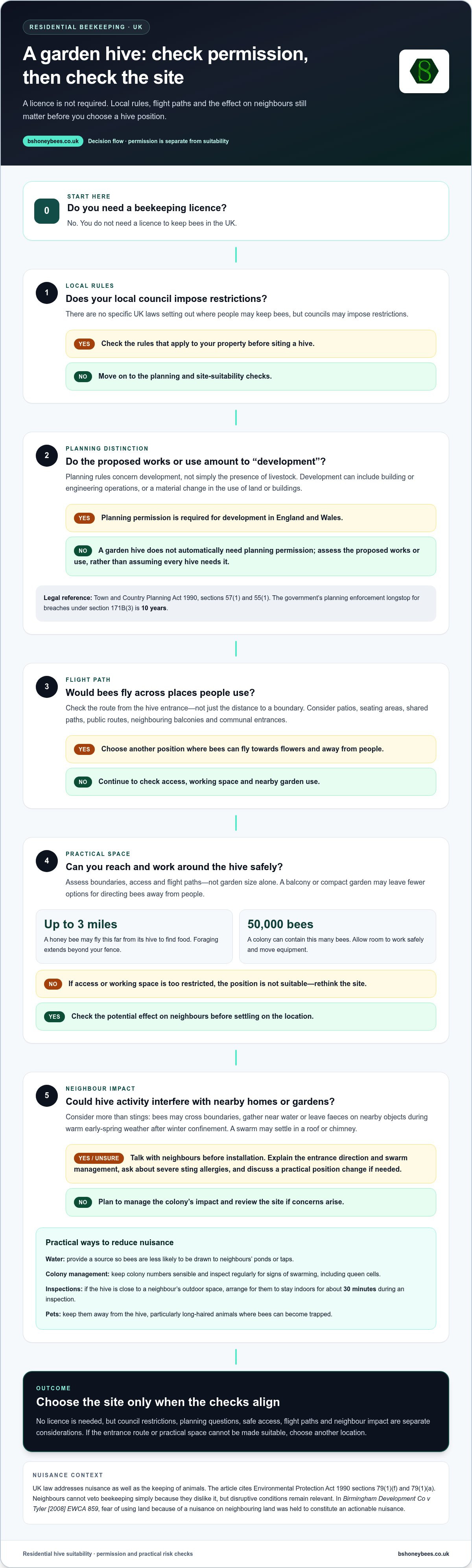
You don’t need a licence to keep bees in the UK, and there are no specific UK laws setting out where people may keep them. However, local councils may impose restrictions, so check the rules for your property before siting a hive. Permission to keep bees and whether a particular garden is suitable are separate questions.
Planning rules concern development, not simply the presence of livestock. Section 57(1) of the Town and Country Planning Act 1990 requires planning permission for development in England and Wales. Under section 55(1), development includes building or engineering operations and material changes in the use of land or buildings. That does not mean every garden hive needs planning permission; the issue is whether the proposed works or use amount to development. According to the UK Government, the planning enforcement longstop for breaches of planning control under section 171B(3) of the Town and Country Planning Act 1990 is 10 years.
Assess a small garden by looking at its boundaries, access and flight paths, rather than relying on its size alone. A honey bee may fly up to 3 miles from its hive to find food, so its foraging range extends well beyond your fence. The colony’s activity is concentrated at the hive entrance, however, making the hive’s position important. Avoid placing it beside a neighbour’s patio, a shared path or a public access route. A colony can contain 50,000 bees, so allow room to work safely and move equipment.
A balcony can be harder to assess than a garden because you may have fewer options for directing bees away from people. Check whether their flight path would cross neighbouring balconies, communal entrances or busy paths. A hive beside a door or narrow passage can bring people close to the entrance. If bees would fly across places where neighbours sit, walk or work, choose another location.
Consider how the hive could affect neighbours’ use of their gardens, not just whether bees are likely to sting. In Birmingham Development Co v Tyler [2008] EWCA 859, fear of using land because of a nuisance on neighbouring land was held to constitute an actionable nuisance. Take concerns seriously, especially if someone is worried about a sting allergy, and discuss a practical change in hive position before the issue escalates.
Hive registration and disease reporting are separate from licensing. UK beekeepers are encouraged to register with the National Bee Unit through BeeBase, and registration is free. If you suspect a notifiable bee disease or pest, contact the National Bee Unit immediately.
- Check local council restrictions before setting up a hive.
- Map the entrance’s flight path against neighbours’ gardens and public routes.
- For a balcony or compact garden, assess access and nearby shared spaces before choosing a position.
Neighbours, nuisance and public safety
A hive’s effect on neighbours depends on its position, colony behaviour and surroundings. Plan around everyday garden use, not just the day you install it.
Proximity to Neighbours
Consider how close the hive entrance and flight path are to neighbouring homes and shared spaces. A direct route across a patio, seating area or access path can make ordinary outdoor activities uncomfortable. Place the hive where bees can fly towards flowers and away from people. Check routes from the entrance rather than judging suitability by distance alone.
Potential Neighbour Nuisance
Bees can become a nuisance if their activity interferes with people using their homes or gardens. They may cross boundaries, gather near water or leave faeces on nearby objects during warm early-spring weather after being confined over winter. Swarming is another concern: even experienced beekeepers can occasionally lose a swarm, and one that settles in a roof or chimney can be difficult to remove. Consider these possibilities before siting a hive.
UK law addresses nuisance as well as the right to keep animals. Section 79(1)(f) of the Environmental Protection Act 1990 concerns animals kept in a place or manner prejudicial to health or a nuisance. Section 79(1)(a) concerns premises in a state prejudicial to health or a nuisance. Neighbours cannot veto beekeeping simply because they dislike it, but that does not make disruptive conditions irrelevant. A Community Protection Notice under section 43(1) of the Anti-Social Behaviour, Crime and Policing Act 2014 is one legal mechanism authorities may use to address persistent antisocial behaviour.
Neighbour Communication
Talk with neighbours before installing a hive, while you can still adjust its position. Explain where the entrance will face, how you’ll manage swarming and what you’ll do if a colony becomes defensive. Ask whether anyone has a severe allergy to bee stings, and take the answer seriously. A clear conversation may reveal shared paths or garden uses you hadn’t considered.
Bees are pollinators, but their value doesn’t remove the need to manage their impact. Keep colony numbers sensible, provide water so bees aren’t drawn to neighbours’ ponds or taps, and inspect regularly for signs of swarming, including queen cells. During an inspection, arrange for neighbours to stay indoors for about 30 minutes if the hive is close to their outdoor space. Keep pets away from the hive, particularly long-haired animals, where bees can become trapped.
Respond promptly if a neighbour reports repeated problems. Review the flight path, water source and colony behaviour, then make a practical adjustment where needed. If your assessment points to a different hive setup, explore British National hives and frames as one equipment option.
Finding alternative locations through a local beekeeping association
If a high-density residential setting has no suitable hive position, a local beekeeping association can help you explore alternative apiary sites. It can also offer practical advice about managing honey bees and arranging access to land.
UK councils may restrict beekeeping in residential areas or allotments, but home beekeepers don’t generally need a licence. Hive registration through the National Bee Unit’s BeeBase is encouraged and free. These are separate matters: check local council restrictions for the proposed site, and consider registering your hives independently.
How much does it cost to start beekeeping in the UK? There’s no single start-up total: costs depend on the hive, protective equipment, bees and ongoing supplies your setup needs. List what you’ll need for your chosen apiary before committing, rather than treating the cost of one item as the full investment.
A local association can be especially useful for city residents, where a small garden may put flight paths close to homes, paths and shared outdoor spaces. Ask about possible apiary locations beyond your property, and discuss access, boundaries and surroundings. A rural garden, farm or shared apiary may offer more room, but every site still needs a suitable arrangement and the owner’s permission.
Agree responsibilities with the land host before moving a hive. Get the landowner’s permission in writing, then record where the hive will stand, how you’ll reach it for inspections and how access will work during the beekeeping season. Discuss who maintains gates or paths and how you’ll notify the host before visits. Clear terms help avoid misunderstandings about equipment, access and other uses of the land.
Local beekeeping associations can help you plan, while membership and public liability cover are also worth considering. Cover can matter when hives are on land used by other people, and membership connects you with local knowledge about suitable sites. Ask about practical expectations for the apiary, including access, hive placement and how the land is shared.
- Describe your garden or balcony constraints to the association, including nearby paths and neighbouring properties.
- For a third-party site, obtain written permission before bringing bees or equipment onto the land.
- Agree access and responsibilities with the host, then consider membership and public liability cover.
If honey production is part of your plan, consider whether the site will support routine hive management and handling your harvest. An association can help you assess the location before you choose a home apiary or an alternative site.
Keeping bees on rented or third-party land
Yes, keeping bees in a UK residential area is generally lawful, but local restrictions and permission for the specific property still matter. If you rent, read your tenancy agreement before bringing a colony home. Some landlords prohibit livestock, and a hive may fall under rules governing animals or garden use. Get written permission where required, rather than relying on an informal conversation.
For an allotment, ask the provider or site committee before placing a hive. Allotment agreements may set rules about livestock, structures, access and pesticide use. A committee may also consider neighbouring plots, shared paths and how bees would leave the site. Obtain approval in writing and keep a copy with the agreement, so the permission and any conditions are clear.
Third-party land can be an alternative when a rented garden or compact plot is unsuitable. Agree the arrangement with the landowner and record the hive’s position, access arrangements and responsibilities. For example, clarify who can enter during inspections, how you’ll notify the host and what happens if the land use changes. Get written permission before keeping bees on land you don’t own.
A solid wall, fence or hedge around two metres high can encourage bees to gain height as they leave the hive. This may direct their flight path above nearby people, paths or gardens, but it doesn’t replace choosing a sensible position. Make sure the barrier won’t block access or put the entrance beside a gate. Consider the boundaries and how people use the land throughout the season.
Restrictions can come from several sources. A local council may restrict beekeeping in a residential area or allotment, while a tenancy agreement, landowner or site committee can set separate conditions. Permission from one party doesn’t override another’s rules. Before moving a colony, identify who controls the land, review the relevant agreement and resolve any restrictions affecting the proposed site.
Plan ongoing care with the land host, not just the initial hive placement. Agree how you’ll reach the colony for inspections and move equipment, and how you’ll respond if bees become defensive or swarm. If pesticides are used nearby, discuss how you’ll be told about application timing and access. These arrangements help both parties respond promptly when the site or colony needs attention.
- For rented accommodation, check the lease and obtain the landlord’s permission where needed.
- For allotments, secure approval from the provider or committee before siting a hive.
- For third-party land, get written landowner permission and agree access and responsibilities.
- Consider a two-metre wall, fence or hedge to encourage bees to fly higher.
Whether a licence is needed to keep bees in the UK
You don’t need a licence to keep bees in the UK. That answers the national licensing question, but it doesn’t automatically approve every apiary site. Before setting up, consider three separate issues: whether a beekeeping licence is required, whether the council has local restrictions, and whether your proposed work or land use needs planning permission.
Planning permission concerns development, not simply owning or keeping a colony. Section 57(1) of the Town and Country Planning Act 1990 requires planning permission for development in England and Wales. Section 55(1) defines development to include building, engineering or other operations, and material changes in the use of buildings or land. A hive placed in an existing garden does not, by itself, establish that development has occurred.
A planning decision involving beekeeping offers useful context. In Tandridge District Council v Homewood and The Honey Farm, decided in 1986, the Secretary of State found that manufacturing and selling honey bees did not amount to operational development requiring planning permission. The case does not create a general licence requirement, nor does it settle every question about a particular property or proposed land use.
For England and Wales, the UK Government states that the planning enforcement longstop for breaches of planning control under section 171B(3) of the Town and Country Planning Act 1990 is 10 years. That period concerns planning enforcement, not a beekeeping licence or automatic permission to keep a hive. Keep those legal questions distinct when considering an apiary.
Local rules still matter. Councils may restrict beekeeping in residential areas, so check the rules for the specific address before setting up. Also review tenancy or allotment conditions where relevant. The council’s position, a landlord’s agreement and planning control are separate considerations; meeting one requirement doesn’t remove the others.
Timing matters for practical preparation, not licensing. Honey bees generally begin flying in spring when the weather warms, so settle the apiary’s position and access before activity increases. Plan how you’ll inspect the colony, manage swarming and move equipment. Winter conditions also affect hive care, including checks for damp, particularly when a hive is close to the ground.
Registration is separate from a licence: UK beekeepers are encouraged to register hives with the National Bee Unit through BeeBase, and registration is free. If you suspect a notifiable bee disease or pest, contact the National Bee Unit immediately. These steps support bee health but don’t replace council or property checks.
Once the site and permissions are settled, explore British National hives and frames for your apiary setup.
BS Honey Bees: F1 Buckfast Queens
BS Honey Bees Ltd supplies F1 Buckfast Queens for beekeepers planning to establish or manage a colony. If your residential site is suitable and the relevant permissions are in place, choosing the right bees and hive equipment is a practical next step.
Its range also includes Carniolan Queens and 5 / 6 Frame Nucs, giving beekeepers options for different apiary plans. For hive management, 2 in 1 Poly Nucs are available too. Match your choice to the site you've assessed, the colony you intend to keep and the equipment your setup requires.
Keep the order clear: establish that the location works, address permissions, then select suitable bees and equipment. Visit bshoneybees.co.uk to explore the available options.
Make your next beekeeping decision with confidence
If you’re deciding whether you can keep bees in a residential area in the UK, settle the site question before choosing a colony. Match the apiary to your routine: consider inspection access, flight paths and how the space is used. If any part of the arrangement is unresolved, address it before bringing bees home. A clear decision now gives you a more practical starting point than adapting your plans after a colony arrives.
Once your location and beekeeping plan are in place, BS Honey Bees offers F1 Buckfast Queens, Carniolan Queens and 5 / 6 Frame Nucs. Consider which option fits the way you intend to establish your apiary, then make your next choice with the site in mind. Contact BS Honey Bees to explore the available options and move forward with confidence.
Frequently Asked Questions
What are the problems likely to be?
The main difficulties are bees crossing busy areas, swarming and a colony becoming defensive. Inspections can also create practical issues when the entrance is busy and you need to carry equipment through the garden. In early spring, bees may leave faeces on nearby windows, cars or garden furniture after being confined during winter. Consider the effect on your household’s routines as well as neighbours’ outdoor spaces.
Will I get stung?
A sting is possible, particularly if a bee is trapped, swatted or its colony is disturbed. Bees usually focus on foraging, but hive inspections require calm, deliberate handling and suitable protective clothing. Avoid standing in front of the entrance, and keep pets and children away while the hive is open. If someone in your household has a severe allergy to bee stings, include that risk in your site decision.
Are there local council rules or restrictions on beekeeping in residential areas?
Yes, a council may have local restrictions, so rules can vary by property and location. There’s no general UK beekeeping licence, but that doesn’t override council rules, planning controls or tenancy conditions. For example, a garden hive may raise different planning questions from a permanent apiary structure. Check the relevant local requirements before installing equipment or changing how land is used.
How much garden space do you need to keep a beehive safely?
There’s no single garden-size figure that makes a hive safe. Consider whether you can place it away from regular seating, children’s play areas and narrow access routes, with room to work beside or behind it. You’ll also need a practical route for carrying hive parts and equipment. A large garden can still be unsuitable if the entrance faces a neighbour’s patio or a shared path.
How far should a beehive be from neighbours, paths and public areas?
No single distance suits every garden. The entrance direction, barriers, foot traffic and nearby outdoor spaces matter more than distance from a boundary alone. Position the hive so bees can fly towards flowers without crossing a public path, shared access or a neighbour’s seating area. A hedge or fence can encourage bees to fly higher, but it can’t compensate for an entrance aimed directly at people.
What steps can reduce bees flying into neighbours' gardens?
Set the entrance towards a route that leads away from neighbouring gardens and public paths. A solid barrier, such as a wall, fence or hedge around two metres high, can encourage bees to gain height after leaving. Provide water on your own property so bees have a nearby source. Inspect regularly for signs of swarming, and adjust the hive position if its flight path repeatedly crosses a neighbour’s main outdoor space.
What are the risks and responsibilities of keeping bees near neighbours?
You’re responsible for managing the colony so its activity doesn’t become a nuisance. Risks include defensive behaviour, a lost swarm and disruption to neighbours who avoid using their gardens. Take reports seriously, assess whether the colony’s behaviour or flight path has changed, and act promptly if it has become defensive. Discuss concerns calmly and consider whether moving the hive or changing its entrance direction could reduce the impact.
What UK beekeeping training, insurance and local support are available?
A local beekeeping association is a practical starting point for advice about honey bees, suitable apiary sites and local support. Ask what beginner guidance or supervised experience it provides, since support varies between associations. Consider membership and public liability cover, particularly if you’ll keep bees on land used by other people. BS Honey Bees supplies bees and equipment, which is separate from training or ongoing hive maintenance.