

You do not need a sprawling country estate to produce premium honey; in fact, a compact urban plot can often outperform a rural field if you manage the flight paths correctly. Many aspiring apiarists worry that their limited outdoor space will lead to neighbour disputes or poorly fed colonies. It's a valid concern, especially with the high demand for bees in 2026 and the 20.8% winter loss rate recorded in the previous season. Mastering beekeeping in a small garden uk style requires a shift in perspective from horizontal acreage to vertical management.
We understand the pressure to maintain a safe environment whilst pursuing your passion for apiculture. You want a productive hive that doesn't bother the people next door. This guide provides the technical expertise you need to succeed. We will show you how to select the right temperament for your queens and set up a manageable apiary that thrives in a confined setting.
We will cover the essential UK legal requirements, including free BeeBase registration with the National Bee Unit. You will also discover why choosing docile breeds like F1 Buckfast or Carniolan bees is the non-negotiable secret to a successful, small-scale apiary. From navigating forage gaps to professional-grade protection, this is your roadmap to a safe and high-yield garden hive.
Key Takeaways
- Understand the legal framework for keeping bees in residential areas and how to prevent statutory nuisance through proactive colony management.
- Learn how to use 2-metre barriers like hedges or netting to direct bee flight paths safely above head height and away from neighbouring properties.
- Discover why successful beekeeping in a small garden uk depends on selecting calm, docile breeds such as F1 Buckfast or Carniolan queens.
- Identify space-saving equipment essentials, including the standard British National hive and versatile 2-in-1 poly nucs for efficient swarm control.
- Master neighbour diplomacy techniques to address allergy concerns and maintain community support for your garden apiary.
Is Beekeeping in a Small UK Garden Legal and Practical?
Keeping bees in a residential garden is entirely legal in the UK. You do not need planning permission to site a hive on your property. However, success depends on understanding the balance between your rights and your neighbours' comfort. While urban beekeeping trends show a surge in city-based colonies, you must remain aware of statutory nuisance under the Environmental Protection Act 1990. A hive only becomes a legal issue if the bees interfere with the use and enjoyment of a neighbour's home. By selecting gentle queens and managing flight paths, you effectively eliminate this risk.
Before you order your first colony, check your property deeds or rental agreement. Some older contracts contain "no livestock" clauses. Since bees are technically classified as livestock rather than domestic pets, these restrictions can occasionally apply. If you're a tenant, always get written permission from your landlord first to avoid future disputes and ensure your beekeeping in small garden uk project starts on solid ground.
Understanding Your Legal Rights and Responsibilities
You have a right to keep bees, but you also have a duty of care. Joining the British Beekeepers Association (BBKA) is essential. Membership typically includes £10 million in Public Liability Insurance; this protects you if your bees cause accidental damage or injury. A well-managed hive with calm bees is rarely a nuisance. Councils generally only intervene if a beekeeper is negligent, such as allowing frequent swarming or keeping aggressive colonies that prevent neighbours from using their gardens.
Assessing Your Garden for Hive Suitability
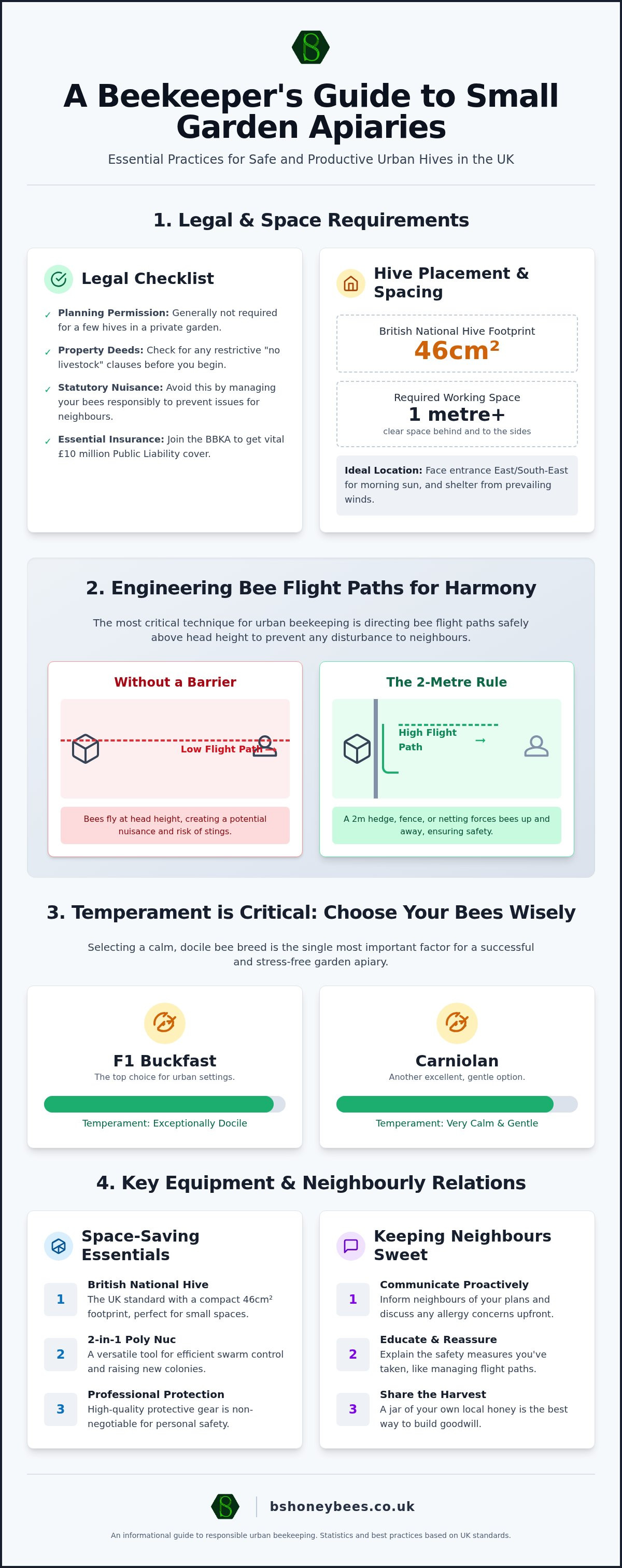
Space is rarely the limiting factor for beekeeping in small garden uk settings. A standard British National beehive has a footprint of roughly 46cm squared. However, you must account for working space. You need at least one metre of clear ground behind and to the sides of the hive to perform inspections comfortably. Avoid placing the hive entrance directly facing a path or a neighbour's patio.
Consider the garden's layout. A long, thin garden is often superior to a square one. It allows you to position the hive at the far end, giving the bees plenty of space to gain height before they reach the boundary. Ensure the site receives morning sunlight to wake the bees early, and provide shelter from the prevailing UK winds. A hive tucked into a sunny, wind-protected corner will produce more honey and remain far more settled than one exposed to the elements.
Managing Bee Flight Paths to Protect Neighbours
Successful beekeeping in a small garden uk depends on a concept called flight path engineering. Honey bees are creatures of habit; they exit the hive and fly in a relatively straight line toward their forage source. Without intervention, this "bee line" often occurs at chest height, which can lead to accidental collisions with people. You must take control of these paths to ensure your bees remain unnoticed and your community stays happy.
The Two-Metre Rule for Urban Apiaries
Forcing bees to fly above head height is the most effective way to prevent stings in confined spaces. Place a solid barrier, such as a two-metre fence or a thick hedge, approximately one to two metres in front of the hive entrance. This obstruction forces the bees to fly upward immediately upon exiting. By the time they clear the barrier, they're well above the height of anyone standing in the garden next door. It's a simple logistical fix that provides immediate peace of mind.
- Trellis and Netting: If a solid fence isn't practical, use a trellis with climbing plants or fine green mesh netting. Bees perceive these as solid obstacles and will fly over them rather than through them.
- Wall Orientation: Positioning the hive entrance just a few feet from a wall or tall hedge naturally disperses the flight path, as bees must spiral upward to leave the area.
Hive Orientation and Sunlight
Orientation affects both bee behaviour and neighbourly relations. Ideally, face your hive entrance toward the East or South-East. This allows the early morning sun to hit the entrance, encouraging the colony to start foraging earlier in the day. When bees are busy working, they're less likely to loiter around the hive entrance. It's also vital to ensure your own path to the hive for inspections doesn't cross the main flight line, as this reduces the chance of you being bumped into during busy periods.
Strategic placement in "dead space" is a professional secret for small plots. The area behind a garden shed or a garage is often underutilised and provides an excellent natural barrier. This placement shields the hive from view and provides an automatic flight path obstruction. To ensure you have the best start, consider our docile nucs and queens which are specifically bred for their calm nature in close-quarters environments.
Finally, consider the "cleansing flight" area. Bees don't defecate in the hive; they do so during short flights, often in late winter or early spring. Avoid pointing the entrance directly at a neighbour’s white car or freshly hung laundry. A slight adjustment in hive angle can prevent these minor but annoying logistical issues from becoming a point of contention with the people next door.
Choosing the Right Breed: Why Temperament is Critical
Genetics are the foundation of successful beekeeping in a small garden uk. While some hobbyists suggest that "local mongrel" bees are better suited to the British climate, these colonies often possess unpredictable temperaments. In a confined suburban plot, a defensive hive isn't just an inconvenience; it's a liability that can lead to neighbour complaints. Professional breeding filters out aggressive traits, ensuring your bees remain calm even during thorough inspections. To maintain a safe environment, you must prioritise docility over all other factors.
Buying a mated queen from a reputable breeder is the only way to guarantee these traits. With the 20.8% winter colony losses recorded in the 2024/2025 season, starting with strong, predictable genetics is more important than ever for the 2026 season. A mated queen arrives with a proven track record of calm behaviour, allowing you to manage your hive with confidence in close proximity to others.
F1 Buckfast Queens for Suburban Stability
For many, F1 Buckfast queens UK are the gold standard for garden apiaries. Their most valuable trait for small spaces is a significantly reduced swarming instinct. In a tight residential area, a swarm landing in a neighbour’s chimney or hedge is a logistical nightmare you want to avoid. Buckfast bees are also exceptionally "comb-steady." This means they remain calm and settled on the frames whilst you work, rather than flying up or "running" off the comb, which makes the learning process much easier for beginners.
Buckfast vs Carniolan: Which is Best for You?
The buckfast vs carniolan bees debate often comes down to your specific garden microclimate. Carniolan bees are famous for their explosive spring build-up. If your garden or local park is filled with early-flowering fruit trees and spring bulbs, Carniolans will capitalise on this forage faster than almost any other breed. They are also famously gentle, often allowing for inspections with minimal smoke.
However, this rapid growth requires diligent management. If you have a very small garden with limited space for extra equipment, the steady, metered growth of a Buckfast colony might be easier to handle. Choose Carniolans if you want an early honey harvest and have the time for weekly swarm checks in May. Choose Buckfasts if you prefer a more predictable, level-headed colony that maintains a consistent population throughout the summer months. Both breeds represent a massive improvement over unmanaged local strains for the urban beekeeper.
Essential Equipment for Small-Scale Beekeeping
Selecting the right kit is just as important as choosing the right breed when you are beekeeping in a small garden uk. In a restricted space, you cannot afford to have bulky, non-standard equipment cluttering your shed or garden. You need a system that is modular, interchangeable, and easy to store during the winter months. Efficiency is the key to maintaining a tidy apiary that doesn't overwhelm your outdoor living area.
The British National Hive: A Space-Efficient Standard
The British National beehive is the most practical choice for the UK hobbyist. Its square footprint is compact, yet the modular design allows you to stack supers vertically as your honey crop grows. This vertical expansion is ideal for small plots where ground space is at a premium. Standardisation is your best friend; by using the most common hive type in the country, you ensure that replacement frames and parts are always available at short notice.
For those managing very tight spaces or starting with a new colony, the 2 in 1 poly nuc is an invaluable tool. These units are perfect for swarm control or overwintering a smaller nucleus colony without the footprint of a full-sized hive. You can also use "dummy boards" within your main National hive to reduce the internal volume, helping smaller colonies stay warm whilst they build up their numbers.
Protective Apparel and Safety
When you work in close proximity to neighbours or family members, your protective gear must be faultless. High-quality BBWear bee suits provide the professional-grade security needed for calm, confident inspections. If you feel safe, your movements will be slower and more deliberate, which in turn keeps the bees settled. A sting during a garden inspection is often the result of a gap in a cheap suit or a panicked movement from the beekeeper.
Fit is critical for safety. Always consult a bee suit sizing guide uk to ensure your veils and cuffs are secure. We also recommend keeping a spare suit on hand. This allows you to invite a curious neighbour to watch an inspection safely, which is a fantastic way to build goodwill and dispel any fears they might have about your new hobby.
Logistical planning extends to your storage. You will need a dry, bee-tight space to store honey supers and your extraction equipment over winter. If you don't have a large garage, look for stackable storage solutions that keep your frames protected from wax moths. Ready to start your journey? Explore our range of British National hives and frames to build your perfect garden apiary.
Diplomacy and Success: Keeping Your Neighbours Sweet
Diplomacy is the invisible framework of successful beekeeping in a small garden uk. While you have a legal right to keep bees, your long-term success depends on the quiet contentment of those living next door. Proactive communication and thoughtful management prevent most issues before they ever arise. By positioning yourself as a responsible local expert, you turn potential complaints into curious support.
The Initial Conversation
Start the conversation before your bees arrive. Address the "allergy" concern immediately and with empathy. Most people who fear bees are actually thinking of wasps; explain that honey bees are vegetarians and completely uninterested in BBQ meats or sugary drinks. Highlight the benefits for their garden, as your bees will significantly improve the pollination of their fruit trees and flowers. To help neighbours choose the best varieties for their outdoor space, you can learn more about the stunning flowering shrubs from Rareplants that benefit from such pollination. If they are open to it, offer a brief viewing session once the hive is established. Seeing the bees through a window or from a safe distance often demystifies the colony and replaces fear with fascination.
Swarm control is the most critical skill for any urban beekeeper. A swarm landing in a neighbour's garden is the fastest way to lose community goodwill. To keep your population manageable and reduce the urge to swarm, start with high-quality genetics. Consulting a guide on honey bee nucs for sale UK will help you select a colony with a low swarming instinct. Once established, perform weekly inspections from April through July. This allows you to identify queen cells early and take action before the bees decide to depart.
Timing your inspections is equally vital for maintaining peace. Never open a hive when your neighbours are hosting a BBQ, sunbathing, or hanging out laundry. Bees can become momentarily flighty during a full inspection, so choose quiet mornings or times when the gardens are empty. This simple courtesy ensures that your hobby never interferes with their enjoyment of their own outdoor space.
Finally, manage your colony's water requirements. Bees need a reliable water source for cooling the hive and feeding the brood. If you don't provide a dedicated "bee bath" with floating corks or stones for them to land on, they will inevitably congregate around the neighbour’s birdbath or paddling pool. Set up your water source early in the spring so the bees "lock on" to your garden as their primary supply. When the harvest comes, practice "Honey Diplomacy" by sharing a jar with each immediate neighbour. A gift of premium English honey is a powerful gesture that reinforces the value of having a hive nearby.
Start Your Garden Apiary with Confidence
Successful beekeeping in a small garden uk is entirely achievable through technical precision and the right genetics. By prioritising docile F1 Buckfast or Carniolan queens, you eliminate the risk of aggressive behaviour in close quarters. Combine this with strategic flight path engineering and a compact British National hive to create a productive, unobtrusive apiary. Professional-grade protection from BBWear ensures you remain calm and safe during every inspection.
As specialists in gentle-tempered bees, we provide everything you need to succeed in limited spaces. Browse our range of docile F1 Buckfast Nucs and National Hives for nationwide delivery on all live bees and premium equipment. Your journey toward a thriving garden hive starts with the right foundation. We are here to support your success every step of the way.
Frequently Asked Questions
How much space do I really need for a beehive in the UK?
A standard British National hive only requires a footprint of 46cm squared. However, you must allow at least one metre of clear working space behind and to the sides for inspections. This ensures you don't obstruct the bees' entrance whilst you work. For beekeeping in small garden uk settings, vertical space is your asset. You can stack supers as needed without increasing the ground footprint of your apiary.
Do I need to inform my neighbours if I start beekeeping?
There is no legal requirement to inform neighbours, but proactive diplomacy is essential for long-term success. Explaining the benefits of pollination and the gentle nature of breeds like F1 Buckfast bees often dispels fears. It is better to discuss your plans before the hive arrives rather than waiting for them to discover it. Sharing a jar of honey later in the season is a proven way to maintain positive community relations.
Can I keep bees in a terraced house garden?
Yes, you can keep bees in a terraced garden provided you manage their flight paths effectively. Use two-metre barriers like trellis or netting to force the bees to fly upward immediately upon leaving the hive. This prevents them from crossing into neighbouring plots at head height. Focus on placing the hive in a quiet corner, ideally behind a shed, to minimise visibility and ensure the colony remains undisturbed by daily household activity.
What is the best bee breed for a small garden with children?
F1 Buckfast queens are the premier choice for families with children due to their exceptional docility. These bees are bred specifically for a calm temperament, meaning they are less likely to react to noise or movement nearby. Carniolan bees are also a gentle alternative. When beekeeping in small garden uk environments, prioritising these stable genetics ensures that the hive remains a fascinating educational feature rather than a source of anxiety for parents.
Will bees in my garden attack my pets?
Bees generally ignore pets as they are focused on foraging for nectar and pollen. Conflicts only occur if a curious dog or cat physically disturbs the hive entrance. To prevent this, place your hive in a fenced-off area or a corner that pets cannot easily access. Most pets quickly learn to give the hive a wide berth, and the bees will not go out of their way to bother them.
How many hives can I realistically keep in a small garden?
We recommend keeping no more than two hives in a small residential garden. This limit ensures there is enough local forage to support the colonies without causing a nuisance under UK common law. Managing two hives allows you to compare colony health and share resources if one hive becomes weak. Keeping a higher number in a confined space increases the risk of flight path congestion and potential friction with neighbours.
What happens if my bees swarm into a neighbour’s garden?
If a swarm settles on a neighbour's property, you have a legal right to retrieve them, but you must ask for permission to enter their land first. You are responsible for any damage caused during the retrieval process. To avoid this stressful scenario, perform diligent weekly inspections during the peak swarm season from April to July. Proper swarm management is the hallmark of a responsible and considerate urban beekeeper.
Do I need a licence to keep bees in my garden in the UK?
You do not need a specific government licence to keep bees as a hobbyist in the UK. However, it is a legal requirement to register your hives on the BeeBase database managed by the National Bee Unit. This registration is free and ensures you receive vital alerts regarding local disease outbreaks or invasive species like the Asian hornet. Maintaining accurate records is a core responsibility for every professional-minded beekeeper.