

Your colony's survival next April isn't decided during the winter frosts; it's won or lost in the fading light of August and September. It's a high-stakes window where every decision directly impacts the health of the "winter bee" generation. This autumn feeding and varroa treatment guide for uk provides the professional roadmap you need to navigate this transition with absolute precision.
We understand the pressure of the late-season inspection. You've likely felt the uncertainty of the nectar gap or the fear that a hidden varroa surge might undo a season of hard work. You aren't alone in wanting more than just "hope" as a winter strategy. By following this guide, you'll gain a clear timeline for essential tasks and the confidence that your hives are heavy enough to withstand a long British winter. We'll examine the latest 2026 treatment protocols, effective feeding ratios, and the specialised equipment needed to ensure your colonies emerge vibrant and productive in the spring.
Key Takeaways
- Identify the critical window for raising healthy "winter bees" and why waiting until October to address the nectar gap is often a fatal mistake.
- Implement a precise mite management strategy using this autumn feeding and varroa treatment guide for uk to prevent late-winter colony collapse.
- Calculate the specific target winter weight for your British National hives and learn when to switch to 2:1 sugar syrup for efficient storage.
- Secure your apiary against seasonal predators by timing the installation of mouse guards and deploying robust wasp management tactics.
- Learn how quality genetics and specialist equipment, such as 2-in-1 poly nucs, provide the thermal stability required for superior overwintering success.
The Critical Window: Why Autumn Preparation Dictates Spring Success
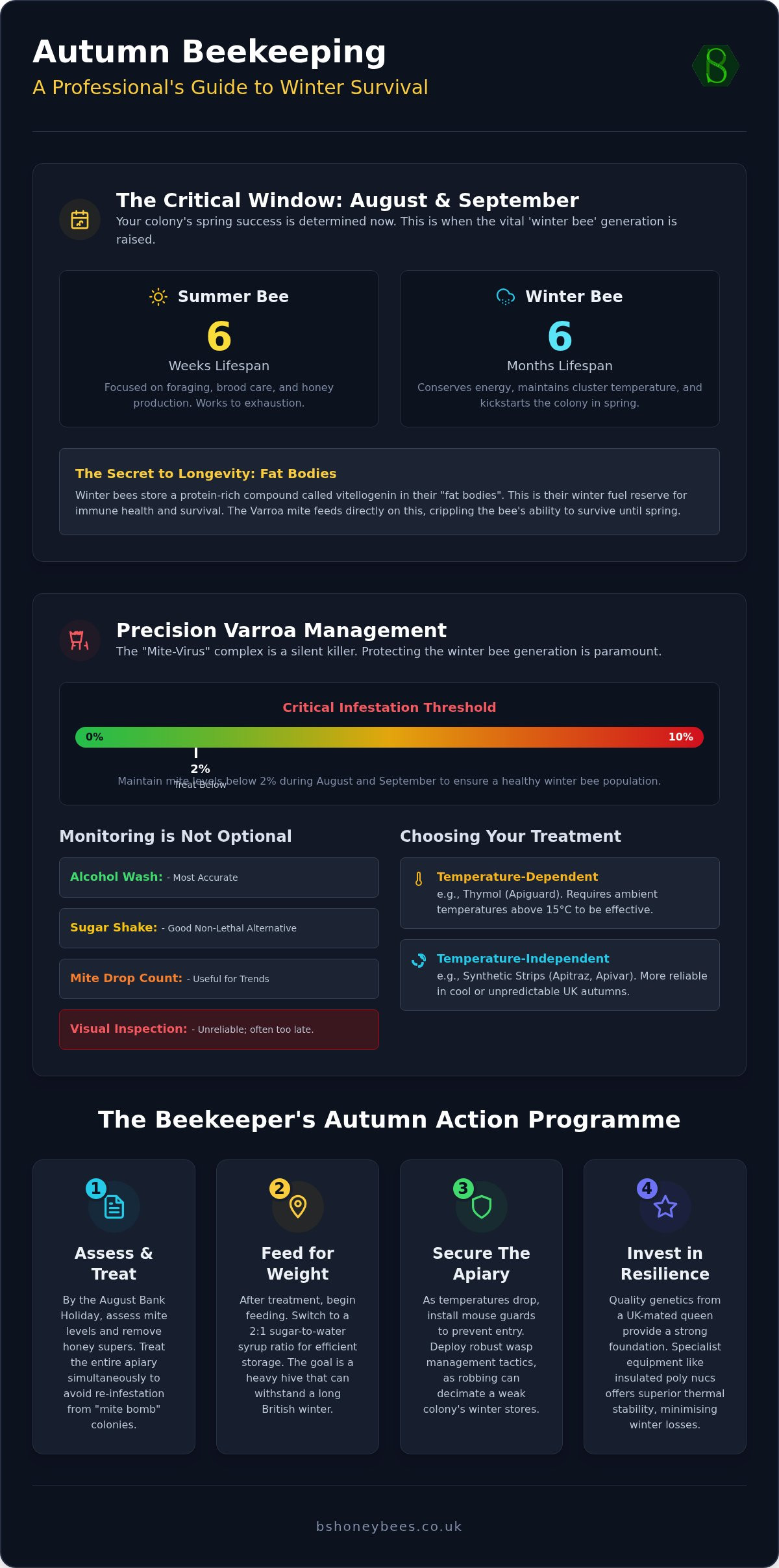
Success in the apiary is a lagging indicator. The vibrant, productive colony you want to see next April is engineered in the late summer of the previous year. This autumn feeding and varroa treatment guide for uk focuses on the "winter bee" generation. These bees are physiologically different from their summer sisters. Whilst a summer worker lives for roughly six weeks, a winter bee must survive for up to six months. Their health is the only metric that truly matters during this transition. If this generation is compromised, the colony will dwindle and fail before the first willow catkins appear.
The UK nectar gap is a treacherous period for the unprepared. Once the main summer flows from lime or blackberry subside, forage availability often plummets. Waiting until October to begin feeding is a common mistake that leads to starvation or stunted brood rearing. In 2026, erratic UK climate trends have made forage even more unpredictable; sudden late-summer heatwaves can dry up floral resources overnight. If you don't provide supplemental nutrition in August, you risk your colony entering the cold months with a population that is too small to maintain the cluster temperature.
The Biology of Winter Bees: Fat Bodies and Longevity
Winter bees rely on "fat bodies," which are internal organs that store vitellogenin. This protein-rich compound acts as a reservoir for immune health and longevity. The Varroa destructor mite represents a direct threat because it feeds on these fat bodies, literally draining the bee of its ability to survive the winter. High-quality pollen in late August and September is non-negotiable. It provides the essential amino acids required to build these reserves before the queen reduces her laying rate. Without these protein stores, bees cannot produce the larval food needed to restart the colony in late January.
Setting Your 2026 Autumn Timeline
Treat the August Bank Holiday as your hard deadline for assessment. It is the point where you must transition from honey production to colony preservation. Whilst late forage like ivy or heather can provide a welcome boost, don't rely on them as your primary survival strategy. Late-season queen failure can also be catastrophic at this stage. Having access to high-quality mated queen bees UK ensures you don't lose a colony simply because a queen failed to return from a late mating flight. Acting now ensures your bees have time to process syrup and settle before the first frosts arrive.
Precision Varroa Management: Protecting the Winter Generation
The "Mite-Virus" complex is the silent killer of the UK apiary. Whilst varroa mites weaken bees by feeding on their fat bodies, the viruses they vector, such as Deformed Wing Virus (DWV), cause the eventual colony collapse. A colony with high mite counts in September will produce a winter generation already riddled with disease. These bees simply won't survive until February. According to the National Bee Unit Varroa guidance, maintaining an infestation level below the 2% threshold is critical during this late-summer window.
Monitoring is the only way to ensure your strategy is working. Don't rely on visual inspections of bees on the comb; by the time you see mites on adult bees, the infestation is likely terminal. An alcohol wash provides the most accurate data, though a sugar shake is a popular non-lethal alternative for hobbyists. Natural mite drop on a floor board offers a useful trend over several days, but be aware that scavengers like ants can skew the results. This autumn feeding and varroa treatment guide for uk recommends treating your entire apiary simultaneously. If you leave one hive untreated, it becomes a "mite bomb" that will re-infest neighbouring colonies through drifting and robbing.
Temperature-Dependent vs. Temperature-Independent Treatments
Your choice of treatment must align with the UK weather forecast. Thymol-based products, such as Apiguard, require consistent ambient temperatures above 15°C to sublimate and disperse through the hive effectively. If the autumn turns cold early, synthetic strips like Apitraz or Apivar are more reliable as they don't depend on evaporation. When using formic acid in British National beehives, ensure the mesh floor is open and ventilation is clear. High concentrations of formic acid in poorly ventilated hives can lead to queen loss or significant brood damage during the first 48 hours of application.
The Step-by-Step Varroa Control Programme
Follow this logical sequence to maximise efficacy and colony safety:
- Step 1: Perform a final mite count immediately after the honey harvest to determine the infestation level.
- Step 2: Remove all honey supers intended for human consumption before applying any chemical treatments.
- Step 3: Monitor the "mite drop" during the first week of treatment to confirm the product is working as expected.
- Step 4: Record all treatment dates and batch numbers in your hive records. Plan for a follow-up oxalic acid treatment during the mid-winter broodless period to catch any surviving mites.
Using professional-grade equipment from BS Honey Bees ensures your applications are precise and your colonies remain undisturbed during these critical late-season interventions.
Autumn Feeding Strategies: Calibrating Stores for a UK Winter
Estimating stores is a skill that separates successful overwintering from heartbreaking spring losses. For a standard British National hive, you should aim for approximately 18kg to 22kg of sealed stores. A simple "heft" test is often sufficient for experienced keepers; the hive should feel immovable, as if it were nailed to the ground. If you can lift it easily with one hand, your bees are at risk. This autumn feeding and varroa treatment guide for uk emphasises that nutrition is the essential partner to mite control. Whilst you monitor how to spot and report Varroa, you must simultaneously ensure the larder is full.
September is the golden month for feeding. The ambient temperature is still high enough for bees to evaporate moisture from syrup and seal the cells. By October, the energy required to process liquid feed often outweighs the nutritional benefit. If your bees have been on the heather, be cautious. Heather honey has a high mineral content that can cause dysentery if the colony is confined during a long, cold snap. Supplementing with white sugar syrup dilutes these minerals and provides a "cleaner" fuel for the winter cluster. It's better to provide a large volume of feed quickly than to drizzle small amounts over several weeks.
Syrup Ratios and Feeding Equipment
Use a 2:1 ratio (2kg of sugar to 1 litre of water) for autumn storage. This "thick" syrup requires less processing than a 1:1 stimulative mix. Rapid tray feeders are the most efficient tool for this task, allowing a strong colony to take down several litres in a single night. To prevent robbing, always feed in the evening and reduce hive entrances to a minimum. Robbing behaviour doesn't just steal stores; it spreads mites and viruses between colonies. If a colony is slow to take feed, check for underlying health issues or queenlessness immediately.
Breed-Specific Nutritional Requirements
Not all bees consume stores at the same rate. F1 buckfast queens UK are bred for productivity and often maintain larger winter clusters. This provides excellent thermal stability but requires a higher volume of stores to sustain the population. In contrast, Carniolans are more frugal in mid-winter but accelerate their consumption rapidly as soon as spring brooding begins. If you are overwintering a nucleus colony, remember that their smaller volume makes them more susceptible to temperature fluctuations. They require a more attentive feeding schedule to ensure they don't run out of fuel during a late-March frost.
Securing the Apiary: Physical Hive Protection and Wasp Defence
UK autumns bring more than just cold weather; they introduce biological and environmental threats that can breach a hive's defences in days. This autumn feeding and varroa treatment guide for uk highlights that physical security is just as vital as chemical intervention. Wasps (Vespula) are a relentless predator during the late season. They seek out sugar stores and protein, often overwhelming colonies that are already stressed by varroa or nectar gaps. It's a battle of attrition that requires proactive management before the first frosts arrive.
Mouse guards are another non-negotiable milestone for the British beekeeper. Fit these metal or plastic barriers once the first night frosts are forecast but before the bees form a permanent winter cluster. Mice seek the warmth and high-calorie food within the hive; their presence causes significant stress and physical damage to the combs. Regarding hive floors, the open mesh floor remains the preferred choice for UK winters to provide adequate ventilation. However, ensure your hive is stable. Use high-quality straps to secure the roof and brood box against autumn gales. A toppled hive in a January storm is almost always a death sentence for the colony.
Defending Against Wasps and Robbing
Help your bees help themselves by reducing entrances to a single bee-space. This creates a bottleneck that guard bees can easily defend against intruders. Place wasp traps around the apiary perimeter, but never directly next to the hive entrance, as this can inadvertently attract more predators to the colony. Late-season inspections are often fraught with tension as bees become more protective of their stores. Ensure you are wearing a professional BBWear bee suit to maintain focus and safety during these aggressive encounters.
Insulation and Internal Moisture Control
Excessive moisture kills more bees in the UK than the cold does. Warm, moist air rising from the cluster hits a cold crown board and condenses, dripping freezing water directly onto the bees. Prevent this by placing insulation, such as Kingspan, directly on top of the crown board to keep the internal surface warm. For smaller colonies or spare queens, the 2-in-1 poly nuc is the gold standard for overwintering. Its superior thermal properties minimise heat loss, allowing the cluster to maintain its core temperature with significantly less energy expenditure.
Protect your investment this winter by upgrading to robust British National hives and frames designed to withstand the British climate.
Investing in Resilience: How Quality Genetics and Equipment Minimise Losses
Management protocols are only as effective as the biological foundation they support. Whilst this autumn feeding and varroa treatment guide for uk provides the technical steps for survival, the resilience of your apiary depends heavily on the quality of your stock and equipment. A colony with poor genetics or a failing queen will struggle to process syrup or maintain a cluster, regardless of how many treatments you apply. Investing in high-standard genetics and standardised equipment is the most effective way to reduce winter mortality rates across your apiary.
Queen age is a primary driver of overwintering success. Statistics from seasonal bee inspections often show that colonies headed by a young, vigorous queen have significantly higher survival rates than those with queens entering their third year. A young queen is less likely to fail during the winter or become a drone layer during the critical spring build-up. For those looking to expand or replace lost colonies, overwintered nucs for sale UK represent the gold standard. These colonies have already proven their ability to survive a British winter, giving you a massive head start when the first forage appears.
The Value of Autumn Requeening
Don't be afraid to requeen in the late season if a colony is underperforming. A fresh queen introduced in August or September will lay a prolific batch of healthy winter bees. Different breeds offer distinct advantages for the UK climate. Buckfast genetics are excellent for building the large, robust clusters needed for thermal stability, although they require more diligent feeding. Carniolans offer a more frugal wintering behaviour, staying small and efficient until the spring. Safe late-season introduction requires a steady nectar supply; use a 1:1 syrup feed to mimic a flow and encourage the colony to accept the new monarch.
Preparing for the 2026 Spring Season
Use the quiet winter months to prepare for a rapid start. The British National Hive is the standard for a reason; its flexibility and compatibility make it the ideal system for the UK beekeeper. Clean your spare frames, scorch your brood boxes, and organise your kit. Review your hive records now to identify which colonies handled the autumn transition most effectively. If you plan to increase your hive count, book your 2026 honey bee nucs for sale UK early. High-quality stock from specialist suppliers often sells out months before the season begins.
True peace of mind comes from knowing you've left nothing to chance. By combining precise autumn management with superior genetics and robust equipment, you ensure your bees aren't just surviving the winter, but are poised to thrive the moment spring arrives.
Secure Your Spring Success Today
Successful overwintering is a deliberate process of engineering colony health long before the first frost arrives. By prioritising the "winter bee" generation through the strategies in this autumn feeding and varroa treatment guide for uk, you've taken the most important step toward a productive next season. Precision mite management and calibrated stores are the twin pillars of survival. When these are combined with robust physical hive protection, your colonies gain the resilience required to withstand the unpredictable British climate.
Don't leave your colony's future to chance with substandard stock or failing gear. Ensure your apiary is winter-ready with premium bees and equipment from BS Honey Bees. As specialist breeders of F1 Buckfast and Carniolan Queens, we provide the productive genetics your hives need to thrive. We also stock professional BBWear protective clothing for those essential late-season inspections and supply high-insulation 2-in-1 Poly Nucs to give your smaller colonies a superior thermal advantage. Your bees are counting on your expertise. Take action now and look forward to the rewarding sight of a strong, vibrant apiary emerging next spring.
Frequently Asked Questions
How much 2:1 syrup does a standard British National hive need for winter?
A standard British National hive requires approximately 18kg to 22kg of total stores to survive a typical UK winter. If your colony has limited natural honey, you should provide roughly 12 to 15 litres of 2:1 sugar syrup in September. This volume ensures the bees can fill and seal enough frames to sustain the cluster through March. Always heft the hive after feeding to confirm it feels heavy enough to withstand a long cold snap.
When is it too cold to use thymol-based varroa treatments in the UK?
Thymol-based treatments become ineffective when average daily temperatures drop below 15°C. The active ingredients rely on evaporation to disperse throughout the hive; cold weather halts this process entirely. If you miss the warm window in August or early September, switch to synthetic strips or wait for a mid-winter oxalic acid treatment. Applying thymol in October is often a waste of resources and leaves your winter bees unprotected against mite-vectored viruses.
Can I feed my bees honey from another hive if they are short of stores?
You should never feed honey from another colony unless you are absolutely certain of its provenance and health status. Transferring honey frames between hives is a primary vector for spreading American Foulbrood (AFB) and European Foulbrood (EFB). This autumn feeding and varroa treatment guide for uk recommends using white granulated sugar or inverted syrup instead. These options provide a sterile, high-energy food source that won't compromise the biosecurity of your apiary.
What happens if I don’t treat for varroa in the autumn?
Neglecting autumn varroa treatment usually leads to colony collapse between January and March. Whilst the hive may look strong in September, the mites will have already compromised the immune systems of the "winter bee" generation. These diseased bees cannot live long enough to raise the first spring brood. Untreated hives also act as "mite bombs," spreading parasites to your healthy colonies as the weak hive is robbed out by stronger neighbours.
Is it better to overwinter bees in a poly nuc or a wooden hive?
Overwintering smaller colonies or nucleus units is significantly more successful in a high-insulation poly nuc. These units provide superior thermal properties compared to traditional wooden hives, helping the cluster maintain its core temperature with less energy expenditure. Whilst wooden British National hives are excellent for large, established colonies, the 2-in-1 poly nuc is the professional choice for ensuring spare queens or late-season splits survive the damp UK winter frosts.
How do I know if my bees are being robbed by other colonies or wasps?
Robbing behaviour is characterised by frantic, zig-zagging flight patterns and visible fighting at the hive entrance. Unlike purposeful foraging, robbers often try to squeeze through gaps in the roof or floor. You'll likely see "greasy" looking bees and ragged wax cappings on the floorboard as intruders tear into the stores. Wasps are particularly persistent in late autumn; if you see them hovering around the entrance, reduce the opening immediately to a single bee-space.
Should I leave the queen excluder on over the winter?
Remove the queen excluder after your final autumn inspection to allow the cluster to move freely. If the excluder is left in place, the cluster may move up into the honey stores whilst the queen remains trapped below. This results in the queen freezing to death whilst the rest of the bees are well-fed just inches away. Ensuring the queen can stay in the centre of the warm cluster is a vital part of any autumn feeding and varroa treatment guide for uk.
When should I fit mouse guards to my beehives?
Fit mouse guards once the first night frosts are forecast, typically in late October or early November. You must install them before the bees form a permanent winter cluster; otherwise, a mouse might already be nesting inside the warm brood box. Once the bees are clustered, they can't defend the hive against rodents. These guards prevent mice from destroying combs and disturbing the bees, which can cause the cluster to break and freeze in sub-zero temperatures.