
The “best” honey bee race for beginners in the UK isn’t automatically the one with the friendliest reputation. A colony’s behaviour can vary, so choosing a bee type means looking beyond broad claims and considering how you’ll manage your hive. If you’re searching for the best honey bee race for beginners uk, start with the traits that matter to you, not a supposed one-size-fits-all winner.
It’s understandable to feel uncertain about temperament when you’re planning your first inspections and choosing a site for your apiary. This guide compares common options, including Buckfast and Carniolan bees, and explains how to weigh their commonly discussed tendencies against your experience, surroundings and preferred management style.
You’ll also find practical points to consider when choosing a queen or a 5- or 6-frame nucleus colony. The individual colony matters as much as its type, so the aim is to make a confident choice for your first hive while understanding the decisions and ongoing care involved in keeping bees in the UK.
Key Takeaways
- Choose according to your priorities, apiary setting and the time you can give inspections, rather than relying on a breed label alone.
- Compare Buckfast, Carniolan and British Black Bees by commonly discussed tendencies, while treating these as broad patterns, not promises about an individual colony.
- Use the comparison to decide which traits matter most when assessing the best honey bee race for beginners uk for your circumstances.
- Remember that inherited tendencies, colony conditions and your management decisions can all shape the bees’ behaviour.
- Decide whether a queen or a 5- or 6-frame nucleus colony better suits your experience and plans for a first hive.
Choosing the Best Honey Bee Race for Beginners in the UK: Start with Your Priorities
No single honey bee race is automatically best for every beginner. A bee race is a population with shared inherited characteristics and tendencies, not a guarantee that every colony will behave in the same way. Individual genetics, colony condition, the apiary environment and the beekeeper’s decisions all influence what you experience at the hive.
That distinction matters when searching for the best honey bee race for beginners uk. A reputation can help you frame questions, but it can’t predict exactly how a particular colony will respond during an inspection. Start with the practical realities of your apiary: how often you can inspect, how confident you feel handling bees, what forage is available through the season and what support you can draw on as you learn.
Bee type is one part of colony suitability; your apiary, management and the individual colony matter too.
What should a first-time beekeeper prioritise?
Prioritise behaviour you can manage during routine inspections, while allowing for variation between colonies of the same race. Be realistic about your available time and confidence. If work or other commitments make regular inspections difficult, a colony that needs close attention may not suit your circumstances, regardless of its breed reputation.
- Assess your setting: consider the space around the hive, nearby people and animals, and the forage available locally.
- Plan for a manageable start: a 5- or 6-frame nucleus colony is a common beginner starting point in the UK, rather than taking on a full-sized hive straight away.
- Build practical support: access to an experienced beekeeper or a local beekeeping association can help you develop sound inspection habits.
Beginner-friendly doesn’t mean effortless. You’ll still need to learn how to inspect, recognise changes in the colony and respond appropriately. Choose bees and a starting format that give you room to build confidence, rather than expecting the work to look after itself.
What does ‘best’ mean for a first hive?
Define “best” by your own priorities, not by a universal ranking. You might value steady, manageable inspections above other traits, or be particularly interested in how a colony develops through the seasons. If you’re interested in breeding, that may also shape which characteristics you pay attention to.
Conditions vary across the UK. Weather, forage and the apiary environment can all affect how a colony develops, so a recommendation that works in one setting may not transfer perfectly to another. Think about what your site can provide and what you can realistically manage.
Bee selection can’t replace careful, consistent colony management. The comparison ahead looks at temperament, commonly discussed seasonal tendencies and management fit. Treat these as factors to weigh, not guarantees. A suitable first choice is one whose likely characteristics fit your circumstances and whose care you’re prepared to learn.
How Bee Race, Colony Genetics and Management Shape Beginner Experience
A bee race can offer a useful starting point, but it can’t tell you exactly what will happen when you open a hive. Race refers to characteristics associated with a group of honey bees within the species Apis mellifera. These are tendencies shaped by selection and breeding, not fixed behaviours shared identically by every colony.
Race can suggest what to look for, but it cannot predict an individual colony’s behaviour on its own.
What can a bee race tell a beginner?
Think of race as one piece of background information, not a complete forecast. A bee type may be discussed in relation to temperament or seasonal development, but claims about gentleness, productivity, disease resistance or overwintering shouldn’t be treated as guarantees. Outcomes depend on the particular bees and the conditions they experience.
Breeding and selection influence inherited traits. A queen passes genetic material to her worker offspring, while the colony’s overall genetic make-up also reflects the drones with which she mated. That’s one reason a broad label cannot fully describe the behaviour of every worker in a hive. For a beginner, the practical questions are: “What do I know about these bees?” and “How will I manage this colony?”
Why management and conditions still matter
Your actions affect the inspection experience. Work calmly and deliberately, avoid unnecessary disturbance, and choose a suitable time to inspect rather than opening a hive in poor conditions. Rushed inspections or awkward handling can make the task harder for both beekeeper and bees. Follow sound guidance as you learn; don’t rely on a race label to make inspections straightforward.
Conditions around the hive change over time. Forage availability and weather differ across the UK and through the season, influencing the resources and conditions a colony experiences. If forage is limited or weather restricts flying, colony activity may look different from a period with more favourable conditions. Consider these factors when observing the hive rather than treating a change as evidence that a particular race has failed to meet a promise.
- Notice patterns, not single moments: record what you observe across inspections instead of judging a colony from one visit.
- Keep conditions in view: consider recent weather, available forage and the colony’s development when interpreting its behaviour.
- Separate observation from assumption: note what the bees actually do rather than attributing every change to their race.
Choosing bees doesn’t remove the need to learn responsible hive management, including regular observation and appropriate care. First understand what you’re selecting, then match that choice to your experience and apiary. If you’re comparing F1 Buckfast and Carniolan queens, treat each as a bee type to consider, not a guarantee of temperament or success. That balanced approach gives you a sounder basis for comparing your options.
Buckfast, Carniolan and British Black Bees: A Beginner’s Comparison
Buckfast and Carniolan bees are two options beginners may encounter when looking for a queen or nucleus colony. The British Black Bee is another type worth understanding, but these names don’t describe identical colonies or guarantee particular behaviour. Use the comparison to identify what you’d like to learn more about, then consider the bees’ breeding background and how their characteristics might fit your apiary.
Descriptions of bee types often focus on tendencies, such as temperament or seasonal development. Treat those descriptions as starting points for comparison, not promises. The actual colony and your management matter too. For more detail on comparing the first two options, see the Buckfast and Carniolan comparison.
| Type | Commonly discussed tendencies | Beginner considerations and caveats |
|---|---|---|
| F1 Buckfast | A selectively bred type; characteristics can depend on the breeding line. | Consider the queen’s breeding background and your priorities. The name alone can’t guarantee temperament, honey yield or disease resistance. |
| Carniolan | Often discussed in relation to seasonal colony development and temperament. | Consider how those tendencies relate to your inspection plans and local conditions. Individual colony behaviour can differ. |
| British Black Bee | Usually refers to the native honey bee subspecies, Apis mellifera mellifera. | Research the particular bees and their background. The name doesn’t mean every dark-coloured bee is this subspecies or that it is a universal beginner choice. |
When might a beginner consider F1 Buckfast bees?
F1 Buckfast bees may suit a beginner whose priorities align with the traits of the particular breeding line. “F1” describes a first-generation cross, so consider the parentage and selection behind the queen rather than assuming every F1 Buckfast colony will be alike. Don’t treat the label as proof of a specific temperament, yield or health outcome. The F1 Buckfast queens guide offers another way to explore this option.
When might Carniolan or British Black Bees suit a beginner?
Carniolans are often discussed in relation to seasonal development, but how that fits your needs depends on the colony, local forage and the time you can give inspections. British Black Bees are a distinct option to research, not a default standard for every UK apiary. Compare the bees’ known background and observed behaviour with your site and management capacity before deciding.
When weighing up the best honey bee race for beginners uk, compare practical fit rather than choosing by reputation alone. Write down the characteristics you value, then weigh them against what you can manage consistently. This makes the comparison useful without turning a broad breed description into a promise about your first colony.
A Beginner’s Checklist for Matching Bees to a UK Apiary
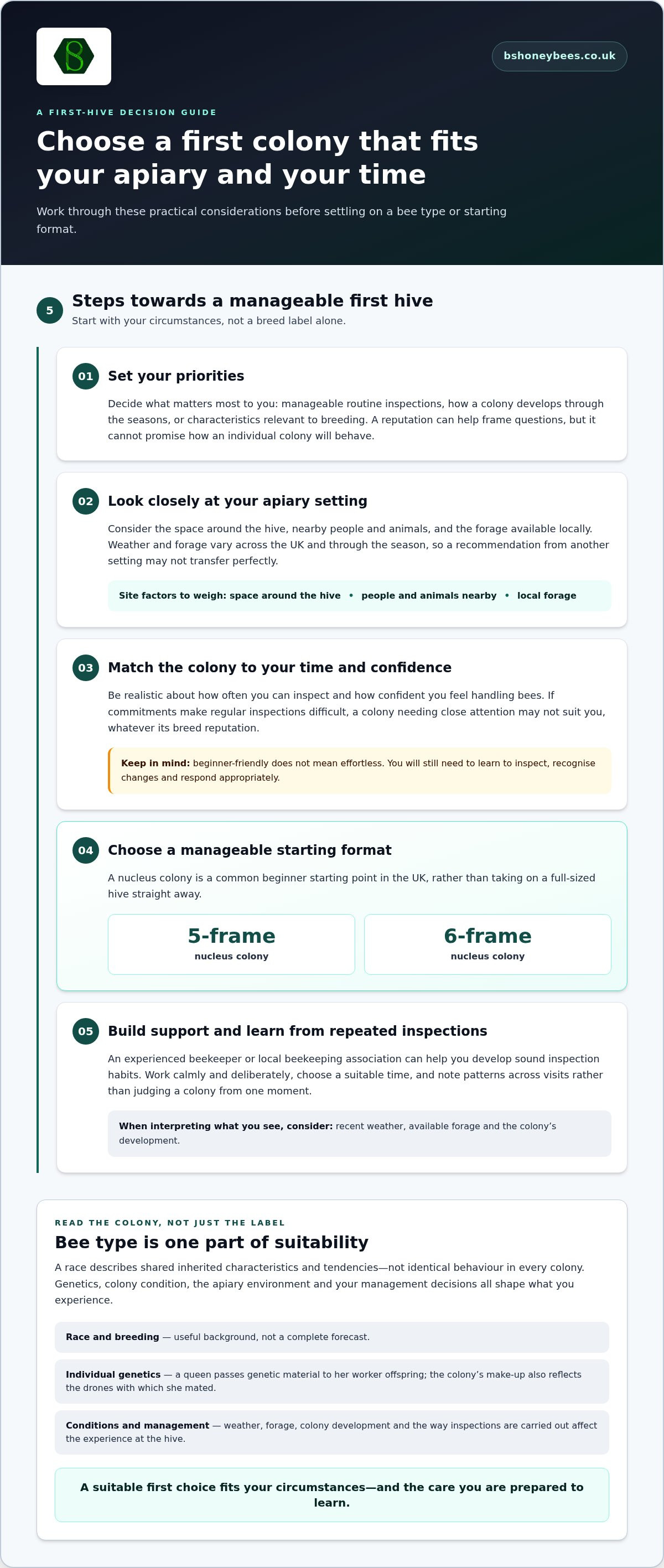
Turn your bee choice into a practical decision before acquiring a colony. Start with your experience, the apiary setting and the time you can commit to inspections. Then compare bee traits against what you can manage, rather than selecting by reputation alone.
The right bees are those whose known tendencies and care requirements fit your apiary, experience and available time.
- Be honest about your experience. If this is your first colony, plan for a learning curve. Consider whether you’ll have practical guidance as you develop confidence inspecting and managing bees.
- Assess the apiary setting. Look at the working space around the hive, the direction bees are likely to fly, and the proximity of neighbours, paths or animals. A confined site calls for careful thought about flight paths and safe access.
- Set a realistic inspection schedule. Consider how regularly you can visit and work with the colony responsibly. Don’t assume a particular bee type will need little attention.
- Rank your priorities. Decide what matters most: manageable inspections, interest in seasonal colony development, or a longer-term interest in breeding. A ranked list helps you compare options without expecting one type to excel at everything.
- Plan equipment and ongoing learning. Before acquiring bees, make sure your hive and equipment plans suit the colony you intend to keep. A British National hive is widely used in the UK, and compatible equipment can make it easier to work with a familiar standard. Include continued learning and responsible colony care in your plan.
How to assess your apiary and capacity
Think beyond the hive stand. You’ll need room to work safely during inspections, and flight paths should be considered in relation to people and boundaries. Weather and forage vary across the UK and through the season, so assess what your site can offer instead of relying on a generic regional assumption. Match your plans to the conditions you can observe locally.
Be realistic about interruptions, too. If you can’t reliably make time for inspections, reconsider when to acquire a colony or how you’ll organise your beekeeping commitments. Even a suitable bee choice needs consistent attention.
How to use bee traits without over-relying on labels
Compare descriptions of bee traits with your priorities, but treat them as information to weigh, not a forecast of your future colony. Look for clear details about the bees’ background and focus on what is actually described. A label such as “gentle” doesn’t remove the need for careful handling or sound management. For another perspective on temperament, explore this guide to gentle honey bee breeds.
Use your checklist to narrow the choice, then decide whether a queen or a nucleus colony better suits your experience and plans. If you’re ready to take that practical next step, explore F1 Buckfast and Carniolan queens and 5- or 6-frame nucleus colonies.
From Bee-Race Choice to Your First Queen or Nucleus Colony
Once you’ve matched your priorities to a bee type, decide how you want to begin. A queen and a nucleus colony are different starting points. A queen isn’t a colony on her own: she’s introduced to an existing colony or used as part of a planned hive set-up. A nucleus, or nuc, is a small established colony, making it a more complete starting point if you’re building your first hive.
Should a beginner start with a queen or a nucleus colony?
Start by considering what you already have. If you’re managing an established colony and have a specific reason to introduce a queen, buying a queen may fit your plan. If you’re starting from scratch, a nucleus colony includes a queen and a functioning group of bees, so you begin with a colony rather than a queen alone. Your experience, equipment and intended starting point should guide the decision.
A 5- or 6-frame nuc is a common UK beginner option. It still needs careful handling and ongoing management; it isn’t a shortcut around learning how to keep bees. For more context on what to consider before choosing one, read this UK nucleus-colony buyer’s guide.
What to do before committing to a first colony
Pause before ordering. Make sure your chosen bee type, apiary and capacity to manage a colony all make sense together. Use this short checklist to bring the decision into focus:
- Bee type: note which traits matter to you, remembering that a race label doesn’t guarantee how an individual colony will behave.
- Management priorities: decide what you can realistically manage, from inspection time to the support you’ll use as you learn.
- Apiary readiness: make sure your planned hive, equipment and working space are ready for the type of starting point you’ve chosen.
- Starting format: choose a queen for a suitable existing colony or plan, or a nuc if you intend to begin with an established colony.
There’s no universal answer to which is the best honey bee race for beginners uk. The useful choice reflects your priorities and experience, while leaving room to assess the actual bees and manage them responsibly.
BS Honey Bees Ltd supplies F1 Buckfast and Carniolan queens, as well as 5- and 6-frame nucleus colonies. Explore the queen and nucleus-colony options as you decide which starting point fits your plans. Compare the options with your apiary and management approach in mind.
Make Your First Colony a Thoughtful Next Step
Your first hive is the start of an ongoing relationship with a living colony, not a one-off breed decision. Keep observing, learning and adjusting your approach as you gain experience. The best honey bee race for beginners uk is ultimately the bee type that fits your apiary and the care you’re ready to provide, without relying on a label to predict every outcome.
BS Honey Bees Ltd supplies F1 Buckfast and Carniolan queens, alongside 5- and 6-frame nucleus colonies, and distributes live bees and beekeeping equipment across the UK. Choose an option that matches your intended starting point and management plans.
Explore F1 Buckfast and Carniolan queens and nucleus colonies to find a suitable starting point for your first colony.
Frequently Asked Questions
Is Buckfast a true honey bee race?
Buckfast is a selectively bred type of honey bee, not a separate species or a single, universally standardised biological race. It was developed through breeding and selection, and different breeding lines may have different backgrounds. For a beekeeper, the name is useful context, but it doesn’t tell the whole story about a queen’s ancestry or the behaviour of her colony. Consider the breeding information alongside your own observations.
What does F1 mean when describing a queen bee?
F1 usually means the first generation produced from selected parent lines. In bee breeding, the label describes a generation, not a guarantee that every daughter will show identical traits. A queen’s offspring also reflect the drones she mates with, so the result can’t be understood from the F1 label alone. If you’re comparing queens, use the term as a prompt to learn about the breeding background, rather than as a behaviour rating.
Can a beginner keep more than one type of honey bee?
Yes, a beginner can keep colonies of different types, provided they can manage each colony carefully. Keeping more than one can make it easier to compare what you observe, but it also means tracking inspections, development and management decisions separately. Clear notes help prevent assumptions about one hive being applied to another. If you’re new to beekeeping, consider whether you have the time, equipment and practical support to care for each colony properly.
Are British Black Bees the same as Buckfast bees?
No. British Black Bees generally refers to the native subspecies Apis mellifera mellifera, while Buckfast bees are a selectively bred type. The names describe different backgrounds, not two interchangeable labels for the same bee. Colour alone isn’t a reliable way to identify a bee’s ancestry. If a colony’s heritage matters to your plans, look for information about its breeding history rather than judging it by appearance.
Does choosing a gentle bee race mean a beginner will not get stung?
No. A reputation for gentleness doesn’t remove the possibility of being stung. Bees may sting defensively, and individual responses can vary with the colony and circumstances. Wear suitable protective clothing, work calmly, and avoid unnecessary disturbance, while remembering that protective equipment reduces exposure rather than making stings impossible. If you’re allergic to bee stings or have had a serious reaction before, seek medical advice before taking up beekeeping.
Can bees from different races mate with each other?
Yes. Honey bees of different races or breeding types can mate, as they belong to the same species, Apis mellifera. A virgin queen mates with drones, and the drones’ genetics contribute to the worker bees she later produces. This matters if you’re interested in maintaining a particular breeding line: the appearance or label of the queen alone won’t determine the ancestry of all her offspring.