
For UK buyers and sellers, 2026 honey prices are best understood as separate benchmarks: local jar prices, beekeeper reports and seasonal bulk rates aren’t interchangeable. Region, honey type, pack size and whether the sale is direct or wholesale all shape the comparison.
A single headline average can be useful, but it won’t tell you exactly what a jar should cost or whether a bulk offer is good value. Compare like with like, and account for seasonal changes in supply.
This guide explains how to interpret local averages, wholesale ranges and beekeeper reports, with a focus on spring and summer bulk pricing. Use these reference points to compare prices more confidently, whether you’re setting a retail price or planning a seasonal purchase.
Key Takeaways
- Compare honey by jar size, variety and sales channel to make local price averages more useful.
- Separate wholesale rates from retail prices; each reflects different costs, margins and quantities.
- Use beekeeper reports alongside seasonal context, including what is in bloom and local harvest conditions.
- When assessing bulk honey, consider the honey type, container format and timing of the purchase.
- For a quality reference point, the Codex Alimentarius Commission identifies the Codex Alimentarius Standard for Honey as CXS 12-1981.
Using local averages to inform honey pricing
When setting 2026 honey prices, compare like-for-like products sold through similar channels. For British honey, local conditions can make a useful benchmark more practical than one national figure.
Local and UK average prices
A local average is a reference point based on honey sold in a particular area.
Start with the UK range, then narrow your comparison to the area where you sell. Match jar weight and sales channel first: direct beekeeper sales and shop prices aren’t equivalent. Treat the average as a starting point, not a fixed price for every local producer.
Factors supporting premium pricing
Premium pricing can reflect features that distinguish a honey from a standard blended product. Floral source, local origin, limited seasonal supply and careful presentation can all support a higher price.
Manuka honey prices in the UK depend on jar size, origin, grade and sales channel. Compare the same pack size and grade to assess value. Shelf prices alone don’t make different products comparable.
Pricing by jar size and weight
Jar-size pricing sets a selling price according to the honey’s weight and packaging. Compare the price per gram as well as the ticket price: a larger pack may cost more overall but offer a different unit value.
Production costs matter too. Include packaging and labour in your calculation, then compare the result with similar local products. Comparing by weight helps explain price differences without implying that every jar should cost the same.
UK supermarket honey prices
Supermarket honey prices vary by pack size, product type and retailer. Compare the weight and label with British local honey before using a shelf price to guide a beekeeper’s charge. A blended product and a single-source jar aren’t direct equivalents.
For a shop sale, the channel also affects the beekeeper’s return. Check these 2026 honey prices against the format and route to market before choosing a comparison.
Wholesale price ranges and year-on-year changes
Wholesale prices apply to honey sold in larger quantities or through trade channels, rather than individual retail jars. Check the country, sales format and reporting period before using a market movement to inform a UK buying or selling decision.
Global wholesale movements by country
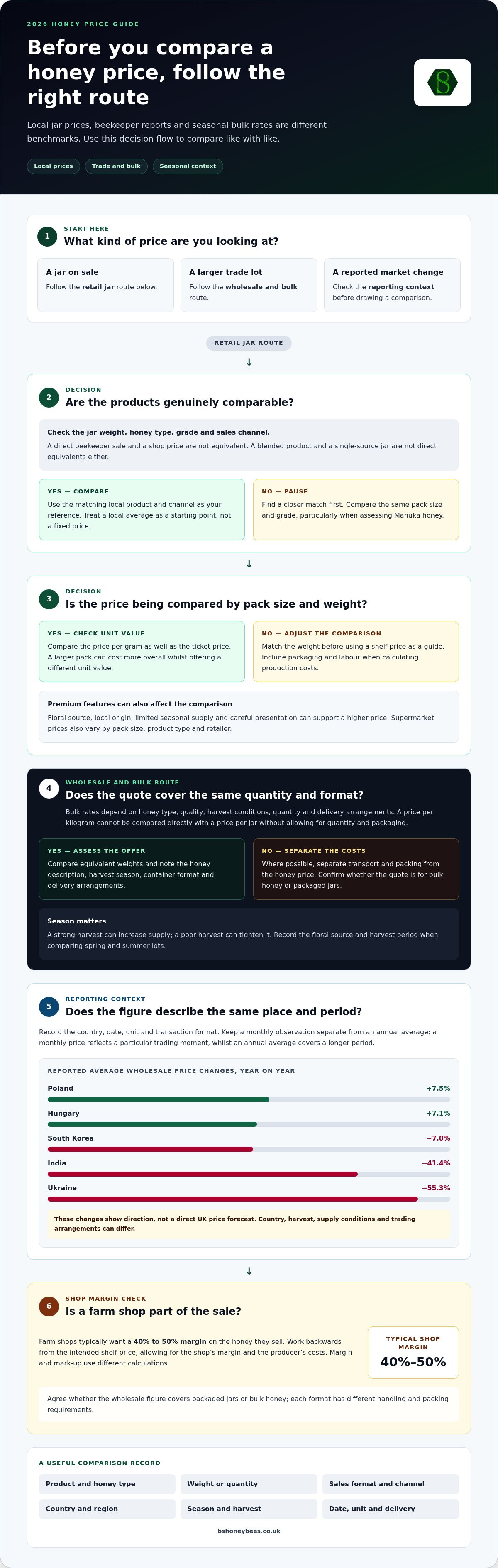
A country comparison shows whether reported wholesale prices are moving upwards or downwards in different markets. The listed average wholesale price for Poland changed by +7.5% year on year, whilst Hungary recorded +7.1%. India’s average fell by 41.4%, Ukraine’s by 55.3%, and South Korea’s by 7.0%.
These percentages show a direction of change, not a direct UK price forecast. A change in one country may reflect its harvest, supply conditions or trading arrangements, and doesn’t establish what a UK producer should charge. Use country comparisons as context, then compare honey of the same type, quality and sales format. An imported bulk lot and a locally harvested crop aren’t automatically equivalent.
For a useful comparison, record the country, date, unit and transaction format alongside each market figure. Keep April 2026 observations separate from annual averages. A monthly price can reflect a particular trading moment, whilst an annual average smooths changes across a longer period.
Wholesale and bulk honey prices
Bulk honey pricing is the price agreed for a larger quantity, often before retail packaging. The unit rate depends on honey type, quality, harvest conditions, quantity and delivery arrangements. You can’t compare a price per kilogram directly with a price per jar without accounting for quantity and packaging.
Season matters. A strong harvest can increase supply, while a poor harvest can tighten it. When comparing spring and summer lots, note the floral source and harvest period, then compare equivalent weights. Light honey in a large container may have a different price from a distinctive varietal lot packaged for shops.
Create a comparison sheet listing the country, harvest season, honey description, quantity and quoted unit. Where possible, separate transport and packing costs from the honey price. This clarifies the offer and shows whether a change reflects the honey itself or the route to market.
Farm shop wholesale margins
A farm shop margin is the share of the retail selling price retained by the shop before its other costs. Farm shops typically want a 40% to 50% margin on honey they sell. That requirement affects the wholesale price a beekeeper can negotiate while leaving the shop room to operate.
Work backwards from the intended shelf price, accounting for the shop’s margin and the producer’s costs. Margin and mark-up aren’t the same: they use different calculations. Agree whether the wholesale figure covers packaged jars or bulk honey, since each format has different handling and packing requirements.
For a UK-focused view of the market, use this honey pricing context alongside local trade comparisons. Record the season and product description each time; consistent notes make year-on-year changes easier to interpret.
Price reports for beekeepers
A beekeeper price report is a regular record of honey prices and local conditions, used to compare sales across regions. The 2026 reports cover January through October, giving readers a view of the year as it develops. Read each entry alongside its month, honey type and location. A spring blossom report and a later wildflower report may describe different crops, not a simple change in the same product’s value.
Each month, honey reporters gather prices in their region, note what is blooming and share their mite treatment. These details put each price observation in context. For example, a report noting blossom alongside a local harvest helps distinguish that honey from a crop produced when different plants were flowering. Record the region and date, then compare reports describing similar honey and sales formats.
Examples of British honey show why product type and pack size should be considered alongside price. These examples aren’t interchangeable: one is a jar weight, another a comb block, and the specialty range groups distinct products.
Use a report to build a like-for-like comparison, not to copy one beekeeper’s price. First note the honey type, such as heather or blossom. Then record the pack format and weight, followed by the region and reporting month. Keep direct-to-customer prices separate from wholesale observations. This makes it easier to distinguish a seasonal price movement from a change caused by product, packaging or sales channel.
For a small apiary, keeping a simple record by season makes reports more useful. Log each sale with its month, variety, jar size and sales channel, then compare it with reports from similar areas. A wildflower jar sold directly isn’t equivalent to bulk honey or cut comb. Recording the same details each time helps beekeepers assess local demand and review prices as flowering and harvest conditions change.
The Honey Index plans to publish annual averages to track honey market trends across the UK. An annual average can help put individual monthly reports into a broader context, but it won’t explain every local difference. Compare it with the underlying region and product details. Used together, the monthly reports from January through October 2026 and planned annual averages offer beekeepers a clearer way to follow changing market conditions.
2026 Spring and summer bulk honey prices
Bulk honey pricing is the rate for honey sold in larger quantities before individual retail sale. In the UK, spring and summer offers depend on harvest volume, floral source, quality, quantity and packing format. Compare those details first: a pail of blossom honey and a batch of distinctive summer honey are different products, even when both are sold in bulk.
Seasonal supply shapes the negotiation. A good season may produce 50-80 lbs of honey per hive, while a poor UK season may yield 10-15 lbs per hive. That difference affects how much a beekeeper can offer buyers and how much honey is available for bottling. Buyers should separate spring and summer lots in their records rather than combine them into one annual bulk price.
Floral source is another key comparison point. Blossom, wildflower and heather describe different honey types, so record the source alongside the harvest period. A clear lot description helps prevent a blended product being compared with a single-source batch. Include the variety, region, harvest timing and quantity in every quote or purchase record.
Packaging affects the practical value of a bulk offer. Buyers purchasing honey in containers for later bottling need to account for handling, storage and the work involved in preparing retail jars. A seller offering honey already packed has different costs. Compare the same format and weight, and record whether packaging and transport are included in the price.
Use a simple three-step check for each spring or summer offer:
- Record the honey type, region, harvest period and quantity.
- Compare like-for-like lots and note whether the honey is bulk, blended or retail-packed.
- Calculate the total purchase cost against the intended use, including packing and handling.
This approach gives buyers a useful seasonal comparison without treating every UK harvest as identical. For example, assess a small spring lot according to its volume and floral source, rather than pricing it as if it matched a larger summer batch. Beekeepers can use the same record to review offers through the season and see which product details influence buyer interest.
Price records are more useful when they distinguish a change in honey value from a change in format or supply. Note the date, unit and container for each transaction, then compare spring with summer. A clear record makes the next negotiation more precise: both sides can discuss the honey, quantity and preparation involved instead of relying on a broad seasonal average.
What is the average price of honey in the UK in 2026?
The average price is a reference point for comparing honey of similar type, weight and sales channel. Differences reflect local conditions and product distinctions, so a range is more useful than one national figure.
Jar weight changes the comparison. Compare the price per gram, not just the shelf price. This shows how much honey each price buys, although it doesn’t account for differences in origin, floral source or presentation.
Location shifts the reference point. Use a local range that matches the area where you intend to sell.
Product type matters as much as geography. These products aren’t equivalent: origin, blend, jar size and sales channel differ. Compare a premium variety with similar specialist honey, not an everyday blend.
For sellers, the average is a starting point, not a complete pricing method. Include the jar, lid, labour and other production costs before setting a retail price. The buyer’s location and sales channel also affect the final figure. Keep costs separate from the market comparison so you can see whether your chosen price covers production.
For buyers, compare the label, weight and honey type before judging value. For sellers, record local prices for the same size and product, then review them as the season changes. If you’re comparing locally produced options, explore English honey as a distinct category alongside blended products. A like-for-like comparison makes the UK average useful without assuming every jar should cost the same.
BS Honey Bees: F1 Buckfast Queens
BS Honey Bees Ltd supplies F1 Buckfast Queens for beekeepers planning their next apiary decision. Honey prices help with budgeting, whilst the right equipment or colony option supports practical planning for the season ahead.
Turn to BS Honey Bees Ltd when you’re considering F1 Buckfast Queens, Carniolan Queens, 5 / 6 Frame Nucs or 2 in 1 Poly Nucs. These offerings give beekeepers options when selecting queens or nucleus colonies to suit their apiary plans. Choose according to what you’re looking to add, rather than treating honey market averages as a guide to the cost of bees or equipment.
For a straightforward next step, visit bshoneybees.co.uk or contact BS Honey Bees Ltd.
Plan your next step with confidence
Use 2026 honey prices as one input when planning your next season, not as a substitute for decisions about your apiary. Consider how your production plans, colony requirements and sales goals fit together before committing to changes. A clear plan helps connect honey pricing with the practical work of keeping bees.
BS Honey Bees offers F1 Buckfast Queens, Carniolan Queens and 5 / 6 Frame Nucs for beekeepers planning their colonies. Explore these options in relation to your own apiary needs, then take the next step when you’re ready.
Contact BS Honey Bees to discuss your beekeeping plans. A considered approach can help you move into the coming season with confidence.
Frequently Asked Questions
How much does UK honey cost per 100g, 340g, or 1kg in 2026?
Prices for 100g and 1kg packs depend on the product and seller, so compare the actual pack weight and price rather than assuming a direct size-for-size equivalent. A 100g jar may carry proportionally higher packaging costs, whilst a larger container can suit bulk buying. Check whether the honey is local, blended or a specialist variety.
How do UK prices for local and artisan honey compare with supermarket honey?
Local and artisan honey generally sits in a higher price bracket than supermarket blended honey. These are different products and pack formats, so compare the label, honey type and weight before judging value. A local jar’s origin and variety help explain its price.
What is the price of imported honey in the UK in 2026?
That figure describes a particular category, not every imported honey: origin, blend, pack size and retailer all affect the shelf price. To compare an imported jar with British honey, check the weight and price per unit, then distinguish blended honey from a named floral variety. A single imported-honey price isn’t a market-wide rate.
How have UK honey prices changed since 2025?
There isn’t one change that applies to every UK honey price. A fair 2025-to-2026 comparison needs the same honey type, pack weight, region and sales channel in both years. A shift in a shop’s shelf price may reflect packaging or retail conditions, whilst a beekeeper’s price can respond to harvest volume and selling costs. Keep those factors separate when reviewing past prices against current offers.
What factors are affecting honey prices in the UK in 2026?
UK honey prices reflect harvest size, floral source, region, labour and packaging, as well as whether the sale is direct, wholesale or through a shop. Seasonal supply matters: a good season may yield 50-80 lbs per hive, compared with 10-15 lbs in a poor UK season. Product type also affects comparison; heather honey, cut comb and blended honey serve different markets and shouldn’t be priced as identical goods.
Where can consumers find the cheapest honey in the UK in 2026?
That is a category reference, not a guarantee that every shop or pack will carry that price. Compare the jar’s weight and shelf price, then check whether the product is blended or British honey. A low ticket price may reflect a different product or format, so use the unit price and label for a more meaningful comparison.
Do UK honey prices vary by region or retailer in 2026?
Yes. Retail channel matters too: a farm shop’s margin affects the shelf price, while direct sales follow a different route. Compare the same jar size and honey type within the relevant area and retailer.