

You don't need an official government licence to keep honey bees in a residential garden, but that freedom brings serious legal accountability. When examining backyard beekeeping regulations UK residents are often surprised to find that domestic apiculture requires no national permits across England, Scotland, or Wales. However, an absence of red tape doesn't mean a lack of legal oversight. Under British law, your primary legal duty centres entirely on proactive nuisance mitigation and strict biosecurity control.
It's entirely natural to worry about council enforcement, friction with neighbours, or the dread of opening an overly defensive hive near a boundary fence. This 2026 legal guide provides complete clarity on domestic property rights, statutory nuisance obligations under the Environmental Protection Act 1990, and disease reporting mandates. We will walk through the exact steps needed to manage flight paths, register your apiary on BeeBase, and select calm, manageable bee stock so you can manage a compliant home apiary with confidence.
Key Takeaways
- Understand your legal position under backyard beekeeping regulations uk, confirming that domestic hobbyists require no official government licence to keep bees on private land.
- Protect your apiary from statutory nuisance claims under the Environmental Protection Act 1990 by managing flight lines and flight path elevations effectively.
- Stay fully compliant with statutory biosecurity laws, including mandatory reporting requirements for notifiable brood pests and voluntary registration on BeeBase.
- Fulfill your legal duty of care through strict seven-day swarm management inspections to prevent defensive swarming into adjoining properties.
- Establish a trouble-free garden apiary using standard British National hives paired with calm, inspected queen genetics designed for residential settings.
UK Beekeeping Law Explained: Do You Need a Licence?
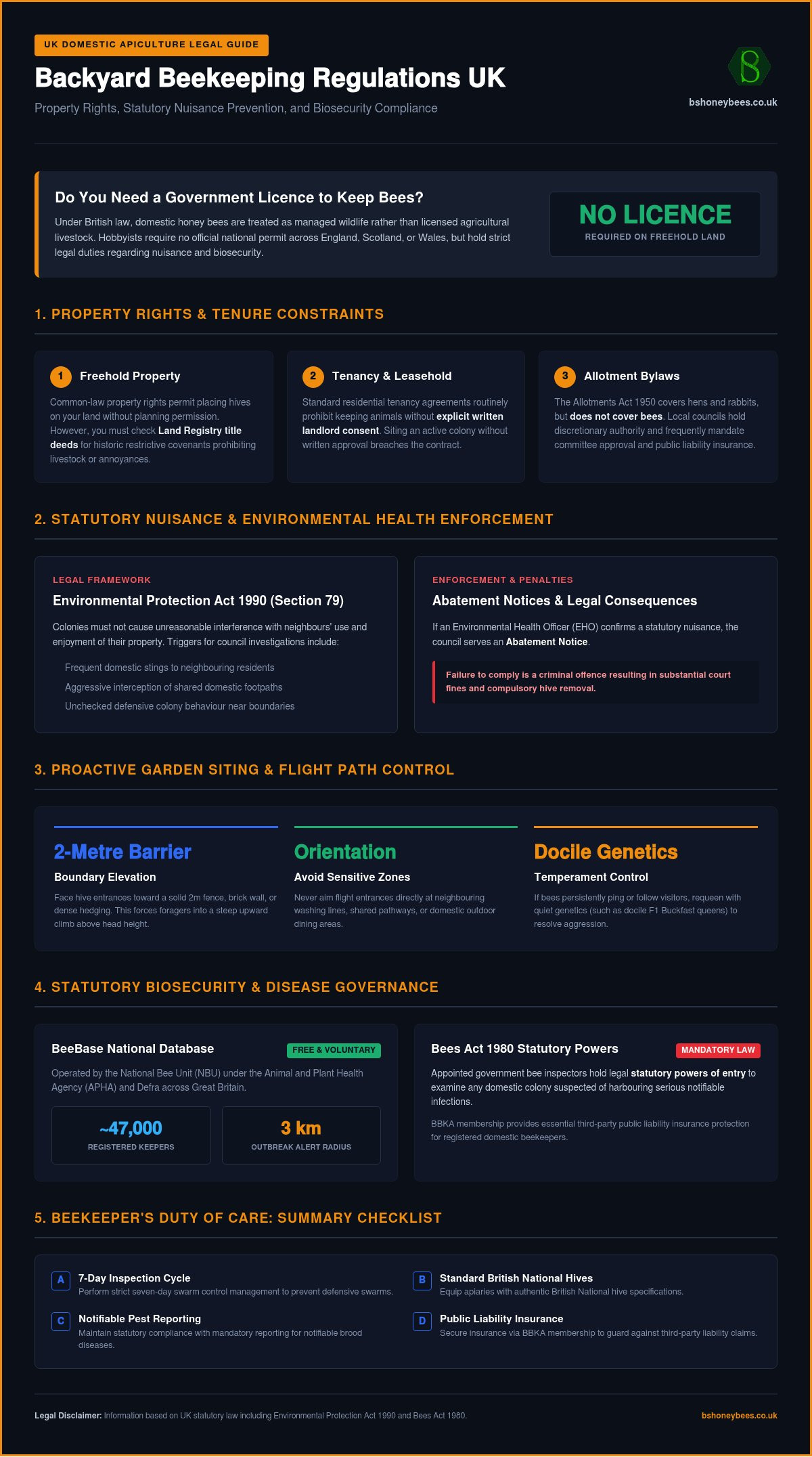
The straightforward answer is no. You do not need a licence, permit, or mandatory qualification to install a hive in your garden. Within modern backyard beekeeping regulations uk law treats domestic honey bee colonies as managed wildlife rather than licensed agricultural livestock. If you own the freehold of your property, your common-law property rights permit you to place hives on your land without applying for planning permission or council approval. The long-standing framework of Beekeeping in the United Kingdom relies on this principle of personal responsibility, placing the legal duty of safe management directly on the individual beekeeper.
Property Rights, Covenants, and Tenancy Clauses
Your freedom to install hives depends directly on your property tenure. Freeholders should always inspect their Land Registry title deeds for historic restrictive covenants. Many modern housing developments and older residential estates include specific covenants that forbid livestock, poultry, or any activity deemed an annoyance, which neighbours can enforce through civil courts.
If you rent your home or hold a leasehold title, additional constraints apply:
- Tenancy Agreements: Standard residential tenancy agreements routinely ban keeping animals or livestock without explicit written landlord consent. Siting an active colony without written approval breaches your contract.
- Allotment Bylaws: While the Allotments Act 1950 permits keeping hens and rabbits for non-commercial purposes, it does not cover bees. Town, parish, and district councils hold discretionary authority and frequently issue bylaws prohibiting apiaries or demanding committee approval alongside third-party public liability insurance.
BeeBase Registration and Statutory Biosecurity
Operating without a licence doesn't place your garden beyond the reach of national biosecurity law. The National Bee Unit (NBU), operating under the Animal and Plant Health Agency (APHA) and Defra, maintains BeeBase. This national database covers approximately 47,000 registered beekeepers across Great Britain.
BeeBase registration is completely free and voluntary for hobbyists in England, Wales, and Scotland. Despite being voluntary, it is vital for domestic apiary management. When a serious disease outbreak or invasive pest sighting occurs within three kilometres of your post code, the NBU uses your coordinates to issue targeted biosecurity alerts. Appointed government bee inspectors hold statutory powers of entry under the Bees Act 1980 to examine any colony suspected of harbouring serious infection, making registration your best line of defence.
Managing Statutory Nuisance and Neighbour Relations Under UK Law
Although keeping bees without a licence is lawful, you remain bound by Section 79 of the Environmental Protection Act 1990. If your colonies cause unreasonable interference with your neighbours' use and enjoyment of their property, local authority Environmental Health Officers (EHOs) possess direct legal powers to intervene. Frequent stings, aggressive interception of domestic footpaths, or unchecked defensive behaviour quickly trigger council investigations.
When an EHO confirms that a statutory nuisance exists, the local council serves a legally binding Abatement Notice. Failing to comply with this notice is a criminal offence, exposing the beekeeper to substantial court fines and compulsory hive removal. While official publications from the National Bee Unit outline safe operational standards, securing public liability insurance through British Beekeepers Association (BBKA) membership provides essential financial protection against third-party claims. Mastering backyard beekeeping regulations uk wide requires implementing preventative measures long before an environmental health officer visits your garden.
Siting Your Hive to Direct Flight Paths
Hive positioning dictates worker traffic. Always face hive entrances toward a solid two-metre boundary fence, brick wall, or dense hedging rather than an open boundary. This physical barrier forces departing foragers into a steep upward climb, lifting them safely above head height before they exit your property. Never aim entrance tracks directly at neighbouring washing lines, shared pathways, or outdoor dining areas. If a colony begins persistently following or pinging visitors, requeening the hive with quiet genetics, such as docile F1 Buckfast queens, resolves aggression before formal complaints arise.
Preventing Water Foraging Nuisance
During peak summer brood rearing, honey bees require regular water supplies to regulate internal brood temperatures and dilute crystallised winter stores. If you don't supply a persistent water point within your garden, scout bees will inevitably target neighbouring paddling pools, hot tubs, ornamental ponds, and bird baths. Once workers fixate on a neighbour's water feature, breaking their foraging pattern is exceptionally difficult. Set out shallow trays filled with damp moss, gravel, or floating wine corks in sunny, sheltered garden spots early in March before natural foraging trails lock in.
Notifiable Pests and Diseases: Legal Obligations for UK Apiaries
Every domestic beekeeper operates under strict statutory obligations set out in the Bee Diseases and Pests Control (England) Order 2006 and its devolved equivalents. Ignorance of these laws is no legal defence. If you suspect the presence of notifiable pathogens or exotic parasites, statutory law dictates that you must immediately notify the National Bee Unit. Under official UK Government Bee Pest & Disease Guidance, failure to report known or suspected cases exposes an apiary owner to legal prosecution.
The primary notifiable threats comprise American Foulbrood (AFB), European Foulbrood (EFB), Small Hive Beetle (Aethina tumida), and Tropilaelaps mites. In addition, the presence of Varroa has been legally reportable across England, Wales, and Scotland since 2021. Understanding these threats is an indispensable requirement of backyard beekeeping regulations uk apiarists must follow.
Identifying Foulbrood: AFB and EFB
American Foulbrood targets sealed brood, leaving sunken, dark, perforated cappings and greasy, decayed larvae that draw out into a brown thread when tested with a matchstick. Treating AFB with antibiotics remains strictly illegal across the United Kingdom. European Foulbrood infects unsealed larvae, causing them to twist unnaturally into yellow-brown, corkscrew shapes before capping.
When an appointed Bee Inspector confirms foulbrood, they immediately serve a formal standstill notice. This legal order prohibits moving hives, bees, equipment, or honey from the site. For AFB, the statutory remedy is compulsory destruction by burning on-site. For EFB, the inspector may permit shook-swarm husbandry or destruction, depending entirely on the severity of infection.
Asian Hornet (Vespa velutina) Reporting Protocol
The Asian hornet poses a grave biosecurity hazard to UK honey bees and native wild pollinators. This invasive predator differs distinctly from the larger native European hornet. Key identification markers include:
- An entirely dark brown or black abdomen featuring a single fine yellow band and a distinct bright orange fourth segment.
- Characteristic bright yellow legs ("yellow-legged hornet"), contrasted against dark brown thighs.
- An entirely orange face paired with dark brown antennae.
Confirming backyard beekeeping regulations uk compliance means actively surveying your hives in late summer with non-native monitoring traps. If you observe an Asian hornet hawking outside hive entrances, log photographic evidence immediately through the official Asian Hornet Watch mobile app or alert Defra via the Non-native Species Directorate. Rapid reporting enables specialised National Bee Unit contingency teams to track and incinerate nests before reproductive queens disperse.
Swarm Control and Colony Temperament: The Beekeeper's Duty of Care
Every UK beekeeper owes a common-law duty of care to their neighbours and the general public. While an uncollected swarm technically ceases to be your personal property once it departs your land, allowing colonies to swarm unchecked into residential gardens, school grounds, or adjoining roads exposes you to civil liability claims for negligence. When an avoidable swarm enters a chimney or settles across an adjoining patio, resulting removal expenses or personal injury claims can be laid at your door.
Preventing these disputes requires strict adherence to a seven-day inspection routine between late April and July. A colony can draw a queen cell from an egg and seal it within eight days. Missing your weekly check virtually guarantees losing a prime swarm. Managing backyard beekeeping regulations uk hobbyists encounter means treating regular swarm suppression as a non-negotiable legal safeguard rather than an optional weekend hobby task.
Choosing Docile Bee Breeds for Urban and Suburban Gardens
Colony temperament represents your greatest liability risk in close residential quarters. Defensive colonies follow people across gardens, ping protective veils, and sting unprovoked. Local feral colonies or wild-mated scrub mongrels often exhibit erratic, aggressive behaviour across successive generations. Selecting carefully bred stock ensures stable, gentle genetics that let you work hives calmly without antagonising adjoining households.
Before sourcing bees, read our detailed guide on Buckfast vs Carniolan Bees: Which Breed is Best for UK Beekeeping? to choose the right strain for your domestic space. If an established colony turns defensive after supersedure, don't tolerate stinging incidents. Eliminate risk by introducing mated stock from F1 Buckfast Queens UK to calm the apiary within a single brood cycle.
Mastering Artificial Swarm Methods
Having the correct spare equipment ready is essential when swarm preparations begin. Always keep an assembled spare brood box, floor, crown board, and frames on site. When you spot charged queen cells, implement the classic Pagden artificial swarm procedure immediately:
- Move the original brood box containing nurse bees and queen cells two metres to one side.
- Place the new brood box on the original hive stand, transferring the existing marked queen on a single frame of open brood to its centre.
- Fill the remaining space with foundation frames and replace the original honey supers on top of the new brood box.
Flying foragers return to the original stand, satisfying the colony's instinct that a successful swarm occurred. To secure reliable, docile genetics and compliant equipment for your domestic apiary, order healthy bees and equipment directly from BS Honey Bees Ltd today.
Equipping a Compliant Garden Apiary: Practical Setup Checklist
Launching a residential apiary requires proper infrastructure from day one. Meeting backyard beekeeping regulations uk standards depends on choosing standard, movable-frame equipment that enables rapid inspection by regional bee inspectors. Non-standard, fixed-comb hives hinder statutory disease checks, making biosecurity enforcement unnecessarily complex. Setting up correctly eliminates practical friction and keeps your colony compliant with Defra health guidelines.
Selecting Standard Hive Infrastructure
Hardware compatibility simplifies management. Invest in The British National Beehive to ensure parts interchange effortlessly across the UK apiculture sector. Standardised National brood boxes and frames fit standard extraction and disease-inspection protocols seamlessly.
When assembling your garden layout, apply these hardware standards:
- Set up solid hive stands on firm patio slabs or gravel footings, keeping hive entrances at least 45 centimetres off damp turf.
- Install open-mesh floors with inspection trays, allowing regular natural mite drop counts without disturbing brood chambers.
- Fit metal entrance reducers to deter robbing during late-summer nectar dearths.
Sourcing Inspected Nucleus Colonies and Protective Gear
Never rely on unvetted wild swarms of unknown origin, temperament, and health status for an urban garden. Start safely with established, disease-screened stock by selecting compliant colonies from Honey Bee Nucs for Sale UK. Sourcing healthy 5 or 6 frame nucs with proven laying queens guarantees a predictable, docile colony dynamic right out of the box.
Handler confidence directly influences honey bee behaviour. Working hives while nervous leads to jerky movements that agitate foraging workers. High-grade protective wear provides vital peace of mind. Consult the comprehensive Bee Suit Sizing Guide UK to choose an impenetrable, ventilated BBWear bee suit tailored to your measurements. Browse nationwide hardware and queen stock directly through BS Honey Bees Ltd to ensure your setup meets every residential standard.
Take Confident Control of Your Domestic Apiary
Navigating backyard beekeeping regulations uk wide doesn't mean facing complex licensing hurdles, but it does demand diligent garden management. Your primary legal duties centre on elevating flight paths to prevent statutory nuisance, adhering to statutory biosecurity reporting, and conducting disciplined weekly swarm inspections. Establishing your apiary with standard equipment and calm genetics ensures you stay firmly on the right side of council guidelines.
Setting up correctly from day one removes the guesswork. As a specialist UK bee breeder, BS Honey Bees Ltd supplies docile F1 Buckfast and Carniolan stock bred specifically for calm temperament in residential settings. We provide healthy, disease-screened nucleus colonies dispatched safely across the UK, alongside fully compatible British National hives, frames, and premium BBWear protective suits. Explore our docile UK-bred nucs, queens, and equipment at BS Honey Bees Ltd to establish a safe, compliant apiary you and your neighbours can enjoy with complete peace of mind.
Frequently Asked Questions
Do I need planning permission to put a beehive in my UK garden?
No, planning permission is not required to install beehives within a domestic curtilage. Standard beehives are classified as temporary, moveable chattels rather than permanent structures under the Town and Country Planning Act 1990. However, if you plan to construct a dedicated outbuilding, permanent honey house, or raised platform to support your apiary, normal permitted development rights and planning criteria apply.
Can my local council force me to remove honey bees from my garden?
Yes, local councils hold the legal authority to force removal if your apiary causes a statutory nuisance. Under Section 80 of the Environmental Protection Act 1990, an Environmental Health Officer can serve an Abatement Notice requiring you to reduce hive numbers, adjust positioning, or remove colonies entirely within a specified timeframe. Defying an abatement notice leads to prosecution in a magistrates' court and heavy financial penalties.
How many beehives can I legally keep in an average UK garden?
There is no statutory ceiling specifying a legal limit on hive numbers in UK gardens. Under backyard beekeeping regulations uk apiarists must ensure stocking density suits the location. For an average suburban garden, keeping one to two production colonies alongside a single nucleus hive is widely considered safe practice. Overcrowding increases swarming risks, triggers defensive behaviour, and quickly prompts legitimate council nuisance complaints.
Is registration on the UK BeeBase database compulsory for hobby beekeepers?
Registration on BeeBase remains voluntary for hobby beekeepers in England, Wales, and Scotland, though government authorities strongly encourage it. Northern Ireland maintains a separate scheme called DataBees. Enrolling is free and gives you rapid notifications if notifiable brood diseases or invasive predators appear near your post code, ensuring you protect your apiary and stay well within broader statutory biosecurity expectations.
What should I do if a neighbour complains about bee stings or flight paths?
Act immediately to de-escalate tension and avoid council involvement. Erect fine netting or screening to lift flight lines above head height. If defensive behaviour persists, re-queen the colony quickly using calm genetics like docile F1 Buckfast stock. Showing proactive management, maintaining written inspection logs, and securing British Beekeepers Association membership with third-party liability cover demonstrates responsible care if local authorities ever investigate.
Are there statutory rules regarding where I can place my beehive?
Statutory legislation does not define exact setback distances from garden borders. Instead, backyard beekeeping regulations uk focus entirely on avoiding nuisance and maintaining public safety. You must position hives thoughtfully away from public footpaths, property boundaries, and outdoor entertaining areas. Direct entrances toward dense hedges or high fences so flying foragers immediately clear human height before leaving your domestic perimeter.
What happens if a statutory bee inspector discovers disease in my hives?
Appointed regional bee inspectors possess statutory enforcement powers under the Bee Diseases and Pests Control Orders. If they diagnose American Foulbrood, they will issue an immediate standstill notice followed by compulsory on-site destruction by burning. If they detect European Foulbrood, depending on disease severity, they may authorise treatment via a shook swarm. Standstill orders remain legally binding until the inspector officially signs off the apiary.