

What if the most effective way to save your struggling colony this winter is to stop trying to keep it alive on its own? It's a difficult question that every responsible beekeeper must face as the days shorten and the nectar flow stops. You've likely spent the summer monitoring their progress, but if the cluster is too small to maintain heat, you're looking at a colony loss by January. Understanding how to combine a weak hive in autumn uk is often the difference between an empty hive and a thriving apiary come April.
We know the anxiety that comes with these decisions. You don't want to lose a queen or cause a fight amongst your workers. This guide provides the precise, step-by-step instructions you need to safely unite colonies using the newspaper method. We'll walk you through selecting the right queen to lead the new unit, the critical mid-October timing, and the specific feeding requirements to ensure they build up enough stores. By the end of this article, you'll have the confidence to take proactive steps that guarantee a strong, viable cluster ready to face the British winter.
Key Takeaways
- Understand the critical "seam" count and why a colony must have sufficient thermal mass to survive the harsh British winter frosts.
- Master the precise steps of how to combine a weak hive in autumn uk using the newspaper method to ensure a peaceful union without worker fighting.
- Learn how to evaluate and select the strongest queen whilst removing underperforming or drone-laying queens to protect the future of the new colony.
- Discover the essential post-combination feeding requirements and why heavy syrup is necessary to build winter stores before the mid-October deadline.
- Explore long-term solutions, such as using 2-in-1 poly nucs or investing in resilient F1 Buckfast genetics to prevent weak colonies in future seasons.
Why Combining Weak Honey Bee Colonies is Essential for UK Winters
In the professional practice of Beekeeping, combining is the strategic process of uniting two separate colonies into a single, robust unit. It is a vital management technique for any apiary facing the unpredictable British climate. Whilst it might feel counterintuitive to sacrifice a queen, the reality is that two weak colonies are a liability, but one united colony is a powerhouse. If you are researching how to combine a weak hive in autumn uk, you are already taking a proactive step toward ensuring your bees survive until the first spring forage appears.
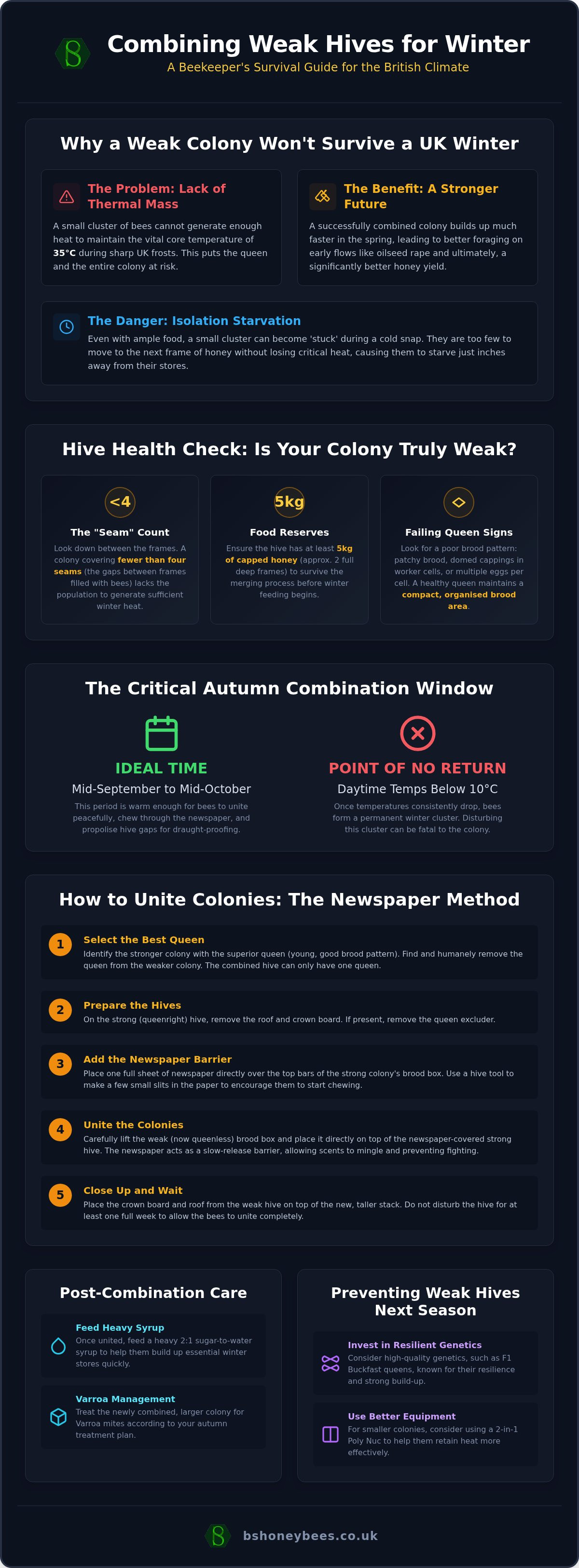
The primary reason for merging is the requirement for thermal mass. Honey bees survive the winter by forming a tight cluster to generate heat. A small colony lacks the "bee power" to maintain the core temperature of 35°C needed to keep the queen safe during sharp UK frosts. Even with ample stores, a weak cluster often faces isolation starvation. This happens when the bees are too few to move across to the next frame of honey without losing critical heat; they effectively starve whilst sitting inches away from food. By uniting them, you create a larger population that can navigate the hive and regulate temperatures efficiently.
A "united we stand" approach doesn't just ensure survival; it sets the stage for a productive season. A strong, combined colony will build up much faster in the spring than two struggling ones. This early momentum is essential for hitting the oilseed rape or sycamore flows, ultimately leading to significantly better honey yields.
The Problem with "Autumn Angst" and Colony Shrinkage
Beekeepers often experience "autumn angst" as they watch hive populations naturally decline. This is normal as drones are evicted to save resources. However, you must distinguish between a healthy seasonal downsizing and a failing colony. A healthy colony will still have a solid "seam" of bees across several frames. A failing one might show patchy brood or a low bee count that can't cover the frames. In the UK's damp autumn weather, these small clusters are highly susceptible to nosema and chilling. If a colony is too small for a full hive but has a high-quality queen, consider using a 2 in 1 Poly Nuc as an alternative to a full merge to help them retain heat.
When is it Too Late to Combine Hives in the UK?
Timing is everything when learning how to combine a weak hive in autumn uk. You should aim to complete the process between mid-September and mid-October. This window provides enough warmth for the bees to chew through the newspaper and, crucially, to propolise the new join. Propolis acts as the hive's immune system and draught-proofing; if it's too cold, the bees won't be active enough to seal the gaps. The point of no return for autumn combinations is the moment daytime temperatures consistently stay below 10°C, as the bees will have already formed a permanent winter cluster that must not be broken.
Evaluating Hive Strength: Is Your Colony Truly Weak?
Before you apply The Newspaper Method, you must determine if the hive is truly failing or simply resting. A precise assessment prevents you from unnecessarily sacrificing a productive queen. Learning how to combine a weak hive in autumn uk starts with a rigorous inspection of the cluster and the brood nest.
Perform a "seam count" by looking down between the frames. A seam is the space between two combs filled with bees. If your bees cover fewer than four seams in a standard brood box, they lack the population to generate sufficient heat. Check their food reserves; they need at least two weeks of immediate stores (about 5kg of capped honey) to survive the merging process. Observe their behaviour. Queenless or stressed colonies often exhibit a high-pitched "roar" or increased defensiveness when the crown board is lifted. Be ruthless during this inspection. If the colony is small, hungry, and aggressive, it is a prime candidate for combination.
Identifying a Failing Queen vs. Seasonal Slowdown
A healthy colony shrinking for winter still maintains a tight, organised brood area. You must be adept at spotting drone laying queen symptoms uk, such as domed cappings in worker cells or multiple eggs per cell. These are clear indicators of a failing queen or laying workers. High-quality mated queen bees UK will continue to lay a compact patch of healthy worker brood well into September. If you see patchy, "pepper-pot" brood patterns instead, the queen is likely exhausted. Varroa levels also play a role. If mite counts have exceeded the 1,000-mite threshold, the resulting viral load often causes a sudden population crash that no amount of feeding can fix.
The "Take Your Losses in Autumn" Philosophy
Professional beekeepers operate on a simple principle: it is better to have one strong hive that survives than two weak ones that perish. Attempting to nurse a failing colony through a British winter is often a waste of expensive sugar syrup. If your British National Hives are under-occupied, merging is the most efficient use of your hardware and time. A colony on fewer than four frames of bees in October is statistically unlikely to reach the spring. By combining now, you consolidate your resources into a single, viable unit that can actually reach its winter stores. This proactive approach ensures you aren't left cleaning out dead hives in March.
The Newspaper Method: How to Unite Bees Safely in Autumn
The newspaper method is the industry standard for merging colonies without triggering defensive behaviour. It relies on a slow scent exchange. By the time the bees chew through the paper barrier, their pheromones have blended, resulting in a peaceful union. When learning how to combine a weak hive in autumn uk, precision in execution is your best tool for success. You must be decisive with your queen selection. Generally, you should keep the queen with the better laying pattern or the one that is younger. If you have a failing queen or one with poor genetics, remove her 24 hours before the join. This short period of queenlessness makes the bees far more receptive to the new pheromones.
Timing the operation is equally critical. Perform the union in the late afternoon or at dusk once flight activity has subsided. This ensures the maximum number of foragers are home and the bees are calmer. Remove the crown board of the stronger colony and prepare your british national beehive for the merge. Lay a single sheet of non-glossy newspaper over the top bars of the bottom box. Make three or four small pin-pricks in the paper with a hive tool or pin. These holes allow the scent to travel whilst preventing the bees from attacking each other immediately. Lift the brood box of the weak hive and place it directly on top of the paper.
Step-by-Step Execution of the Newspaper Join
- Step 1: Locate and remove the inferior or failing queen 24 hours prior to the merge.
- Step 2: Place a single, clean sheet of newspaper over the top bars of the strong hive.
- Step 3: Make small pin-pricks in the paper to facilitate scent exchange amongst the workers.
- Step 4: Place the weak hive's brood box directly on top, then replace the crown board and roof securely.
Managing the Hive After the Join
Leave the colonies undisturbed for at least five to seven days. If you open the hive too early, you risk the workers "balling" the queen in the confusion. Once you see chewed paper fragments at the hive entrance, you'll know the bees have successfully united. After a week, you can consolidate the best frames of brood and food into a single brood box. This consolidation is a vital part of Post-Combination Care: Feeding and Varroa Management, as it ensures the cluster remains tight and has immediate access to stores.
You'll be left with a spare floor, crown board, and roof. Don't simply stack them in the shed. Scrape away all propolis and wax, then sterilise the components with a blowlamp or soda crystals to prevent the spread of disease. Any frames of clean, capped honey from the weak hive should be moved into the new single brood nest to boost winter reserves. If you have surplus frames of old or empty comb, render them down for wax rather than storing them, as they can attract wax moths during the winter months.
Post-Combination Care: Feeding and Varroa Management
Once you've successfully executed how to combine a weak hive in autumn uk, your focus must shift immediately to resource management. A united colony is a hungry colony. Whilst they now have the population to survive, they have also doubled the number of mouths to feed. In the UK, a colony requires roughly 20 to 22kg of stores to navigate a winter that often stretches into a cold, damp April. You must ensure the hive is "heaving" with weight before the first hard frost. If the hive feels light when you heft it from the back, it isn't ready for winter.
Choosing the right feeder is a logistical decision. Rapid feeders are the preferred choice for early autumn. They allow the bees to take down large volumes of syrup in a matter of days. If you've left it later in the season and temperatures are dipping, a contact feeder placed directly over the cluster is more efficient. This reduces the distance the bees must travel from the warmth of the cluster to the food source. Every day of warmth you have left is an opportunity to get those stores capped and cured.
Autumn Feeding Guide: Ratios and Timing
Speed is essential. Use a thick 2:1 sugar syrup ratio, which consists of 2kg of granulated sugar to every 1 litre of water. With UK sugar prices at approximately £0.96 per kilogram in late 2026, feeding is a significant but necessary cost. This concentrated mixture requires less energy for the bees to dehydrate and cap. Once daytime temperatures consistently fall below 10°C, the bees will struggle to process liquid feed. At this point, switch to solid white fondant. Always use entrance reducers during late-season feeding to prevent robbing from stronger neighbouring colonies or wasps.
Final Varroa Treatment for the Merged Colony
Combining two colonies can inadvertently concentrate the mite population. If both original hives were hovering near the National Bee Unit’s critical threshold of 1,000 mites, your new unit is now at extreme risk. Since 30-50% of global colony losses are attributed to Varroa and its associated viruses, a final treatment is non-negotiable. Select a temperature-appropriate treatment for October, such as an oxalic acid sublimation or a thymol-based strip, depending on your current local weather. Monitor the mite drop on your varroa floor for 48 hours to confirm the treatment's efficacy and ensure your winter bees are healthy. For the best start to the new season, ensure you are using British National Hives and frames that allow for easy monitoring and treatment application.
Preventing Weak Hives: Choosing Resilient Genetics for Next Season
Prevention is always more cost-effective than a late-season rescue. Whilst knowing how to combine a weak hive in autumn uk is an essential skill for emergency management, your long-term strategy should focus on building colonies that don't fail in the first place. A colony's ability to maintain a large winter cluster is dictated by the queen's laying behaviour during August and September. If your queen stops laying too early, you'll be left with a dwindling population of old foragers rather than a robust cluster of young, fat-bodied winter bees that can survive until April.
Choosing the right breed for the UK climate makes a significant difference. When comparing buckfast vs carniolan bees, you must consider your specific management goals. Buckfast bees are particularly prized in the UK for their prolific autumn brooding, often maintaining a large nest well into October. This natural vigour ensures the colony has the thermal mass required to survive without intervention. If you find your apiary is consistently understrength, planning ahead by securing honey bee nucs for sale UK allows you to replace underperforming stock with resilient genetics before the winter window closes.
For those smaller colonies that are healthy but simply lack the numbers for a full brood box, the 2 in 1 Poly Nuc is a superior alternative to merging. These specialised units allow two small colonies to share heat through a central divider. This effectively doubles their chances of survival whilst remaining separate entities, allowing you to have two productive queens ready for the spring instead of just one.
The Buckfast Advantage for UK Beekeepers
Buckfast queens are bred for their calm temperament and high productivity. Their ability to forage in cooler, damp UK conditions means they can continue to bring in pollen for late brood rearing when other breeds might shut down. A young, vigorous queen introduced in July or August is your best insurance policy against winter losses. She will lay the thousands of workers needed to create a dense, warm cluster, drastically reducing the likelihood of you needing to research how to combine a weak hive in autumn uk next year.
Investing in Quality Equipment
Hardware choice is just as critical as genetics. Whilst traditional cedar hives are the standard, they offer poor insulation compared to modern poly hives. High-density polystyrene (poly) hives retain heat far more effectively, allowing a smaller cluster to maintain its core temperature with less energy expenditure. This reduces food consumption and lowers the stress on the bees during prolonged frosts. Combine superior genetics with professional-grade hardware to ensure your apiary remains productive year after year. Prepare your apiary for success with BS Honey Bees Ltd equipment and queens to ensure you start the next season with strong, viable colonies.
Securing Your Apiary for a Productive Spring
Mastering how to combine a weak hive in autumn uk is about more than just survival. It's about setting the foundation for next year's honey harvest. By choosing to unite struggling colonies before the mid-October deadline, you ensure your bees have the thermal mass and stores needed to withstand the damp British winter. Use the newspaper method for a seamless transition and follow up with heavy feeding to guarantee the cluster remains viable during the coldest months.
Long-term success depends on high-quality genetics and robust equipment. As specialist F1 Buckfast and Carniolan breeders, we provide the resilient stock required to prevent weak hives in future seasons. Whether you need nationwide live bee delivery or premium BBWear protective clothing, we have the resources to support your growth. Browse our F1 Buckfast Queens and National Hives for a stronger apiary. Don't wait until spring to address today's challenges; take decisive action now to protect your colonies and ensure a thriving start to the new season.
Frequently Asked Questions
Can I combine two weak hives if both have queens?
Yes, but you must remove one queen first. Leaving two queens in a combined hive usually results in a battle where both might be injured or killed. Select the queen with the superior laying pattern or the younger age to lead the united colony. Remove the inferior queen 24 hours before you begin the process of how to combine a weak hive in autumn uk to ensure the workers are ready to accept their new monarch.
How long does the newspaper method take to work?
The process typically takes between three and five days for the bees to chew through the paper. This slow integration is intentional. It allows the pheromones of the two colonies to mingle gradually, preventing immediate aggression. You'll know it's working when you see small confetti-like fragments of paper outside the hive entrance. Do not open the hive for at least seven days to allow the new social structure to stabilise.
What happens if the bees don’t chew through the newspaper?
If the bees haven't breached the paper after a week, it's usually because the temperature has dropped too low for active movement. In the UK, this often happens during late October cold snaps. You may need to carefully tear a slightly larger hole yourself, but only if you're certain the colonies have had enough time to share scents. Ensure the paper isn't too thick or glossy, as this physically prevents the bees from biting through.
Is it better to put the weak hive on top or the bottom?
Always place the weak or queenless hive on top of the stronger, queen-right colony. Heat rises, so the lower colony will help keep the upper bees warm during the integration. Additionally, foragers from the top box will have to pass through the bottom box to exit the hive, which facilitates a faster and more thorough scent exchange. This orientation is a standard part of how to combine a weak hive in autumn uk successfully.
Can I combine hives in November in the UK?
November is generally too late for a successful combination because the bees have already formed their winter cluster. Breaking this cluster to insert newspaper can chill the brood and cause significant stress. If you discover a weak hive this late, your best option is to move it into a highly insulated 2 in 1 Poly Nuc rather than attempting a merge. This hardware provides the necessary heat retention without requiring the bees to reorganise their social structure.
Should I remove the queen from the weak hive before combining?
Yes, you should remove the queen you don't want to keep 24 hours before the merge. This short window of queenlessness makes the workers more eager to accept the queen from the other colony. If you leave both queens, the workers may "ball" and kill both during the initial confusion. Always prioritise the queen with the best temperament and the most consistent brood pattern to ensure the new colony's long-term health and stability.
What is the minimum number of frames a hive needs to overwinter in the UK?
A colony typically needs at least four to five frames densely covered with bees to survive a standard British winter. This population provides the necessary thermal mass to maintain the cluster's temperature. If your colony occupies fewer than four frames, it's unlikely to generate enough heat to reach its food stores during a frost. In these cases, combining is the most professional and compassionate choice to prevent a total colony loss.
Can I use the newspaper method for a nuc and a full hive?
Yes, you can unite a five-frame nucleus colony with a full British National Hive using this method. Simply place the nuc box directly on top of the newspaper-covered brood box. If the nuc doesn't fit the footprint of the main hive, use a temporary adapter board or a crown board with the central hole uncovered to bridge the gap. This is an excellent way to use a spare nuc to boost a struggling colony's population.