

What if the quickest way to calm a colony is to pause before changing anything? Dealing with aggressive honey bees can feel urgent, especially when an inspection brings repeated attacks or people nearby may be at risk. But bees defending the hive aren’t necessarily showing a lasting temperament problem, and rushing to requeen can mean missing a simpler trigger.
Take unusual defensive behaviour seriously. Give the colony and surrounding area space, and don’t continue an inspection if you can’t do so safely. Then review what may have changed, including your inspection technique, conditions around the hive and the colony’s condition, before deciding how to respond.
This guide will help you recognise behaviour that calls for immediate precautions, investigate likely causes and choose a measured next step. You’ll also learn when replacing a queen might be worth considering, and why it can’t guarantee a calmer colony. Start with safety, assess the evidence, then act with a clear plan.
Key Takeaways
- Learn to distinguish normal hive defence from repeated, disproportionate behaviour that makes routine inspections difficult.
- When dealing with aggressive honey bees, investigate possible triggers such as recent disturbance, weather, nectar conditions and signs of colony problems.
- Compare changes to inspection practice, address identifiable issues and consider requeening before choosing the least disruptive suitable response.
- Use a clear safety-first plan: protect people, avoid unnecessary disturbance and postpone inspections when conditions or your protection are inadequate.
- Consider replacing the queen only after assessing the pattern and earlier changes. It’s a management option, not a guaranteed temperament fix.
Dealing with aggressive honey bees: how to tell when behaviour is a concern
A colony defending its nest is responding to a perceived threat, not necessarily showing a persistently difficult temperament. Defensive behaviour is a reaction to disturbance; sustained aggression is a repeated, disproportionate response that continues beyond the immediate disturbance. The distinction matters: one uncomfortable inspection doesn’t prove the colony has a lasting problem.
Honey bees are most defensive close to the hive, where workers protect the colony. Foragers away from it are generally less likely to sting unless provoked or trapped. For background on their social behaviour and defence, see Honey bee defensive behavior.
Which signs suggest a colony is persistently defensive?
Look for a pattern across more than one occasion. Repeated stinging, bees following you after you’ve moved away, or attacks that make routine inspections difficult deserve attention, particularly if they happen in different conditions. By contrast, a single sting or an unsettled response during a disruptive inspection may reflect that particular event rather than the colony’s general temperament.
Keep a brief record after each encounter. Note what you were doing, the time and weather, any recent disturbance, and whether the bees settled after you withdrew. These details help distinguish a one-off reaction from recurring behaviour and give you a clearer basis for deciding what to investigate next.
When does bee behaviour create a wider safety concern?
Assess the setting as well as the bees. Consider how close the hive is to paths, neighbours, livestock and places where people may pass or gather. Repeated stinging, especially incidents involving people without protective clothing, calls for prompt reassessment. Put immediate safety first: keep others clear of the area while you work out what may be driving the behaviour.
Keep two decisions separate. First, decide whether people need to be kept clear and whether an inspection should be postponed. Then investigate the colony’s behaviour and possible triggers. This avoids making a long-term management decision based on one alarming event, without dismissing a pattern that could put others at risk.
- Record: what happened, when, the weather and any recent disturbance.
- Observe: whether the bees settle after you withdraw or continue to follow.
- Reassess: repeated stinging or incidents involving unprotected people promptly.
Use these observations when dealing with aggressive honey bees. A clear record helps you judge whether the response was tied to a particular disturbance or points to an ongoing concern.
Why honey bees become defensive: investigate the colony before intervening
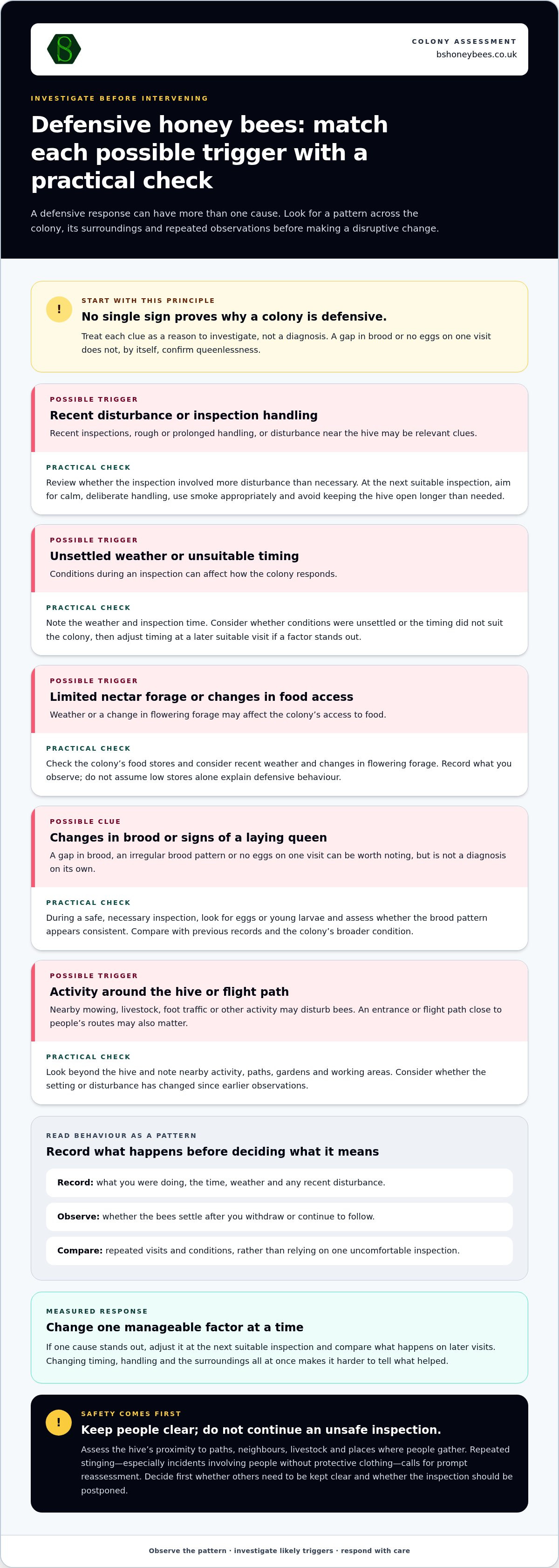
Before changing a colony, look for what may have prompted the response. Recent inspections, rough or prolonged handling, disturbance near the hive, unsettled weather and limited nectar forage can all be relevant clues. Several factors may overlap: a colony under pressure from its surroundings may react more strongly to an inspection than it otherwise would.
No single sign proves why a colony is defensive; look for a pattern across the colony, its surroundings and repeated observations. Treat each clue as a reason to investigate, not a diagnosis. When dealing with aggressive honey bees, this distinction helps you avoid a disruptive change before you understand the likely trigger.
What colony conditions should you check first?
During a safe, necessary inspection, look for evidence of a laying queen, such as eggs or young larvae, and assess whether the brood pattern appears consistent. A gap in brood or an absence of eggs on one visit doesn’t, by itself, confirm queenlessness. Consider what you see alongside the colony’s broader condition and your previous records.
Check food stores and consider whether recent weather or a change in flowering forage may have affected the colony’s access to food. Don’t assume that low stores, an irregular brood pattern or a missing sign of the queen explains defensive behaviour on its own. Record what you observe at each inspection, including what has changed since the last visit. A sequence of observations is more useful than trying to reconstruct events from memory.
Could inspection technique or surroundings be contributing?
Review the inspection itself. Was it carried out in unsettled conditions, at a time that didn’t suit the colony, or with more disturbance than necessary? Consider whether your handling was calm and deliberate, whether smoke was used appropriately, and whether the hive was open longer than needed. If one factor stands out, adjust it at the next suitable inspection rather than changing several things at once.
Look beyond the hive, too. Nearby mowing, livestock, foot traffic or other activity may disturb bees. Consider whether the entrance and flight path bring bees close to a path, garden or working area. Changing inspection timing, handling and the surroundings all at once makes it harder to tell what helped. Keep notes and make one manageable adjustment at a time, then compare what happens on later visits.
Once you’ve investigated likely causes and considered the evidence over time, you’ll be better placed to choose a response. If your assessment points towards requeening, explore F1 Buckfast and Carniolan queens as part of a considered decision, not as a guaranteed solution to defensive behaviour.
Choosing a response to aggressive honey bees: compare practical options
Match your response to the evidence. If behaviour coincides with a disruptive inspection, adjust your handling before making a major colony change. If you’ve identified a colony issue, address it and monitor what follows. Requeening is a considered option when defensive behaviour persists, not an automatic first step. The comparison below links possible triggers to proportionate responses.
| Possible trigger | Response to consider | Disruption | What to monitor |
|---|---|---|---|
| Inspection timing or handling appears to unsettle the bees | Review timing, smoke use and handling; keep inspections purposeful | Low | Whether the response changes during later inspections |
| An identifiable colony issue, such as low stores or signs of queenlessness | Address the issue based on your assessment of the colony | Varies by intervention | Stores, brood and behaviour on subsequent visits |
| Repeated defensive behaviour remains after other likely causes are addressed | Consider requeening as part of a wider management plan | Significant colony intervention | Queen establishment and behaviour over time |
| The hive’s location or colony structure presents an ongoing concern | Assess whether moving or dividing is appropriate in that specific situation | Potentially high | Colony condition, flight paths and risks at the new or altered setup |
When might changing the queen be worth considering?
Requeening may be worth considering when repeated observations point to persistent defensive behaviour and you’ve assessed other likely causes, including inspection practice and colony condition. Queen genetics may influence temperament, but they can’t guarantee a particular outcome. A change isn’t immediate, either: replacing the queen doesn’t alter the behaviour of workers already in the colony. Plan the process carefully and follow a reliable guide to introducing a new queen successfully.
When might other management changes be more appropriate?
Start with a clear, correctable cause. If stores appear inadequate, address that colony need; if inspections are unnecessarily disruptive, refine your approach and observe the result. Where practical, change one factor at a time so your follow-up gives you useful evidence rather than guesswork.
Moving or dividing a colony can carry substantial risks and depends on the colony, site and circumstances. Treat either as a specialist decision, not a quick fix. Destruction isn’t a routine response to one difficult inspection. When dealing with aggressive honey bees, the most useful option is one that addresses an evidenced trigger while limiting unnecessary disruption. For a considered queen-management option, explore F1 Buckfast and Carniolan queens.
How to manage a defensive colony safely: a step-by-step plan
Separate urgent safety measures from the later task of diagnosing the colony. If bees are following or stinging, don’t keep inspecting to find out why. Withdraw, reduce exposure for other people, then assess the situation when it’s safe to do so.
- 1. Protect people. Move calmly away from the hive and keep others clear of its immediate flight area. If someone is stung and develops severe symptoms, seek urgent medical help.
- 2. Stop unnecessary disturbance. Don’t reopen the hive or carry on with routine work after a serious incident. Give yourself time to reassess the conditions and your protective equipment.
- 3. Record what happened. Note the activity, conditions, inspection details and whether the bees settled after you withdrew. Record any incident involving someone nearby.
- 4. Assess before returning. Consider what needs checking, whether conditions are suitable and whether you can carry out the work with adequate protection.
Safety checklist: protect people and withdraw now; postpone unnecessary inspection; diagnose the cause later, with suitable conditions, a clear purpose and proper protection.
What should you do immediately after a serious incident?
Once you’re away from the hive, make sure people aren’t walking into the bees’ flight area. Avoid further disturbance until you’ve reassessed the site and your equipment. If severe symptoms develop after a sting, call 999 for emergency medical help. Don’t treat a serious incident as a reason to rush back and inspect the colony: immediate safety comes first.
How should you plan the next inspection?
There’s no universal waiting period that suits every colony or situation. Choose a time when conditions are suitable and you can work without exposing yourself or others to avoidable risk. Check that your protective clothing fits properly and is in good condition. If it doesn’t provide adequate protection, postpone the visit.
Set one clear objective before opening the hive, such as checking for a specific colony condition. Prepare what you need, keep handling controlled and don’t extend the visit beyond that purpose. If the bees’ response escalates or conditions change, stop and withdraw safely. Afterwards, record what you found and how the colony behaved. You can then compare this visit with earlier observations and decide on the next step.
A well-fitted suit is one part of a safe inspection plan. Explore protective BBWear bee suits as you review your equipment before returning to a defensive colony.
When to requeen a defensive colony and plan your next steps
Requeening may be appropriate when a colony’s defensive behaviour is repeated, creates an ongoing safety concern and continues after you’ve addressed plausible causes such as disruptive inspections or an identifiable colony problem. Base the decision on notes from more than one visit, not a single difficult inspection or an assumption that the queen is responsible.
How can you decide whether requeening is justified?
Compare the behaviour you recorded before and after making practical changes. Did bees settle more readily after you adjusted your inspection approach or addressed an issue with stores or brood? Is the behaviour still persistent, and could it expose neighbours, passers-by or livestock to risk? Weigh that risk against the disruption of intervening. If the cause remains unclear, continue gathering observations where it’s safe rather than treating requeening as a guaranteed fix.
Queen genetics may influence colony temperament, so replacing a queen can be one considered management option. But it can’t promise a particular result, and the existing worker bees don’t change simply because a new queen is introduced. The choice of queen and the introduction process both matter to your plan. Use relevant queen-selection and new-queen introduction guidance before making the change.
What should you monitor after a management change?
Keep your records going. At subsequent checks, note the colony’s response to necessary inspections, the brood pattern and signs that the new queen is established, such as evidence of eggs or young larvae. Interpret these observations together: one sign alone may not tell the whole story. Avoid setting a fixed deadline for a temperament change, as the outcome and pace can vary.
- Review: Is defensive behaviour recurring, or was it linked to a specific event?
- Check: Have likely non-genetic causes been investigated and addressed?
- Weigh: What is the current risk to people, and what disruption would requeening involve?
- Monitor: Record behaviour and colony condition after any change.
For beekeepers who have weighed these factors and are considering a replacement queen, explore F1 Buckfast and Carniolan queen bees as part of a measured colony-management plan. Dealing with aggressive honey bees is a process of observation and informed decisions, not a search for a guaranteed quick cure.
Take a measured next step for your colony
Dealing with aggressive honey bees starts with recognising the difference between a response to disturbance and a repeated pattern that raises concern. Protect people first, record what happens and investigate possible triggers before choosing a management change.
If defensive behaviour continues after you’ve addressed likely causes, requeening may be worth considering. It’s one option, not a guaranteed or immediate temperament fix, so monitor the colony and base your next decision on what you observe.
BS Honey Bees specialises in F1 Buckfast and Carniolan queen bees, with live bees and beekeeping equipment distributed across the UK. Explore queen bees from BS Honey Bees as part of a considered plan for your colony. With a clear record and a safety-first approach, you can make the next decision with greater confidence.
Frequently Asked Questions
Why have my honey bees suddenly become aggressive?
A sudden change may follow disturbance or a change in the colony’s conditions, but investigate rather than guess. Review recent inspections, handling, weather and forage, and check the colony’s brood and food stores during a safe inspection. Queenlessness may also be relevant, but no single sign proves the cause. Record what happened and whether the behaviour recurs. This evidence helps guide your next step when dealing with aggressive honey bees.
How can I tell whether my honey bees are defensive or genuinely aggressive?
Defensive behaviour is usually a response to perceived disturbance near the hive; a persistent concern involves repeated, disproportionate attacks that continue across occasions or make routine work difficult. Note whether bees settle after you withdraw or keep following, and record conditions and recent disturbance. One sting or one unsettled inspection isn’t enough to establish a lasting temperament. Look for a pattern, while taking repeated stinging or risks to nearby people seriously.
Should I requeen an aggressive honey bee colony?
Consider requeening if repeated observations show persistent defensive behaviour after you’ve reviewed plausible causes and inspection practices. First check for identifiable colony issues and assess whether changes to handling or conditions affect the response. Weigh the risk to people against the disruption of replacing the queen. Requeening is a management option, not a guaranteed or immediate fix, and a single difficult inspection doesn’t justify assuming the queen is responsible.
Can a queen bee make a colony aggressive?
A queen’s genetics may influence the temperament of her colony, so she can be one factor to consider after assessing persistent defensive behaviour. However, behaviour can also reflect disturbance, colony condition and environmental conditions. A queen’s presence or apparent absence alone doesn’t prove the cause. If you’re considering replacement, base the decision on repeated observations and understand that a new queen can’t guarantee a particular temperament outcome.
What should I do if honey bees are stinging people near the hive?
Put people’s safety first: withdraw calmly and keep others away from the hive’s immediate flight area. Don’t continue inspecting or disturb the colony further until conditions and your protection can be reassessed. Record what happened once it’s safe, then plan any follow-up inspection carefully. If someone is stung and develops severe symptoms, seek urgent medical help. Treat repeated stinging or incidents involving unprotected people as a prompt to reassess the situation.
Will a defensive colony become calmer on its own?
It may settle if the behaviour was linked to a temporary disturbance or unsuitable conditions, but don’t rely on that without observing what happens. Record behaviour at subsequent safe inspections and note any changes to handling, surroundings or colony condition. If defensive responses continue, investigate further and consider a measured management change. Avoid unnecessary inspections, but don’t assume persistent behaviour will resolve without identifying and addressing its likely cause.