

Is your apiary a source of genuine pride or a constant source of dread? Many UK beekeepers struggle with aggressive colonies and poor honey yields, but the solution starts with superior genetics. When you decide to buy buckfast queen bees, you're not just purchasing livestock; you're investing in the future temperament and productivity of your entire apiary. You deserve a hive that is calm to manage and consistently fills supers without the anxiety of defensive behaviour or high swarming tendencies.
We recognise the challenges of the 2026 season and the specific logistical worries that come with live bee transit. This guide provides the professional expertise you need to source high-quality F1 Buckfast queens that are specifically bred to thrive in the British climate. You'll learn how to identify genuine F1 pedigree, understand why queens are marked white for the 2026 season, and manage the essentials of reliable, tracked delivery. Follow this roadmap to ensure your colonies are productive, gentle, and ready for a record-breaking honey harvest.
Key Takeaways
- Understand why the Buckfast lineage remains the gold standard for managing the challenging British climate and maximising honey yields.
- Master the science of F1 quality and hybrid vigour to ensure you buy buckfast queen bees that are both gentle and highly productive.
- Identify the critical health standards and certifications required to protect your apiary from diseases and emerging invasive pests in 2026.
- Eliminate delivery anxiety with professional insights into the seasonal shipping window and the logistical advantages of 7-day-a-week tracked transit.
- Recognise the importance of the 2026 White colour marking for efficient colony management and easy queen identification.
The Heritage of the Buckfast Bee: Why Breed Matters for Your Apiary
The story of the Buckfast bee is one of survival and meticulous selection. In the early 20th century, the British honey bee was nearly wiped out by the devastating "Isle of Wight Disease". Brother Adam, a Benedictine monk at Buckfast Abbey, dedicated his life to creating a strain that could withstand the damp, unpredictable British climate whilst maintaining high productivity. The Heritage of the Buckfast Bee began with a specific cross between the surviving English Black bee and the Italian Ligurian bee. Over decades, this lineage evolved into a highly successful hybrid.
When you decide to buy buckfast queen bees for your apiary, you're investing in a legacy of performance. This breed wasn't created by accident; it was engineered to solve the specific problems of UK beekeeping. Brother Adam's work focused on three core pillars: honey production, disease resistance, and ease of management. These traits remain the hallmark of genuine F1 stock today. For the modern beekeeper, this means a colony that is prolific in egg-laying yet maintains a remarkably low swarming tendency compared to local mongrel bees.
The "Perfect Bee" Philosophy
Brother Adam's approach was revolutionary because he looked beyond simple honey yields. He prioritised overwintering ability and a robust resistance to parasites. By selecting for "hybrid vigour", he developed a bee that builds up rapidly in the spring. This makes them the primary choice for commercial honey farmers who need large, healthy populations ready for the first spring flows. These bees don't just survive the winter; they emerge ready to work. This significantly reduces the maintenance costs associated with feeding and intensive colony support throughout the colder months.
Docility and Ease of Management
One of the most striking features of the Buckfast strain is their exceptional docility. They remain "calm on the comb", staying settled during inspections rather than flying at the beekeeper or boiling over the hive sides. This predictable behaviour is essential for several reasons:
- Urban Suitability: Their gentle nature makes them a responsible choice for beekeepers in residential areas or near public footpaths.
- Efficient Inspections: You can work through your hives faster. There's less need for heavy smoke or restrictive, heavy-duty protective gear like the thickest BBWear suits.
- Confidence Building: For those new to the craft, a gentle colony allows for better observation of bee behaviour without the distraction of defensive stings.
Investing in quality genetics pays for itself through filled honey supers and a stress-free beekeeping experience. When you buy buckfast queen bees from a reputable UK source, you're choosing a bee that works for you, not against you. A calm hive is a productive hive.
Understanding F1 Quality: What to Look for When You Buy Buckfast Queen Bees
The term "F1" is frequently used in beekeeping circles, yet its practical impact on your hive's daily performance is often understated. When you prepare to buy buckfast queen bees, understanding the genetic tier of your livestock is the difference between a record honey harvest and a season spent managing aggressive swarms. An F1 queen is the first-generation daughter of a breeder-grade mother. This specific breeding step is vital because it captures a biological phenomenon known as heterosis, or hybrid vigour.
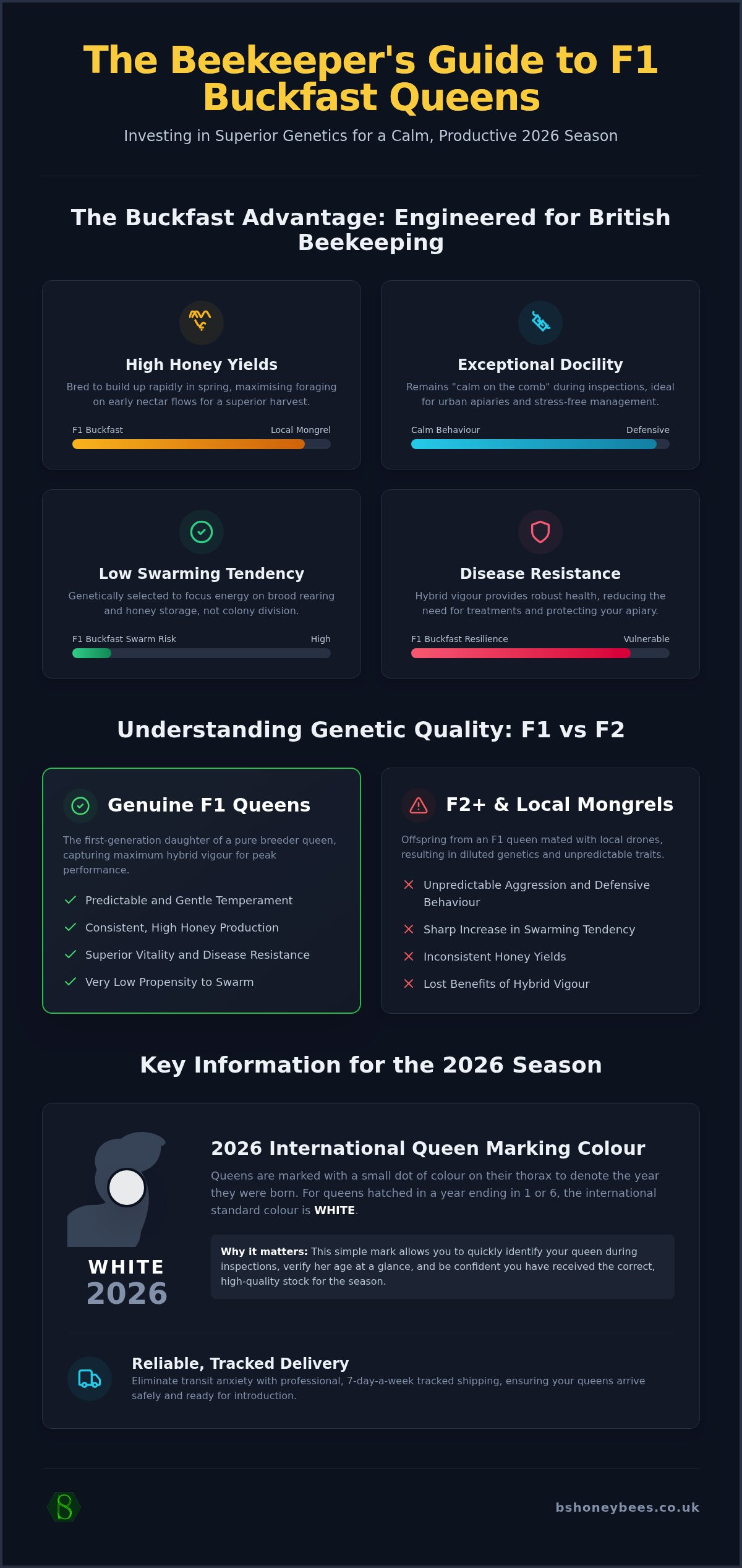
Hybrid vigour ensures that the colony possesses superior vitality, disease resistance, and foraging drive compared to either parent line. In practical terms, this translates to more honey in your supers. Whilst an F1 queen offers a predictable and stable temperament, the same cannot be said for F2 or "local" queens. F2 queens are the granddaughters of the original breeder stock. When they mate with local drones, the carefully selected Buckfast traits begin to dilute. This often results in unpredictable aggression and a sharp increase in swarming tendencies. Relying on local mongrels is a gamble that rarely pays off in productivity.
Mating Standards and Genetic Purity
The quality of an F1 queen is dictated by her mating environment. While instrumentally inseminated (II) queens are the backbone of breeding programmes, most beekeepers find that open-mated queens from a professional breeder offer the best balance of cost and performance. Reliability depends on drone saturation. A specialist breeder ensures the mating apiary is flooded with high-quality Buckfast drones, minimising the chance of "mismating" with local, defensive bees. This rigorous process maintains the gentle characteristics you expect from the breed.
The 2026 Marking Standard
For the 2026 season, the international queen marking colour is White. A marked queen is not just a convenience; it is a fundamental management tool. It allows you to locate the queen quickly during time-sensitive inspections, reducing the risk of accidental injury. Crucially, a white mark helps you identify if your colony has superseded. If you open a hive in mid-summer and find an unmarked queen or a queen with a different colour, you know the original F1 genetics have been replaced by a local cross. To ensure you start your season with the highest genetic standards, you can pre-order your 2026 F1 Buckfast queens from a trusted UK breeder.
The UK Breeder Decision Framework: Evaluating Standards and Reliability
Choosing where to buy buckfast queen bees is a decision that impacts your apiary for years, not just a single season. A reliable breeder prioritises biological security and logistical transparency. In 2026, this is more critical than ever. The UK government recently suspended imports from specific regions in Italy, Honduras, and Ukraine due to outbreaks of Small Hive Beetle and limited surveillance for Tropilaelaps mites. You must ensure your supplier adheres to these strict health standards. A reputable breeder provides queens from apiaries free from American Foulbrood (AFB) and European Foulbrood (EFB), ensuring you don't inadvertently introduce pathogens to your local area.
Reliability also extends to stock management. Many beekeepers face the frustration of "ghost stock", which are queens listed as available that result in indefinite waitlists. Demand real-time stock control. Additionally, consider the "freshness" of the livestock. A queen that has languished in a mailing cage for weeks will have depleted pheromone levels. This leads to lower acceptance rates and poor initial performance. Technical support is another vital factor. A professional breeder should be a supportive mentor, offering advice on introduction techniques long after the sale is complete.
Brood Patterns and Laying Performance
A high-quality Buckfast queen is defined by her prolificacy. When inspecting a new colony, look for a "solid" brood pattern. This means frames filled from edge to edge with larvae of the same age, with very few empty cells. This efficiency allows the colony to build up strength rapidly in the spring. If you see a "pepper-box" pattern with scattered empty cells, it often indicates poor mating or a failing queen. Selecting a specialist breeder ensures you receive a queen capable of sustaining a massive workforce for the summer honey flow.
Comparing Buckfast vs Carniolan Bees
While Buckfast bees are the gold standard for honey production in the UK, some beekeepers consider Carniolan stock for their explosive spring buildup. Your choice should depend on your specific goals and local forage. You can read our detailed comparison on Buckfast vs Carniolan Bees: Which Breed is Best for UK Beekeeping? Both breeds are excellent for overwintering in the British climate, but the Buckfast's lower swarming tendency often makes them easier for those managing multiple hives. When you buy buckfast queen bees, you are choosing a bee bred for sustained, manageable growth throughout the entire season.
Logistics and Delivery: Ensuring a Safe Arrival for Your 2026 Queens
Logistics are the bridge between a breeder's genetic standards and your apiary's success. When you buy buckfast queen bees, the transit phase is often the most stressful period for the beekeeper. The window of availability in the UK typically runs from March to September, aligning with the peak breeding season. Outside of this period, the risk of chilled queens or poor mating increases significantly. To mitigate transit stress, Royal Mail Special Delivery remains the only professional choice. It guarantees next-day arrival, minimising the time the queen spends in a dark, vibrating environment.
The design of the transport cage is equally vital. Most high-quality breeders use Nicot, Lyson, or JzBz slow-release designs. These cages feature a specific compartment for queen candy, which serves as both food and a timed-release mechanism. This ensures the colony can eat through the candy at a controlled pace, allowing them to become accustomed to the new queen's pheromones before she is physically released. A major evolution for 2026 is the availability of 7-day-a-week delivery. This eliminates the "weekend bottleneck" where queens were previously held in sorting offices over Sundays, ensuring you receive your livestock exactly when you are ready to introduce them.
The Arrival Checklist
Your responsibility begins the moment the postman arrives. Follow this checklist to ensure a smooth transition:
- Initial Inspection: Check the cage immediately. You should see a lively queen and a small group of active attendants.
- Hydration: Transit is dehydrating. Use a cocktail stick or finger to place a single, tiny drop of water on the mesh of the cage. Do not drown them; a single drop is sufficient.
- Storage: If you cannot introduce her immediately, keep the cage in a cool, dark place. A kitchen cupboard is usually ideal. Avoid the fridge, as extreme cold will kill the queen.
Successful Queen Introduction
Patience is your most effective tool during introduction. The candy release method is the gold standard for success. Before you start, ensure the recipient colony is truly queenless and has no active queen cells. For a deeper dive into managing your livestock this year, read our F1 Buckfast Queens UK: The Ultimate Guide to the 2026 Beekeeping Season. Wait at least 48 hours before checking for acceptance. If the bees are clinging tightly to the cage in a "balling" behaviour, do not release her; they are still aggressive toward her. If they are walking calmly over the cage and fanning, the introduction is likely a success. You can order your 2026 Buckfast queens now to secure your preferred delivery date.
Securing Your 2026 Stock: Why BS Honey Bees Is the Preferred UK Supplier
BS Honey Bees has earned its position as the UK's #1 queen retailer through a relentless commitment to quality and logistical precision. When you buy buckfast queen bees from us, you're accessing F1 genetics that have been meticulously selected for the specific demands of the British season. We don't just sell bees; we provide the foundation for a thriving apiary. Our approach is built on trust and efficiency. We recognize that your success as a beekeeper depends on the reliability of the livestock you introduce.
Our 7-day-a-week delivery service via Royal Mail Special Delivery is a cornerstone of our operation. We understand that beekeepers have busy lives. You shouldn't be forced to wait at home for days on end. This flexibility ensures your queens arrive in peak condition on a day that suits your schedule. Combined with our use of slow-release candy cages and the 2026 white marking standard, we've removed the common friction points from the purchasing process. We prioritize the health of the bee and the convenience of the customer in equal measure.
Beyond the livestock, we provide comprehensive support for every stage of your beekeeping journey. This includes high-performance protective gear like the BBWear bee suit, which is essential for comfortable, confident hive management. We maintain a no-nonsense approach to communication. If a queen is listed as in stock, she is ready for dispatch. We avoid the frustration of indefinite waitlists by using a real-time stock control system that gives you total peace of mind during the busy spring buildup.
The Full Apiary Solution
Success in the apiary requires more than just a high-quality queen; it requires a compatible environment. Pairing your new F1 genetics with a British National Hive ensures your colony has the space and insulation it needs to thrive in the UK climate. For those starting new colonies, our 2-in-1 poly nucs offer a versatile starting point that supports rapid population growth. By choosing specialist UK breeders, you're directly supporting the health and sustainability of the domestic honey industry whilst ensuring your bees are perfectly adapted to local forage conditions.
Ordering for the 2026 Season
Demand for premium F1 Buckfast stock is consistently high. Early pre-orders are essential if you want to secure a specific dispatch date within the critical March to September window. Our transparent ordering system allows you to plan your season with confidence, knowing exactly when your new queens will arrive. Join the growing community of beekeepers across the United Kingdom who trust our expertise. Secure your 2026 stock today and experience the difference that professional breeding and unrivalled logistics make to your honey production.
Prepare Your Apiary for a Productive 2026 Season
The 2026 season offers an incredible opportunity to revitalise your apiary with superior genetics. By focusing on F1 pedigree and verified health standards, you eliminate the risks of aggressive behaviour and poor honey yields. Reliable logistics, including Royal Mail Special Delivery and our unique 7-day-a-week shipping window, ensure that your livestock arrives safely and on your terms. You can finally move away from the unpredictability of local mongrel bees and enjoy a calm, manageable hive.
When you buy buckfast queen bees from a specialist breeder, you aren't just getting a queen; you're gaining a partner in your beekeeping success. As the UK’s #1 queen retailer, we offer marked and mated F1 stock that is specifically bred for the British climate. Our no-nonsense approach to stock availability means you can plan your spring buildup with total confidence. Every queen is supplied in a slow-release candy cage, ready for immediate and successful introduction into your colonies.
Pre-order your 2026 F1 Buckfast Queens today for nationwide delivery to secure your preferred dispatch date and start the new year with a thriving, gentle apiary. We look forward to helping you fill your honey supers in 2026 and beyond.
Frequently Asked Questions
How much does an F1 Buckfast queen bee cost in the UK?
When is the best time of year to buy a Buckfast queen?
The optimal window to buy buckfast queen bees is between May and August when the weather is stable and drones are plentiful for successful mating. While pre-orders often open in early spring, introducing a queen during the peak nectar flow increases the likelihood of colony acceptance. Avoid ordering too early or late in the season to prevent the risk of chilled queens or poor brood development.
Can I introduce a Buckfast queen to a colony of different bees?
Yes, you can successfully introduce a Buckfast queen into a colony of different bees, such as local mongrels or Carniolans. The process requires ensuring the recipient colony is completely queenless and removing all existing queen cells before introduction. Using a slow-release candy cage allows the workers to gradually acclimatise to the new queen's specific pheromones, which is the key to a smooth transition.
What happens if my queen bee arrives dead in the post?
If your queen arrives dead, you must contact the supplier immediately and provide photographic evidence of the queen within her original, unopened cage. Most reputable breeders offer a replacement for queens that don't survive transit, provided they were sent via a tracked service like Royal Mail Special Delivery. Never attempt to introduce a dead or severely weakened queen into a hive, as this will lead to immediate failure.
How long can a queen bee survive in a mailing cage?
A queen bee can typically survive for three to five days inside a mailing cage, provided she has attendant bees and a supply of fondant. However, her vitality and pheromone strength begin to decline the longer she is kept away from a colony. You should aim to introduce her within 24 hours of arrival. If a delay is unavoidable, keep the cage in a cool, dark place and provide a tiny drop of water for hydration.
Why is my new Buckfast queen marked with a white dot for 2026?
The white dot signifies the international queen marking colour for the year 2026, following a standard five-year rotation. This system allows beekeepers to quickly identify the age of the queen and determine if she has been superseded by the colony. The colours used are white, yellow, red, green, and blue. A marked queen is much easier to spot during routine inspections, which reduces the risk of accidental injury during hive management.
Do Buckfast bees swarm more than other honey bee breeds?
Buckfast bees are specifically bred for a low swarming tendency compared to many other honey bee breeds. While no honey bee is entirely swarm-proof, the selection process pioneered by Brother Adam prioritised bees that remain focused on honey production rather than reproduction. Maintaining a young F1 queen and providing ample space for the queen to lay and for the colony to store nectar will further minimise swarming risks throughout the summer.
How do I know if my queen bee has been successfully accepted?
You'll know the queen has been successfully accepted when you see a solid, healthy brood pattern of eggs and larvae within seven to ten days of release. During your first inspection after introduction, look for workers walking calmly over the frames and attending to the queen. If the bees are fanning their wings or feeding the queen through the cage mesh before release, these are excellent indicators of a positive reception from the colony.