

Choosing between Buckfast and Carniolan bees for your 2026 season is a strategic decision that determines whether you'll be harvesting surplus honey or chasing swarms across the countryside. You've likely felt the frustration of opening a hive only to be met by aggressive "mongrel" bees or watching a promising colony collapse during a fickle British spring. It's a common struggle for beekeepers who want reliable results without the stress of difficult handling or unpredictable colony losses.
This guide explores the critical differences between buckfast vs carniolan bees uk to help you optimise your honey yield and ensure your colonies thrive in our unpredictable climate. We'll compare temperament, overwintering success, and management requirements so you can select the breed that turns your apiary into a productive and gentle environment. Whether you're looking for the explosive spring build-up of the Carniolan or the steady, prolific nature of the F1 Buckfast, we provide the expert insight needed to make an informed choice for your upcoming season.
Key Takeaways
- Understand how the distinct genetic profiles of Buckfast hybrids and Carniolan subspecies dictate their survival during the unpredictable UK spring.
- Learn why F1 Buckfast genetics are the industry standard for high honey yields and exceptionally docile behaviour during your hive inspections.
- Discover how the Carniolan’s explosive spring growth and efficient winter clustering help colonies thrive in harsher or more exposed apiary locations.
- Evaluate the buckfast vs carniolan bees uk comparison to match swarm management requirements and honey production cycles to your available time.
- Determine which breed suits your specific local forage profile and why British National Hives provide the ideal foundation for both.
The UK Beekeeping Challenge: Buckfast vs Carniolan Bees in 2026
Successful beekeeping in Britain requires more than just a hive; it demands a breed that can withstand our notoriously fickle weather. As we look toward the 2026 season, the choice between buckfast vs carniolan bees uk has never been more relevant. With shifting climate patterns and a heightened focus on biosecurity, your colony's genetics will be the deciding factor in whether you harvest a record crop or face an empty hive by June. Understanding these biological foundations is the first step toward a productive year.
Subspecies vs Hybrids: What Beekeepers Need to Know
The Carniolan bee, or Apis mellifera carnica, is a naturally occurring subspecies originating from Central Europe. It evolved to survive cold winters and respond with explosive growth as soon as the first forage appears. Conversely, the Buckfast is a man-made hybrid. If you explore the History of the Buckfast Bee, you'll discover it was developed by Brother Adam at Buckfast Abbey to merge the disease resistance and productivity of various global bee races. While some argue for "local bees," these are frequently unrefined crosses that lack the stable traits found in established breeds. For urban or garden apiaries where space is tight, the predictable nature of a Buckfast or Carniolan is far superior to an unknown "mongrel" colony.
The 2026 season outlook suggests we may face another year of erratic spring temperatures. This makes breed selection a critical survival factor. You need bees that can either shut down brood production during a cold snap or those with enough "frugality" to manage their winter stores until the nectar truly begins to flow. Both breeds are elite performers, but they achieve their success through very different biological rhythms.
The Role of F1 Genetics in Colony Temperament
Predictability in the apiary starts with F1 genetics. An F1 queen is the direct, first-generation descendant of a breeder queen. This ensures that the colony inherits the specific traits of docility and honey production the breeder intended. Professional breeding centres in the UK work tirelessly to maintain these high standards through isolated mating stations or instrumental insemination. This control separates professional operations from hobbyist experiments.
Relying on second-generation (F2) queens or local crosses often leads to "mongrel" bees. These colonies frequently exhibit high levels of aggression, making inspections difficult and unpleasant. Investing in F1 buckfast queens UK guarantees that your bees remain a pleasure to handle. When you choose F1 stock, you aren't just buying bees; you're securing the peace of mind that comes with a calm, productive, and manageable apiary throughout the 2026 season.
The Buckfast Bee: Exceptional Honey Yields and Docile Behaviour
The Buckfast bee stands as a testament to the meticulous selection process initiated by Brother Adam. Through the Buckfast Abbey's bee program, this hybrid was engineered to solve the specific problems facing 20th-century British beekeepers, namely the devastating Isle of Wight disease. Today, the modern Buckfast remains a favourite amongst commercial bee farmers because it combines high productivity with an exceptionally calm temperament. When evaluating buckfast vs carniolan bees uk, the primary advantage of the Buckfast is its ability to maintain massive, stable populations that translate directly into heavy honey supers.
Temperament is where the Buckfast truly excels. During inspections, these bees are frequently described as "sitting on the comb." They don't run or boil over the top of the frames. Instead, they remain preoccupied with their work, allowing you to identify the queen or check for disease with minimal disruption. This docility makes them an excellent choice for garden apiaries where neighbourly relations are a priority. However, be aware that this prolificacy comes at a cost. Buckfast colonies are "hungry" bees. Because they maintain a large brood nest throughout the winter, they require significantly more stores than the more frugal Carniolan to avoid spring starvation.
Productivity and Foraging Power
Buckfast bees are renowned for their work ethic. They are often the first out of the hive in the morning and the last to return, frequently foraging in light rain or lower temperatures that would keep other breeds grounded. Their low swarming tendency is another major benefit for the honey producer. Whilst a Carniolan colony might prepare to swarm at the first sign of a nectar flow, a well-managed Buckfast colony focuses its energy on storage. Prolificacy in Buckfast queens refers to their relentless egg-laying capacity, ensuring a constant stream of foragers to capitalise on every available flowering event from spring through to autumn.
Management Needs for Buckfast Colonies
Standard equipment often fails to contain the ambition of a Buckfast queen. To prevent congestion, you must provide a large brood nest. Utilising a British National Jumbo hive or a "brood and a half" system is often necessary to give the queen the space she requires. Monitoring stores is equally vital, particularly during the "June Gap." This is a period in the UK where early spring forage has ended but summer flowers have yet to bloom. Because Buckfast bees do not naturally reduce their brood rearing during forage shortages, they can quickly exhaust their honey reserves.
Ensure you are prepared for these intensive inspections. Wearing a high-quality BBWear bee suit provides the physical protection and mental confidence needed to manage these powerful colonies effectively. If you are ready to scale up your honey production for the 2026 season, consider starting with our F1 Buckfast queens to secure the best genetics for your apiary.
The Carniolan Bee: Winter Hardiness and Explosive Spring Growth
While the Buckfast is a powerhouse of sustained production, the Carniolan (Apis mellifera carnica) is a master of efficiency. Its biological rhythm is perfectly tuned to regions with harsh winters and short, intense nectar flows. In the debate of buckfast vs carniolan bees uk, the Carniolan offers a distinct advantage for beekeepers in more exposed or northern locations where winters are unforgiving. Their ability to adapt to environmental shifts makes them a resilient choice for the 2026 season.
Unlike the Buckfast, which maintains a large population year-round, the Carniolan colony reacts to the end of the foraging season by rapidly reducing its brood. They overwinter as a small, tight, and highly efficient cluster. This frugality allows them to thrive on minimal stores. They are particularly well-suited to the UK's damp winters, where high humidity and fluctuating temperatures can stress less hardy breeds. By consuming fewer resources during the dormant months, they often emerge in spring with more significant food reserves intact.
Mastering the Spring Surge
As soon as the first pollen from willow or hazel appears, the Carniolan queen begins laying at an incredible rate. This "explosive" build-up is designed to meet early spring forage like Oil Seed Rape (OSR). However, this rapid expansion can catch beekeepers off guard. If the brood nest becomes congested, the colony's strong swarming instinct is triggered almost immediately. It's a biological response to their rapid growth.
Proactive space management is essential. Providing extra supers early or utilising a 2-in-1 poly nuc for split management helps mitigate the swarm risk. By staying ahead of their growth, you can harness their incredible spring energy for a massive early honey harvest. Success with Carniolans depends on your ability to match their pace during these critical weeks in April and May.
The 'Gentle' Bee in the Garden Apiary
For beekeepers with neighbours in close proximity, temperament is non-negotiable. Carniolans are widely considered the gentlest honey bees available. They remain incredibly calm during inspections, often ignoring the beekeeper entirely. This makes them a pleasure to handle, even for those with less experience. Another practical benefit is their low use of propolis. This "clean" behaviour means frames are easy to move, and hive components don't become glued together, which simplifies your colony management.
To maintain these desirable traits, it is vital to source high-quality genetics. Using mated carniolan queen bees for sale UK ensures you are introducing pure, tested stock into your apiary. This prevents the "mongrelisation" that occurs when colonies are left to mate with aggressive local drones. High standards in queen selection preserve the tranquil environment of your garden whilst ensuring your bees remain productive and hardy.
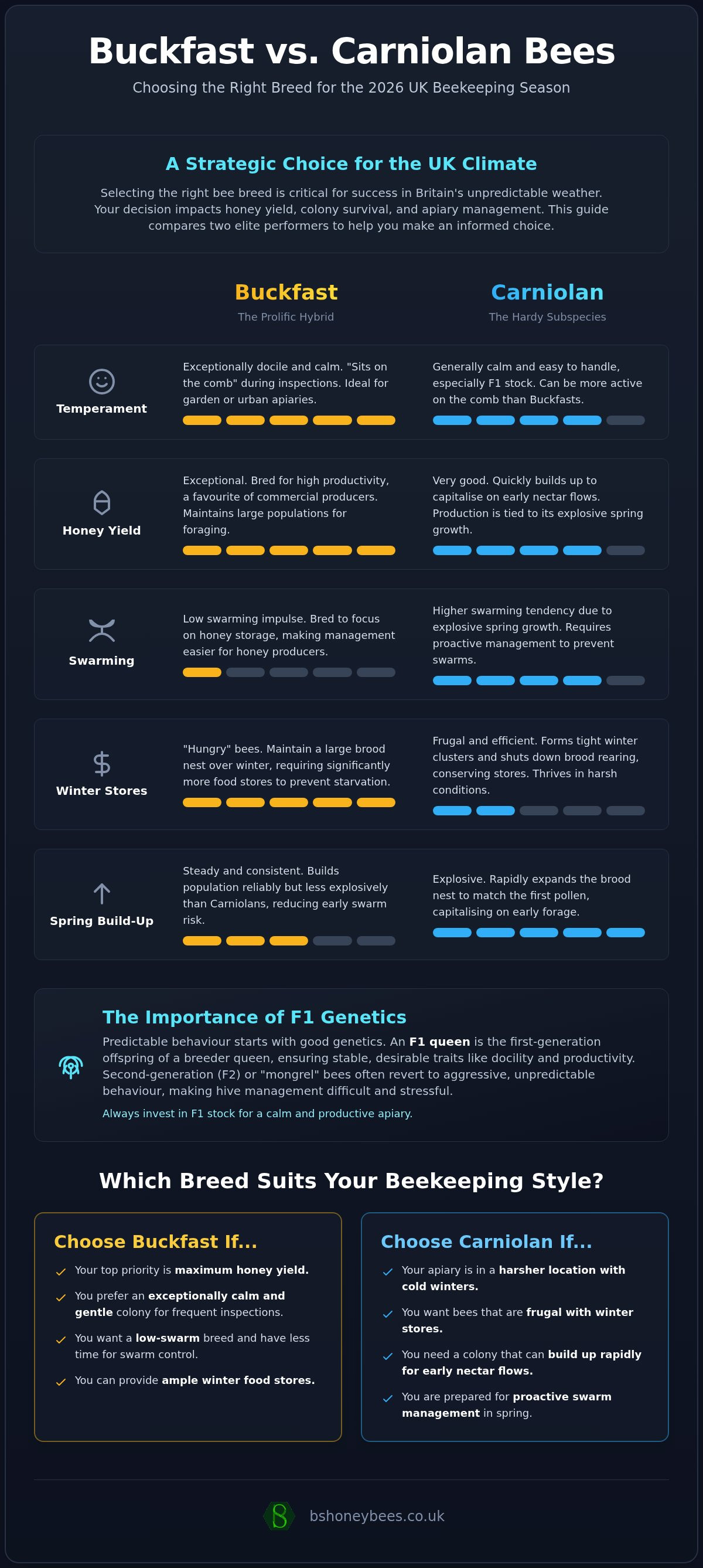
Head-to-Head: Comparing Management, Swarming, and the 'F2 Factor'
Choosing between these two breeds requires an honest assessment of your beekeeping style and your local environment. Managing an apiary is a game of timing. Success depends on whether you can match your management actions to the biological rhythm of your bees. In the buckfast vs carniolan bees uk debate, the choice often boils down to whether you prefer a "sprinter" that hits the ground running in April or a "marathon runner" that provides a steady, massive harvest throughout the entire summer.
Buckfast vs Carniolan: The Comparison Table
The following table outlines the practical differences you will encounter in the field. These traits are heavily influenced by the UK's unpredictable weather, where a sudden June washout can ground a high-intensity colony or trigger a swarm in a congested brood nest.
| Trait | F1 Buckfast | Carniolan |
|---|---|---|
| Build-up Speed | Steady and prolific | Explosive spring surge |
| Swarm Risk | Low (bred for stay-at-home) | High (instinctive response) |
| Winter Stores | High consumption | Frugal and efficient |
| Honey Yield | High (Sustained) | Early Peaks (OSR specialist) |
| Gentleness | Excellent (Calm on comb) | Exceptional (Very docile) |
Buckfasts are the marathon runners of the bee world. They maintain a large, productive workforce for as long as the weather allows. Carniolans are the sprinters. They are unmatched for early season forage, but they require a vigilant beekeeper to manage their rapid expansion. If you miss a single swarm cell in a Carniolan hive during May, you may lose your entire honey crop for that colony.
The Reality of Second-Generation Temperament
The "F2 Factor" is the most overlooked aspect of breed selection. When your gentle F1 queen eventually swarms or is superseded, her daughter (the F2 queen) will mate with whatever drones are flying in your local area. In the UK, these drones are often from "mongrel" colonies with defensive genetics. This cross-breeding frequently results in a breakdown of the docile behaviour you originally paid for. By the second or third generation, a once-gentle garden colony can become defensive, "runny" on the comb, and difficult to inspect without full protection.
Identifying a "turned" colony is simple. If your bees begin to follow you back to the house or ping your veil repeatedly during a routine check, the genetics have likely shifted. Requeening annually or biennially is the only way to preserve the safety and enjoyment of your apiary. Mated queen bees delivered from a specialist are the best insurance against the unpredictability of local drone populations. To ensure your apiary remains a pleasure to manage, order your 2026 queens from our DASH-accredited breeding stock today.
Making Your Decision: Which Queen Should You Introduce This Season?
Finalising your choice between buckfast vs carniolan bees uk requires a practical look at your apiary's geography. A garden in the suburbs of Manchester has different forage demands than a heather moor in Scotland. You must align the breed's biological strengths with the floral resources available within a three-mile radius of your hives. Making an informed decision now ensures you aren't fighting against your bees' natural instincts all season long.
Your equipment also plays a pivotal role in this selection. British National Hives remain the UK standard for a reason. They offer the versatility needed for both breeds. Whilst the prolific Buckfast might eventually require a double brood system or jumbo frames, the standard National footprint provides a solid foundation for managing the Carniolan's spring surge. Standardising your equipment across your apiary makes management more efficient, regardless of the breed you choose.
Forage-Based Selection
Consider your local nectar flow before placing your 2026 order. If your area is rich in early spring blossom or surrounded by Oil Seed Rape, the Carniolan's explosive build-up will allow you to capitalise on these early peaks. However, if you rely on late-season forage like heather or the autumn ivy flow, the Buckfast's sustained prolificacy is superior. Many beekeepers managing multiple out-apiaries choose to keep a mix of both breeds. This diversification spreads the risk and allows you to compare performance across different micro-climates.
Why Sourcing from BS Honey Bees Ltd Matters
Genetic purity is the foundation of a successful apiary. When you source from BS Honey Bees Ltd, you benefit from our logistical excellence and DASH-accredited standards. We provide F1 queens mated in professional, drone-saturated environments to ensure the temperament and productivity we promise. Our specialist nationwide live bee delivery means your queens or nucleus colonies arrive in peak condition, ready to thrive from day one.
If you're unsure which breed to commit to, starting with a 5 or 6 frame nucleus colony is the most effective way to see these traits in action. It allows you to observe the colony's build-up and behaviour before scaling your operation. Use this final checklist to guide your 2026 orders:
- Forage: Does the breed match your peak nectar flows?
- Equipment: Are you prepared for the space requirements of a prolific queen?
- Time: Can you commit to the weekly swarm checks required for Carniolans in May?
- Temperament: Is your apiary location suitable for the breed's handling characteristics?
Don't leave your 2026 success to chance. Browse our full range of live bees and beekeeping equipment to secure your preferred delivery dates. Whether you choose the industrious Buckfast or the hardy Carniolan, starting with F1 genetics is the best investment you'll make this season.
Prepare Your Apiary for a Productive 2026 Season
Your success in the coming year depends on matching the biological rhythm of your bees to your local environment. Whether you choose the sustained productivity of the Buckfast or the early-season efficiency of the Carniolan, starting with verified F1 genetics is non-negotiable. This decision determines not only your honey yield but also the safety and enjoyment of your hive inspections. You'll find that a well-chosen breed makes every aspect of management more rewarding and significantly reduces the stress of swarm season.
Understanding the nuances of buckfast vs carniolan bees uk allows you to manage your colonies with precision rather than guesswork. To ensure the best results, always source from reliable breeders who prioritise genetic standards. As DASH Accredited Bee Farmers, we specialise in F1 genetics to guarantee predictable temperament and performance. We use nationwide Royal Mail Special Delivery to ensure your live bees arrive in peak condition, regardless of your location in the UK.
Secure your F1 Buckfast or Carniolan Queens for the 2026 season today and take the first step toward a thriving, manageable apiary. We're ready to help you achieve your most successful honey harvest yet.
Frequently Asked Questions
Is a Buckfast bee better for beginners in the UK?
Buckfast bees are often recommended for beginners because of their exceptionally calm temperament and low swarming instinct. These traits allow new beekeepers to focus on learning hive biology without the stress of managing a defensive colony. Their predictable behaviour during inspections makes them a reliable choice for those still gaining confidence in handling frames and identifying the queen.
Can Carniolan bees survive a harsh UK winter better than Buckfast?
Carniolan bees generally exhibit higher winter hardiness than Buckfast colonies due to their frugal nature. They naturally reduce their brood production as forage disappears, overwintering in a small, efficient cluster that consumes minimal stores. This biological adaptation makes them particularly resilient during long, damp UK winters where food reserves must be managed carefully until the spring flow begins.
How do Buckfast and Carniolan bees differ in honey production?
The main difference in honey production involves timing and duration. Buckfast bees are prolific foragers that maintain large populations for a sustained harvest throughout the entire summer. In contrast, Carniolans excel at early-season peaks, making them ideal for capitalising on spring blossom or Oil Seed Rape. When comparing buckfast vs carniolan bees uk for yield, your choice should align with your local forage peaks.
What happens if my F1 queen swarms and produces an F2 colony?
If an F1 queen swarms, the resulting F2 colony will often exhibit more defensive or erratic behaviour. This occurs because the new queen mates with local drones of unknown and often aggressive genetics. You'll likely notice the bees become more "runny" on the comb or ping your veil during inspections. To maintain a gentle apiary, it's best to requeen these colonies with fresh F1 stock.
Do Carniolan bees swarm more than Buckfast bees?
Carniolan bees do have a more pronounced swarming instinct compared to the Buckfast breed. Their rapid spring expansion can lead to brood nest congestion very quickly, which triggers the swarm response if not managed proactively. While Buckfast bees have been specifically bred for a stay-at-home nature, Carniolans require a vigilant beekeeper to provide extra space as soon as the first nectar flows begin.
Which breed is more docile during hive inspections?
Both breeds are famously gentle, but they behave differently on the frames. Buckfast bees are renowned for "sitting on the comb," remaining calm and preoccupied with their work while you inspect. Carniolans are equally docile and unlikely to sting, though they're often more active. For most garden beekeepers, either breed represents a massive improvement over aggressive local crosses or defensive mongrel colonies.
Can I keep Buckfast and Carniolan bees in the same apiary?
You can certainly keep both breeds in the same apiary, provided you're prepared for their different management cycles. You'll need to monitor the Carniolans for swarming much earlier in the season whilst ensuring the Buckfast colonies have sufficient winter stores. Mixing breeds is a great way to compare performance and ensure you have foragers ready for both early and late nectar flows.
What is the best hive type for Buckfast and Carniolan bees in the UK?
The British National Hive is the standard choice for both breeds in the UK. When considering buckfast vs carniolan bees uk equipment needs, remember that prolific Buckfast queens often require a Jumbo brood box or a double-brood system to prevent overcrowding. Carniolans generally thrive in a standard National box, provided you're prompt with adding supers during their explosive spring build-up to manage congestion.