

Could a single queen change your entire relationship with beekeeping? If you've ever spent a weekend dreading hive inspections because of aggressive colonies, you know that temperament is everything. Many beekeepers in the UK struggle with defensive "mongrel" bees that turn hostile during a summer nectar dearth or fail to survive the damp, unpredictable British winters. You deserve a calm apiary experience and the high honey yields that come from a truly professional strain of bee.
We understand that choosing the right genetics is the most important decision you'll make this season. This detailed analysis of buckfast bees pros and cons uk will help you determine if these high-performance bees are the right choice for your specific management style. We'll explore their legendary docility, their prolific brood-rearing habits, and the essential 2026 management techniques required to keep them healthy. By the end of this guide, you'll know exactly how to leverage F1 Buckfast genetics to achieve a productive, stress-free season and ensure your colonies overwinter with strength and vitality.
Key Takeaways
- Evaluate the essential buckfast bees pros and cons uk to decide if their high-performance foraging and docile nature align with your beekeeping style.
- Learn why proactive autumn feeding is vital for sustaining the large brood nests these bees maintain throughout the damp British winter.
- Uncover the truth about the 'F2 aggression' myth and the importance of sourcing F1 queens to preserve a peaceful apiary.
- Understand how Buckfast colonies compare to other strains regarding spring build-up speeds and overall honey production potential.
- Discover why starting with a 5 or 6-frame nucleus colony provides the most reliable foundation for establishing a thriving Buckfast apiary in 2026.
The Legacy of the Buckfast Bee: A British Success Story
The Buckfast bee isn't a product of random evolution. It's a masterpiece of selective breeding designed specifically to thrive in the British Isles. This strain represents a human-engineered solution to the challenges of UK beekeeping, offering a level of predictability that wild colonies simply can't match. In a country where the weather can turn from sunshine to a damp drizzle in minutes, having a bee that remains productive and calm is a significant advantage.
Much of this success is owed to the tireless work of Brother Adam, a monk at Buckfast Abbey in Devon. He spent decades crossing various subspecies to combat the devastating effects of the Isle of Wight disease in the early 20th century. You can explore the detailed History of the Buckfast Bee to understand how his rigorous selection process created a bee that changed the industry forever. Today, his legacy continues as beekeepers across the UK rely on these genetics for their stability and performance.
The secret to their success lies in hybrid vigour. By carefully crossing different strains, breeders create a bee that is often hardier and more productive than its parent stock. This genetic edge is why they remain the most popular choice for both commercial honey producers and hobbyists in 2026. They offer a balance of traits that helps beekeepers manage their colonies with confidence and efficiency.
What Exactly is a Buckfast Bee?
It's vital to clarify that the Buckfast is a strain, not a pure species. It belongs to the Apis mellifera family, but its DNA is a curated blend. This mix includes the high productivity of Italian bees, the winter hardiness of Carniolans, and the local resilience of the native English Dark bee. It's a stable hybrid bred specifically for high honey production and an exceptionally gentle temperament.
The Importance of F1 Genetics in the UK
When you're evaluating buckfast bees pros and cons uk, the conversation must start with genetics. An F1 queen is the first-generation daughter of a certified breeder queen. These queens are the gold standard because they carry the predictable, desirable traits you need for a stress-free apiary.
Contrast this with "local mongrels" or F2 crosses. Whilst a second-generation bee might seem fine initially, the genetics often break down, leading to unpredictable aggression and lower yields. Prioritising F1 genetics is the only way to ensure your bees remain docile and productive. In the modern UK landscape, using verified F1 stock is the most effective way to avoid the "aggressive mongrel" problem that plagues many ill-prepared apiaries.
The Pros: Why UK Beekeepers Favour Buckfast Bees
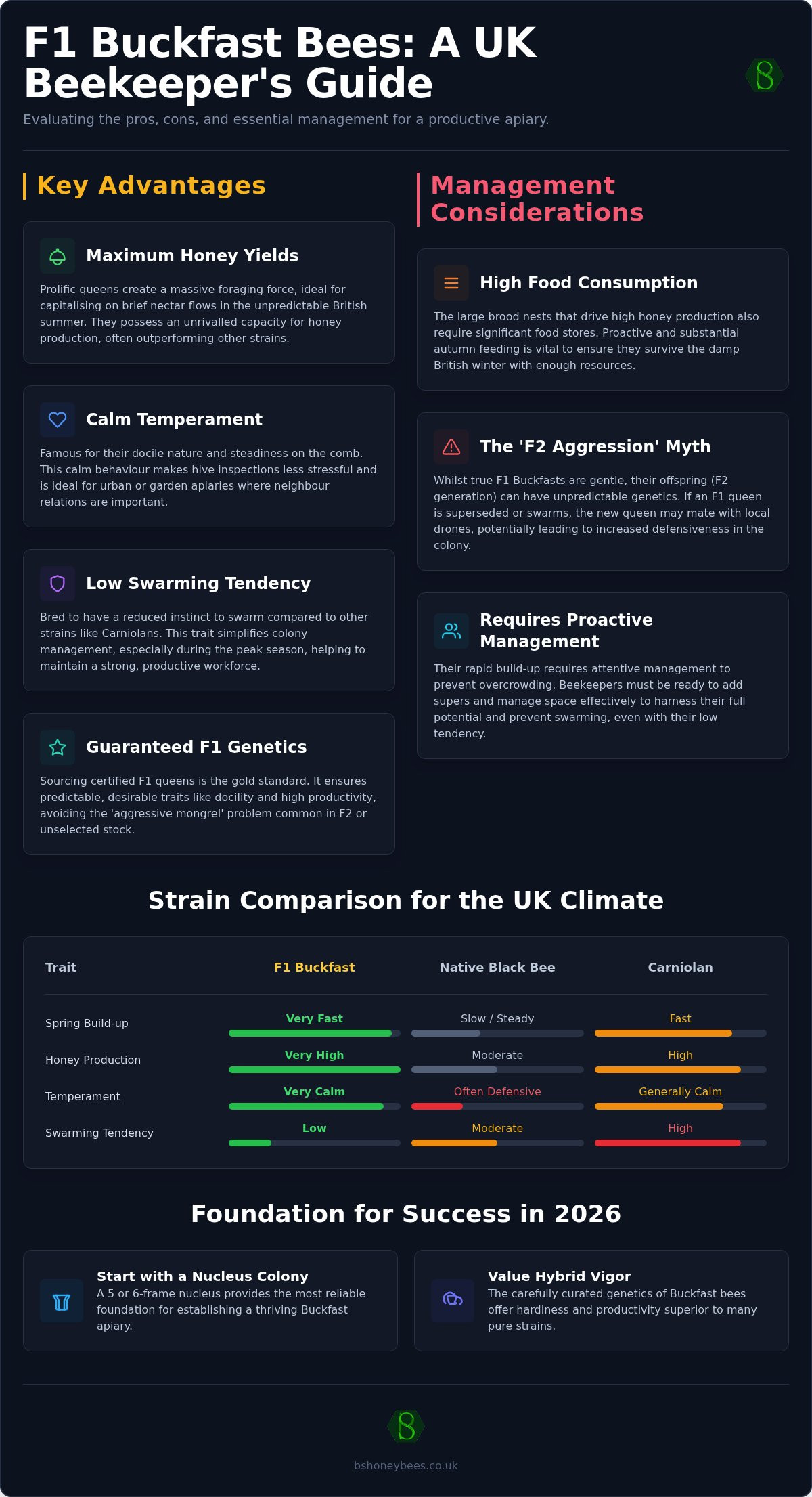
Evaluating the buckfast bees pros and cons uk beekeepers encounter usually starts with a focus on their exceptional productivity. These bees are effectively the high-performance engines of the apiary world. Their primary advantage is an unrivalled capacity for honey production, driven by queens that are prolific layers. This results in a massive foraging force that is ready to capitalise on even the briefest nectar flows in our unpredictable climate.
Maximum Honey Yields in Short British Summers
Our summers are notoriously fickle. Whilst the Native Black Bee is hardy, it often lacks the explosive population growth required to fully exploit major spring flows like Oil Seed Rape. Buckfast bees build up with incredible speed. They possess a unique ability to forage in marginal weather where other strains might remain hive-bound. This efficiency is a core reason they remain the top choice for commercial honey producers across the country. They don't just survive the season; they dominate it.
Calm Temperament and Ease of Inspection
For many, the most significant benefit is the breed's legendary gentleness. They are famously steady on the comb, which means they don't boil over the top of the hive or fly aggressively when you lift a frame. This calm behaviour makes them the gold standard for beekeepers in urban environments or garden settings where neighbour relations are paramount. While some veterans boast of the 'inspect in a t-shirt' reputation, professional standards dictate you should always wear a high-quality BBWear bee suit to ensure total safety.
In modern , the selection process continues to prioritise low swarming tendencies and hygienic behaviour. Unlike Carniolan bees, which can be prone to swarming if space isn't managed perfectly, Buckfasts are generally easier to keep in the hive. Their natural grooming instincts also help them manage Varroa mite populations more effectively than unselected stock. If you're looking to improve your colony's performance this season, investing in F1 Buckfast genetics is a proven way to see immediate results.
The Cons: Management Challenges and Common Misconceptions
Buckfast bees are high-performance livestock. Like any high-output breed, they require specific management inputs to prevent colony failure. One major factor in the buckfast bees pros and cons uk debate is their high metabolic demand. Unlike some native strains that shut down brood rearing during a nectar dearth, Buckfasts continue to maintain large populations. This means they require heavy autumn feeding and vigilant monitoring during the 'June gap' to avoid starvation. If the bees are hungry whilst others in the apiary seem fine, it's usually because their massive brood nest has exhausted their stores.
Managing a Buckfast colony requires a proactive mindset. If you're used to a 'set and forget' approach, these bees will likely frustrate you. They are designed to work hard. If you don't provide the infrastructure to support that work, the colony can quickly become stressed or swarm due to congestion. This is the logical trade-off for their record-breaking honey yields.
Managing the Prolific Breeder
A common mistake amongst UK hobbyists is trying to keep a Buckfast colony in a single British National beehive. These bees are exceptionally prolific. A single brood box is often insufficient for an F1 queen's laying capacity. You'll likely need to adopt a 'brood and a half' or a double brood system to give them the room they require. Without this space, the queen becomes 'brood bound', which means there's no room for eggs. This triggers an early swarming impulse. Timely supering is equally critical. You must add honey supers before the bees actually need them to ensure the colony doesn't feel congested.
Addressing the Aggression Issue
Beekeeping forums often buzz with stories of Buckfast colonies turning into 'assassins' after the first year. It's vital to understand that this isn't a trait of the breed itself. It's a result of local mating. When an F1 queen's daughter (an F2) mates with local drones of unknown heritage, the resulting workers often exhibit extreme defensive behaviour. Defensive behaviour in Buckfasts is almost always a sign of mongrelisation in the F2 generation. The solution is simple: maintain your apiary's temperament by regular requeening with high-quality mated queen bees UK. This ensures your genetics remain pure and your inspections stay peaceful.
UK Climate Resilience: Overwintering and Spring Build-up
Understanding the buckfast bees pros and cons uk beekeepers face requires a look at our unique maritime climate. Unlike the dry, predictable cold of Central Europe, British winters are notoriously long and damp. Buckfast bees, originally developed in the humid conditions of Devon, possess a natural resilience to this moisture. They are bred to survive the "damp chill" that often causes other imported strains to succumb to nosema or dysentery. This local adaptation is a primary reason they remain a staple in British apiaries.
Their spring build-up is characteristically steady. Whilst Carniolan bees might explode into life at the first sign of pollen, Buckfasts tend to wait for more consistent temperatures. This cautious approach prevents the colony from overextending itself during a deceptive "false spring". For smaller colonies or late-season splits, using high-quality poly nucs provides the thermal efficiency needed to ensure they reach full strength by the time the main flow begins. These insulated units are particularly effective for overwintering smaller units that might otherwise struggle in traditional wooden hives.
Winter Survival Strategies
Success in the UK requires a proactive approach to winter stores. Because Buckfasts maintain a larger winter cluster than native bees, you must ensure they have access to high-quality fondant or thick syrup. Ventilation is your primary concern. In the British Isles, moisture kills more bees than the cold. Ensure your hives have adequate airflow to prevent condensation from dripping onto the cluster. Reduce the entrance for winter protection early to prevent robbing and to keep out vermin. A well-prepared Buckfast colony is remarkably hardy and will emerge in spring ready to work.
Navigating the June Gap
The infamous June Gap is where the buckfast bees pros and cons uk dynamic becomes most apparent. These bees are prolific breeders. If the nectar supply stops abruptly, the queen may continue laying, leading the colony to consume its honey stores rapidly. Monitor your hives closely during this forage-poor period. If a sudden cold snap hits, you might need to provide light feeding to ensure the queen doesn't stop laying. This maintenance pays off. It keeps the population high for late-summer flows like heather or ivy. Prepare your apiary for a high-performance season and secure your F1 Buckfast queens and nucs today.
Starting Your Buckfast Journey: Sourcing and Installation
Setting up your apiary for success begins with how you source your stock. When weighing up the buckfast bees pros and cons uk, the most critical factor is the foundation you build upon. We always recommend starting with a nucleus colony rather than a package. Packages often experience significant stress during transit and can suffer from queen supersedure shortly after installation. A nuc, however, arrives as a balanced, functioning colony with brood at all stages and established food stores. This provides a massive head start in the short British season.
Safe delivery is paramount. When considering the buckfast bees pros and cons uk, the logistics of sourcing shouldn't be overlooked. We focus on nationwide live bee delivery using specialist couriers who understand the requirements of transporting high-performance genetics. Timing is equally vital. Demand for quality Buckfast stock often outstrips supply by late spring. Booking early for the 2026 season ensures you receive your bees during the optimum window for colony expansion.
Choosing Between 5 and 6 Frame Nucs
The choice between a 5 and 6-frame nuc depends on your goals for the season. A 5-frame unit is a standard entry point, but a 6-frame nuc offers a significantly more robust start. That extra frame of brood and food provides the momentum needed to fill a full British National Hive much faster. When your nuc arrives, transfer the frames into the centre of your hive in the same order they were in the travel box. Add foundation on either side and feed them light syrup to encourage rapid comb drawing.
The Professional Approach to Requeening
To maintain the breed's famous docility, you must be proactive about your queen's age. An F1 queen is at her peak in her first two seasons. Beyond this, the risk of swarming or supersedure increases. If the colony raises its own queen, you move into the unpredictable F2 generation discussed earlier. Regular requeening ensures your apiary remains a calm and productive environment. When introducing a new queen, ensure the colony is queenless for at least 24 hours and use a slow-release cage to allow the workers to accept her pheromones.
Secure your F1 Buckfast Queens UK for the upcoming season today to guarantee your place in the 2026 delivery window.
Maximise Your Honey Yields and Apiary Peace
Choosing the right strain is the foundation of a successful beekeeping year. We've explored the essential buckfast bees pros and cons uk beekeepers must navigate, from their unrivalled honey production to the necessity of proactive space management. By prioritising F1 genetics, you eliminate the stress of aggressive colonies and ensure your bees possess the resilience needed for damp British winters. These high-performance bees don't just survive; they thrive when managed with the right expertise.
As specialist F1 Buckfast breeders with over 10 years of UK beekeeping expertise, we provide the high-standard stock your apiary deserves. Don't leave your 2026 season to chance. Our nationwide live bee delivery guarantee ensures your new colony arrives in peak condition, ready to work. It's time to move away from unpredictable mongrels and embrace the legendary docility of the Buckfast strain.
Shop our F1 Buckfast Queens and Nucs for UK-wide delivery
Your journey toward a calmer, more productive apiary starts with the right decision today. We look forward to supporting your success and helping your colonies flourish in the seasons ahead.
Frequently Asked Questions
Are Buckfast bees suitable for beginner beekeepers in the UK?
Yes, Buckfast bees are an excellent choice for beginners due to their exceptionally calm temperament. This docility makes hive inspections far less stressful for those still learning the craft. However, novices must be prepared for their prolific nature. You'll need to manage space effectively to prevent swarming and ensure they have adequate stores. Starting with a 5 or 6 frame nuc provides a manageable foundation for a new beekeeper.
Do Buckfast bees require more food than other breeds over winter?
Buckfast colonies generally require more winter stores than native strains because they maintain a larger cluster and continue brood rearing later into the autumn. You should ensure they have at least 20 to 25kg of stores to survive until spring. If the weather is particularly mild and damp, they may consume these resources faster. Vigilant monitoring and supplemental feeding with high-quality fondant are essential for successful overwintering in the UK.
Why do people say Buckfast bees become aggressive?
Aggression is typically a result of mongrelisation rather than the breed's genetics. When an F1 queen's daughter mates with local drones of unknown heritage, the resulting F2 generation often exhibits defensive behaviour. This is a common point in the debate over buckfast bees pros and cons uk. Maintaining a peaceful apiary requires regular requeening with certified F1 stock to ensure the colony retains its legendary gentleness and predictable traits.
How often should I requeen my Buckfast colony?
We recommend requeening every one to two years to maintain peak productivity and temperament. An F1 queen is most prolific during her first two seasons. Beyond this period, her pheromones may weaken, increasing the risk of supersedure or swarming. By introducing a fresh mated queen, you ensure the colony remains easy to manage and continues to deliver high honey yields. This proactive approach is standard practice for professional UK beekeepers.
Can Buckfast bees survive a cold UK winter?
Buckfast bees are highly resilient and well-adapted to the British climate. They were originally developed at Buckfast Abbey to handle the damp, cold conditions of the West Country. Whilst they can survive severe cold, moisture is the greater threat in the UK. Providing adequate ventilation and using insulated 2-in-1 poly nucs for smaller units can significantly improve survival rates during the long, unpredictable winter months and ensure a strong spring build-up.
Are Buckfast bees better than Carniolans for honey production?
Buckfast bees are often preferred for commercial honey production due to their massive foraging force and ability to work in marginal weather. Whilst Carniolans are excellent, they have a stronger swarming instinct that can reduce yields if not managed perfectly. Buckfasts are bred to prioritise honey storage and maintain a steady population throughout the season. This makes them a highly efficient choice for beekeepers aiming for maximum surplus from UK nectar flows.
What hive type is best for Buckfast bees in the UK?
The British National Hive is the standard choice, but you must adapt it to the breed's prolific nature. A single brood box is rarely enough for a high-performance F1 queen. Most successful beekeepers use a "brood and a half" or double brood system to prevent the colony from becoming brood-bound. Providing this extra space is crucial for managing the buckfast bees pros and cons uk effectively and preventing premature swarming during peak flows.
How do I stop my Buckfast bees from swarming?
Effective swarm control for Buckfast bees centres on proactive space management. You must add honey supers before the bees actually need them to prevent congestion in the brood nest. Keeping a young F1 queen also significantly reduces the swarming impulse. If the colony feels it has ample room for both brood and stores, it's far less likely to initiate queen cells. Regular inspections remain essential during the peak swarming season to ensure health.