

What if the safest way to unite two bee colonies is to slow the process down? The best way to unite two bee colonies is usually the newspaper method, which gives workers time to mingle their scents as they chew through the paper. But it only makes sense when both colonies are suitable and healthy enough to combine.
It’s reasonable to worry about fighting or whether the queen you keep will be accepted. Assess both colonies first, decide which queen to retain and avoid rushing the introduction. A weak or queenless colony may benefit from being united, but combining colonies can also spread disease or pests if you skip health checks.
This practical UK guide explains when uniting may be appropriate, what to inspect before combining hives and how to set up the newspaper method. You’ll also learn what to check afterwards, including signs of fighting, queen problems or health concerns. A careful start gives the bees a better chance to settle, without promising that every unite will succeed.
Key Takeaways
- Unite colonies for a clear reason, such as managing a weak or queenless colony, and assess both before choosing to combine them.
- The best way to unite two bee colonies depends on their condition. The newspaper barrier allows gradual contact, whilst stacked-box arrangements may suit different setups.
- Prepare the hive before starting: loosen hive parts and remove brace comb from the frame bottoms to make assembly easier.
- After combining, watch the bees’ behaviour and reassess whether the colonies have joined and the chosen queen is still present.
- Let the colonies’ condition guide your decisions at each stage, rather than relying on a guaranteed timetable or outcome.
When is uniting two bee colonies the right decision?
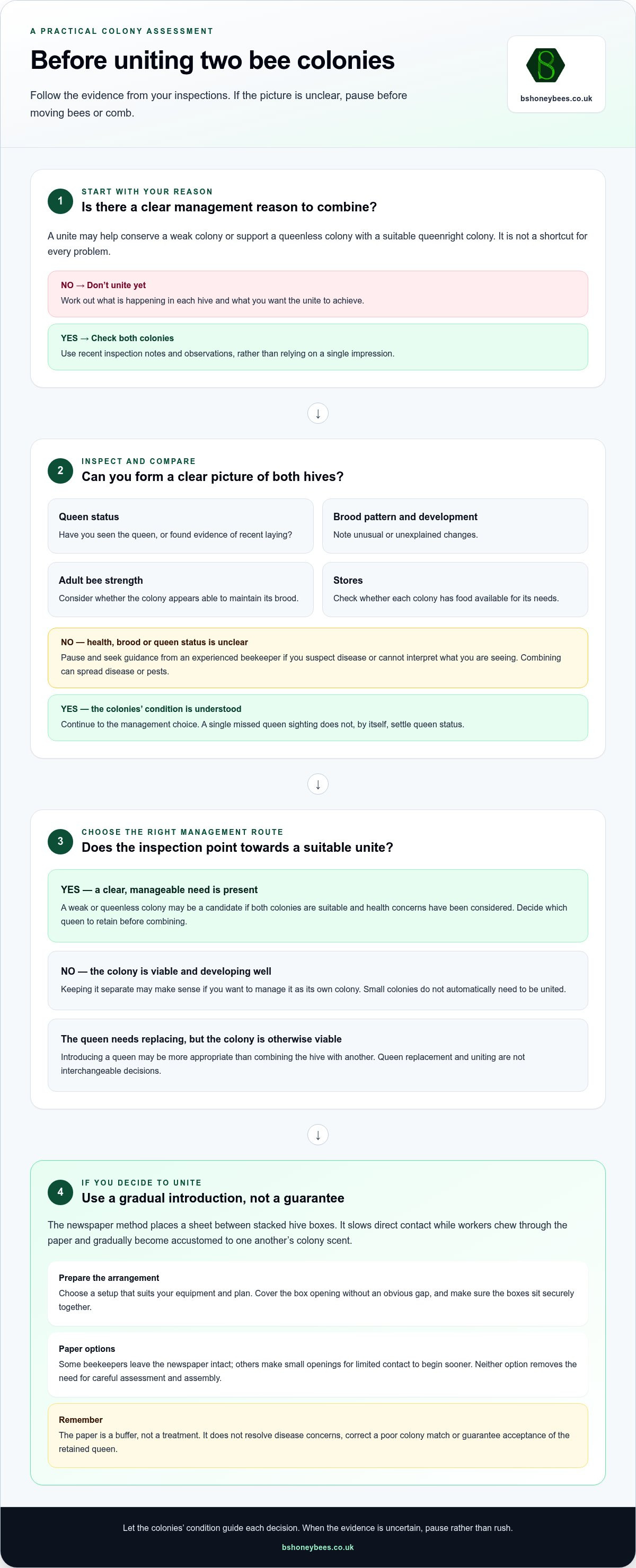
Unite colonies only when you have a clear management reason and a sound understanding of both hives. Combining bees may help conserve a weak colony or give a queenless colony the support of a suitable queenright colony. It isn’t a shortcut for every problem. First work out what is happening in each hive and what you want the unite to achieve.
A small colony may be struggling because it has too few adult bees, but low numbers alone don’t explain why. Check whether the queen is present and laying, whether brood is developing normally and whether the bees have enough stores. If the cause of weakness is unclear, combining the colony could carry the problem into the other hive rather than resolve it. Good Beekeeping practices and hive management begin with observing the colony and making decisions in context.
What should you assess before deciding to unite?
Use notes from recent inspections to compare the colonies, rather than relying on a single impression. Record:
- Queen status, including whether you’ve seen the queen or found evidence of recent laying.
- Brood pattern and development, noting any unusual or unexplained changes.
- Adult bee strength, and whether the colony appears able to maintain its brood.
- Stores, including whether each colony has food available for its needs.
Consider the weak colony’s overall condition before deciding to combine it. A colony with a clear, manageable need may be a candidate. Unexplained brood problems or signs that could indicate disease call for a pause. Don’t diagnose from one sign alone. If you suspect disease or can’t interpret what you’re seeing, seek guidance from an experienced beekeeper before moving bees or comb between colonies.
Uniting is also different from replacing a queen. If the colony is otherwise viable but its queen needs replacing, introducing a queen may be more appropriate than combining the hive with another. Follow a separate, careful process for introducing mated queen bees. Uniting two colonies and introducing a replacement queen are not interchangeable decisions.
When might keeping colonies separate be preferable?
A colony with a healthy, viable queen may have a different management need from a weak or queenless one. Keeping it separate can make sense if it is developing well and you want to manage it as its own colony. The decision depends on your objective and what inspections show, not a universal rule that small colonies should always be united.
Uncertain queen status is a reason to inspect carefully, not to rush. Look for a consistent picture across your records and observations. The absence of a sighting during one inspection doesn’t, on its own, settle the question. If brood condition, queen status or general health remains unclear, pause and seek experienced guidance. Once you understand both colonies and have a defined reason to combine them, you can choose a suitable setup and plan the unite with greater confidence.
How the newspaper method unites two bee colonies
The newspaper method separates two colonies with a sheet of paper placed between their hive boxes. Instead of putting unfamiliar bees into immediate, unrestricted contact, the barrier slows their meeting and gives them time to become accustomed to one another as they work through it. This gradual introduction is the method’s central idea, not a guarantee that the bees will accept one another or the queen being retained.
The newspaper barrier slows direct contact while the bees gradually become accustomed to one another and combine.
Why does newspaper help colonies unite?
Bees from separate colonies have their own colony scent, the shared odour that helps workers recognise the bees belonging to their hive. Abrupt mixing can bring unfamiliar workers into close contact at once. A temporary paper barrier delays that contact, allowing the groups to meet progressively as the paper is chewed through. The aim is to make the transition less sudden, not to remove all risk of fighting or queen rejection.
Think of the paper as a buffer, not a treatment. It doesn’t correct a poor colony match, resolve disease concerns or replace a sound decision about which queen to retain. For broader bee-health context, the Honey Bee Health Coalition for best practices provides resources on honey bee health and management. Use these alongside guidance relevant to your own hives.
What does the basic newspaper arrangement involve?
In a basic stacked setup, one colony’s hive box is placed above the other, with newspaper separating the two boxes. A brood box is the hive box where the colony raises brood, or developing young bees. Depending on the equipment and the colonies being combined, the stacked boxes may contain brood frames from each colony. Choose an arrangement that suits the hive format and your plan for the unite, rather than forcing a single layout onto every situation.
Beekeepers differ on whether to make small holes in the newspaper before placing it. Some prefer to leave the sheet intact; others use small openings to allow limited contact to begin sooner. Neither variation removes the need to assess the colonies and assemble the hive carefully. Use a sheet that covers the box opening without leaving an obvious gap around the edges, and make sure the boxes sit securely together.
The newspaper method is often considered the best way to unite two bee colonies because it offers a simple, gradual introduction. Its suitability still depends on colony condition, the queen plan and the equipment available. If your hive configuration differs from a standard stacked arrangement, adapt the setup rather than forcing boxes or frames into an unstable position. Next, prepare the equipment and complete the unite in a controlled sequence.
If uniting isn’t the right route and you’ve decided to establish or rebuild a colony, queen bees and nucs from BS Honey Bees may be relevant to your plans.
Newspaper uniting or another setup: which approach fits your colonies?
Choose the arrangement around the colonies and equipment you actually have. The familiar setup places newspaper between the boxes holding the two colonies, but a nuc, a full hive and a hive with supers can create different points where bees meet. The aim is to keep the intended groups separated by paper until they can make contact gradually, whilst keeping the assembled hive stable and manageable.
Use this comparison to think through the main configurations. These are possible arrangements, not fixed instructions for every hive. Consider which bees occupy each box and where the barrier needs to sit.
| Colony situation | Possible setup | Key point to consider |
|---|---|---|
| Two full colonies | Stack the boxes with newspaper between the colonies | Plan which queen and brood arrangement you intend to retain. |
| A nuc and a queenless hive | Place the nuc and hive in a suitable stacked arrangement, separated by newspaper | Check how much brood space the combined setup will leave you managing. |
| Supers or different equipment | Use newspaper between adjacent boxes holding different groups of bees | Map where each group is before closing the hive; formats may not align directly. |
How does a nuc-to-hive unite differ from combining two full colonies?
A nuc contains fewer frames and may use a different box arrangement from a full hive, so the boxes and brood space won’t necessarily match. For example, a beekeeper might consider placing a nuc above a queenless hive, with newspaper separating the groups. That’s a scenario to assess, not a universal recommendation. Before assembling them, decide how much brood space you intend to keep. Retaining both sets of boxes may leave a larger arrangement than you want to manage.
What changes when supers or different hive equipment are involved?
Supers and boxes can hold bees from different parts of the operation, so don’t assume that placing newspaper between the main brood boxes separates every group. Trace which bees occupy each box, including any super, and identify where separate groups would meet when boxes are stacked. If different bees occupy adjacent boxes, place newspaper between them as well. Adapt the setup to the equipment in front of you; not every beekeeper uses the same hive format or box dimensions.
The best way to unite two bee colonies is not a single box recipe. It’s an arrangement that separates the intended groups at their points of contact, suits the hive equipment and leaves a practical amount of brood space to manage. If you can’t tell which bees are in each box, or can’t assemble the stack securely, pause and rethink the layout before proceeding. A clear plan makes the step-by-step process easier to carry out.
How to prepare and unite two bee colonies step by step
A good unite is organised before either hive is opened. Confirm the colonies are suitable, settle the queen plan and choose an arrangement that fits your equipment. The best way to unite two bee colonies is a careful, controlled process, not a race to stack boxes. Work only when the weather, bee activity and conditions allow you to handle the colonies safely and calmly.
What should you prepare before opening either hive?
Set out the newspaper and hive parts you’ll need, and decide exactly where each box will sit. Make sure the intended queen is identified and complete any planned queen management before bringing the colonies together. Don’t leave these decisions until you’re holding open boxes. Hive parts can stick, so loosen them beforehand. Remove brace comb from frame bottoms too, so frames and boxes can be positioned without avoidable disruption.
What sequence should you follow during the unite?
Adapt these steps to your hive system and the condition of the bees. If conditions change or safe handling becomes difficult, pause rather than forcing the assembly.
- Confirm the plan. Check which colonies are being combined, which queen you intend to retain and how the boxes will be arranged. Make sure the selected setup is stable and manageable.
- Prepare the equipment. Have the newspaper, boxes and any required hive parts to hand. Loosen stuck components and clear brace comb from frame bottoms before disturbing the colonies.
- Open the first hive carefully. Handle frames calmly and keep track of which bees and frames belong to each colony. Follow your planned arrangement rather than making decisions on the fly.
- Position the first colony’s box. Place it in the planned position on the hive floor or lower stack, according to your equipment and setup.
- Lay the newspaper across the box. Cover the meeting surface so the two groups are separated when the next box is added. Beekeepers vary on whether they make small holes in the paper; treat this as a method variation, not a required step.
- Add the second colony’s box. Lower it steadily into place, keeping the newspaper between the groups of bees. If your arrangement includes other boxes containing different bees, account for those contact points too.
- Check and close the hive. Ensure the stack is secure, the boxes are aligned and the entrance is clear. Close the hive without unnecessary further disturbance.
Keep the process deliberate. A box that won’t sit securely, an uncertain queen plan or bee behaviour that makes handling unsafe are reasons to stop and reassess, not to improvise under pressure. Once the hive is closed, don’t assume the unite has worked. Let the bees’ behaviour and the conditions around the hive guide your follow-up.
If you’ve decided to rebuild a colony rather than unite, explore nucs and queen bees from BS Honey Bees as possible options for your apiary plans.
What to check after uniting colonies, and when to reassess
Don’t use a fixed number of days as proof that a unite has worked. Choose a follow-up time according to the bees’ behaviour, weather and conditions for safe handling. The first inspection should answer practical questions: have the groups settled together, is the queen you planned to retain present, and does the brood and general condition of the colony look as expected?
What should you look for at the first follow-up inspection?
Open the hive calmly and keep the inspection focused. Look for the retained queen or signs of her recent laying, assess the brood and note how the bees are behaving. A single observation may not tell the whole story, so compare what you see with your earlier records. Evidence that the bees have settled, alongside a coherent picture of queen and brood status, can help guide your next step.
- Queen: Check whether the intended queen is present, or look for evidence consistent with her continuing to lay.
- Brood: Note its condition and whether any concerns from earlier inspections remain.
- Colony behaviour: Observe whether the bees appear settled together or continue to show signs of disturbance.
- Hive arrangement: Record which boxes and frames are occupied before deciding whether any equipment is redundant.
Only consolidate the hive when inspection findings support doing so. If bees are still using more than one box, or you’re unsure whether they’ve combined, leave the arrangement in place and reassess when conditions allow. Removing boxes too soon can disrupt the colony’s usable space. Clear notes help you compare inspections and make the next management decision based on evidence, not assumption.
When should you pause and seek experienced guidance?
Pause if you can’t find the chosen queen, the bees remain unsettled or brood concerns persist. Don’t try to correct an unclear situation by repeatedly opening the hive or making further changes without understanding what the signs indicate. Seek guidance from an experienced beekeeper. If disease is suspected, consult current UK bee-health advice from the National Bee Unit and APHA, and follow relevant instructions before moving bees or equipment.
The best way to unite two bee colonies includes being prepared to reassess, even when the initial setup seemed straightforward. If your observations show that the colony hasn’t settled or can’t be managed as planned, reconsider the options rather than assuming the unite will succeed. If you decide a new colony is needed instead, a UK guide to nucleus colonies can help you consider that as a separate route.
If you’ve assessed your colony and decided live bees or equipment are needed for your next step, explore BS Honey Bees’ live bees and beekeeping supplies.
Use what you learn to guide your next apiary decision
A unite is one decision in the ongoing management of your apiary. Keep a record of how the combined colony develops and what you would change next time. Those observations can help you make better-informed choices in future, whether you’re managing existing colonies or planning to establish one. The best way to unite two bee colonies is the approach that fits the bees in front of you, while leaving room to reassess if their condition changes.
If your assessment points towards rebuilding rather than combining, consider the equipment or live bees you’ll need for that separate plan. BS Honey Bees supplies live bees and beekeeping equipment and holds Full DASH accreditation. Explore BS Honey Bees’ live bees and beekeeping supplies when you’re ready to take that next step.
Make your decision carefully, then let the colony’s condition guide what comes next. With thoughtful observation, you can move forward with greater confidence.
Frequently Asked Questions
What is the best way to unite two bee colonies?
For colonies that are suitable to combine, the newspaper method is a common choice. The best way to unite two bee colonies still depends on their condition, equipment and queen plan. For example, a nuc and a full hive may need a different box arrangement from two full colonies. Decide how you’ll manage the brood space and confirm which queen to retain before assembling the hive. A gradual introduction can reduce abrupt contact, but it can’t guarantee acceptance.
Can you unite two queenright bee colonies?
Yes, two queenright colonies can be united, but you need a clear reason to combine them and a plan for the queens. If both queens are left together, they may conflict, so beekeepers generally decide which queen to retain and remove the other before the colonies meet. Be certain you can identify the queen you intend to keep. If either queen’s status is uncertain, delay the unite until you have a clearer picture.
Should you remove one queen before uniting colonies?
Usually, decide which queen to keep and remove the other before bringing the colonies into contact. This avoids leaving the outcome to a conflict between queens. Be certain you’ve identified the queen correctly, particularly if you haven’t seen her during recent inspections. If the colony is queenless, or you’re unsure whether a queen is present, don’t remove a queen based on guesswork. Reassess the evidence before proceeding.
How long should you leave newspaper between two bee colonies?
There isn’t a fixed period that suits every unite. The paper’s condition, how quickly the bees work through it, their behaviour and the weather all affect when to inspect. Avoid opening the hive simply because a set number of days has passed. Look for evidence that the barrier has been dealt with and consider whether conditions allow a calm inspection. The paper being gone alone doesn’t prove the colonies have settled together.
Can you unite a nuc with a full hive?
Yes, a nuc may be united with a full hive if both colonies are suitable and the arrangement fits their equipment. For instance, a beekeeper might consider combining a nuc with a queenless hive, but that isn’t automatically the right choice for every pair. Plan where the nuc’s frames will sit and whether the combined hive leaves more brood space than you intend to manage. Don’t use a unite to bypass an unresolved health concern.
What should you do if bees are fighting after a unite?
If fighting continues, don’t assume the unite is settling normally or keep reopening the hive without a plan. Observe the entrance and note whether the disturbance is easing or persisting, then reassess when you can handle the bees safely. Check your notes about the queen decision and hive arrangement. If you can’t identify a likely cause or the behaviour remains concerning, seek experienced beekeeping guidance before making further changes.
Is it safe to unite a colony with signs of disease?
No. Don’t unite a colony if you suspect disease, as this could expose the other colony and spread the problem. Pause and follow current UK bee-health advice. If you suspect a notifiable disease such as American or European foulbrood, contact the National Bee Unit immediately and don’t move colonies or equipment from the site until approved. Don’t try to resolve unexplained brood symptoms by combining colonies; seek appropriate guidance first.