
The cheapest way to start your first apiary might actually be the most expensive mistake you ever make. It's a common trap; many new keepers focus on finding the lowest price for every frame and veil, only to face total colony loss when poor genetics or diseased second-hand gear fail them. We understand that the initial investment for beekeeping on a budget uk can feel overwhelming, especially when you're staring down the barrel of significant upfront costs for hives and protective clothing. You want to support pollinators without draining your bank account, and you certainly don't want your hard-earned money to fly away with a feral swarm.
This guide promises a strategic shift in how you view your apiary expenses. By prioritising high-quality F1 genetics and standard British National equipment, you'll build a resilient, productive setup that pays for itself through better honey yields and lower replacement costs. We'll outline the essential gear you truly need, explain why professional-grade bees are a better investment than free swarms, and provide a clear roadmap to a sustainable, low-cost beekeeping future. You'll learn how to avoid the pitfalls of false economies while keeping your setup costs firmly under control.
Key Takeaways
- Master the 2026 entry-level costs by breaking your budget into three strategic pillars: hardware, live bees, and protective gear.
- Adopt the British National Standard to ensure equipment compatibility and long-term savings through easy frame swapping with local beekeepers.
- Protect your investment by choosing high-quality F1 genetics over "free" swarms that often carry hidden costs like disease or aggressive temperament.
- Implement practical strategies for beekeeping on a budget uk, including mixing your own winter feed and identifying which equipment is safe to reuse.
- Prioritise your safety with professional-grade protective gear and the "Essential Five" tools to avoid the expensive cycle of replacing cheap imitations.
Understanding the Start-up Costs of British Beekeeping
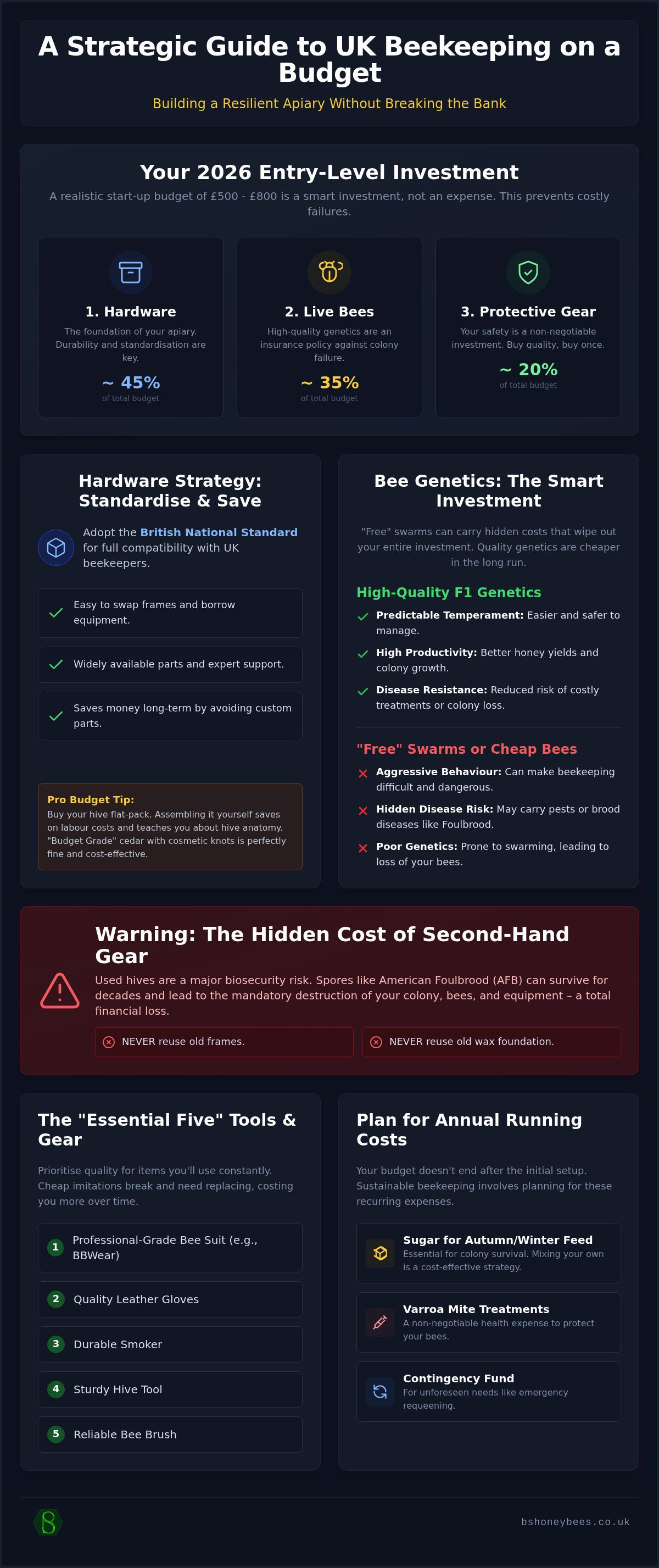
Entering the world of beekeeping (or apiculture) requires a clear financial strategy to avoid the common pitfalls that drain a beginner's bank account. For most hobbyists, a successful first year in the UK relies on an entry-level budget that covers three non-negotiable pillars: hardware, live bees, and protective gear. Expecting a total spend between £500 and £800 is realistic for a high-quality, sustainable start that won't require immediate reinvestment. Attempting to bypass these costs with ultra-cheap, unbranded kits from international marketplaces is a classic false economy. These sets often arrive with poorly machined parts, thin timber, or toxic finishes that fail within months. Budget beekeeping is the minimisation of waste through the selection of compatible, durable equipment.
Fixed Costs vs Variable Annual Expenses
Your initial outlays include fixed, one-off purchases like a high-quality smoker and a sturdy hive tool. These tools are the workhorses of your apiary and should last a decade if properly maintained. Investing in professional-grade protection, such as a BBWear bee suit, also falls into this category as a long-term safety investment. However, successful beekeeping on a budget uk also requires planning for recurring variable expenses. Annual costs typically include sugar for autumn feeding and essential varroa treatments to ensure colony survival through the winter. You should also budget for "unforeseen" expenses, such as emergency requeening. Sourcing a high-quality F1 Buckfast queen early on acts as a productivity insurance policy, significantly reducing the likelihood of costly colony failures during the first season.
The Financial Risk of Second-Hand Equipment
Buying used hives might seem like a clever way to save money, but it carries significant biosecurity risks that can lead to total financial loss. Second-hand equipment often harbours spores of American Foulbrood (AFB) or European Foulbrood (EFB). These diseases are devastating and usually result in the mandatory destruction of your entire colony by government bee inspectors. The time and cost involved in professional sterilisation often exceed the price of a new, budget-friendly British National hive made from quality cedar. Whilst hive bodies can sometimes be scorched clean with a blowlamp, you should never reuse old frames or wax foundation. These must always be purchased brand new to protect the health of your bees and the security of your initial investment.
Choosing Hardware: The British National Standard
Standardisation is your greatest financial ally when establishing an apiary. In the United Kingdom, the British National Hive is the undisputed industry standard for a reason. Choosing this design ensures that every component you buy will be compatible with gear from other local beekeepers and major suppliers. This compatibility is vital for beekeeping on a budget uk; it allows you to swap frames during a swarm or borrow a spare super in an emergency without needing custom-built parts. Whilst alternative hive designs like the Top Bar might seem cheaper initially, they often become a logistical headache when you cannot source standard replacement parts or sell the equipment later. Following the guidance of the National Bee Unit (NBU) regarding hive registration and management is much simpler when you use standard equipment that inspectors and mentors recognise instantly.
Purchasing your hive in flat-pack form is a highly effective way to reduce your initial investment. Most beginners can assemble a cedar hive with just a hammer and some wood glue. This process doesn't just save you money on assembly fees; it provides a hands-on education in hive anatomy. You'll understand exactly how the bee space works and how each component fits together before your bees even arrive. If you're looking for a reliable starting point, consider investing in high-quality British National Hives & Frames to ensure your setup is built to last.
Budget Cedar Hives: What to Look For
When shopping for "Budget Grade" cedar, don't be deterred by knots or cosmetic marks in the timber. These are purely aesthetic and do not compromise the structural integrity of the hive. Ensure the joints are tight and the wood is free from deep cracks that could allow moisture to penetrate. A basic budget setup requires a mesh floor, a deep brood box, a crown board, and a roof. You can add honey supers later in the season as the colony grows, allowing you to spread the cost over several months rather than paying for everything upfront.
The 2-in-1 Poly Nuc Advantage
For those looking to maximise their resources, the 2 in 1 poly nuc offers exceptional value. These units serve a dual purpose: they provide a secure home for a new nucleus colony and can later be used for queen rearing or swarm control. High-density polystyrene offers superior insulation compared to traditional timber. This thermal efficiency helps the bees maintain a stable temperature with less effort, which directly reduces the amount of expensive sugar syrup you'll need to provide for winter feeding. They are also incredibly lightweight and durable, making them easy to handle for hobbyists who may struggle with the weight of full cedar boxes.
Why Quality Bees Prevent Expensive Failures
Many beginners assume that catching a wild swarm is the ultimate way to achieve beekeeping on a budget uk. It's a tempting thought; free bees mean more money for hardware. However, this is often a significant tactical error. Wild swarms or "free" bees from unknown sources come with hidden liabilities, including aggressive behaviour, a high propensity for swarming, and poor honey production. You also risk importing diseases that could lead to the destruction of your entire setup. Consulting the UK National Bee Unit (BeeBase) for health guidelines is essential, but the best preventative measure is starting with known, high-quality genetics.
A nucleus colony (nuc) is far more cost-effective than a package of bees. Whilst a package is just a box of bees with a queen, a nuc is a functioning mini-colony with established brood and food stores. This head start ensures the colony builds up rapidly, often allowing for a honey harvest in the first year. Gentle temperament in bees reduces the need for expensive, heavy-duty interventions, allowing you to manage your hives with basic, reliable gear and minimal stress.
The ROI of F1 Buckfast and Carniolan Queens
Investing in F1 buckfast queens UK provides a measurable return on investment. Unlike local mongrel bees, which can be unpredictable, F1 queens are bred for high honey yield and calm temperament. When deciding between buckfast vs carniolan bees, both offer superior traits compared to wild-caught swarms. Calm bees save you time during inspections and drastically reduce the risk of neighbour complaints, which can be socially and legally costly in residential areas. A hardy, well-bred queen also ensures better overwintering success, preventing the significant cost of replacing a dead colony next spring.
Mated Queens vs Virgin Queens for Beginners
For novices, mated queen bees UK are the only logical choice for a budget-conscious start. Virgin queens are cheaper upfront but require successful mating flights, which are weather-dependent and fraught with risk. If a virgin queen fails to mate or is lost during her flight, your colony becomes queenless. This often leads to the "drone layer" trap, where the colony produces only male bees and eventually dies out. A mated queen is ready to lay immediately, accelerating colony buildup and ensuring your journey into beekeeping on a budget uk starts with a win rather than a wipeout.
Practical Ways to Reduce Annual Running Costs
Once your apiary is established, your focus shifts from capital investment to managing recurring expenses. Making your own sugar syrup for autumn feeding is a fundamental skill for anyone beekeeping on a budget uk. Whilst pre-mixed invert sugar is convenient, it carries a significant price premium. You can achieve the same results by mixing white granulated sugar with water at a 2:1 ratio for winter stores. This simple DIY approach slashes your feeding bill and ensures you know exactly what is entering your hives. Efficiency in these small details prevents your hobby from becoming a financial burden.
The "Two-Hive Rule" is a strategic insurance policy that actually saves money in the long run. Starting with two colonies allows you to compare their progress and, more importantly, share resources. If one hive loses its queen, you can move a frame of eggs from the stronger colony to the weaker one. This simple act of balancing resources prevents a total colony loss; the most expensive setback a beekeeper can face. You should also be discerning about reusing equipment. While you can boil or scorch cedar frames to sterilise them, never reuse old wax foundation. Fresh wax is essential for colony health and prevents the buildup of pathogens that could lead to a costly disease outbreak.
Shared Resources and Community Saving
Joining a local beekeeping association is one of the smartest financial moves you can make. These groups often provide members with access to expensive, specialised kit that you might only use once or twice a year. Borrowing honey extractors, settling tanks, and wax melters saves you hundreds of pounds in upfront costs. Beyond equipment, associations are excellent for bulk-buying consumables. Organising a group order for honey jars and labels allows you to access wholesale prices that are usually out of reach for a solo hobbyist. A mentor within the group can also help you avoid "shiny object syndrome" by steering you away from unnecessary gadgets that promise much but deliver little.
DIY vs Professional Maintenance
Extending the life of your hardware is key to a sustainable budget. While cedar is naturally rot-resistant, applying a bee-safe preservative or paint to the exterior of your hives can add decades to their lifespan. For pest management, skip the expensive laboratory diagnostic kits. Simple, manual varroa monitoring techniques like using a sticky floor insert or a sugar shake are highly effective and cost almost nothing. You can also reduce the need for supplemental pollen by creating a "bee-friendly" garden with a succession of nectar-rich plants. Secure your long-term success by sourcing your initial British National Hives & Frames from a trusted specialist who understands the needs of the UK climate.
Strategic Buying: Essential Gear for the Budget-Conscious
Success in beekeeping on a budget uk isn't about finding the lowest price tag; it's about making every pound work harder through disciplined selection. Your financial priority must always be the health and temperament of your bees. If you have a limited budget, invest in the highest quality genetics first, followed by standard, durable housing. Gadgets, decorative hive stands, and specialised honey processing equipment can all wait until your apiary is turning a profit. By focusing on the bees first, the boxes second, and the gadgets last, you ensure your capital is tied up in assets that actually grow your colony and produce honey.
To manage your cash flow effectively, phase your purchases across the first twelve months of your journey. During the winter months, focus on sourcing and assembling your flat-pack British National hives. As spring approaches, secure your protective gear and tools. You only need the "Essential Five" to begin: a professional bee suit, a reliable smoker, a sturdy hive tool, the hive itself, and a feeder for autumn. This staged approach prevents a massive upfront bill and allows you to learn the craft without the distraction of unnecessary extras like bee brushes or electric uncapping knives.
BBWear Suits: The Cost-Per-Year Calculation
Prioritising protection is a non-negotiable safety investment. A cheap, unbranded import might save you £50 today, but it often lacks the fabric density and secure veiling required to keep you safe. A single bad experience with stings can ruin a beginner's confidence, leading to an abandoned hobby and wasted investment. When choosing a bee suit UK keepers trust, BBWear stands out for its professional standards. Whilst the initial cost is higher, these suits are designed to last ten years or more with proper care. When you calculate the cost-per-year, a professional suit is significantly cheaper than replacing a flimsy alternative every two seasons.
Sourcing Quality Nucleus Colonies
Your most reliable starting point is a nucleus colony rather than a package of bees. Selecting from high-quality honey bee nucs for sale UK ensures you receive five or six frames of established brood, food stores, and a laying queen. This biological head start is the best insurance policy against the variable British weather. A thriving nuc will expand rapidly into a full colony, often producing a surplus of honey in its first year that can be sold to offset your initial costs. View our range of nucleus colonies and mated queens to start your journey with the professional standard your apiary deserves.
Build Your Sustainable Apiary Today
Strategic beekeeping on a budget uk is achieved by prioritising longevity over low initial costs. By adopting the British National Standard for your hardware and investing in high-quality F1 Buckfast or Carniolan genetics, you create a resilient foundation. This approach pays dividends through consistent honey production and superior colony survival rates. We've discussed how standardisation simplifies management and how professional-grade protection ensures you work with confidence for years. Avoid the false economy of cheap imitations. Focus your resources where they matter most: on healthy bees and durable, compatible equipment.
As specialists in F1 Buckfast and Carniolan breeding, we are dedicated to your success. We are official BBWear stockists and provide nationwide live bee delivery to ensure every keeper has access to the best start possible. Take the next step toward a thriving, cost-effective apiary. Browse our range of cost-effective British National hives and F1 queens to secure your season with confidence. Your journey into beekeeping is a rewarding commitment. Make sure it's an investment that lasts.
Frequently Asked Questions
Is beekeeping on a budget really possible in the UK?
Beekeeping on a budget uk is absolutely achievable if you focus on strategic standardisation rather than hunting for the lowest price. Success relies on investing in high-quality, durable equipment that won't require immediate replacement. By choosing standard British National hives and professional-grade protective gear, you avoid the expensive cycle of buying cheap imitations that fail. Prioritising quality genetics early on also prevents the significant financial loss associated with colony collapse or aggressive behaviour.
How much does a basic beekeeping starter kit cost in 2026?
Current industry data for 2026 indicates that a basic beekeeping starter set is priced around £94.50. A more comprehensive beginner's kit for a British National Beehive, which includes essential options, typically costs approximately £261.00. It's vital to remember that these prices generally cover hardware and tools but exclude the cost of live bees. Budgeting between £500 and £813 for your first year ensures you start with reliable, professional-standard equipment.
Can I build my own beehive to save money?
Building your own hive is possible if you have advanced woodworking skills and access to high-grade cedar. However, for most keepers, purchasing a flat-pack "budget grade" cedar hive is the more cost-effective route. These kits use timber with cosmetic knots that don't affect structural integrity. Assembly is straightforward and ensures every component adheres to the precise "bee space" required. This method saves on labour costs whilst guaranteeing your equipment remains compatible with standard frames.
What is the cheapest way to get bees for a new hive?
Whilst catching a wild swarm is technically free, it's rarely the most economical choice for beginners. Unknown swarms often carry diseases or aggressive traits that can lead to total colony loss. The most reliable strategy for beekeeping on a budget uk is purchasing a 5 or 6 frame nucleus colony. These established units come with a laying queen and food stores, providing a much faster return on investment through superior honey production and winter survival.
Should I buy a wooden or poly hive if I am on a budget?
Both materials offer distinct financial benefits depending on your goals. Cedar hives are the traditional British standard and offer excellent long-term durability and resale value. Polystyrene hives, such as 2-in-1 poly nucs, provide superior thermal insulation. This extra warmth helps your bees maintain their cluster more efficiently during winter. This directly reduces the amount of expensive sugar syrup you'll need to provide, lowering your annual running costs significantly over several seasons.
What beekeeping equipment can I safely buy second-hand?
You can safely source non-porous items like stainless steel honey extractors, settling tanks, and smokers from the second-hand market. These items are easy to sterilise and represent a significant saving. However, you should be extremely cautious with used wooden hive parts. These can harbour devastating spores like American Foulbrood. Never buy second-hand wax foundation or frames. The risk of a mandatory destruction order from a bee inspector far outweighs the small initial saving on used timber.
How can I save money on honey extraction and processing?
The smartest way to save on processing is to join a local beekeeping association. These groups often have expensive extractors and tanks available for members to borrow or hire for a nominal fee. This removes the need for a large upfront investment in kit you'll only use once a year. You can also save by bulk-buying honey jars and labels amongst your local beekeeping community to access wholesale prices that aren't available to individuals.
Is it cheaper to start with one hive or two?
Starting with two hives is actually the more cost-effective strategy for the long term. If you have only one hive and it becomes queenless or weak, you have no internal resources to fix the problem. With two colonies, you can move frames of brood or eggs between them to balance their strength. This "Two-Hive Rule" acts as an insurance policy, preventing the total loss of your investment and the need to buy replacement bees.