

A honey bee colony rarely freezes to death in a British winter; instead, it's far more likely to drown in its own condensation. Whilst the natural instinct is to wrap hives tightly against the frost, trapping moisture inside is a recipe for disaster. Getting the balance of beehive ventilation in winter UK right is the difference between a mouldy, dead cluster and a vibrant colony ready for the first spring forage. With winter colony losses reaching 20.8% in the 2024/2025 season, your approach to airflow must be precise and informed by modern science rather than outdated guesswork.
We understand the anxiety of checking your apiary after a wet January only to find damp frames and failing queens. This guide provides the clarity you need to master hive ventilation, moving beyond conflicting advice to deliver a practical setup for your specific equipment. You'll learn exactly how moisture moves through the hive and how to configure your British National hives or poly nucs for maximum survival. We'll show you how to protect your bees from the damp British winter and ensure a healthy spring build-up for 2026.
Key Takeaways
- Understand why managing metabolic moisture is more critical for colony survival than heat retention during the damp British winter.
- Master the specific balance of beehive ventilation in winter uk by correctly utilising open mesh floors and insulated crown boards.
- Learn how high-density poly hives and 2-in-1 poly nucs provide a thermal advantage that prevents lethal internal condensation.
- Evaluate traditional techniques like the "matchstick trick" against modern insulation methods to find the ideal setup for your British National hives.
- Implement a proactive wintering strategy that ensures your Buckfast or Carniolan queens emerge into a healthy, dry spring build-up.
Understanding the Role of Beehive Ventilation in a Damp UK Winter
In the context of beekeeping, ventilation refers to the controlled movement of air designed specifically to remove metabolic moisture. Many beekeepers mistakenly equate airflow with heat loss, but in the damp British climate, moisture is a far greater threat than the cold itself. The UK's maritime weather brings high humidity and frequent temperature fluctuations, making beehive ventilation in winter uk significantly more complex than in continental regions where the air remains crisp and dry. Stagnant, saturated air prevents the colony from thermoregulating efficiently and puts unnecessary stress on their winter stores.
Your primary goal is to prevent cold water from dripping directly onto the winter cluster. When you understand how bees survive the winter, you realise they don't heat the entire hive; they only heat the cluster itself. Therefore, providing ventilation isn't about "cooling the hive" but rather "clearing the air." By ensuring a steady exchange of air, you allow the colony to maintain its core temperature without fighting the cooling effects of dampness. This is particularly vital for premium genetics like F1 Buckfast or Carniolan queens, which require stable conditions to manage their winter clusters effectively.
The Danger of Condensation: Why Damp Kills
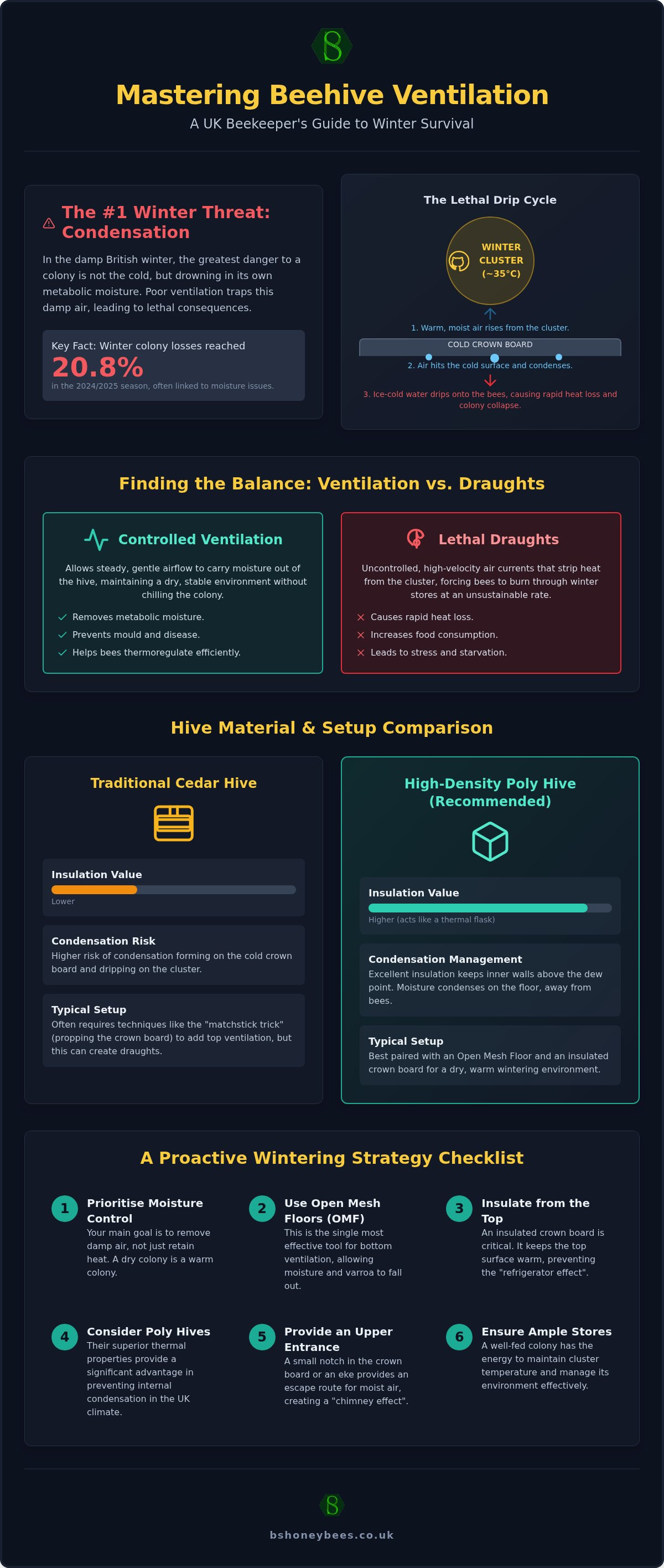
As bees consume honey to maintain their core temperature, they release water vapour as a natural byproduct of respiration. In a poorly ventilated hive, this warm, moist air rises and strikes the cold underside of the crown board or roof. This creates a "refrigerator effect" where the vapour condenses into ice-cold droplets. If these droplets fall onto the bees, the cluster loses heat rapidly, often leading to colony collapse. Beyond the immediate chill, prolonged damp conditions foster the growth of mould and increase the risk of diseases such as dysentery and nosema, which thrive in high-humidity environments.
Ventilation vs. Draughts: Finding the Balance
Achieving the right balance is a matter of distinguishing between helpful ventilation and lethal draughts. It's a common concern for those using standard British National Hives, where the line between the two can feel thin. Consider these definitions:
- Draughts: These are uncontrolled, high-velocity air currents that strip heat from the cluster too quickly, forcing bees to consume stores at an unsustainable rate.
- Controlled Ventilation: This allows moisture-laden air to exit the hive at a steady pace, maintaining a stable internal environment without chilling the colony.
The dew point within a beehive is the specific temperature at which air becomes saturated and begins to deposit moisture; managing this point through insulation and airflow is vital to ensure condensation occurs on the walls rather than above the bees. By mastering this balance, you ensure your colony remains dry and healthy until the first forage of the new season.
The Science of Overwintering: Managing Heat Retention vs Moisture Release
Overwintering is a complex metabolic balancing act. To maintain a core temperature of approximately 35°C, bees consume honey and vibrate their wing muscles. This process generates the necessary heat to keep the cluster alive, but it also produces significant amounts of water vapour as a byproduct. Managing beehive ventilation in winter uk requires a firm grasp of how this vapour moves amongst the frames. In a standard wooden hive, warm air rises from the cluster, creating what beekeepers call the 'chimney effect'. Whilst this effect helps pull moisture away from the bees, it can also strip away precious heat if the airflow is not carefully regulated.
The choice of hive material dramatically alters these thermodynamic principles. Traditional cedar hives are naturally breathable but have relatively low insulation values compared to modern alternatives. High-density polystyrene (poly) hives, however, act like a thermal flask. They retain heat so effectively that the internal walls often remain above the dew point, encouraging moisture to condense on the floor rather than the ceiling. This approach aligns with the National Bee Unit winter guidance, which stresses that dampness is a far more frequent killer of colonies than the cold. As the winter progresses, the cluster moves slowly upwards and across the British National hive frames to access fresh stores, requiring a dry environment to prevent the chilling of the outer bees.
Thermal Stratification in the Hive
During a cold snap, air within the hive body separates into distinct layers. The warmest air sits directly above the cluster. If the hive has a 'cold ceiling', such as an uninsulated crown board, the temperature of that surface will drop. When warm, moist air hits that cold surface, it turns into liquid water that can drip onto the bees. To prevent this, you must ensure the top of the hive remains the warmest part of the structure. Colonies headed by F1 Buckfast queens excel in these conditions. These bees are bred for their ability to form exceptionally tight, efficient clusters, which reduces the overall surface area losing heat and minimises the volume of air they need to keep warm.
The Role of Propolis in Natural Ventilation
Bees are master engineers of their own environment. Throughout the autumn, they use propolis to seal every crack and crevice, effectively 'waterproofing' and draught-proofing their home. This natural behaviour creates a controlled microclimate where the bees manage airflow themselves. Beekeepers often override this by adding top vents or matchsticks, which can disrupt the colony's carefully managed environment. If you're looking to upgrade your setup to better support these natural processes, consider our range of British National hives and frames designed for UK conditions. Allowing the bees to dictate their own ventilation often leads to more stable wintering results and a stronger spring build-up.
Comparing Ventilation Strategies: Open Mesh Floors vs Solid Bottoms
Deciding between an open mesh floor (OMF) and a traditional solid bottom board is one of the most debated aspects of beehive ventilation in winter uk. Historically, solid floors were the standard until the arrival of Varroa mites necessitated a way for parasites to fall out of the hive. However, beekeepers quickly discovered that the OMF offered a secondary, arguably more vital benefit: superior moisture management. Whilst a solid floor creates a sealed environment that can trap damp air at the base of the hive, an open mesh floor allows for a constant, passive exchange of air that prevents the buildup of stagnant humidity.
A frequent concern amongst beginners is whether an open floor makes the hive too cold. It's vital to remember that bees don't heat the entire hive body; they heat the cluster. As long as the hive is protected from direct upward gales, the bees are perfectly capable of maintaining their core temperature. The scientific principles of hive ventilation suggest that a colony can produce over a litre of water per week through metabolism. Without an exit point, this moisture has nowhere to go. Regarding the Varroa tray, the general consensus for the UK's damp winters is to leave it out entirely. This ensures that moisture and debris don't collect on the slide, which would otherwise become a breeding ground for mould.
The Case for Open Mesh Floors
Open mesh floors are particularly effective because both carbon dioxide and moisture-laden air are heavier than fresh air. These elements naturally sink to the bottom of the hive. By using an OMF, you allow these waste products to 'fall' out of the entrance and through the mesh, significantly reducing the risk of mouldy frames in the lower brood box. An OMF is the most popular choice for honey bee nucs for sale UK in damp regions because it provides essential airflow for smaller colonies that might struggle to move air as effectively as a full-sized hive.
When to Consider a Solid Floor
Solid floors still have a place in specific UK environments, particularly in apiaries exposed to extreme, persistent winds. In these locations, a completely open floor might cause uncontrolled air currents that strip heat from the cluster too aggressively. If you choose a solid floor, you must compensate by providing top ventilation, such as matchsticks under the crown board, to prevent the 'chimney' from becoming a 'pressure cooker' of dampness. Using a solid floor changes the humidity profile, often resulting in higher internal moisture levels that require vigilant monitoring throughout the winter months.
Practical Setup: Preparing Your British National Hive for Winter Success
The British National Hive remains the backbone of UK beekeeping, yet its single-walled design requires a methodical approach to wintering. Successfully managing beehive ventilation in winter uk involves five critical steps to ensure your colony stays dry. First, assess your crown board. If you have an open mesh floor, the modern preference is to keep the crown board sealed and heavily insulated. This traps a pocket of warm air at the top, preventing the "cold ceiling" effect that leads to condensation dripping onto the cluster.
Second, evaluate the "matchstick trick." This involves placing a matchstick at the corners of the crown board to create a 2mm gap. Whilst this old-school method provides an exit for moisture, it can also create a draught if the hive is in a windy location. Modern spacers or ventilated ekes offer a more uniform alternative. Third, fit your mouse guards and entrance blocks early. Ensure the entrance is reduced to roughly 25mm to prevent "wind-tunnel" cooling. Fourth, add insulation. A 50mm slab of PIR insulation board placed directly on top of the crown board is the most effective way to keep the cluster warm. Finally, give the hive a slight forward tilt. A 5-degree lean ensures that any rain or internal condensation runs away from the cluster and out through the entrance.
Configuring the Crown Board
The configuration of your crown board dictates the internal airflow. If you aren't providing top ventilation, ensure porter bee escape holes are securely covered with tape or a heavy weight. Many professionals now favour clear crown boards. These allow you to monitor the cluster's position and stores without breaking the propolis seal and losing vital heat. If you find your bees are short on stores, use a shallow eke to provide space for a block of fondant above the frames whilst keeping your insulation layer flush. For those looking to upgrade their equipment for the coming season, explore our range of British National Hives and Frames designed for durability in the British climate.
Entrance Management and Airflow
Bottom-up ventilation is only effective if the entrance remains clear. Throughout the winter, dead bees can accumulate behind the mouse guard, effectively sealing the hive and trapping moisture. Use a piece of stiff wire to gently rake out debris once a month. When choosing mouse guards, ensure the perforations are large enough to allow air exchange but small enough to exclude rodents. A reduced entrance combined with an open mesh floor provides the ideal balance of airflow and protection, preventing the excessive cooling that can occur with wide, unprotected openings.
Advanced Wintering Solutions: Poly Hives and Crown Board Management
High-density polystyrene (poly) is rapidly becoming the industry standard for beekeepers seeking to minimise winter losses in Britain. The primary thermal advantage of these hives lies in their ability to eliminate "cold walls," a common issue in traditional cedar hives where the internal surfaces drop below the dew point. In a poly hive, the material's superior insulation ensures that the walls remain warm, preventing moisture from condensing above or beside the cluster. This fundamental shift in thermodynamics means that beehive ventilation in winter uk can be managed with a "less is more" philosophy, as the insulated environment naturally regulates its own microclimate.
Because the internal surfaces of a poly hive stay warm, the moisture-laden air produced by the bees doesn't turn into liquid droplets on the ceiling. Instead, the humidity remains in the air until it eventually sinks and exits through the floor. This setup reduces the stress on the colony, allowing them to focus their energy on maintaining the cluster rather than battling dampness. For those using modern poly equipment, the need for top vents or "matchsticks" is virtually eliminated, provided the top of the hive is properly sealed and insulated.
The Benefits of the 2-in-1 Poly Nuc
Smaller colonies, such as late-season splits or nucleus hives, face the greatest challenge in maintaining cluster temperature. The 2 in 1 poly nuc offers an advanced solution by mimicking the thick, protective hollow of a natural tree. These units allow beekeepers to overwinter two colonies side-by-side, separated only by a thin central divider. This configuration allows the colonies to share metabolic heat, significantly reducing the amount of honey they must consume to stay alive. It's no surprise that these units are the preferred choice for mated queen bees UK breeders who need to ensure their premium stock survives until the first spring forage.
Top Insulation: The 'Warm Way' Method
Creating a thermal barrier at the top of the hive is the most effective way to prevent top-down condensation. By using Kingspan or similar PIR boards directly above the crown board, you create a "warm ceiling" that keeps the rising heat within the cluster area. This insulation allows you to move away from top-ventilation methods that often strip too much heat. Instead, the "warm way" method relies on an open mesh floor to provide all necessary gas exchange. This ensures that whilst the bees stay warm, heavy CO2 and moisture can still escape from the bottom of the hive. Use this final checklist for a "set and forget" winter strategy for 2026:
- Seal all top vents and apply at least 50mm of high-quality PIR insulation board above the crown board.
- Confirm the open mesh floor is clear of any summer debris or propolis to allow passive airflow.
- Ensure the hive is securely strapped to prevent wind damage during winter storms.
- Verify that your mouse guards are fitted correctly and don't restrict the entrance height.
Secure Your Colony's Future for Spring 2026
Success during the British winter depends on your ability to manage the delicate balance between heat retention and moisture release. By prioritising a "warm ceiling" through top insulation and allowing metabolic gases to escape via an open mesh floor, you effectively eliminate the threat of lethal condensation. Mastering beehive ventilation in winter uk is the most proactive step you can take to ensure your cluster remains dry and energetic throughout the coldest months of the year.
As specialist UK breeders of hardy Buckfast and Carniolan bees, we understand that high-quality hardware is the foundation of overwintering success. We offer nationwide delivery on all essential equipment, from standard British National Hives to advanced 2-in-1 poly nucs. Ensure you're fully prepared for the season by equipping yourself with premium BBWear protective gear for those final autumn assessments. Upgrade your apiary with our British National Hives and Poly Nucs for superior winter survival. With the right setup in place, you can rest easy knowing your colonies are protected and ready to thrive when the first forage of 2026 arrives.
Frequently Asked Questions
Should I leave the crown board holes open during winter in the UK?
You should generally keep crown board holes sealed if you're using an open mesh floor. Sealing these holes and placing insulation directly on top creates a warm air pocket that prevents condensation from forming above the bees. If you use a solid floor, you may need to keep one hole partially open to allow moisture to escape. Proper beehive ventilation in winter uk depends on your specific floor and hive material combination.
What is the chimney effect in a beehive and is it good for wintering?
The chimney effect occurs when warm, moist air rises from the winter cluster and exits through top vents, drawing cooler air in from the bottom. Whilst this process is excellent for removing metabolic moisture, it can also strip vital heat from the colony if the airflow is too fast. Striking a balance between this natural convection and heat retention is the core challenge of managing winter airflow in traditional wooden hives.
Do I need to insulate my wooden British National hive?
Insulating the top of a wooden British National hive is highly recommended to prevent lethal top-down condensation. Cedar wood has relatively poor thermal properties compared to high-density polystyrene, meaning the roof often becomes the coldest surface in the hive. By adding a 50mm PIR insulation board above the crown board, you ensure the internal ceiling remains warm, forcing any necessary condensation to occur harmlessly on the hive walls instead.
Is condensation always a sign of poor beehive ventilation?
Condensation is a natural byproduct of bee metabolism and isn't always a sign of failure. In fact, a small amount of moisture on the hive walls can provide essential drinking water for the colony during a cold snap. The issue only arises when condensation forms on the ceiling and drips onto the cluster. Effective beehive ventilation in winter uk ensures that moisture is managed and directed away from the bees rather than eliminated entirely.
Can I use matchsticks to prop up the crown board for extra airflow?
You can use matchsticks to create a 2mm gap under the crown board, but this "old-school" method has some drawbacks. Whilst it successfully provides an exit for damp air, it can create uncontrolled draughts in exposed apiaries. Many modern beekeepers now prefer to keep the crown board sealed and rely on an open mesh floor combined with thick top insulation to manage the hive's internal microclimate more precisely.
Should the Varroa tray be left in or out during the winter months?
You should leave the Varroa tray out during the winter months to facilitate maximum airflow. Leaving the tray in can trap moisture and falling debris, which quickly becomes a breeding ground for mould and fungi. A completely open mesh floor allows heavy carbon dioxide and water vapour to sink and exit the hive naturally, ensuring the environment remains dry even during the typical damp spells of a British winter.
How do I know if my hive has too much ventilation?
The most reliable sign of excessive ventilation is an unusually high rate of store consumption. If the bees are subjected to draughts, they must vibrate their wing muscles more vigorously to maintain cluster temperature, burning through honey reserves far too quickly. If you notice your colonies are exceptionally light during mid-winter checks, you may need to reduce top ventilation or provide better wind protection for the hive entrance.
What are the signs of a damp hive when I check them in the spring?
Common signs of a damp hive include blue or green mould on the outer frames and a distinct, musty odour when you first open the roof. You might also find sodden floor debris or fermented honey that has absorbed too much atmospheric moisture. These conditions are often the result of poor ventilation and can lead to health issues like nosema, making it vital to adjust your setup for the following season.