

Nuc installation failure is rarely about the bees; it's almost always about misinterpreting transit stress as a total colony collapse. As you start your 2026 season, you've invested significant capital into high-quality genetics, and seeing your bees clumped or lethargic on arrival is enough to make any beekeeper's heart sink. It's perfectly natural to feel anxious about potential bee nuc installation problems, especially when the unpredictable UK weather refuses to cooperate. You need to know that your new queen is accepted and that your investment is secure before the first nectar flow begins.
This guide helps you master the critical first 48 hours by separating normal transit behaviour from genuine emergencies. You'll learn exactly how to identify and solve common installation errors before they threaten the hive's survival. We'll provide actionable steps to confirm your colony's health, manage queen acceptance, and troubleshoot issues with your British National hives. We're moving past the guesswork to ensure your nucleus colony transitions into a thriving, productive hive with precision and confidence.
Key Takeaways
- Distinguish between normal orientation flights and genuine drifting to ensure your bees settle correctly into their new environment.
- Master the "Look for Eggs" rule to verify queen acceptance and health without causing unnecessary disruption to the brood nest.
- Protect your investment from the unpredictable UK climate by learning how to identify and prevent chilled brood during early spring transfers.
- Implement immediate corrective actions, such as rescue feeding, to resolve bee nuc installation problems before they compromise the colony's future.
- Ensure a seamless transition by using high-quality British National hives and resilient F1 Buckfast or Carniolan genetics.
Troubleshooting the First 48 Hours: Normal vs. Problematic Behaviour
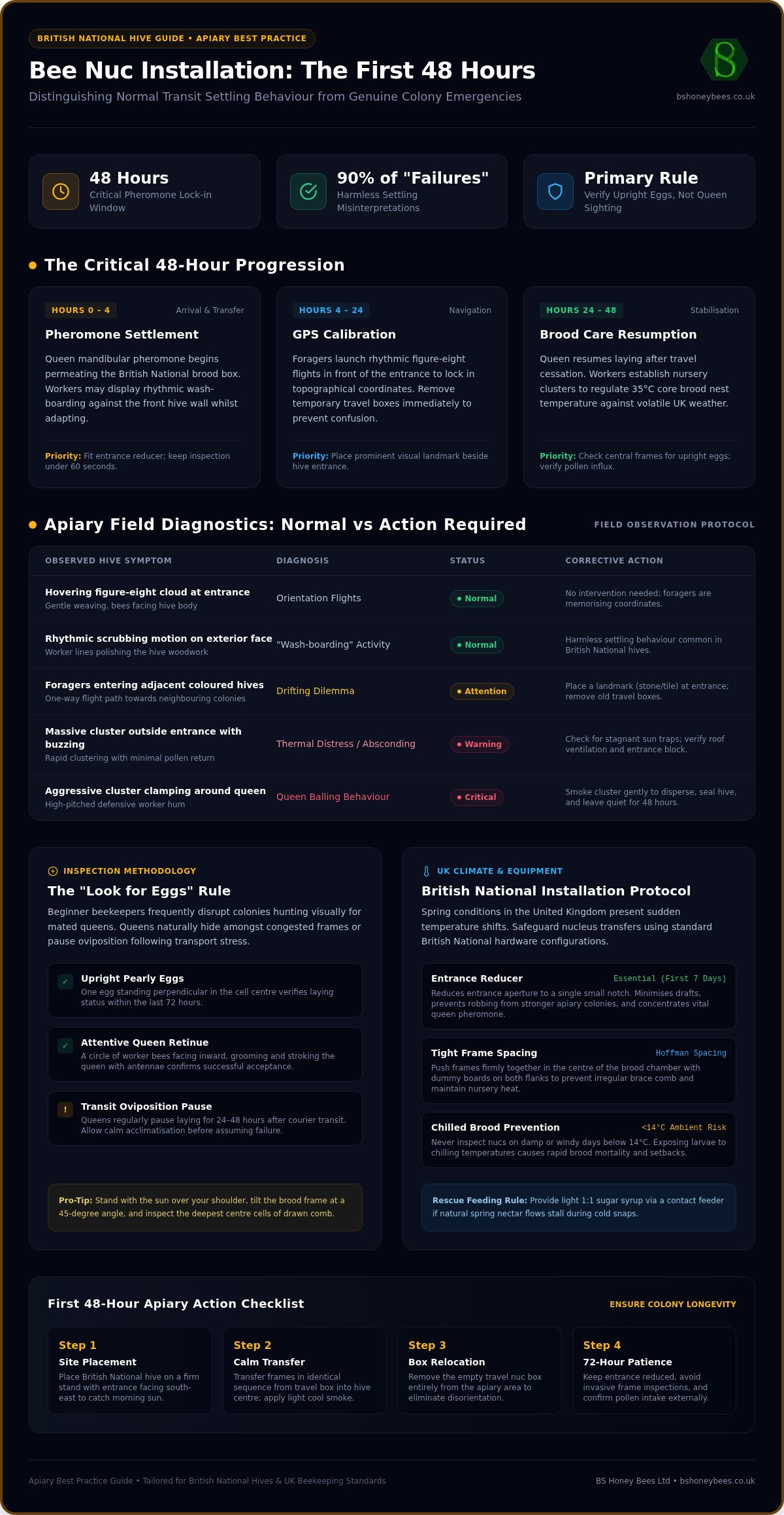
The opening 48 hours after transferring a honey bee nucleus colony are the most stressful for the keeper and the bees. During this window, the colony must transition from transit stress to a settled, organised unit. Pheromones are the invisible glue in this process. The queen's scent needs to permeate the new hive to anchor the workers and signal that the journey is over. You might observe "wash-boarding", where bees move in a rhythmic, scrubbing motion on the hive front. This is a common, non-critical settling behaviour and not a sign of impending bee nuc installation problems.
The "Drifting" Dilemma: Why Your Bees are Leaving
Orientation flights are often confused with drifting. A healthy orientation flight looks like a rhythmic, figure-eight cloud of bees hovering in front of the entrance as they memorise their new GPS coordinates. Drifting, conversely, is a one-way trip where foragers mistakenly join a neighbouring hive. This occurs when bees fail to lock onto their specific hive's location. Uniform apiary layouts, where every hive is the same colour and height, exacerbate this issue. To fix this, place a distinct landmark, such as a large stone or a specific plant, near the entrance. If you've moved the bees from a temporary travel box, ensure the old box is removed from the site entirely. Foragers returning to the exact spot where the old box sat will eventually find the new entrance if it's positioned within a few inches of the original location.
Cluster Logic: When Entrance Crowding is a Warning
Seeing a mass of bees at the entrance can be alarming, but it's often a simple matter of thermal regulation. In a humid British spring, bees may form a "beard" outside the entrance to manage internal hive temperatures. However, if the bees appear agitated and the cluster grows rapidly without foragers returning, they may be preparing to abscond. This is rare with a well-ventilated British National beehive, but it can happen if the space is too cramped or the hive is placed in direct, stagnant heat. Use these steps to manage the environment:
- Use an entrance reducer: Keep it in place for the first week to help the colony defend their new home and concentrate queen pheromones.
- Monitor thermal mass: Ensure the hive isn't in a complete sun trap during an unseasonably warm spell.
- Check frame spacing: Ensure frames are pushed tightly together to prevent irregular comb building that can lead to congestion.
Identifying these bee nuc installation problems early prevents the loss of your entire investment. Most settling issues are resolved with minor environmental adjustments rather than invasive hive inspections.
Queen Acceptance and Identification Issues Post-Transfer
Don't panic if you can't spot the queen during your first inspection. This is one of the most common bee nuc installation problems for new keepers. Beginners often assume the worst, but a mated queen is an expert at hiding amongst thousands of workers. Instead of hunting for her, focus on the "Look for Eggs, Not the Queen" rule. Finding tiny, pearly white eggs standing upright in the centre of the brood cells is definitive proof of her presence. It's much more reliable than a visual sighting alone.
A queen may temporarily stop laying after a long journey. This isn't a failure; it's a physiological response to being confined or moved. According to Penn State Extension honey bee management research, colony establishment depends on the workers accepting the queen's pheromones and preparing the cells for her to resume laying. If you see a "retinue" of workers facing the queen and touching her with their antennae, acceptance is successful. Be careful not to disrupt this delicate period. If you are too aggressive during an inspection, the workers might "ball" the queen, clustering around her in a defensive but lethal mass. If you see this, smoke the ball gently, close the hive, and leave them alone for at least two days.
Signs of a Successful Queen Introduction
A calm colony temperament is your best indicator of success. If the bees are busy foraging and ignore you when the hive is opened, they're likely queen-right. Look for fresh, upright eggs in the very centre of the brood nest. This shows she has settled and resumed her duties. You should also watch for the workers' behaviour. A queen who is accepted will be surrounded by a circle of attentive workers. If you see queen cells, don't automatically tear them down. Emergency cells on the comb face suggest the queen is missing, whilst supersedure cells on the edges might indicate the bees are unhappy with her performance post-transit. Identifying bee nuc installation problems like these early allows you to make informed management decisions.
What to Do if the Queen is Missing
Don't rush to requeen on day one. Wait seven days to allow the colony to settle. If you still see no eggs or start noticing drone laying queen symptoms uk, such as multiple eggs per cell or scattered, domed brood, you have a problem. This requires immediate intervention to prevent the colony from becoming terminal. Introducing high-quality mated queen bees UK can restore the hive's productivity. If you're unsure about your colony's status, our team at BS Honey Bees can help you diagnose whether your queen is simply resting or truly absent.
Environmental Impacts: Navigating the UK Climate and Hardware
Installing a nucleus colony in the UK requires a strategy that respects the unpredictability of a British spring. Many bee nuc installation problems occur because keepers underestimate how quickly a sudden temperature drop can affect a small, vulnerable colony. Unlike established hives, a new nuc has a limited population to maintain the 35°C core temperature needed for brood development. Wind protection is equally vital; orienting your hive entrance away from prevailing south-westerly winds prevents cold air from being forced into the entrance, which leads to excessive energy consumption. If bees are forced to consume stores just to stay warm, they won't have the resources to expand the brood nest during those first critical weeks.
Combating the UK Spring Chill
You should never inspect a new nuc when the ambient temperature is below 15°C. Opening the hive in cold conditions allows heat to escape instantly, potentially causing "chilled brood" where the larvae die from exposure. To mitigate this, use dummy boards to consolidate the colony within a full-sized brood box. This reduces the volume of air the bees need to heat, concentrating their thermal energy on the brood nest. Feeding is also non-negotiable. Whilst some keepers rely on external forage, the UK's "June Gap" or a week of rain can starve a new nuc in days. Provide a light 1:1 sugar syrup using a contact feeder to prevent the scent from inducing robbing behaviour from stronger, neighbouring colonies.
Hardware Hurdles: British National Hive Quirks
Success depends on hardware compatibility. Most honey bee nucs for sale UK are supplied on frames designed for the british national beehive. However, variations in lug lengths can cause issues; if your frames don't sit flush on the hive runners, you'll create "bee space" violations, leading to excessive propolis or wild comb. Avoiding these hardware-related bee nuc installation problems is as simple as ensuring a tight fit before the bees arrive. When transferring from a 2-in-1 poly nuc, move all frames in their original order to maintain the colony's internal organisation. Wooden hives offer excellent breathability for the UK climate, but you must ensure the roof and joints are watertight. Dampness in a British National hive is a far greater threat to a UK colony than the cold itself.
Corrective Actions: How to Save a Failing Installation
When you identify bee nuc installation problems, immediate action is required to prevent colony loss. A failing nuc doesn't have the luxury of time. If you notice the population dwindling or the queen has stopped laying, start with a rescue feed. Choose fondant for immediate energy if the weather is cold, as liquid syrup can increase internal humidity and chill the bees. Consolidating the brood nest with dummy boards is essential for maintaining thermal mass. This ensures the remaining bees can keep the larvae warm without exhausting themselves. If a colony drops below two frames of bees, it's often too weak to recover alone. In this case, combine it with a stronger colony using the newspaper method to preserve the genetics.
Cross-combing is another issue that requires a swift hand. If you've installed frames incorrectly and the bees have built wild comb across multiple frames, you must correct it before the comb hardens and contains large amounts of brood. Gently smoke the bees, use your hive tool to remove the wayward wax, and ensure your frames are pushed tightly together. Precision in your hardware setup prevents these structural bee nuc installation problems from recurring.
Step-by-Step: Re-orienting a Drifting Colony
If you notice your foragers are drifting to a neighbouring hive or returning to the old nuc box location, you must "reset" their internal GPS. Close the hive entrance for 24 hours to break their current flight pattern. When you reopen the hive, place leafy branches or a piece of glass leaning against the entrance. This physical obstruction forces the bees to perform a new orientation flight rather than flying straight out. Always remember the "3 feet or 3 miles" rule. If you need to move the hive to a better location within your apiary, move it no more than 3 feet per day to ensure the foragers can find the entrance.
Fixing Feeding Failures
Starvation is a leading cause of nuc failure during a wet British spring. Identify starvation signs early by looking for bees with their heads deep in cells and a complete lack of capped honey. For a British National hive, a rapid feeder or a contact feeder placed directly over the crown board hole is the most efficient delivery method. In emergency cases where the cluster is too weak to move to a feeder, place a block of fondant directly on top of the frames. To avoid these issues from the outset, ensure you are using high-quality British National Hives & Frames that provide the correct bee space for efficient feeding and thermal management.
Ensuring Long-Term Success with Quality Stock and Gear
Long-term success starts before the bees even arrive at your apiary. Choosing resilient genetics is the most effective way to prevent bee nuc installation problems from escalating. F1 Buckfast and Carniolan bees are specifically selected for their stability and calm nature. They're far more resilient to the stresses of transit and rehoming than local mongrel swarms. Starting with an overwintered, disease-inspected nuc ensures you have a queen that's already proven her laying ability through a British winter. When combined with professional live bee delivery UK services, your colony arrives with its social structure intact and ready to expand into its new home.
The Buckfast Advantage: Temperament and Resilience
F1 Buckfast bees are renowned for their prolific early-season build-up. This is vital for hitting the first nectar flows in 2026. Their gentle temperament is a significant asset during the installation process. Calm bees stay on the frames, allowing you to work methodically without the distraction of defensive behaviour. This reduces beekeeper error. You can take the time to ensure every frame is correctly positioned in your British National hive without being harassed. Sourcing from a reputable UK breeder guarantees you're receiving true F1 genetics. This avoids the unpredictable aggression often found in second-generation or unmanaged local stock.
Professional Protection for Confident Installations
Your confidence as a beekeeper directly impacts the success of the colony. If you're nervous or rushed, you're more likely to drop a frame or miss signs of queen stress. Investing in a high-quality bee suit UK is essential for maintaining a steady hand during those first 48 hours. BBWear suits are the favourite of UK commercial beekeepers for a reason. They provide the security needed to focus entirely on the bees' welfare rather than your own protection. Proper gear prevents rushed installations. It ensures you follow every troubleshooting step with precision and calm authority. We recommend using professional-grade protection to ensure your focus remains on the health of the brood nest.
Ready to start your season with the best possible foundation? Browse our range of 2026 F1 Nucs and Hives to ensure a successful, stress-free installation.
Secure Your 2026 Season with an Expert Foundation
Successful beekeeping in 2026 depends on your ability to act decisively during the first 48 hours. By distinguishing between normal transit behaviour and genuine bee nuc installation problems, you protect your investment and ensure your colony's long-term productivity. You now have the tools to manage the unpredictable British spring chill and the hardware knowledge to ensure a seamless transfer into your British National hives. Trust the "Look for Eggs" rule and maintain your thermal mass to give your bees the best possible start.
Starting with resilient genetics and professional-grade gear provides the security needed to navigate these early challenges. As F1 Buckfast and Carniolan specialists, we provide high-quality stock and expertise for every level of beekeeper. Our nationwide live bee shipping ensures your colony arrives in peak condition, whilst our status as an official BBWear stockist keeps you protected and confident in the apiary.
Order your 2026 F1 Buckfast Nucleus Colony from UK Specialists and set your apiary up for a thriving season. You have the knowledge to troubleshoot with precision; now it's time to begin your journey with confidence.
Frequently Asked Questions
How long should I wait after delivery before installing my bee nuc?
Wait between 24 and 48 hours after delivery before performing the transfer. Place the travel box on top of or in front of the final hive location and open the entrance immediately upon arrival. This allows the foragers to orientate and the colony to recover from transit stress. Rushing the transfer can exacerbate bee nuc installation problems by causing the bees to drift or behave defensively.
Why are my bees clustering outside the hive entrance after transfer?
This is typically a sign of thermal regulation or orientation rather than a genuine emergency. During a warm British spring, bees often "beard" outside the entrance to manage internal hive temperatures. It can also occur if the bees are performing orientation flights to lock in their new coordinates. Unless the cluster is accompanied by agitated behaviour or a lack of foraging, it's a normal settling response.
What should I do if I cannot find the queen in my new nuc?
Check for fresh, upright eggs in the centre of the brood nest instead of hunting for the queen herself. Queens are expert hiders and often stop laying briefly during transit. If you see tiny white eggs standing at the bottom of cells, the colony is queen-right. Avoid repeated, invasive searches that might lead to the workers "balling" the queen out of stress.
Is it normal for a new nuc to have dead bees at the bottom of the box?
Finding a small handful of dead bees, approximately 20 to 50, is normal after nationwide shipping. Transit involves vibration and temperature fluctuations that naturally claim the lives of older foragers. However, if you see hundreds of dead bees or the floor is completely covered, this indicates a significant issue such as overheating or starvation during the journey that requires immediate attention.
Should I feed my new nucleus colony even if there is a nectar flow?
Yes, you should always feed a new nuc regardless of external forage. A nucleus colony needs significant energy to draw out new foundation and expand the brood nest into a full British National brood box. Provide a light 1:1 sugar syrup using a contact feeder. This ensures the bees have a constant resource, even if the UK weather prevents them from foraging for several days.
How soon after installation can I perform my first full inspection?
Wait exactly seven days before conducting your first thorough inspection. The colony needs this time to accept the queen's pheromones and organise their new home. Opening the hive too early is one of the primary causes of bee nuc installation problems, as it can cause the workers to reject or kill the queen. After a week, you can safely check for a regular laying pattern and brood expansion.
What happens if it rains on the day my bee nuc is delivered?
Keep the nuc box in a cool, dark, and well-ventilated area until the weather clears. Don't attempt a transfer in heavy rain or when temperatures are below 15°C, as this risks chilling the brood. If you must wait more than 24 hours, ensure the bees have access to water by lightly misting the mesh vent, but avoid over-saturating the box or the cluster.
Can I install a 5-frame nuc into a 10-frame British National brood box?
Yes, this is the standard procedure for expanding a colony. Position the five frames in the centre of the brood box and flank them with fresh foundation. Use dummy boards on either side to consolidate the space. This helps the bees maintain the 35°C core temperature required for brood rearing whilst preventing them from building wild comb in the unoccupied areas of the hive.