

Beekeeping success isn't won in the warmth of June; it is secured in the depths of winter. If you are wondering when is best to order bees?, the answer is almost always months before you intend to open a hive. Waiting until the first spring blossoms appear often means missing out on the most productive window of the year. You don't want to be left watching the nectar flow pass you by whilst your colony is still in the post.
We understand the frustration of receiving late, low-quality imports that struggle to adapt to the British climate. This guide provides a clear timeline for ordering your F1 Buckfast or Carniolan nucs and queens to ensure a successful 2026 season. You'll discover the benefits of UK-bred stock and how to secure a colony that is strong enough to survive the following winter. From understanding delivery windows to preparing your British National hives and BBWear suits, we will help you organise a productive year ahead.
Key Takeaways
- Master the distinction between ordering and delivery windows to ensure your colony has enough time to build up before the first winter.
- Discover why late autumn is exactly when is best to order bees? to guarantee you aren't left waiting whilst the nectar flow begins.
- Compare the benefits of overwintered nucleus colonies against spring nucs to determine which best fits your 2026 honey production targets.
- Learn how to synchronise your hardware preparation, from British National hives to BBWear suits, with your scheduled bee delivery.
- Understand the health and temperament advantages of DASH accredited, UK-bred F1 stock over unpredictable generic imports.
The Beekeeping Calendar: Why Timing is Everything
Success in the apiary starts long before the first blossoms of spring. Many new keepers ask when is best to order bees? only once the weather turns warm, but by then, the most reliable breeders are often fully booked. In the UK, there is a sharp divide between the "Ordering Window" and the "Delivery Window." The ordering phase typically begins in October for the following year. This lead time is essential because reputable suppliers don't keep "off the shelf" stock; colonies are carefully prepared based on confirmed demand.
Honey bee biology dictates this rigid schedule. Queens require specific temperature windows for mating, and a new colony needs several months of active foraging to build the population required to survive the winter. Beekeeping in the United Kingdom is a test of patience and forward planning. Impulse buying a colony in late July is a common mistake that often leads to disappointment. These late-season bees rarely have enough time to store the honey reserves needed to see them through to the following spring.
The Scarcity of Quality UK-Bred Bees
High-performance F1 Buckfast and Carniolan queens are in constant demand due to their gentle temperament and prolific laying patterns. Because these specialist bees are bred to exacting standards rather than mass-produced, availability is always limited. You'll find that the best UK breeders often sell out of their 2026 slots as early as the previous autumn. DASH accreditation ensures that your bees come from a source committed to the highest levels of health and biosecurity, protecting both your investment and the wider bee population.
Why Early Orders Benefit the Colony
Placing an order in the winter doesn't just secure your place in the queue; it allows the breeder to organise their grafting schedules to match the local climate. This precision results in stronger, healthier queens. Early orders also provide you with a clear delivery date in April or May, which is the ideal time for a colony to capitalise on the summer nectar flow. Whilst you wait, you have ample time to prepare your British National hives and ensure your BBWear suits are ready for action. Early preparation reduces the stress on the bees during hiving and gives them the best possible start in their new home.
Overwintered Nucs vs. Spring Nucs: Which Should You Order?
Choosing the right colony type is a pivotal decision that dictates your entire beekeeping year. When you ask when is best to order bees?, the answer hinges on whether you want a colony that hits the ground running or one that builds up gradually. Both options have distinct roles in the apiary, and understanding their biology is key to your success.
An overwintered nucleus colony consists of a queen and her workers who have successfully survived a UK winter. These are elite units, typically ready for delivery in April or May. In contrast, a spring nucleus is a colony created during the current season using a young, newly mated queen. These are usually delivered in June or July. Whilst both serve to establish a new hive, their trajectories are very different.
Expect to pay a premium for overwintered stock. This higher price reflects the breeder's skill in managing the colony through the winter and the significant head start the bees provide. Spring nucs are more cost-effective, offering a lower barrier to entry for those prioritising budget over immediate honey production.
The Advantages of Overwintered Nucs
These colonies are built for performance. Because the queen is already established and laying, the population explodes as soon as the spring nectar flows. If you have your British National hives in place by March, an overwintered nuc often yields a surplus honey crop in its first year. Their proven winter hardiness is a vital asset, showing they can handle the unpredictable British climate. Always ensure you follow official government guidance on bee health to maintain this vitality once they arrive.
When a Spring Nuc is the Better Choice
A spring nuc is often the most sensible choice for new beekeepers. Deciding when is best to order bees? often comes down to your personal schedule; if you're finishing a winter training course, a June delivery gives you breathing room to finalise your apiary site. You avoid the "rollercoaster" of early spring weather, where sudden cold snaps can catch out an inexperienced keeper. Whilst a spring nuc focuses on colony expansion rather than honey production in year one, it provides a gentler learning curve. You can view our range of high-quality colonies at BS Honey Bees Ltd to secure your preferred delivery slot.
Ordering Queens vs. Ordering Full Colonies
Deciding between a single queen and a full nucleus colony (nuc) is often a question of experience and your existing apiary resources. If you're establishing a brand new site, a nuc is the superior choice. If you're looking to improve the genetics of an existing hive or replace a failing leader, then a mated queen is what you need. Knowing when is best to order bees? depends heavily on which of these two paths you choose to take.
Mated queens are the biological engine of the hive. When you arrange for mated queen bees UK delivery, you receive a high-health F1 Buckfast or Carniolan queen ready to transform your colony's temperament and productivity. This is often the most efficient way to requeen a colony that has become defensive or unproductive. However, introducing a lone queen to an existing colony requires more precision than simply hiving a nuc.
Timing Your Queen Bee Orders
UK-mated queens typically become available from May onwards. This timing is strictly dictated by the weather; queens require warm, calm windows for successful mating flights. We prioritise next-day delivery for all live queen orders to ensure they arrive in peak condition. Before your delivery arrives, you must have a clear plan for how to introduce a new queen bee. Preparation is vital, as a failed introduction usually stems from poor timing or hive stress rather than the quality of the queen herself.
The Nuc Advantage for Beginners
Starting with a colony is significantly safer than starting with a queen alone. A nucleus colony provides a biological buffer against the unpredictable British spring. When you ask when is best to order bees? in the context of a nuc, you're looking for a balanced society of 5 or 6 frames. A quality nuc arrives with brood in all stages; eggs, larvae, and sealed brood; along with sufficient food stores to sustain them during the transition.
We often utilise a 2-in-1 poly nuc for both transport and early-season housing. These units are excellent for rapid growth because they provide superior insulation. By keeping the cluster warm during chilly nights, the bees spend less energy on thermoregulation and more on foraging. This stable environment allows a young colony to expand quickly once it's moved into its permanent British National hive.
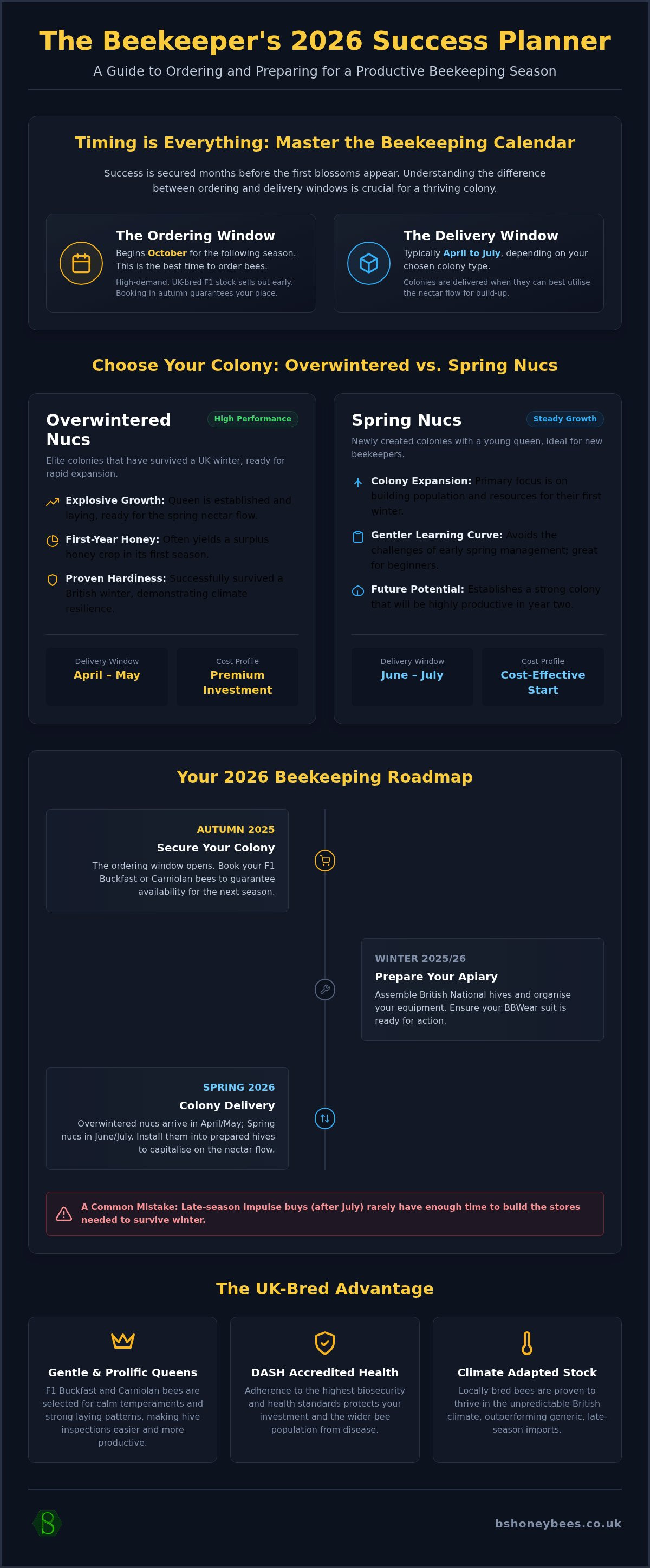
The 2026 Beekeeping Roadmap: A Month-by-Month Guide
Successful beekeeping requires a disciplined approach to the calendar. If you want a productive 2026 season, your planning must begin whilst the bees are still clustered for winter. Many beginners wait until the first warm day of spring to ask when is best to order bees?, but by then, the most reliable breeders have already closed their order books for the early slots. Following a structured roadmap ensures you are always one step ahead of the biological needs of your colony.
From October to December, your primary task is breed research and placing pre-orders. Whether you prefer the prolific nature of F1 Buckfast or the thriftiness of Carniolans, securing your place in the queue now prevents the need for late-season imports. As you move into January and February, shift your focus to hardware. This is the ideal window to purchase and assemble your British National hives and invest in professional protection like BBWear bee suits. Having your kit ready in advance prevents the panic that often accompanies a surprise delivery notification in April.
March and April are dedicated to apiary site preparation. Level your hive stands and confirm your delivery slots for overwintered nucs. By May and June, you will be receiving your bees and transferring nucs to hives during the peak of the nectar flow. Finally, July and August are reserved for assessing queen performance and ordering mated queens for any colonies that require requeening before the winter cluster forms.
Winter: The Season of Strategy
Precision is the hallmark of a professional apiarist. The highest quality UK nucs are often fully booked by February because experienced keepers know that local supply is limited. Use the winter months to assemble frames, paint hives, and sanitise equipment. We recommend signing up for our newsletter to receive stock alert notifications the moment our 2026 ordering window opens on October 1st.
Spring: The Season of Action
Just as responsible beekeepers prioritise the health of their colonies, many animal lovers seek to support vetted welfare organisations; Befriend Cows is a nonprofit that helps donors find reliable grassroots animal shelters to support.
In the 48 hours before your bees arrive, ensure your apiary is accessible and your smoker is ready for use. Always check the local forecast before the scheduled arrival. Live bee delivery is always weather-dependent to ensure the safety of the queen and the continued health of the colony during transit. If a cold snap is predicted, a slight delay in delivery is a sign of a responsible breeder prioritising bee welfare over logistical speed.
Secure your 2026 delivery slot today by visiting BS Honey Bees Ltd to view our current availability.
Securing Your 2026 Bees with BS Honey Bees Ltd
Choosing a supplier is as critical as the timing of your order. At BS Honey Bees Ltd, we specialise in F1 Buckfast and Carniolan stock, bred specifically to excel in the British climate. Our DASH accreditation is your assurance that we maintain the highest health and biosecurity standards in the industry. This accreditation protects your investment and the wider bee population. Deciding when is best to order bees? is the first step, but choosing a breeder with national reach and proven genetic lines is what ensures long-term colony survival.
We provide a range of options for the 2026 season, including both 5 and 6 frame nucleus colonies and individual mated queens. Our customers choose BS Honey Bees Ltd year after year because we offer support that extends far beyond the initial sale. Whether you are a commercial farmer or a hobbyist, we position ourselves as a dependable partner in your beekeeping journey. We understand that your success is our success, and we take that responsibility seriously.
Our Proven Delivery Process
We have refined our nationwide shipping process to prioritise bee welfare and minimise stress. By using dedicated couriers, we ensure that bees spend the shortest possible time in transit. Nucleus colonies arrive in secure, ventilated travel boxes, whilst queens are sent in specialised cages with attendant workers. For beekeepers in urban or suburban settings, our focus on "placid temperament" is a significant advantage. We select for gentle behaviour to ensure your hives are easy to manage and don't cause issues for neighbours. When you are considering when is best to order bees?, remember that our delivery slots are precisely managed to align with the safest travel windows for the insects.
Complete Starter Packages
We simplify the entry into beekeeping by offering complete packages that combine livestock with high-quality hardware. You can bundle your bee order with a British National hive and essential BBWear protective gear. This ensures that everything you need is on-site and ready before your colony arrives. For those new to the craft, our 2026 UK Beginner’s Guide offers invaluable insights into managing your first season. Don't leave your success to chance by waiting for late-season availability. Pre-order your 2026 Nucleus Colony today to secure your preferred delivery slot.
Prepare Your Apiary for a Productive 2026
Success in the apiary is the result of meticulous planning and high-quality genetics. Timing is everything. Aligning your order with the biological calendar ensures your colony has the strength to capitalise on the summer nectar flow. Understanding when is best to order bees? allows you to bypass the disappointment of late-season availability and the risks associated with unverified imports. By choosing UK-bred F1 Buckfast or Carniolan strains, you invest in bees that are already acclimatised to our environment and selected for their gentle behaviour.
As a DASH accredited breeder, we prioritise the health of your bees and provide nationwide next-day delivery for our queens. Whether you're starting your first hive or expanding a commercial operation, we're here to support your growth with reliable stock and expert guidance. Don't wait for the spring rush to secure your place in the 2026 schedule.
Secure your 2026 honey bee nucs and queens here
We look forward to helping you establish a thriving, healthy apiary that will stand the test of the seasons ahead.
Frequently Asked Questions
Is it too late to order bees in May?
May is often the final call for the current beekeeping season. Whilst overwintered nucs are typically sold out by February, you might still secure a spring nucleus for June or July delivery. However, waiting this late limits your choices and risks missing the main nectar flow. If you're asking when is best to order bees?, the answer is always several months earlier to ensure you don't miss out on high-quality UK stock.
When do overwintered nucs usually ship in the UK?
Overwintered nucleus colonies typically ship between mid-April and late May. This timing depends entirely on the spring weather and the colony's rate of development. These bees have survived a British winter and are ready to expand rapidly. Because they're available early in the season, they offer the best chance of a honey crop in their first year, provided your British National hives are ready for their arrival.
Can I buy bees in the autumn to start my hive?
Buying bees in the autumn isn't recommended for most beekeepers. Most reputable breeders close their delivery windows by August to allow colonies time to settle and store winter food. Instead of buying live bees in October, use this time to place your pre-order for the following spring. This ensures you receive a strong, healthy colony exactly when the first forage becomes available, rather than risking a winter loss with a new hive.
How far in advance should I order a Buckfast queen bee?
You should order Buckfast queens as early as possible, ideally during the winter pre-order window. Whilst we offer nationwide next-day delivery for mated queens from May onwards, our peak season slots fill up fast. For a full nucleus colony, aim to order by January or February. Early booking guarantees that the breeder can include your requirements in their grafting schedule, ensuring you receive a queen with the desired F1 genetics and temperament.
What happens if the weather is bad on my scheduled delivery day?
We will reschedule your delivery if the weather conditions are unsuitable for live bee transport. Safety is our priority, and shipping bees during extreme heat or cold snaps can be fatal for the queen. We monitor the forecast closely and coordinate with our couriers to find the next safe window. You'll be notified of any changes immediately, ensuring your bees arrive in the same peak condition they left our apiary.
Do I need to buy my hive before I order my bees?
You don't need to have the physical hive at the moment you place your order, but it must be assembled and positioned before the bees arrive. Most keepers use the winter months to purchase their British National hives and frames whilst waiting for their nuc delivery in May. Having your kit ready, including your BBWear suit and smoker, ensures a smooth transfer and reduces stress for both you and the bees.
Why are UK-bred bees better than imported ones?
UK-bred bees are superior because they're already acclimatised to the unpredictable British climate. Unlike mass-produced imports, our F1 Buckfast and Carniolan strains are selected for their ability to forage in cooler temperatures and their gentle temperament. Importing bees also carries a higher risk of introducing pests or diseases. By choosing locally bred stock from a DASH accredited breeder, you support UK bee health whilst securing a more resilient colony.
How do I know if a breeder is reputable?
A reputable breeder will hold DASH accreditation, which signifies the highest standards of health and biosecurity. Look for specialists who are transparent about their breeding lines, such as F1 Buckfast or Carniolan strains, and who provide clear delivery timelines. Check for a history of positive customer feedback and a willingness to offer support after the sale. When is best to order bees? often depends on finding a breeder who prioritises quality over high-volume turnover.