

With over 245,000 honey bee hives across the United Kingdom, the choice you make for your apiary determines whether your colony survives the damp British winter or succumbs to the elements. Selecting high-quality wooden beehives is more than a nod to tradition; it's a critical decision for any beekeeper prioritising thermal regulation and durability. You've likely felt the frustration of looking at poorly cut flat-pack kits or worrying if a bargain hive actually meets the British National standard. It's stressful to invest time and money into a setup only to see the timber rot or the frames fit poorly during a mid-summer inspection.
This guide eliminates that uncertainty, ensuring you select a hive that's built to last and easy to manage. We'll compare materials, break down essential components, and show you exactly what to look for to ensure your bees thrive in a standard-compliant home. By the end of this article, you'll have the confidence to choose a durable, professional-grade setup that supports your colony's success for years to come.
Key Takeaways
- Understand why the British National Hive is the de facto standard for UK beekeepers, ensuring total compatibility across your equipment.
- Discover how the natural thermoregulation of wooden beehives provides a superior environment for brood rearing whilst protecting bees from winter damp.
- Compare the logistical advantages of flat-pack and pre-assembled hives to choose the most efficient setup for your experience level.
- Learn the essential maintenance steps required to protect pine timber from rot and ensure your apiary remains durable for years.
- Recognise the importance of specific design features, such as deep roofs and open-mesh floors, for improving hive security and pest management.
Why Choose a Wooden Beehive for Your UK Apiary?
Choosing the right housing for your colony is the most significant investment you'll make as a beekeeper. Whilst modern materials have entered the market, wooden beehives remain the gold standard for the 44,000 amateur beekeepers currently managing apiaries across the UK. There's a reason for this enduring popularity. Timber offers a traditional aesthetic that integrates seamlessly into rural landscapes and British gardens, but its benefits go far beyond looks. It provides a natural environment that mimics the hollow trees bees have inhabited for millennia.
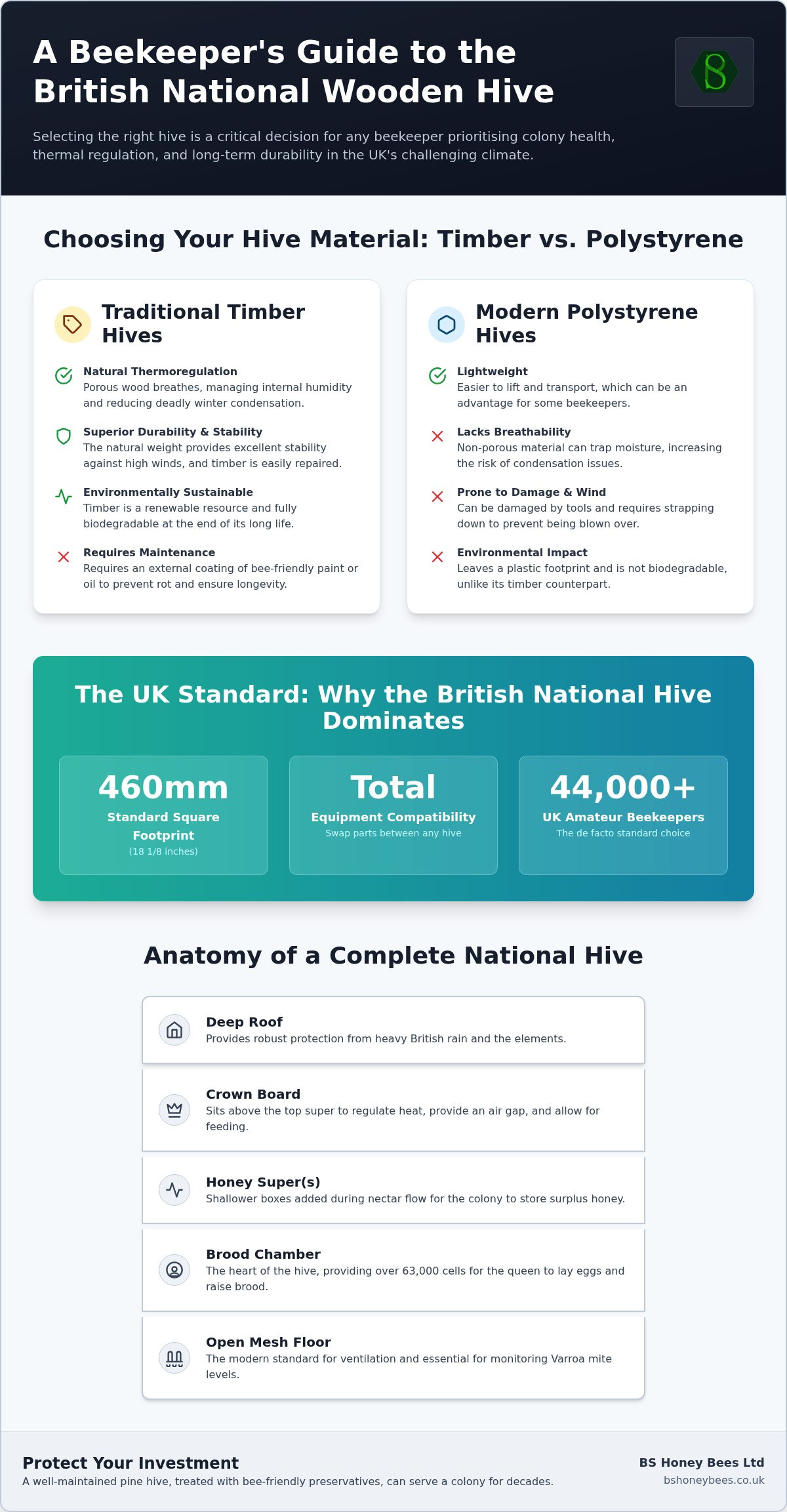
The primary advantage of timber is its inherent breathability. Unlike synthetic alternatives, wood is a porous material that assists with thermoregulation throughout the changing British seasons. It effectively manages the internal humidity levels of the hive, which is vital during the damp winter months when condensation can become a silent killer for a cluster. Additionally, wooden equipment is environmentally sustainable. At the end of its long life cycle, a timber hive is fully biodegradable, leaving no plastic footprint in your local ecosystem.
- Structural Integrity: Timber provides a rigid, heavy-duty frame that resists warping if sourced from high-quality stock.
- Repairability: Unlike poly hives which can crack or degrade, wooden components are easy to sand, fill, or reinforce with standard woodworking tools.
- Stability: The natural weight of wood ensures the stack remains secure against the high winds often experienced in exposed UK apiary sites.
Timber vs Poly: Making the Right Choice
The debate between timber and polystyrene often comes down to weight and insulation. Poly hives are undeniably lighter, which helps during transport, but they often lack the "heft" required to stay grounded without heavy strapping during a storm. Wooden hives offer superior structural security and a reassuringly solid feel during inspections. While the Langstroth hive design revolutionised beekeeping globally by introducing the concept of bee space, the British National wooden hive remains the favourite in the UK for its balance of thermal mass and manageable size. It fits the traditional garden aesthetic perfectly, appearing as a professional piece of horticultural equipment rather than an industrial box.
The Longevity of Pine Beehives
High-quality pine has become the cost-effective standard for modern beekeeping. It offers excellent strength-to-weight ratios and is significantly more accessible than expensive cedar alternatives. To ensure your investment lasts, you must apply an external treatment before the bees move in. A simple coat of bee-friendly paint or natural oil prevents rot and shields the timber from the driving rain of a British autumn. A well-maintained pine hive can serve a colony for decades when treated with the care it deserves.
Understanding the British National Hive Standard
The British National Hive is the most popular design in the UK for a very specific reason: compatibility. With a standard square footprint of 460mm, or 18 1/8 inches, this design ensures every component fits perfectly regardless of the manufacturer. This level of standardisation is essential when you're expanding your apiary or purchasing honey bee nucs for sale UK. Because the National standard is the de facto choice for the 44,000 amateur beekeepers in the country, you'll never struggle to find compatible parts or expert advice tailored to your setup.
Choosing wooden beehives built to this standard simplifies your seasonal management. You can swap brood boxes between colonies or move honey supers between hives without worrying about gaps or "bee space" violations. This interoperability reduces stress for the beekeeper and provides a stable environment for the bees. For official guidance on maintaining these standards and managing colony health, the National Bee Unit provides invaluable resources for UK-based apiarists. If you're ready to invest in quality, our range of British National wooden beehives offers the durability your colony needs.
Anatomy of a Complete Hive
A functional National hive consists of several critical layers. It starts with the Open Mesh Floor, which is now the industry standard for monitoring Varroa mite levels and ensuring adequate ventilation. Above this sits the brood chamber, providing over 63,000 cells for the queen to populate. Supers are shallower boxes added on top for honey storage. The entire stack is capped with a crown board to regulate heat and a deep roof to deflect the heavy British rain. This modular approach allows you to scale the hive's volume as the nectar flow increases.
Frames and Foundation Requirements
Your choice of internal hardware is just as important as the external box. For the brood chamber, you'll typically use DN4 frames, whilst supers require the shallower SN4 frames. Using wired foundation is essential for most, as it provides the structural support needed when extracting honey or inspecting heavy brood combs. Don't settle for poorly cut timber. Ensure your frames are assembled with precision so they sit squarely on the hive runners, maintaining that critical 8mm bee space that prevents the colony from gluing everything together with propolis.
Essential Features to Compare When Buying
When browsing wooden beehives, the first decision you'll face is whether to buy flat-pack or pre-assembled units. Whilst pre-assembled hives save time, they often carry a significant price premium and higher shipping costs due to their bulk. Flat-pack options are the cost-effective choice for beekeepers willing to spend an afternoon in the workshop. This approach also allows you to inspect the quality of the timber before it's nailed together, ensuring there are no hidden defects in the finger joints or rebates. High-quality kits should feel substantial and fit together with precision, leaving no gaps for draughts.
Don't overlook the roof depth during your comparison. A deep roof is essential in the UK as it provides a larger overlap, preventing driving rain from reaching the crown board or seeping into the supers. Similarly, your choice of floor impacts long-term colony health. Most modern kits include an Open Mesh Floor (OMF) as standard. These are vastly superior to solid floors because they allow varroa mites to fall through the mesh, preventing them from re-entering the hive whilst providing vital winter ventilation. For those seeking community advice on equipment choices, the British Beekeepers Association offers extensive resources for new starters to help them avoid common purchasing mistakes.
Assembly: What to Expect
Building a flat-pack hive requires only basic tools: a hammer, a square, and water-resistant wood glue. Always use galvanised nails to prevent rust from bleeding into the wood over time, which can eventually weaken the structure. It's vital to ensure your brood boxes are perfectly square during assembly. Even a slight misalignment can create gaps that violate bee space, leading the colony to fill the voids with propolis and making future inspections unnecessarily difficult. Take your time with the first box; it sets the standard for the rest of the stack.
Hive Security and Entrance Management
Entrance management is your primary tool for helping a colony defend its stores. Entrance blocks are indispensable during the autumn when wasps and robber bees are most active. A landing stage is also a helpful feature, providing a clear platform for heavily laden foragers returning from the field with nectar and pollen. A secure, reduced entrance is the first line of defence for F1 buckfast queens UK, ensuring the colony remains calm and protected from external threats.
Standout Wooden Hives from BS Honey Bees Ltd
Selecting the right equipment shouldn't be a matter of guesswork. At BS Honey Bees Ltd, we specialise in wooden beehives designed to withstand the rigorous demands of the UK climate whilst maintaining the strict British National standard. Our range focuses on high-quality pine, a material that offers an exceptional balance of affordability and long-term durability. When you invest in our timber housing, you're choosing a foundation that supports your colony's growth from their first spring forage through to the heaviest summer nectar flows.
We recognise that many beekeepers struggle to differentiate between a standalone hive and a complete starter bundle. To address this, we've curated specific configurations that cater to both expanding apiaries and those just beginning their journey. Whether you need a single unit to house a new swarm or a comprehensive kit to launch your hobby, our equipment arrives ready to perform. You can explore our full range of wooden beehives today to find the perfect fit for your site.
The National Pine Wooden Hive with 2 Supers
This configuration is the versatile workhorse of the modern UK apiary. It's built for beekeepers who prioritise honey production and colony health in equal measure. The set includes a 4-inch deep base equipped with an open mesh floor and a slide-out varroa tray, making pest monitoring a simple, non-intrusive task. To ensure you're prepared for a strong nectar flow, we include two supers as standard. The entire unit is protected by a solid deep roof featuring a heavy-duty galvanised steel cover, providing an impenetrable barrier against driving rain and snow.
The Beginner-Friendly Pine Starter Kit
Launching your beekeeping journey in 2026 requires more than just a box for the bees. Our British National Hive Pine Starter Kit is the most cost-effective all-in-one solution available. It includes a complete hive plus the essential tools you'll need for your first inspections, such as a smoker and hive tool. This kit pairs perfectly with our bee suit sizing guide uk, ensuring you have the right protective fit before your first colony arrives. It removes the friction of sourcing individual components, allowing you to focus on the bees themselves.
For those looking to maximise hive security, BS Honey Bees Ltd also offers the Hive-Five® Multi-Guard. This advanced entrance protection system is an essential upgrade for any wooden hive, providing superior defence against predators and helping your colony maintain its internal temperature more efficiently during the winter months.
Maintenance and Preparation for Your New Hive
A new set of wooden beehives represents a fresh start for your apiary, but the longevity of that investment depends entirely on your initial preparation. Pine is an excellent, sustainable choice for the British climate, yet it's susceptible to rot if left exposed to the elements without a barrier. You must apply a protective finish to the exterior surfaces before the first foragers arrive. This treatment prevents moisture from penetrating the grain, ensuring the timber doesn't warp or degrade during a relentless UK winter. Maintaining your wooden beehives is a seasonal commitment that pays dividends in colony stability.
Treating Your Timber Hive
This focus on long-term durability and quality of life is a value shared by specialists in home comfort; for instance, Bennetts Bedrooms brings extensive experience in the UK and Portugal to help you find the perfect sleep setup for your own home.
Raw linseed oil is a favourite amongst traditionalists who prefer a natural look. It penetrates deep into the wood, offering a breathable finish that won't peel or flake over time. If you prefer a splash of colour, specialised beehive paints provide a thicker layer of protection whilst allowing you to distinguish between different colonies at a glance. There's one crucial rule to follow: never treat the inside of the hive or the frame rests. The bees will coat these internal surfaces with propolis, creating their own natural antimicrobial seal. Introducing synthetic chemicals to the brood area can disrupt the delicate pheromone balance and health of the colony.
Siting Your Hive Correctly
The location of your apiary is just as vital as the quality of the hive itself. Find a level, stable spot that's sheltered from the prevailing UK winds to prevent the stack from being buffeted during autumn storms. Ideally, ensure the hive entrance faces south or south-east. This orientation catches the early morning sun, warming the entrance and encouraging foragers to start their work sooner in the day. Always use a dedicated hive stand to keep the floor away from ground-level dampness. This simple step significantly extends the life of the timber and helps maintain a dry internal environment for the winter cluster.
Preparation for the season doesn't end with the woodwork. Once your hive is treated and sited, you'll need to ensure the internal environment is ready for its inhabitants. If you're planning to introduce mated queen bees UK, your timing must be precise. Performing maintenance during the dormant winter months or early spring ensures you don't disturb the colony once the queen begins her heavy laying cycle. A well-prepared hive, correctly positioned and properly treated, is the best gift you can give a new colony.
Ready to Secure Your Apiary's Future?
Choosing the right housing is the most significant step you'll take in supporting your colony's health and productivity. You now understand why the British National standard is essential for long-term compatibility and how the natural properties of timber assist your bees with thermoregulation during volatile British seasons. By selecting high-quality equipment and committing to a simple exterior maintenance routine, you're building a sustainable foundation that will serve your apiary for years.
At BS Honey Bees Ltd, we combine durable pine construction with specialist breeder support to ensure you have the best start possible. We provide nationwide UK delivery on all our equipment, from standalone boxes to comprehensive starter kits. Our focus remains on logistical excellence and the success of our customers, ensuring your gear arrives ready for the season ahead.
Browse our full range of British National wooden beehives and invest in equipment that puts the success of your bees first. We look forward to supporting your beekeeping journey throughout the 2026 season and beyond.
Frequently Asked Questions
Do wooden beehives come with frames and foundation?
Most wooden beehives are sold as standalone units, meaning frames and foundation aren't included as standard. However, our British National Hive Pine Starter Kit provides a complete package for those starting from scratch. Buying frames separately allows you to choose between different types, such as DN4 for brood boxes or SN4 for supers. Always check the product description to ensure you have everything needed for a functional setup before your bees arrive.
Is pine or cedar better for a British National hive?
Cedar is naturally rot-resistant but carries a significantly higher price tag. Pine has become the cost-effective industry standard for modern UK beekeeping because it's sturdy and provides excellent value for money. Whilst pine requires external treatment with bee-friendly paint or oil to prevent weathering, it offers the same structural benefits as cedar. For most hobbyists, high-quality pine provides the best balance of performance and affordability for their wooden beehives.
How often do I need to paint or treat my wooden beehive?
You should apply an initial treatment of paint or natural oil to your wooden beehive before it's sited and populated. After this first coat, a maintenance check every two to three years is typically sufficient. Look for signs of weathering or timber fading, especially on the roof and south-facing sides. Regular maintenance ensures the timber remains waterproof and prevents rot from taking hold during the damp British winter months when humidity levels are highest.
Can I move my bees from a poly nuc into a wooden hive?
Yes, you can easily transfer a colony from a poly nuc into a wooden hive if both use the British National standard. Simply move the frames directly from the nuc into the centre of the new brood box. Ensure you keep the frames in the same order to avoid disrupting the brood nest. Once the transfer is complete, you can add extra frames to fill the remaining space in the larger chamber for the colony.
How long does it take to assemble a flat-pack wooden hive?
A beginner can typically assemble a complete flat-pack hive in approximately one to two hours. The process is straightforward if you have the right tools, including a hammer and water-resistant wood glue. Our kits are designed with precision-cut joints that slot together easily. Taking your time ensures the boxes are perfectly square, which is vital for maintaining proper bee space and making future inspections much easier to manage throughout the beekeeping season.
What is the difference between a brood box and a super?
The brood box is the deeper bottom chamber where the queen lives and lays her eggs. It's the heart of the colony. In contrast, supers are shallower boxes placed on top for the bees to store surplus honey. Because supers are smaller, they're much lighter and easier to lift when full of honey. Using a queen excluder between the two levels ensures the queen stays in the brood area whilst the honey remains clear.
Are wooden beehives heavy to move during inspections?
Wooden equipment has a natural weight that provides stability in high winds. A full brood box can be heavy, often weighing over 25kg when packed with bees and winter stores. However, during routine inspections, you'll mostly move the lighter honey supers. If weight is a concern, you can inspect the hive frame by frame to reduce the lifting required. The structural integrity of timber makes it worth the extra heft for long-term apiary use.
Does the British National hive starter kit include a bee suit?
Our British National Hive Pine Starter Kit includes the hive, frames, and essential tools, but it doesn't include a bee suit as standard. This allows you to choose the specific size and style that fits you best. As stockists of premium BBWear suits, we recommend referring to our sizing guide to find your perfect fit. Combining a high-quality suit with a durable hive ensures you're fully protected for your first beekeeping season.