

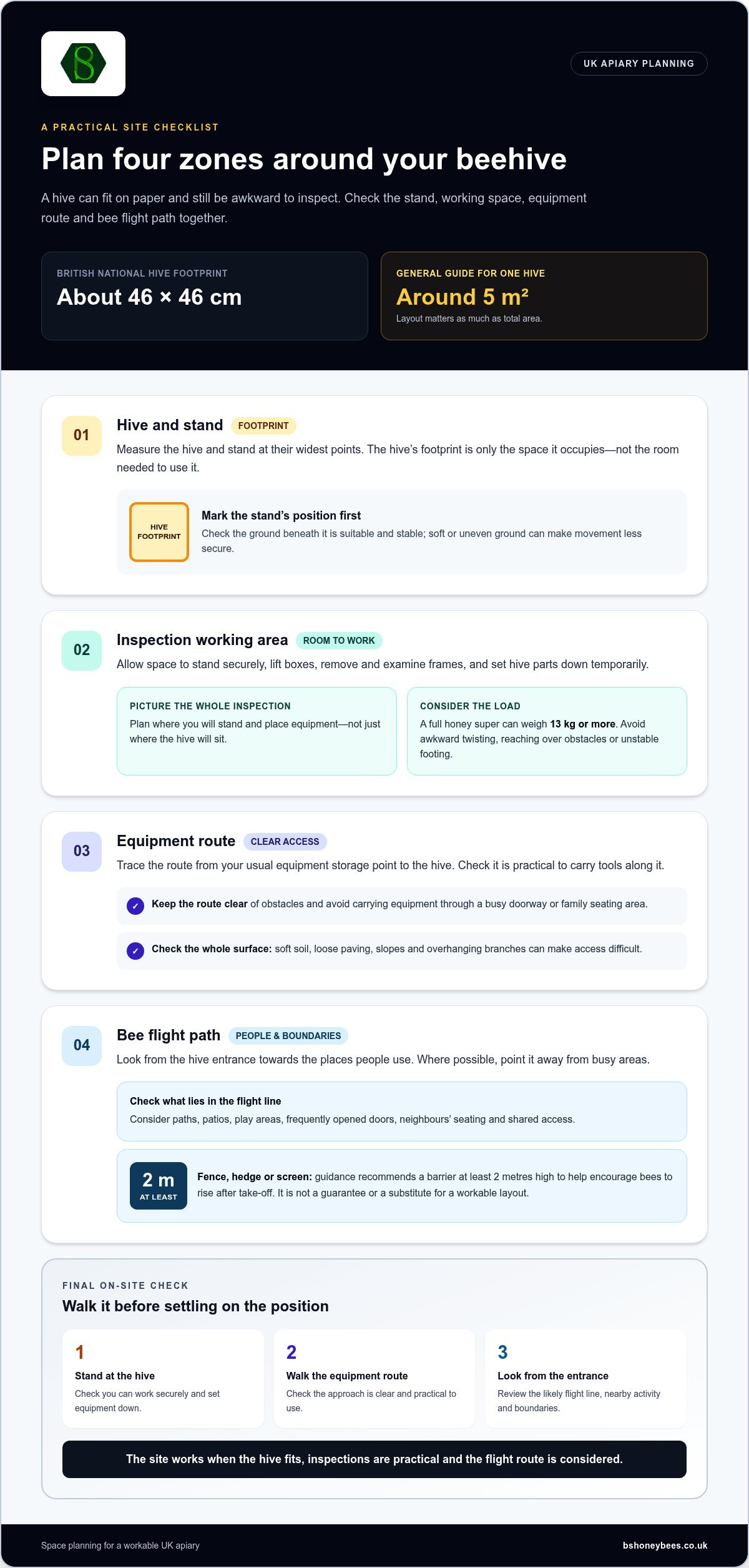
The hive itself may be the smallest part of the space you need. If you’re asking “how much space do you need for a beehive uk”, a British National hive has a footprint of about 46cm by 46cm, but you’ll also need room to inspect it and consider where the bees will fly. Around 5 square metres is generally considered sufficient for one hive, although the layout matters as much as the total area.
The practical question isn’t just whether the hive will fit in your garden. It’s whether you can work safely around it without placing the bees’ flight path across a doorway, path or seating area. A hive that fits neatly on paper may still be poorly placed if you can’t access it easily or bees fly towards neighbours.
This guide explains how to estimate the space for the hive and routine inspections, then assess access, boundaries and flight direction before choosing a position. You’ll also learn what to measure and how a British National hive or 2-in-1 poly nuc might suit your available space. Plan for more than the footprint, and you’ll be better placed to choose a workable setup.
Key Takeaways
- There’s no single answer to how much space do you need for a beehive uk. Assess the hive, inspection access and surroundings together.
- Map the hive stand, working area, equipment route and bee flight path separately before settling on a position.
- In a compact garden, consider how bees may travel in relation to paths, doors, seating and play areas.
- Measure your site against the chosen hive format, then decide whether the layout is safe and workable.
- Compare British National hives and 2-in-1 poly nucs against your available footprint and access needs.
How Much Space Does a Beehive Need in the UK?
There’s no single space figure that suits every hive and site. If you’re asking how much space do you need for a beehive uk, separate the hive’s physical footprint from the room needed to inspect it, move equipment and manage the bees’ flight. Your answer will depend on the hive model, how you work, the ground beneath it and what surrounds the site.
The hive footprint is the area occupied by the hive and stand. Usable apiary space also includes working clearance, equipment access and safe approach and flight areas. This distinction matters. A hive may fit into a small corner, but that corner isn’t automatically suitable if you can’t stand securely beside it or handle its parts without obstruction.
What counts as space for a beehive?
Think in three zones. First, the footprint: the hive and stand, measured at their widest points. Second, the working area: room to lift boxes, remove and examine frames, set components down and carry tools. Third, the approach and flight area: your route to the apiary and the space bees cross as they leave and return. These zones may overlap, but each serves a different purpose.
For example, a clear area directly behind a hive may be more useful than extra open ground on the far side of a fence. You need stable footing and enough room to handle equipment without twisting or stepping over obstacles. Hive layouts and the concept of bee space vary by design; beehive types and bee space provide useful background on how different hives are constructed.
Why there is no universal minimum
Hive design and inspection methods affect how much clearance is practical. The way you access frames, handle boxes and arrange removed parts determines where you need to stand and put equipment. Check the dimensions of the hive and stand you plan to use, then picture a full inspection rather than only measuring where the hive will sit.
A compact footprint doesn’t guarantee a workable site. Uneven or soft ground can make movement less secure, while a narrow access route may leave nowhere to put equipment. A nearby doorway, seating area or boundary can also affect where people and bees move. Judge the layout as a whole: the hive must fit, and you must be able to work around it safely with the flight route in mind.
Use measurements as a planning tool, not a universal pass-or-fail threshold. Mark the stand’s position, then allow for your working posture, the parts you’ll handle and the route you’ll take with equipment. Once you’ve marked these areas on the ground, you can judge whether the position is practical before choosing a hive setup.
Which Parts of a UK Apiary Layout Need Space?
Plan the layout as four distinct zones: the hive and stand, the inspection working area, the equipment route, and the bees’ flight path. Mark each one before choosing a final position. This helps you spot a layout that fits the hive but leaves no safe place to stand, or sends departing bees across a well-used part of the garden.
These zones interact, but they solve different problems. Your route for carrying tools to the hive doesn’t have to match the bees’ route out of it. Consider both as you assess fences, sheds, established plants and everyday household activity.
Working access for inspections and equipment
Allow room to reach the hive from the direction you’ll use during inspections. You may need to lift supers, remove frames and set equipment down temporarily. A full honey super can weigh 13kg or more, so plan to handle it without awkward twisting, reaching over obstacles or carrying it across an unstable surface.
Trace a practical route from your usual equipment storage point to the hive. It should be clear enough to carry tools without going through a busy doorway or across a family seating area. Check the ground along the route as well as around the stand. Soft soil, loose paving, slopes or overhanging branches can make a seemingly generous work area difficult to use. Trim vegetation that obstructs access, while keeping the hive entrance and flight area in mind.
Flight paths, people and boundaries
Consider where bees will go just after leaving the entrance. If it faces a garden path, patio, children’s play area or frequently opened door, people may regularly cross the flight line. Where possible, orient the entrance away from these busy areas and towards a less-used part of the garden. Consider neighbours too, particularly if the entrance points towards a boundary, shared access or neighbouring seating area.
A fence, hedge or screen can encourage bees to rise higher soon after take-off, helping guide their initial flight above nearby activity. Research guidance recommends barriers at least 2 metres high for this purpose. Treat a barrier as one part of the layout, not a guarantee: bees can travel beyond it, and it won’t prevent every interaction with people or neighbours. Leave enough clearance to maintain the barrier and keep the hive accessible.
Before settling on the position, walk the equipment route and stand where you expect to work. Then look from the entrance towards paths, seating and boundaries. If your route is awkward or the likely flight line crosses regular activity, adjust the arrangement. Once the layout works on the ground, compare the available footprint with suitable British National hives and frames as you choose equipment for your site. This practical check answers more than “how much space do you need for a beehive uk”: it helps you decide whether the whole apiary arrangement is workable.
Does a Small Garden Have Enough Room for a Beehive?
Possibly, but garden area alone won’t tell you whether a hive will fit safely into daily life. A compact garden with a quiet corner and clear inspection access may be more workable than a larger garden where the entrance faces a patio or busy path. Consider how the space is used, where people move and whether you can manage the hive without disrupting household activity.
Use this comparison to identify the layout questions that matter. It isn’t a pass-or-fail guide: assess each site on its own.
- Compact garden: Check whether you can reach the hive comfortably and keep the entrance away from doors, seating and play areas. Nearby boundaries and regular activity may limit your options.
- Larger garden: More room may give you a choice of positions and clearer separation from everyday use. You’ll still need a stable working area and a considerate flight direction.
- Open plot: Space can make access and orientation easier to arrange, but assess the ground, equipment route and nearby people or properties rather than assuming the site is suitable.
What makes a compact garden more challenging?
In a small garden, the main constraint may be the layout rather than the dimensions. A narrow strip beside a shed might fit a hive but leave little room to stand, handle equipment or move around during inspections. An entrance close to a frequently used back door, washing line or seating area may also direct bees across the spaces people use most.
Consider how the garden is used at different times of day and how it changes through the year. Children may use one area for play, or a path may be a regular route between the house and garden. Don’t judge suitability by measuring the empty patch alone. Include access, working room and the likely flight line.
How a more open site changes the layout
A larger or more open plot can give you more choice about hive orientation and the inspection area. You may be able to keep the approach route clear while directing the entrance away from seating or regular foot traffic. That flexibility can make planning simpler, but you still need to consider people beyond the apiary.
Even an open site needs firm, stable footing and a practical route for carrying equipment. Check for slopes, soft ground, gates or vegetation that could hinder access. Consider neighbouring boundaries and any public or shared routes too. A secluded site isn’t consequence-free: bees may still fly towards places used by other people.
To answer “how much space do you need for a beehive uk” for your own garden, sketch the hive position alongside paths, doors, seating, play areas and boundaries. Then check whether the working space and entrance direction suit the way the garden is used. A sensible layout is one you can reach and manage while taking everyday activity into account.
How to Measure and Assess Your Beehive Site
A site survey turns a promising garden corner into a practical plan. Measure the hive you intend to use, then map the area needed to inspect it and carry equipment. Include everyday movement and likely bee flight routes. This gives you a clearer answer to “how much space do you need for a beehive uk” than relying on the hive footprint alone.
Measure the hive and inspection area
Use this sequence to assess the position before setting up. A tape measure, garden stakes or chalk can help you mark each zone on the ground and see where space becomes restricted.
- Identify the hive model. Note the dimensions of the hive and stand you’re considering, including any parts that extend beyond the main body.
- Mark the footprint. Outline where the stand and hive will sit. Check that the position leaves room to reach the entrance and work from the side or direction you expect to use.
- Add inspection space. Mark where boxes and frames can be handled and set down during a routine inspection. Make sure you can stand securely and move without stepping over obstacles.
- Trace the equipment route. Walk between the hive and the place where you’ll keep or collect tools. Note narrow gates, steps, turns and surfaces that could make carrying equipment awkward.
- Map people and flight routes. Mark paths, doors, seating, play areas and boundaries, then consider how the entrance direction relates to these regular routes.
Check the site through the seasons
A position that looks clear on survey day may change as the garden does. Consider whether growing vegetation could narrow access or obstruct the entrance. Notice how sunlight and shade move across the spot, and whether it is exposed to wind or likely to become wet underfoot. Check drainage after rain rather than judging the ground only when it’s dry.
Check that gates, paths and the equipment route will remain usable throughout the year, including when the garden is being used for its usual activities. If the hive is near a boundary or shared space, note any neighbour concerns to discuss and any local planning or allotment rules to research carefully. Don’t assume a position is suitable simply because it fits within your property.
Garden survey checklist: record the hive and stand dimensions, inspection clearance, equipment route, ground condition, drainage, sunlight, shelter, vegetation, household activity, boundaries and likely flight direction. If any part is awkward to access or conflicts with everyday use, adjust the marked position and reassess it.
Once your measurements show what will fit, compare the planned footprint with British National hives and frames as you consider equipment for your site.
Choose a Beehive Setup That Fits Your Available Space
Choose equipment after measuring the site, not before. The hive and stand must fit the marked position, but the footprint is only part of the decision. Make sure your layout also leaves room to reach the hive, handle boxes and frames, and move equipment along a practical route.
Keep two decisions separate: whether the site is safe and workable, and which hive format suits it. A compact setup won’t make an unsuitable flight path or difficult access acceptable. Resolve the site plan first, then compare hive options against the space you’ve marked out.
Match the hive format to your planned layout
Use the dimensions of the specific hive and stand you’re considering. Mark their full footprint, then check where you’ll stand and place components during inspections. If you’re considering a British National setup, the British National beehive guide can help you understand this familiar UK hive format as you plan your equipment.
Consider the colony as part of the setup too. A nucleus colony needs a hive arrangement that suits its planned location and inspection access. BS Honey Bees Ltd supplies 5 and 6 frame nucleus colonies, as well as 2-in-1 poly nucs. Plan the colony, hive and access together rather than assuming equipment alone will solve a layout problem.
Your next steps before setting up
Before acquiring a hive or colony, review your measurements and walk the intended route with the equipment you’ll need in mind. Check that the stand can sit on stable ground, that you can reach the hive comfortably, and that the entrance direction takes account of paths, doors, seating, play areas and boundaries. Revisit the site in different conditions if wet ground, seasonal growth or changing garden use could affect access.
If the marked layout creates awkward handling, unstable footing or a flight line across regular activity, reconsider the position. A different hive format may match the available footprint, but it can’t replace a safe, practical site plan. Settle the position first, then select equipment and a colony to suit it.
Once your plan is in place, you can explore beekeeping equipment and compare suitable hive options with the space you’ve measured.
Turn Your Site Plan into a Confident Next Step
Your answer to how much space do you need for a beehive uk is most useful when it helps you make a practical decision. Keep your measurements to hand while choosing equipment, rather than letting a hive’s footprint dictate a position that doesn’t work for your garden or plot. If your preferred setup doesn’t fit the plan, adjust the equipment choice or reconsider the location before committing.
With the site decision made, compare options at your own pace. BS Honey Bees Ltd supplies British National hives and frames, 2-in-1 poly nucs and live bees to customers across the UK. Choose equipment that matches your measured space and the way you intend to manage your apiary.
Ready to take the next step? Explore beekeeping equipment and plan a setup around your site.
Frequently Asked Questions
Is there a legal minimum space for a beehive in the UK?
Don’t assume there’s one nationwide minimum that applies to every garden or apiary. Practical working clearance is a planning need, while legal or local requirements depend on the circumstances and location. If your hive would be on an allotment, shared land or near a public route, check the current guidance that applies there and any relevant local rules. Don’t treat an uncited measurement as a legal requirement.
Can you keep a beehive in a small garden?
A small garden isn’t automatically suitable or unsuitable. Consider a typical busy moment: could someone use the back door or sit outside while you inspect the hive, and would their route cross the bees’ likely flight line? Include visitors and routine activities, not only your own movements. If the layout leaves no practical way to manage those interactions, another position or deciding against that site may be more appropriate.
How far should a beehive be from a fence or boundary?
There isn’t one boundary distance that suits every site. A solid fence, open railing or dense hedge can affect how bees move after leaving the entrance, but the result also depends on entrance direction and activity on the other side. Consider where neighbours spend time and whether the flight route could cross their access or seating areas. Before relying on a distance or legal rule, check current authoritative guidance for your circumstances.
How much room should you leave around a beehive for inspections?
Leave enough usable room to approach the hive, handle its boxes and frames, and put components down without blocking your footing. The amount depends on the hive design and how you carry out inspections. If you’re asking “how much space do you need for a beehive uk”, rehearse the movements at the proposed position with the equipment you’ll use. Check whether you can work without reaching across obstacles or putting frames somewhere unsuitable.
Can you keep more than one beehive in the same garden?
More than one hive may fit physically, but that doesn’t establish whether the full arrangement is workable. Check that each hive can be approached and inspected, and consider whether the entrances direct bees towards different parts of the garden. Imagine working at one hive while another is active, and assess how this affects movement near paths, seating or neighbouring boundaries. Avoid relying on a universal garden limit; assess the layout and consult reliable beekeeping guidance.
Does a beehive need to be in full sun?
Full sun shouldn’t be treated as essential for every UK site. Assess the position at different times of day and through the seasons, noting how shade, shelter and exposure change. Also consider whether the ground stays workable after rain and whether the hive is easy to reach. A spot that is sunny but exposed or difficult to access may be less suitable than another position. Weigh sunlight alongside the whole site rather than using it as the only test.
What should you check before putting a beehive near a public footpath?
Check whether the entrance faces towards the path and where bees are likely to travel after take-off. Consider how you’ll inspect the hive without placing equipment on or obstructing the route, and whether passers-by regularly stop nearby. A hedge or screen may influence flight behaviour, but it can’t remove every possible interaction. Before choosing a position beside a public path, check current authoritative beekeeping guidance and any land or access rules that apply.