
A “food-safe” label on a tin doesn’t automatically mean the finish is suitable around bees. If you’re looking for a food safe finish for beehives uk, look beyond the label: check the product’s intended use, the surface you plan to treat and the conditions required for it to cure fully.
Advice on oils, waxes, paints and preservatives can seem contradictory. There’s no specific UK government standard defining a food-safe finish for the outside of a beehive, so you need to weigh product claims against the hive material, potential bee exposure and curing requirements before introducing a colony.
This guide explains what safety claims do and don’t establish, compares common finishes and shows how to protect exposed surfaces without coating parts that don’t need it. You’ll also learn why curing matters, how advice can differ between a British National wooden hive and a poly hive, and what to check before your bees move in.
Key Takeaways
- Assess a food safe finish for beehives uk by its intended use, not by a label alone.
- Compare oils, waxes, paints and preservatives against the hive material and the surface being treated.
- Use a practical checklist to assess application, curing, maintenance and the evidence behind a finish’s claims.
- Follow the product label for preparation and curing, and avoid coating surfaces that don’t need protection.
- Choose your next step with the hive material and finish requirements in mind, including for British National equipment.
What does “food-safe finish for beehives” actually mean?
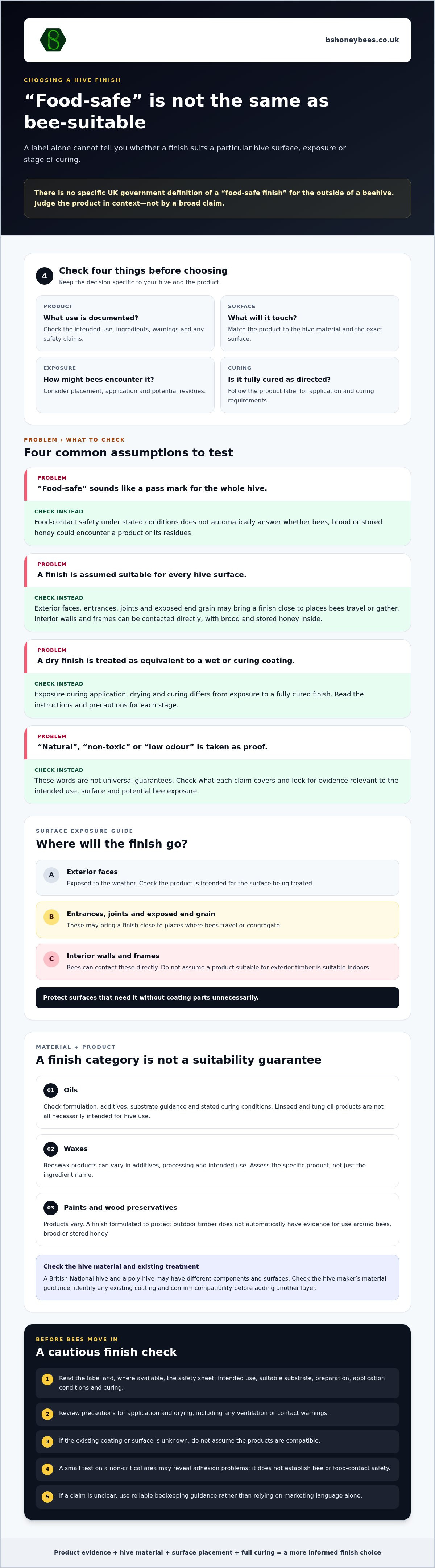
“Food-safe” sounds like a clear pass mark, but it isn’t one for beehives. In the UK, there’s no specific government definition of a “food-safe finish” for the outside of a hive. The phrase appears in beekeeping and product marketing, but it doesn’t establish that a coating is suitable for every hive surface or safe at every stage of use.
A food-safe beehive finish is a product whose documented use, ingredients, placement and fully cured condition are appropriate for the particular hive surface, while minimising exposure risks to bees and hive products. Treat this as a practical decision, not a guarantee provided by a broad label claim. A general overview of beekeeping in the United Kingdom offers background, but it isn’t evidence that a particular finish is suitable.
That distinction matters if you’re searching for a food safe finish for beehives uk. Food-contact safety concerns whether a material is suitable for contact with food under stated conditions. Bee suitability asks a different question: whether bees, brood and stored honey could be exposed to the product or its residues. A claim addressing one doesn’t automatically answer the other.
Does food-safe mean safe for bees?
No, not automatically. A claim about a fully cured product may not cover exposure while it’s being applied, drying or curing. Wet coatings and their vapours present a different exposure picture from a dry finish. Don’t assume a product described as safe for people, animals or food is suitable around a colony without checking exactly what the claim covers.
Read the product label for intended use, application instructions, precautions and curing guidance. Look for information relevant to the product’s use on the surface you plan to treat and around bees. Words such as “natural” or “low odour” aren’t proof of safety. If a claim is unclear, use reliable beekeeping guidance to inform your decision rather than relying on marketing language alone.
Which hive surfaces are exposed to a finish?
Start by listing the surfaces you plan to coat. Exterior faces are exposed to the weather, but entrances, joints and exposed end grain may also bring a finish close to places where bees travel or congregate. Interior walls and frames are different: bees can contact them directly, and brood and stored honey are inside the hive. Don’t assume a product appropriate for exterior timber is suitable indoors.
Construction matters as well as material. A British National hive may have different components and surfaces from a poly hive, so don’t apply the same coating approach by default. Check the hive maker’s material guidance alongside the finish label, and identify any existing treatment before adding another layer. This helps you protect the surfaces that need it without coating others unnecessarily.
Keep the decision specific: what is the finish, which surface will it touch, how might bees encounter it, and what does the evidence say about its cured use? Those questions put “food-safe” into context and stop a broad claim from standing in for a considered choice.
How do hive materials and finish ingredients affect suitability?
Judge a finish in context. The hive material, any existing coating and the exact product formulation all matter. A coating designed for bare exterior timber may not adhere to a previously painted surface, while a product suitable for wood may be incompatible with another hive material. For a British National hive, check the material and condition of each component rather than assuming every part needs the same treatment.
Ingredients matter, but a familiar or natural-sounding ingredient doesn’t make a finish suitable by itself. Linseed oil, tung oil and beeswax products can vary in additives, processing and intended use. Paints and wood preservatives vary too. A finish formulated to protect outdoor timber doesn’t automatically have evidence for use around bees, brood or stored honey. Assess the specific product and where you intend to use it, not just its category.
Terms such as natural, non-toxic and food-safe aren’t interchangeable proof of hive suitability. Each may refer to a particular ingredient, use or condition, and none should be treated as a universal guarantee. The National Bee Unit Honey & Food Safety provides context on honey and food safety, but it doesn’t certify every finish for beehives. For a food safe finish for beehives uk, match the product’s evidence to the material, application and potential exposure.
What should you check on a finish label or safety sheet?
Read the label and, where available, the safety sheet before buying or applying a coating. Check whether it names the intended use and suitable substrate, then follow its instructions for preparation, application conditions and curing. Review warnings for both application and drying, including precautions about ventilation or contact. If the product makes food-contact or other safety claims, check the conditions those claims cover and consult current UK guidance before interpreting them.
Check previous treatments too. Identify the existing coating if possible, then see whether the new product can be applied over it. If the surface or coating is unknown, don’t assume the products are compatible. A small test on a non-critical area can reveal adhesion problems, but it won’t establish bee or food-contact safety.
Are oils, waxes and paints suitable for beehives?
None of these categories is automatically suitable or unsuitable. Compare the evidence for each product with its intended use and the surface you plan to treat:
- Oils: Check the formulation, additives, substrate guidance and stated curing conditions. Don’t assume every linseed or tung oil product is intended for hive use.
- Waxes: Beeswax may sound like an obvious choice, but blends and application directions vary. Check whether the product is designed for the surface and use in question.
- Paints and preservatives: Confirm material compatibility and exterior-use guidance. In particular, solvent-based products may damage polystyrene, so follow the hive and finish manufacturers’ instructions.
Keep the choice evidence-led, and let the hive material guide your checks. If you’re selecting equipment as well, our British National hives and frames provide a starting point for considering the surfaces you’ll need to protect.
How should you compare beehive finishes before choosing one?
Compare products against the job they need to do, not a “natural” or “non-toxic” headline. A finish may protect exterior timber from the weather without offering evidence about bee exposure. Conversely, wording about safety doesn’t prove the coating will suit your hive material, adhere to an existing finish or provide the protection you need.
Use the label and product information to complete this comparison before deciding. If a detail is missing, record it as unknown rather than treating it as a positive claim.
| Criterion | What to compare | Why it matters |
|---|---|---|
| Intended use | Exterior timber, another named substrate, or a different application | Use on one surface doesn’t establish suitability on another. |
| Application | Preparation, number of coats and stated application conditions | Directions help show whether it can be used on the surface as it stands. |
| Curing | Labelled cure time and conditions before use | Dry to the touch may not mean fully cured. |
| Maintenance | Inspection, recoating or upkeep instructions | A finish may need periodic attention to remain protective. |
| Evidence | Specific claims about timber protection and suitability around bees | These are separate questions; evidence for one doesn’t establish the other. |
Choose by checking the product’s intended use, hive material, existing surface, bee exposure, application directions, curing conditions and maintenance evidence. No single finish is the universal winner.
Which criteria matter more than “natural” or “non-toxic” labels?
Start with the intended use and full product information. Confirm that the substrate matches your hive component, then check the application and curing instructions. Consider whether bees could touch the treated area, including around entrances or joints, and whether the product information addresses that use. Treat broad marketing terms as prompts to investigate, not proof. For a food safe finish for beehives uk, the relevant evidence must match the product and application.
When is no finish the simpler option?
Sometimes the more cautious choice is not to add a coating, particularly to an internal surface that bees contact directly when no protective treatment is needed. The decision still depends on the hive material, construction and condition. Western Red Cedar is often left untreated because of its natural durability, whilst other timber or exposed surfaces may have different protection needs. Don’t assume every hive needs coating, or that every finish is unsuitable.
Check the existing surface before adding anything. A previously treated component may need maintenance, a compatibility check or no further coating. For a British National hive, consider each part and its material separately: the box, floor and other components may not have the same exposure or maintenance needs. This keeps the decision focused on useful protection without adding a finish where it brings no clear benefit.
How do you apply and cure a beehive finish cautiously?
A careful process starts before you open the tin. Identify the component you’re treating, check what it’s made from and follow the product’s directions from preparation through to full cure. Keep bees away from the application and curing area, and follow any precautions stated on the label. Don’t rely on a generic drying estimate: products and conditions differ.
Work through this checklist in order:
- Identify the surface. Confirm the hive material, the area to be coated and whether it already has a finish. Include edges, joints and exposed end grain in your inspection.
- Prepare as directed. Follow the product instructions for cleaning, sanding and surface moisture. Don’t use a preparation method just because it worked on a different hive or coating.
- Apply according to the label. Use the stated method, coverage and application conditions. Avoid coating surfaces beyond those intended for treatment, and keep bees away as directed.
- Allow the full cure. Follow the stated curing time and conditions before bees or hive products can contact the treated surface. If the instructions are unclear, don’t guess when the hive can be used.
How should you prepare a hive surface?
Begin by checking the material and existing coating. A British National hive may include components with different surfaces or previous treatments, so inspect each part rather than assuming one preparation method suits all. Follow the finish manufacturer’s specific guidance on removing dirt, sanding or applying over an existing coating. Pay attention to any stated moisture or temperature conditions. Preparation affects adhesion and performance, and an unsuitable cleaning agent or sanding method could damage the surface or interfere with the finish.
Prepare only the areas you intend to treat. Keep the inside of the hive, frames and other bee-contact surfaces separate unless the product directions specifically support that use. Set components on a clean, stable surface, and keep application materials away from bees, honey and equipment that will return to the colony.
When can bees return to a treated hive?
Use the product’s stated full curing period and conditions, not an assumed drying time. Dry to the touch does not necessarily mean fully cured. A finish may feel dry whilst it still needs more time under the conditions specified by its manufacturer. Temperature, airflow and the surface can affect how a coating behaves, so follow the label rather than transferring timings from another product.
Persistent odour or tackiness is a reason to wait and review the instructions, but the absence of either doesn’t prove that curing is complete. Don’t place bees in contact with a treated surface until the product’s directions support doing so. If the label doesn’t explain when the treated hive can be used, pause rather than estimating.
Applying a finish to hive equipment is only one part of choosing suitable kit. If you’re planning a British National setup, explore our British National hives and frames as you assess the materials and surfaces you’ll need to prepare.
Choosing a finish for your UK beehive: make the next step confidently
There’s no universal best finish. A sound choice depends on what your hive is made from, which surface needs protection, what the product evidence covers and whether you can meet its application and curing requirements. If those details don’t line up, pause before coating. Protect the hive where it needs it, and avoid adding a finish simply because it’s labelled “natural” or “bee-friendly”.
Use this decision path: identify the material and any previous treatment; decide whether the surface genuinely needs a coating; check that the product is intended for that surface and application; then follow its directions through full curing before bees can contact it. A claim about outdoor timber protection and a claim about suitability around bees answer different questions. Keep them separate as you weigh your options.
A final checklist before treating a hive
Before opening the tin, work through these checks. They make the decision repeatable, not just reassuring in the moment.
- Confirm the surface. Identify the hive material, the exact component to be treated and any existing coating.
- Read the full product information. Review the label and available safety information, including intended use, application conditions, precautions and curing requirements.
- Check the exposure. Consider whether bees could contact the treated area, and don’t assume exterior-use guidance also covers internal surfaces.
- Record the treatment. Note the product, the area treated and the application date. This gives you a useful reference when inspecting the hive or planning future maintenance.
These checks are especially useful when hive components have been treated at different times or with different products. If you can’t establish what’s already on a surface, don’t assume a new coating will adhere or perform as intended. Review the product directions and identify the surface before proceeding.
How can the right hive equipment support your plans?
Hive format and component design influence which surfaces you’ll assess and how you’ll maintain them. If you’re weighing up British National equipment, the British National beehive guide can help you consider the format and its components as part of your apiary plans. Match your equipment choice to the setup you intend to manage, then assess each component’s material and condition before deciding whether it needs treatment.
BS Honey Bees Ltd supplies British National hives and frames for beekeepers planning their equipment. If this is the hive format you’re considering, explore the range and assess the finish separately, using the specific product directions and the surfaces involved. Browse our beekeeping equipment as you plan your apiary, then use the checklist to make your finish decision with confidence.
Plan your next hive setup with confidence
Make your next step practical: keep a record of the surface treated, the product used and when it was applied. That note gives you a clear starting point at your next inspection and helps you plan future maintenance without relying on memory. A considered approach to a food safe finish for beehives uk is part of setting up equipment you can manage confidently over time.
As your apiary plans take shape, match your hive format and components to the setup you want to maintain. BS Honey Bees Ltd supplies British National hives and frames, alongside beekeeping equipment distributed nationally across the UK. Explore the range when you’re ready to plan your equipment.
Explore British National hives and beekeeping equipment, and take your next step with confidence.
Frequently Asked Questions
Is a food-safe wood finish automatically safe to use on a beehive?
No. A food-contact claim doesn’t automatically cover exposure to bees, brood or honey, or the product’s use on a hive surface. For a food safe finish for beehives uk, check what the claim applies to, including whether it covers the cured coating, the particular substrate and the intended conditions. For example, a finish intended for a worktop may not be suitable for a hive entrance or interior wall.
Can I paint the inside of a beehive?
Generally, avoid painting interior surfaces unless the specific product directions support that use. Bees move across the walls and comb, and coatings may put them in direct contact with residues. Painting the inside of a brood box, for example, is different from protecting an exterior face from rain. If you’re replacing a component, leave its interior untreated unless there’s clear product-specific guidance for that application.
How long should a beehive finish cure before bees are introduced?
There isn’t one safe waiting period for every finish. Follow the product’s stated full-cure time and conditions, which may differ from its touch-dry time. If the label says curing depends on temperature or airflow, allow for those conditions where the hive is stored. Don’t introduce bees just because the surface feels dry. If cure guidance is missing or unclear, keep the hive out of use until you have reliable product-specific instructions.
Is beeswax a suitable finish for beehive timber?
It can be considered, but beeswax isn’t automatically suitable just because bees produce it. Pure wax, a blended treatment and a product containing other ingredients may have different uses and application directions. Check whether the formulation is intended for the timber and surface in question, and whether it offers the weather protection you need. A wax treatment intended for furniture, for example, may not be designed for exposed outdoor hive parts.
Can I use linseed oil on a wooden beehive?
Possibly, but check the exact formulation first. Products sold as linseed oil can differ, including whether they contain drying agents or other additives, and their directions may specify particular uses or curing conditions. Don’t assume instructions for raw linseed oil apply to a blended or modified product. Check substrate compatibility and keep bees away until the stated cure requirements have been met.
Does a beehive finish need to be reapplied every year?
No fixed annual schedule applies to every hive or coating. Inspect treated surfaces as part of routine equipment checks, looking for peeling, cracking, worn patches or exposed timber. Recoat only when the product directions and the surface condition support it. A sheltered hive and an exposed hive may weather differently, so follow the finish’s maintenance instructions rather than applying another layer by habit.
What should I do if a treated hive still has a strong smell?
Keep bees away and don’t try to mask the smell. Check the label for curing conditions and precautions, then allow more time in suitable conditions if the instructions permit. A strong or persistent odour can indicate the coating isn’t ready for use, but smell alone can’t confirm whether it has cured. If the product guidance doesn’t resolve the concern, keep the hive out of service until you have clear advice about that specific finish.