

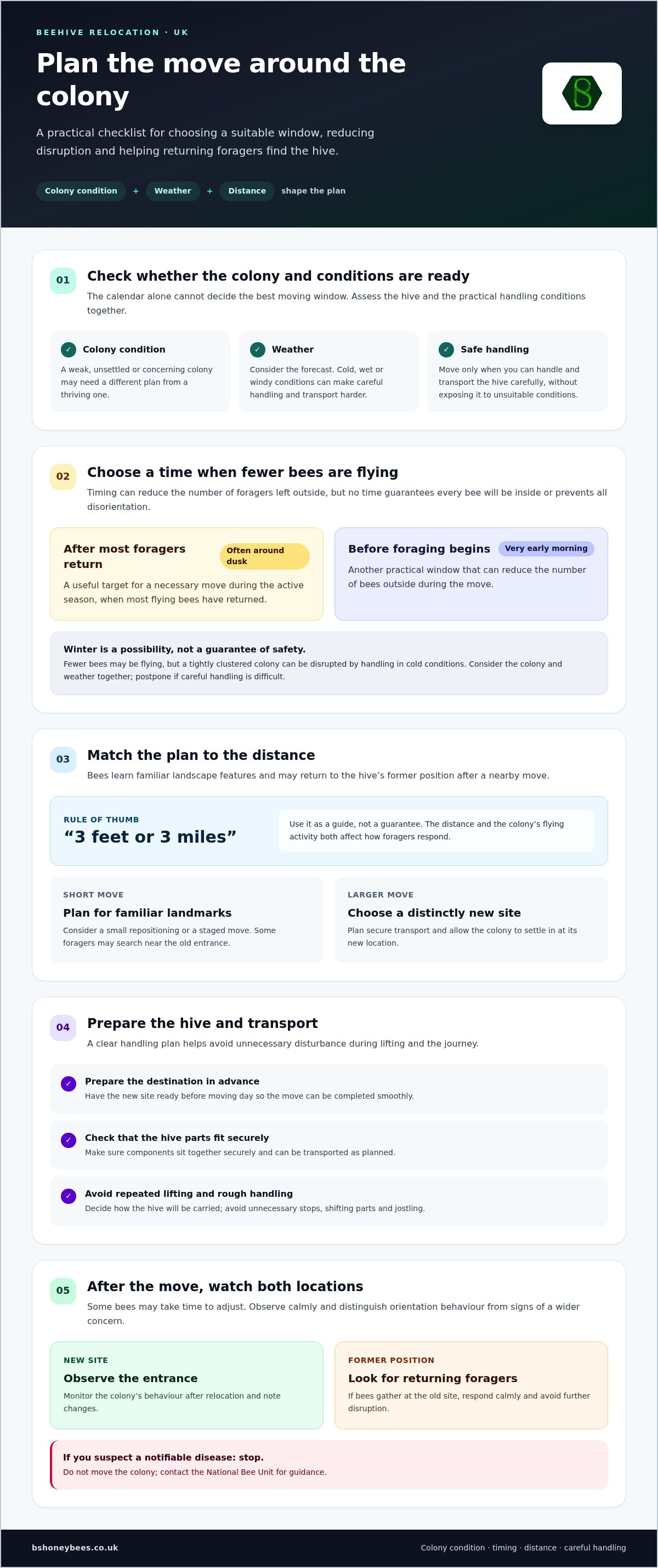
Could choosing the wrong moving day leave foragers circling the hive’s old position? If you’re searching for the best time to move a beehive uk, start by assessing two things: the colony’s condition and the distance to its new site. Moving at dusk, after most foragers have returned, or very early in the morning, before they leave, can reduce the number of bees left behind.
Winter may seem safer because fewer bees are flying, but disturbing a tightly clustered colony in cold conditions can be risky. The season matters as much as the hour. Distance matters too: after a short move, experienced foragers may return to the old location, while a move to a distinctly different site calls for secure transport and a plan for the colony to settle in.
This guide explains how to choose a suitable season and time of day, prepare the hive for transport, and monitor the colony afterwards. It also covers the commonly used “3 feet or 3 miles” guideline and what to consider when neither option is practical.
Key Takeaways
- The best time to move a beehive uk depends on the colony’s condition and whether you can handle and transport it safely, not the calendar alone.
- Use the “three feet or three miles” advice as a rule of thumb. For a short move, consider a small repositioning or a staged move; for a larger move, plan for a distinctly new site.
- Prepare the destination and transport before moving day, and secure the hive components for careful handling.
- After the move, observe the entrance and former position for returning bees. If foragers gather at the old site, respond calmly and avoid further disruption.
- Some adjustment in bee behaviour may be expected after relocation. Pay attention to changes and seek informed guidance if you notice signs of a wider concern.
When is the best time to move a beehive in the UK?
Choose a time when the colony is settled and conditions allow you to handle and transport the hive carefully. In the UK, that means weighing up the season, the weather on moving day and how well you can plan the move. A dormant-season move may mean fewer flying bees are out navigating, but cold conditions can make disturbing the colony a poor choice.
Look beyond the calendar when planning a relocation. Consider the colony’s condition, whether bees are likely to be flying and whether you can complete the move smoothly without exposing the hive to unsuitable weather. General beekeeping practices involve managing colonies in response to their behaviour and surroundings. The same practical judgement applies when choosing a moving window.
Winter can be a useful time to consider a move, but it isn’t an inflexible rule. Move only when the colony and conditions make careful handling appropriate.
Is winter always the best time to move a beehive?
Winter may offer a useful planning window because bees are less likely to be flying, reducing the chance of foragers returning to the hive’s former position. However, the colony may be tightly clustered. Handling it in cold, wet or otherwise unsuitable conditions can cause disruption. Assess the colony and the forecast together; don’t assume winter is automatically the safest season.
Seasonal conditions vary, so a winter date isn’t a green light on its own. If the colony appears unsettled or the weather makes secure, careful handling difficult, postpone a planned move where practical. The best time to move a beehive uk is a decision based on the colony and conditions, not a fixed month that applies to every apiary.
What time of day is best for a necessary move?
For a necessary move during the active season, aim for after most flying bees have returned, often around dusk, or very early in the morning before foraging begins. This can reduce the number of bees left outside during the move. Moving while bees are actively foraging increases the chance that some will return to the hive’s previous position. No time of day can guarantee every bee will be inside or prevent all disorientation.
Urgency affects the decision. If the move can’t wait for a more suitable seasonal window, choose the calmest practical period and prepare the destination and handling plan in advance. Don’t rush a move simply to meet a preferred time if conditions are unsafe. If you suspect a notifiable disease, stop: don’t move the colony, and contact the National Bee Unit for guidance. If there’s no urgent reason, waiting for a settled opportunity is usually the more considered choice.
Why timing and bee orientation matter when relocating a hive
Honey bees don’t navigate by the hive entrance alone. They learn visual features around the apiary and use them to find their way home. This tendency to return to a familiar place is called site fidelity. After a nearby move, some returning foragers may search around the hive’s former position, even though the colony is now elsewhere. Bees won’t all respond in exactly the same way.
Distance affects how easily foragers recognise a new location, while timing affects how many bees are flying during the move. Both matter. Moving a hive while bees are out foraging creates a different challenge from moving it when most are inside. The best time to move a beehive uk therefore depends on the season, the distance and the colony’s flying activity.
How do foragers find their way back to the hive?
Foragers use the appearance of the landscape around the apiary to orient themselves. Trees, fences, buildings and other visible features can help them approach the right spot. If the hive moves only a short distance, bees returning from a forage trip may head towards familiar landmarks and search where the entrance used to be. Some may find the new position quickly; others can take time to adjust.
Moving a hive isn’t simply a matter of placing it elsewhere and expecting every bee to locate it straight away. The Guidelines for moving bees in the UK provide further context for planning a relocation, including how to think about distance and returning foragers.
What can make a hive move more stressful for the colony?
Orientation is only one part of the picture. Handling and transport can disrupt the colony too, particularly if the hive is lifted repeatedly, its components shift, or the journey hasn’t been planned. Decide how the hive will be carried, keep its parts secure and avoid unnecessary stops or rough handling. These steps reduce avoidable disturbance, though they can’t guarantee the colony will show no signs of stress.
- Colony condition: A weak, unsettled or otherwise concerning colony may need a different plan from a thriving one.
- Weather: Cold, wet or windy conditions can affect handling and transport. Assess the forecast as well as the hive.
- Equipment fit: Check that the hive parts sit securely together and can be transported as planned.
Keep orientation and transport disruption distinct as you plan. A forager searching at the old site is an orientation issue; loose hive parts or unnecessary jostling are handling risks. Both deserve attention, but they call for different precautions. If you’re reviewing hive format or equipment as part of your preparation, explore British National hives and frames from BS Honey Bees Ltd.
Short move or new apiary? Choose a method that fits the distance
The often repeated “three feet or three miles” advice is a starting point, not a law or a guarantee. It suggests that bees may accommodate a very small adjustment more easily, while a move to a distinctly new site gives returning foragers different surroundings to learn. Between those extremes, bees may still search familiar surroundings, so plan for the possibility that some return to the former position.
Distance alone doesn’t determine what will happen. A hedge, building or other landmark may make a nearby position feel familiar, while an open or changed landscape can alter how bees approach it. Treat the rule as a prompt to assess the site, not a universal threshold that predicts every colony’s response. The best time to move a beehive uk and the distance plan work together: timing affects how many bees are flying, while distance shapes how they reorient.
How should you handle a very short hive move?
If you’re adjusting a hive within the same apiary, a tiny repositioning may be more manageable than shifting it a substantial distance in one go. Another option is to move it gradually in small increments, allowing the colony to encounter each new position before making another adjustment. There’s no single schedule for every site, so avoid rushing through successive changes.
After each adjustment, observe the entrance and the former position. Look for returning bees gathering where the hive stood, and consider whether nearby landmarks could be directing them there. Use what you see to decide whether to pause or continue. A gradual approach lets you respond to the colony, but it can’t guarantee that no foragers will become disoriented.
- Very small adjustment: Make a minimal change and watch how bees approach the entrance and the old spot.
- Staged short move: Shift the hive in manageable increments, pausing to observe before continuing.
- New apiary: Plan a move to a distinctly unfamiliar setting, with a prepared destination and secure transport.
What changes when the hive is moving to a new apiary?
A new apiary can give bees a different set of surroundings to learn, particularly when the site feels distinct from the original one. Don’t assume that a particular distance will prevent every bee from returning, though. Choose a stable, ready position before moving the colony, and plan the journey so the hive can be transported securely without unnecessary delays or handling.
Check that the hive format and its components suit the prepared site before moving day. If you’re using British National equipment or reviewing compatibility, the British National beehive guide can help you understand the format. Whatever the distance, make a plan that suits the colony and site, then observe how returning bees respond once the hive is in place.
How to prepare and move a beehive with less disruption
A well-planned move reduces last-minute handling and gives you a clear order of work. Prepare the destination, suitable transport and help before disturbing the colony. The hive must remain stable and ventilated throughout the journey. The right way to secure and manage its entrance depends on the hive, journey and conditions, so follow current beekeeping guidance rather than applying one method to every move.
What should you prepare before moving day?
Choose the new position first and make sure its stand or base is stable and ready. Check that the hive body, roof, floor and attachments are secure, and plan how you’ll carry and load the complete hive. Arrange enough help for its weight, the route and the conditions. Protective clothing should suit the work and allow safe handling.
- Prepare the destination. Set up a stable position before moving the colony. Clear the route and make sure the site is ready for the hive.
- Check the hive. Look over the body, roof, floor and attachments. Plan how to keep the parts together during lifting and transport.
- Organise people and transport. Choose suitable transport, plan the route and make sure everyone involved understands how the hive will be handled. Have appropriate protective clothing ready.
- Plan containment and ventilation. Decide how to manage the entrance for this particular journey. If bees need to be contained, use an approach that allows adequate ventilation. Don’t assume that blocking the entrance is suitable in every situation.
- Move and position the hive. Handle it steadily, avoid unnecessary stops and exposure, and place it securely at the prepared destination before managing the entrance. Follow current guidance on reopening and settling the colony.
- Make post-move checks. Observe the entrance and the hive’s stability after placement. Watch for normal activity and follow up if you notice a concern.
What should happen during and immediately after the move?
Keep the journey as controlled as possible. Before setting off, make sure the hive is secure and ventilation hasn’t been obstructed. At the destination, settle the hive into its planned position before changing how the entrance is managed. Reopening isn’t a one-size-fits-all step: take account of the journey and conditions, and use verified guidance for your setup. Then observe calmly rather than repeatedly disturbing the colony.
Include protective clothing in your handling plan, rather than treating it as an afterthought. If you need suitable beekeeping clothing, explore BBWear bee suits as part of your equipment checklist.
After moving a beehive: monitor the colony and plan your next steps
Once the hive is in place, keep checks calm and focused. Start by watching from outside. Look for bees orientating near the new entrance, returning foragers finding their way in, and a stable hive with a clear entrance. Some searching or uneven flight activity may reflect short-term adjustment, but behaviour varies between colonies. It doesn’t by itself confirm that everything is well or that something is wrong.
What should you watch for after relocation?
Observe the entrance without repeatedly opening the hive. Check that it hasn’t become blocked and that the hive hasn’t shifted on its stand. If bees gather at the previous position, note how many are there and whether their activity changes. Don’t assume they’ll all find the new entrance immediately, and don’t expect that every returning forager can be recovered.
If the old position is close by, monitor it as well as the new entrance. Avoid moving the hive again in haste, as another change may add confusion. Instead, assess the situation and use current, reliable beekeeping guidance to decide whether further action is appropriate. If you see signs that concern you beyond orientation, seek an informed assessment rather than trying to diagnose the colony from flight activity alone.
Give the colony time to settle. Unnecessary inspections immediately after handling can add disturbance, so don’t open the hive just to check whether the move has worked. The right interval before an inspection depends on the colony, conditions and reason for looking inside. Follow current UK beekeeping guidance, and inspect sooner only where there’s a clear need and it’s appropriate to do so.
- At the entrance: Watch for bees flying out, returning and orientating around the new position.
- At the former site: Look for foragers gathering there, and note whether their activity changes over time.
- At the hive: Check externally that it remains stable and the entrance is unobstructed.
- Within the colony: Avoid unnecessary disturbance; use informed guidance if there are signs of a wider concern.
How can suitable equipment support careful hive handling?
Good preparation includes protective clothing suited to the work and equipment that fits your hive setup. These are practical considerations, not a substitute for careful handling or a guarantee against stings or other risks. If separate colony-management questions arise later about queen status, use an inspection and informed guidance rather than treating disorientation after a move as proof of a queen problem. The mated queen bees guide can help with that distinct topic.
For your next equipment checklist, explore beekeeping equipment from BS Honey Bees Ltd, including British National hives, frames and BBWear bee suits.
Make your next hive move a considered one
Before setting a date, match your plan to the colony, destination and equipment you’ll use. A move is easier to manage when you’ve prepared the site and have what you need for careful handling. Keep observing after the hive is settled, and let the colony’s behaviour inform any further decisions.
Choosing the best time to move a beehive uk isn’t about finding one perfect date. It’s about making a practical decision for your circumstances, then carrying it out carefully. BS Honey Bees Ltd supplies beekeeping equipment, including British National hives, frames and BBWear bee suits.
Explore beekeeping equipment from BS Honey Bees Ltd to prepare for your next season in the apiary.
Frequently Asked Questions
Is winter the safest time to move a beehive?
Winter can be convenient because bees are generally less active outside the hive, but it isn’t automatically the safest season. A mild, settled spell may be more suitable than cold, wet or windy weather, and the colony’s condition matters too. When considering the best time to move a beehive uk, assess the actual conditions rather than relying on the season alone. Choose a suitable, settled period and check current beekeeping guidance before moving.
Can you move a beehive during the day?
Yes, but during a daylight move some foragers may be away from the colony and return to the hive’s former site. If the move can’t wait, plan the route and have the destination ready before disturbing the hive. Choose a period when the colony is settled, taking its activity and the conditions into account. Moving at a particular hour may reduce disruption, but it can’t guarantee that no bees will be left behind.
What happens if bees return to the hive’s old position?
Some returning foragers may use familiar landmarks and search where the hive stood before. Observe the old position and the new entrance from a safe distance. If bees gather at the former site, avoid handling them. Where it’s safe, you can place a gentle visual cue near the new entrance, such as a leafy branch, to draw attention to the changed surroundings. Not every bee will necessarily relocate, so don’t assume all can be recovered.
Can a beehive be moved when it has supers on?
It may be possible, but supers add weight and can make the hive harder to keep stable during lifting and transport. Assess the complete stack, how securely its parts fit together, the route and the help available before deciding how to prepare it. Removing boxes changes the load, but isn’t automatically the right choice for every colony or setup. Base the decision on safe handling and current beekeeping guidance.
How many people are needed to move a beehive?
There’s no fixed crew size that suits every move. A hive’s weight and configuration, the distance to carry it, access along the route and the people’s ability to lift safely all affect the plan. Consider obstacles such as steps or uneven ground, not just the hive itself. Arrange adequate assistance and suitable handling equipment in advance. Don’t attempt a lift alone if you can’t keep the hive stable and under control.
Should I move a hive before or after inspecting the colony?
Make any necessary assessment before moving, but avoid opening the hive out of routine if that would add unnecessary disturbance. The reason for relocation, colony condition and weather should shape whether an inspection is appropriate and when to carry it out. Plan the assessment so you can check relevant concerns and equipment before moving day, then handle the colony deliberately. There’s no universal inspection schedule that fits every hive or situation.
Does relocating a beehive affect honey production?
Relocation can temporarily interrupt normal activity as bees adjust to a changed position, but the effect on a honey crop varies. Colony strength, season, forage available at the new site and how the move goes can all influence the outcome. Don’t assume relocation will either reduce or preserve the harvest. Allow the colony to settle and observe its activity; assess honey production later in the context of the season and forage conditions.