
The most expensive mistake a new apiarist can make isn't buying too many tools; it's investing in the wrong equipment standard for the British climate. You've likely felt the frustration of scrolling through endless forums, only to end up more confused about whether to choose a National or Langstroth hive. It's a valid concern; nobody wants to waste money on flimsy gear that fails after one season or a suit that doesn't actually prevent stings. You deserve a setup that prioritises both your safety and the health of your colony from the very first inspection.
This guide cuts through the noise to identify the essential, professional-standard beginner beekeeping equipment UK enthusiasts need to start with absolute confidence in 2026. We'll explain why the British National hive is the undisputed standard for our local environment and why professional-grade protection is a non-negotiable investment for your peace of mind. You'll also learn why starting with a calm-tempered nucleus colony, rather than a package of bees, is the smartest move for your first year. By the end of this guide, you'll have a clear, no-nonsense checklist to get your apiary up and running safely.
Key Takeaways
- Learn why investing in professional-grade BBWear bee suits is the gold standard for preventing stings and building confidence during your first inspections.
- Understand why the British National hive is the logical UK standard and how Western Red Cedar provides the durability and insulation needed for our climate.
- Discover why starting with a 5 or 6 frame nucleus colony is a safer, more reliable alternative to a package of bees for new beekeepers.
- Identify the essential beginner beekeeping equipment UK that prioritises quality over "false economy" starter kits that often include flimsy components.
- Gain clarity on selecting hive tools and smokers designed for longevity, ensuring your initial investment supports many successful seasons ahead.
The Essential Beekeeping Checklist for UK Beginners
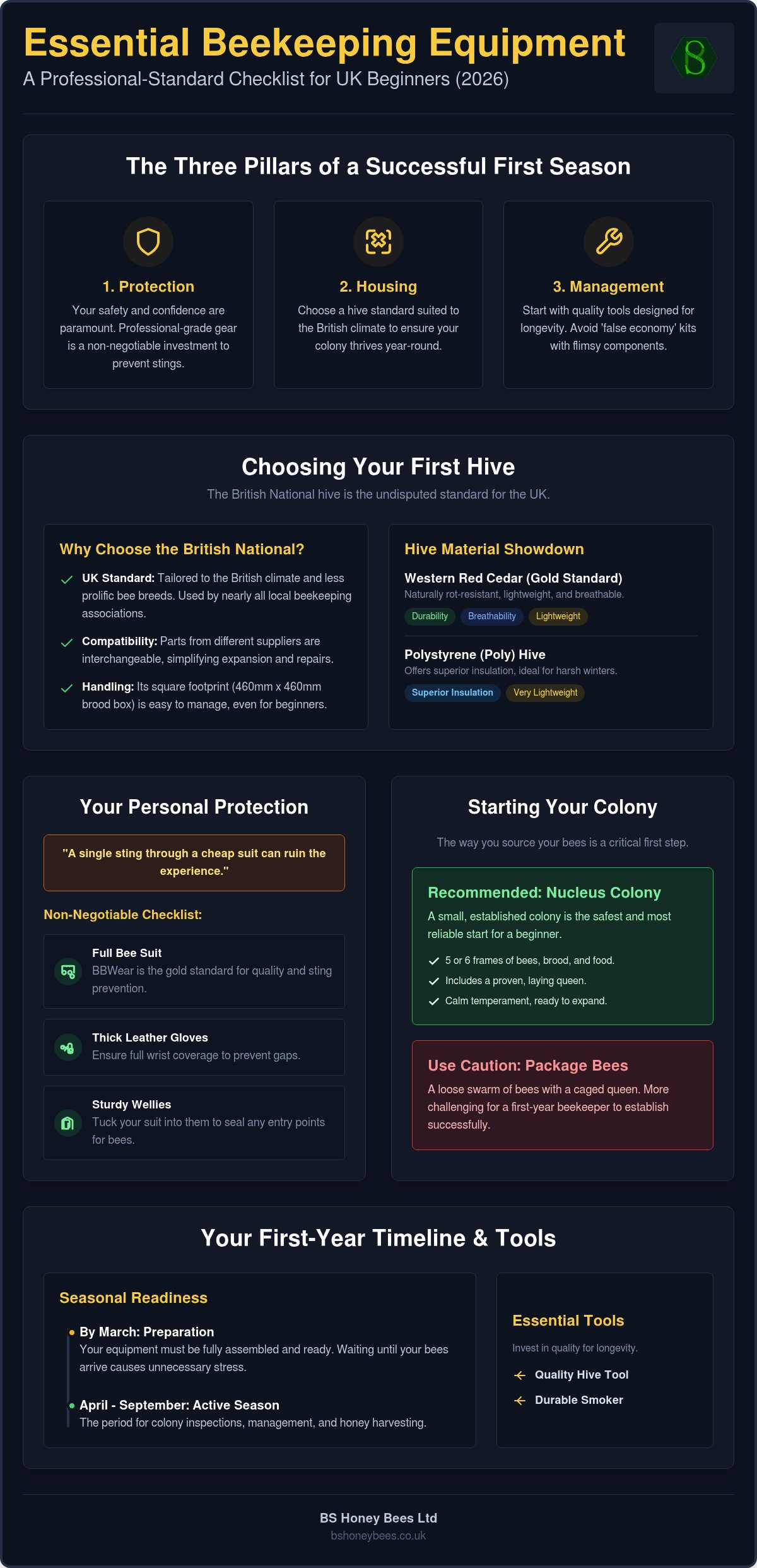
Success in your first season depends on three fundamental pillars: Protection, Housing, and Management. Choosing the right beginner beekeeping equipment UK involves more than just clicking "buy" on the cheapest bundle you find online. Many mass-market starter kits represent a false economy. They often include thin, poly-cotton veils that tear easily or lack the structural integrity to keep mesh away from your face, leading to avoidable stings. A beekeeping starter kit is the functional minimum required to house and manage one colony safely.
Timing is critical for your setup. The UK active season typically runs from April to September; however, your equipment must be assembled and ready by March. Waiting until your bees arrive to build your hive is a recipe for unnecessary stress. Procuring your gear during the winter months allows you to familiarise yourself with the components before the pressure of live bees is added to the mix.
Personal Protection: Staying Safe Amongst the Bees
Safety builds confidence. Beginners often fear being stung, and whilst bees are generally calm, a single sting through a cheap suit can ruin the experience. A full bee suit is non-negotiable whilst you learn to read bee behaviour. Quality counts here. Pair your suit with thick leather gloves and sturdy wellies to ensure no gaps are left for inquisitive foragers. To avoid a loose, dangerous fit that allows the mesh to touch your skin, consult our bee suit sizing guide uk before ordering your protective gear.
The Hive: Choosing the Right Home
Your choice of hive dictates your entire management style. The British National hive is the undisputed favourite amongst UK hobbyists. Its popularity is rooted in the long history of Beekeeping in the United Kingdom; this makes it simple to find compatible parts or advice from local associations. A complete hive consists of a mesh floor, a brood box for the queen to lay eggs, supers for honey storage, a crown board, and a weatherproof roof. A standard National brood box measures 460mm x 460mm, providing a compact yet expandable home for your colony. Inside, you'll need frames fitted with wax foundation to guide the bees as they build their comb. Using the National standard ensures your equipment remains interchangeable as your apiary grows.
Choosing Your First Hive: The British National Standard
Selecting the right hive is the most significant decision you'll make when gathering your beginner beekeeping equipment UK. The British National hive is the undisputed standard across the country. Whilst designs like the Langstroth are popular in North America, the National is tailored to the UK climate and the less prolific bee breeds favoured here. Its square footprint makes it easy to handle. Its dominance means that almost every local beekeeping association in Britain uses it. This ensures that help is always at hand from experienced mentors who understand your specific equipment setup.
Compatibility is a major advantage of the National standard. You can purchase parts from various suppliers, and they will fit together seamlessly. This interchangeability is vital when you need to expand your apiary quickly or replace a damaged component during the active season. Adhering to this standard also simplifies compliance with UK government guidance on bee pests and diseases, as most diagnostic and treatment tools are designed specifically for National dimensions.
Cedar vs. Poly Hives: Which Is Best for Beginners?
Western Red Cedar remains the gold standard for hive construction. It's naturally rot-resistant, lightweight, and doesn't require painting or chemical treatments. It offers a classic look and excellent breathability, which helps manage moisture levels within the colony. In contrast, high-density polystyrene (poly) hives provide superior insulation. These are particularly effective for helping bees maintain heat during harsh UK winters. This emphasis on durable, weather-resistant materials is common across various outdoor industries; for instance, Big Country Blinds produces fibreglass hunting blinds that offer similar longevity and protection against the elements. Many beginners find the 2-in-1 poly nuc to be a versatile alternative for overwintering smaller colonies before they're ready for a full-sized cedar hive.
Understanding the internal components is just as important as the hive box itself. You'll primarily work with DN4 frames for the brood chamber and SN4 frames for the honey supers. The British National design is built around the concept of "bee space," a precise gap that prevents bees from sealing parts together with propolis. For your first year, always choose wired wax foundation. It provides the necessary reinforcement to prevent comb collapse whilst you learn the delicate art of hive inspections. If you're looking for professional-grade gear, you can browse a range of British National hives and frames to start your journey correctly.
Protective Clothing: Why Professional Grade Matters
The number one fear for anyone starting out is the prospect of being stung through their clothing. It is the most common barrier to entry for prospective apiarists. Whilst many retailers offer "economy" poly-cotton kits, these often prove to be a false economy. Thin fabrics can be easily penetrated by a determined guard bee; furthermore, weak zips frequently fail after just a few washes. When selecting your beginner beekeeping equipment UK, prioritising professional-grade fabrics like those found in the BBWear bee suit is the most effective way to build confidence.
Visibility is another critical factor. A poorly designed veil centre can distort your view or collapse against your face in a breeze. High-quality suits maintain a rigid structure that keeps the mesh safely away from your skin whilst providing a clear, wide-angle view of the frames. This clarity is essential for spotting the queen or identifying eggs during your first few inspections. The British Beekeepers Association (BBKA) often stresses the importance of adequate protection for safe apiary management, and professional gear meets these high standards reliably.
The BBWear Advantage for New Beekeepers
British-made BBWear suits have become the industry benchmark amongst commercial beekeepers for a reason. They're built for the rigours of daily use. Key safety features include robust, chunky zips that won't snag and heavy-duty elasticated seals at the wrists and ankles. Choosing a full bee suit with veil ensures that there are no vulnerable gaps between your headwear and your torso. Whilst an economy suit might last a single season, a professional-grade suit will often last for several years with proper care. It's a one-time investment in your safety.
Gloves and Footwear: Completing the Armour
The debate between thick leather gloves and disposable nitrile alternatives is common in beekeeping circles. Whilst nitrile offers superior dexterity, beginners should start with gauntlet-style leather gloves. The added thickness provides a psychological safety net whilst you're still learning how to handle frames without squashing bees. Ensure your suit trousers are tucked into sturdy wellies or leather boots. There should be no gaps for bees to crawl into. This complete seal allows you to focus entirely on the colony rather than worrying about a stray bee inside your clothing. Building this secure barrier is the first step toward enjoying a lifetime of beekeeping.
Essential Tools and Nucleus Colonies: Completing the Setup
Tools are the physical bridge between you and your colony. Whilst many retail kits include "fluff" items like frame grips or fancy scrapers, you only need a few high-quality basics to manage your bees effectively. Investing in professional-standard beginner beekeeping equipment UK means choosing durability over novelty. A smoker is your most vital tool. Whilst smaller models exist, a larger stainless steel smoker is far easier to keep lit during a long inspection. The increased volume allows for better airflow, ensuring you don't run out of smoke just as you reach the brood chamber.
Your hive tool is the secondary essential. You'll choose between the traditional flat scraper and the "J" type tool. Many beginners prefer the J-type because the hook provides mechanical advantage when lifting DN4 frames that have been glued down with propolis. Pair these with a soft-bristled bee brush. This allows you to gently move bees away from frame ears or the hive's edge without triggering defensive behaviour. Don't overlook the "live" equipment; your choice of bees is just as critical as the timber they live in.
The Nucleus Colony: The Safest Way to Start
The most reliable way to begin is by sourcing honey bee nucs for sale UK. A nucleus colony, or "nuc," is a small, established hive typically consisting of 5 or 6 frames. Unlike "packages," which are just loose bees in a box, a nuc comes with established brood, food stores, and a laying queen already accepted by her workers. This setup provides a massive head start for the season. For garden beekeeping, temperament is everything. F1 Buckfast or Carniolan bees are specifically bred for their calm nature, making them much easier for a beginner to handle without fear.
Smoker Fuel and Lighting Techniques
Lighting a smoker is an art. A well-lit smoker produces cool, white smoke that masks alarm pheromones without harming the colony. Use natural fuels like rotten wood, dried lavender, or commercial smoker pellets. Start with a small piece of crumpled newspaper at the bottom, light it, and slowly add your fuel whilst pumping the bellows. Once you have a thick, cool smoke, you're ready to begin. Finally, keep a queen marker pen in your tool kit. Finding a queen amongst 50,000 workers is challenging; a small dot of the year's colour on her thorax makes her instantly visible during inspections. To ensure your first season is a success, order your nucleus colony and essential tools from a specialist you can trust.
Why BS Honey Bees Ltd is the Right Partner for Your First Season
BS Honey Bees Ltd isn't just a retailer; we're a specialist breeder and supplier committed to your long-term success. Choosing your beginner beekeeping equipment UK from a single, authoritative source ensures that every component, from the hive floor to the queen's genetics, works in harmony. We've built our reputation on logistical excellence and a no-nonsense approach to quality. By specialising in the British National standard, BS Honey Bees Ltd guarantees that our hives and frames fit perfectly every time, eliminating the frustration of mismatched parts from different suppliers.
Our expertise extends beyond timber and fabric. We are specialists in breeding F1 buckfast queens UK beekeepers rely on for exceptionally calm temperaments. This focus on genetics is what sets a specialist breeder apart from a general farm shop. When you start with bees that are easy to handle, your learning curve becomes a rewarding experience rather than a daunting challenge. BS Honey Bees Ltd provides the weight of industry leadership to support your first steps amongst the hives, providing you with the right tools for a productive apiary.
Quality Assurance in Live Bee Delivery
Transporting live bees requires precision, speed, and care. BS Honey Bees Ltd utilises specialised courier networks to ensure our 5 and 6 frame nucs arrive in peak condition. For the best possible start, we prioritise "overwintered" nucs. These colonies have already successfully navigated a British winter, proving their resilience and providing you with a significant head start in the spring. You'll receive expert support from a team that understands the nuances of bee health and logistical precision. Buying from a specialist like BS Honey Bees Ltd means you're getting bees bred specifically for the UK climate, not just a generic package.
The Complete Beginner Package
The ideal setup for a new apiarist is simple but uncompromising: a professional BBWear suit, a British National Cedar Hive, and a calm Buckfast nuc. Organise your apiary site well before your bees are scheduled to arrive in late spring. Ensure the ground is level and the hive entrance faces away from prevailing winds to keep the colony warm. Having your equipment assembled and positioned by March allows you to focus entirely on the bees when they arrive. Don't settle for "budget" kits that you'll need to replace in twelve months. Start your journey with professional-grade equipment and the backing of an industry leader. Browse our range of hives, suits, and nucs to secure your setup for the 2026 season.
Prepare for Your First Successful Season
Starting your apiary is a significant investment in the future of British pollinators. You now understand why the British National hive is the logical standard for our climate and why professional-grade protection isn't just about comfort; it's about building the confidence you need to manage your first colony safely. Choosing the right beginner beekeeping equipment UK is the most important step you'll take this year. By prioritising high-quality gear over cheap economy kits, you ensure your setup remains a reliable asset for many seasons to come.
We provide the weight of an industry leader to support your journey. As an official BBWear stockist and specialist F1 Buckfast breeder, we offer everything from the safest suits on the market to calm-tempered, productive bees. Our nationwide UK delivery ensures that your equipment and nucleus colonies arrive in peak condition, regardless of your location. It's time to turn your interest into a rewarding reality.
Browse our Beginner Beekeeping Starter Gear and Live Bees
The 2026 season offers a fresh start for new beekeepers across the country. Take the first step today, organise your site, and prepare to welcome your first colony with the professional tools you deserve.
Frequently Asked Questions
What is the absolute minimum equipment I need to start beekeeping in the UK?
You need a complete British National hive, a protective suit, a smoker, and a hive tool to start safely. These items constitute the functional minimum of beginner beekeeping equipment UK enthusiasts require. Without a smoker to calm the colony or a professional suit to prevent stings, inspections become unnecessarily stressful. We also recommend a bee brush for gentle handling. Secure these basics before your bees arrive to ensure a smooth transition.
Why is the British National hive the most popular choice for beginners?
The British National hive is the most popular choice because it's the standard used by almost every local beekeeping association in the UK. This dominance ensures that spare parts, frames, and advice are always readily available. Its dimensions are perfectly suited to the less prolific bee breeds common in Britain. Choosing this standard means you can easily swap equipment with neighbouring beekeepers or mentors during the active season without compatibility issues.
Do I really need an expensive BBWear bee suit as a beginner?
Investing in a professional BBWear suit is highly recommended for beginners because it provides a superior sting-proof barrier. Cheap, poly-cotton alternatives often have thin fabric and weak zips that fail after minimal use. A high-quality suit builds the confidence you need to handle frames calmly whilst you're still learning bee behaviour. It's a one-time investment in your safety that typically outlasts three or four budget suits purchased from general retailers.
Which is better for a beginner: a nucleus colony or a package of bees?
A nucleus colony is significantly better for a beginner than a package of bees. A 5 or 6 frame nuc arrives with an established laying queen, brood at all stages, and food stores already in place. This provides a massive head start and a much higher success rate for your first year. Packages are simply loose bees that must build everything from scratch, which often leads to colony failure in inexperienced hands.
How much space do I need in my garden for a beehive?
You don't need a vast estate; a standard garden can easily accommodate two hives. The key is ensuring a clear flight path so bees fly up and over fences rather than into neighbours' gardens. Placing a two-metre tall barrier, such as a trellis or hedge, in front of the hive entrance encourages bees to fly high immediately. Always ensure the site is level, well-drained, and receives plenty of morning sunlight.
Is beekeeping a time-consuming hobby for a beginner?
Beekeeping is not overly time-consuming, but it requires regular commitment during the active season. You should expect to spend roughly 30 to 60 minutes per week inspecting a single hive between April and August. These inspections are vital for monitoring queen health and preventing swarming. Outside of this window, the workload drops significantly; winter requires almost no intervention beyond occasional checks for storm damage or food levels to ensure colony survival.
When is the best time of year to buy beekeeping equipment and bees?
The best time to buy your beginner beekeeping equipment UK is during the winter months. This allows you plenty of time to assemble hives and familiarise yourself with your tools before the season starts. For live bees, you must order your nucleus colony in early spring, typically between January and March. Most reputable breeders sell out of overwintered nucs by April, so early booking is essential for a May delivery.
Can I start beekeeping without taking a course?
Whilst you can technically start by reading books and watching guides, we recommend seeking mentorship from a local association. Beekeeping involves managing live animals and understanding complex biological cycles. Joining a local group provides access to experienced apiarists who can offer hands-on advice. Learning the theory is a great start, but nothing replaces the insight gained from observing an expert work through a hive during a live, practical inspection.