

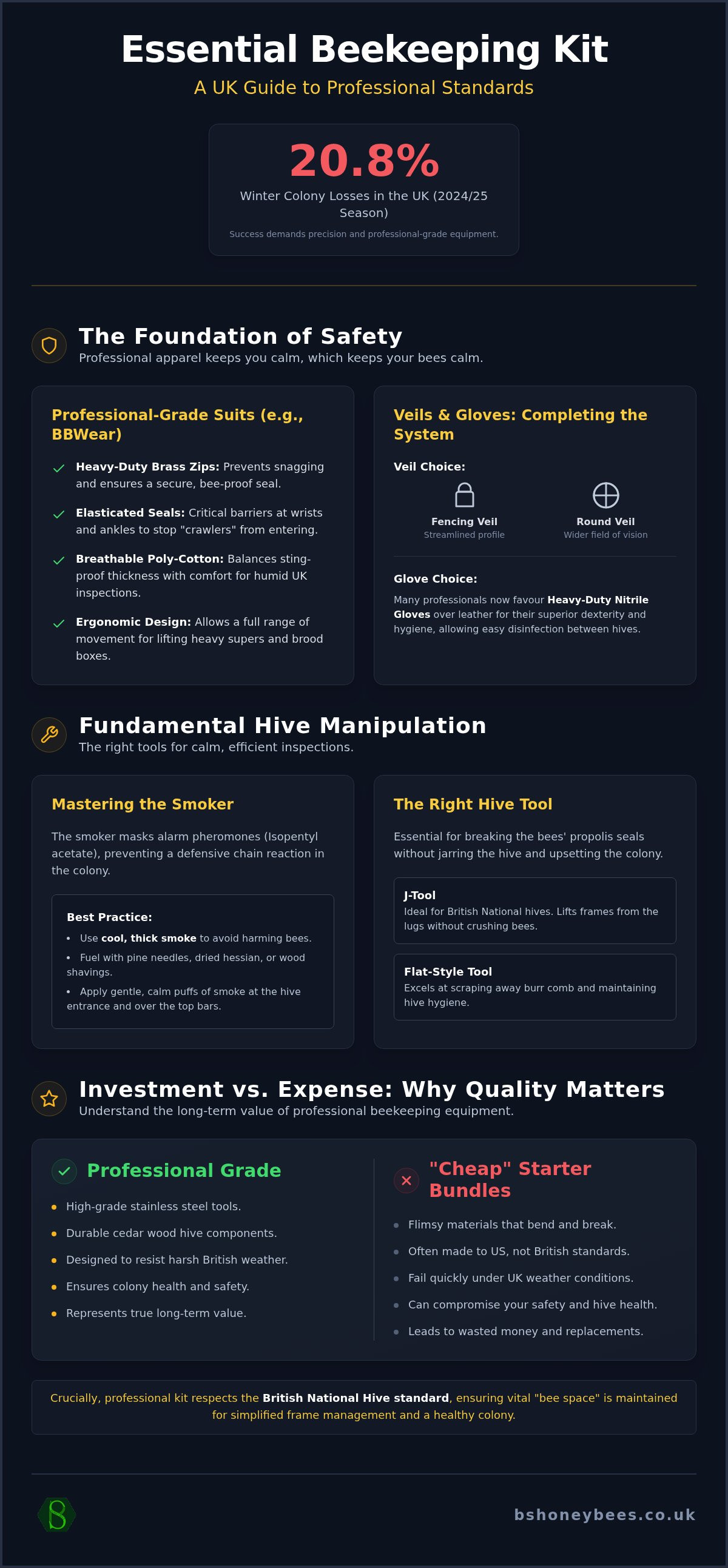
Did you know that winter colony losses in the UK reached 20.8% during the 2024/2025 season? It's a sobering statistic that highlights why precision and the right equipment are non-negotiable for success. Many beginners feel understandably overwhelmed by the conflicting advice found online; they often struggle to distinguish between American standards and the British National equipment required for our specific climate. You might worry about wasting money on flimsy "starter bundles" or, more importantly, whether your gear will actually protect you during a hive inspection.
We understand those frustrations. You deserve a setup that works as hard as you do. This guide is designed to help you master beekeeping tools and their uses, ensuring you can manage your British colonies safely and with professional-grade precision. We'll strip away the confusion and focus on the high-quality kit that actually matters. We'll explore everything from the indispensable hive tool used for prying British National frames to the superior protection of BBWear suits. By the end of this article, you'll have a clear, functional list of essentials and the confidence to perform your next inspection entirely independently.
Key Takeaways
- Learn how to manage colony temperament whilst maintaining absolute safety by selecting professional-grade protective apparel that meets UK standards.
- Master the essential beekeeping tools and their uses, including how to leverage the smoker and hive tool to navigate the hive without distressing your bees.
- Understand the specific requirements of the British National Hive standard to ensure your equipment respects vital "bee space" and simplifies frame management.
- Discover the specialist kit required for successful queen introduction and colony expansion, ensuring the health and productivity of your F1 Buckfast or Carniolan queens.
- Recognise the long-term value of investing in high-grade stainless steel and cedar over "cheap" starter bundles that often fail under British weather conditions.
The Foundation of Safety: Protective Beekeeping Apparel
Your suit isn't just a uniform. It's the most critical component of your toolkit. When you feel safe, your movements are fluid and calm. Bees react to jerky, nervous behaviour; therefore, a reliable suit directly influences colony temperament. Understanding beekeeping tools and their uses starts with what you wear. A professional suit acts as a psychological and physical barrier, allowing you to focus on the health of your bees rather than the fear of a sting.
The anatomy of a professional-grade suit is precise. It relies on heavy-duty brass zips that don't snag and elasticated seals at the wrists and ankles to prevent "crawlers" from entering. In the UK, we face a specific challenge: balancing thick, sting-proof material with the need for breathability during humid July inspections. High-quality poly-cotton blends or ventilated mesh layers are essential. Maintenance is equally vital. Propolis and wax build up quickly, but more importantly, suits can carry pathogens. Regular washing at 60°C helps prevent the spread of diseases between apiaries. Mastering beekeeping tools and their uses requires a professional approach to every piece of kit, including your apparel. Store your gear in a cool, dry place to maintain the integrity of the elastic and veils.
Why Professionals Choose BBWear Suits
We stock BBWear suits because they represent the gold standard in British-made protection. They are engineered for the rigours of the field. The ergonomic design ensures you have a full range of movement when lifting heavy British National supers or bending over a brood box. Unlike cheap imports, these suits are cut to fit properly, reducing the risk of fabric bunching where bees might get trapped. If you are unsure which fit is right for you, consult our Bee suit sizing guide UK to ensure your protection is effective.
Veils and Gloves: Completing the Protective Layer
Choosing the right veil is a matter of personal preference and visibility. Fencing veils offer a streamlined profile and are easy to throw back, whilst round veils provide a wider, unobstructed field of vision. Both must be integrated into the suit with secure zip closures. Gloves present a similar choice. Many professionals move away from thick leather towards heavy-duty nitrile. Nitrile provides superior dexterity and can be easily disinfected between hives, which is crucial for modern beekeeping equipment standards. Ensure your gloves overlap your sleeves perfectly. A gap at the wrist is the most common entry point for a defensive bee. Total protection is about the system, not just the individual pieces.
Fundamental Hive Manipulation Tools and Their Uses
Effective hive management relies on physical intervention that respects the colony's natural instincts. Mastering beekeeping tools and their uses is about more than just owning gear; it's about knowing how to apply it to maintain a productive environment. When you approach a hive, your primary goal is to perform necessary tasks without triggering a defensive response. This requires a combination of biological understanding and the right mechanical leverage.
Mastering the Smoker
The smoker is the beekeeper's primary method for managing colony temperament. It doesn't simply "frighten" the bees. Instead, the smoke interrupts the alarm pheromone, known as Isopentyl acetate, which guard bees release to signal a threat. By masking this chemical, you prevent a defensive chain reaction amongst the workers. To achieve a cool, thick smoke, choose your fuel wisely. Pine needles, dried hessian, or wood shavings are excellent choices for British apiaries. Avoid aggressive "blasts" of hot air. Use gentle puffs to maintain a calm atmosphere. If the smoke is too hot, it can singe wings and cause unnecessary distress.
Choosing the Right Hive Tool
Propolis acts as a powerful adhesive that seals every gap within the hive. Without a lever, you'll never move a frame without causing a jarring vibration that upsets the colony. For those using the British National hive, selecting the right hive tool is a matter of practical efficiency. The J-tool is particularly effective for lifting frames from the end lugs without crushing bees, whilst the flat-style tool excels at scraping. Use the edge to remove "burr comb" and maintain hive hygiene. The hive tool is the multi-purpose lever of the apiary.
Bee brushes allow you to gently move bees from a frame during health checks or harvests without causing defensive behaviour. Use long, soft strokes rather than short flicks. Finally, remember that beekeeping tools and their uses are only effective if the equipment is maintained. Dunking your metal tools in a bucket of washing soda between inspections prevents the cross-contamination of diseases. If you're ready to upgrade your setup, investing in high-quality British hardware ensures your tools are perfectly compatible with your hive standards.
Managing the British National Hive Standard
The British National Hive remains the dominant standard across the UK for good reason. Its compact size and ease of handling suit our temperate climate and the typical behaviour of local honeybee strains. When discussing beekeeping tools and their uses, you must understand how these implements interact specifically with National dimensions. For a detailed breakdown of the architecture itself, see our guide on The British National beehive. Precision is the priority here. Using equipment that doesn't align with these standards leads to poor colony health and logistical headaches.
Effective management of this hive requires specific hardware to ensure productivity. A queen excluder is indispensable for honey production. It confines the queen to the brood box whilst allowing workers to pass through to the supers. This prevents the queen from laying eggs in your honey frames, which simplifies the extraction process. Dummy boards are another vital component. These wooden or poly inserts act as "bookends" for your frames. They make it significantly easier to remove the first frame during an inspection without crushing bees. They also help maintain the correct thermal properties within the hive during the colder months.
Frame Holders and Perches
Organisation is the hallmark of a disciplined beekeeper. Using a frame perch allows you to hang the first one or two frames securely on the outside of the hive body. This creates the necessary internal space to move the remaining frames along, drastically reducing the risk of "rolling" the queen. Always keep frames in their original order and orientation. Disruption to the brood nest's structure can cause unnecessary stress to the colony. Remember that beekeeping tools and their uses are only effective if you respect the 6-9mm "bee space". If your frames aren't seated correctly, the bees will fill the gaps with propolis, making future inspections difficult.
Feeders and Winter Preparation Tools
As the season turns, your toolkit must adapt to the colony's changing needs. Rapid feeders are ideal for the heavy autumn feed. They allow bees to take down large volumes of syrup quickly before the temperature drops. In contrast, contact feeders are better for providing a slow, steady supply or for stimulating the queen in early spring. Winter protection is equally critical in the UK. Install mouse guards early in the autumn to prevent rodents from nesting in the warm cluster. If you're in a high-risk area, consider woodpecker netting or covers for your wooden hives. Finally, ensure you have dedicated cleaning tools to sterilise your wooden and poly nuc components. Hygiene isn't a suggestion; it's the foundation of a healthy, surviving apiary.
Specialist Tools for Queen and Colony Management
Managing your most valuable asset requires a specialised set of skills and equipment. Identifying the queen is often the most daunting task for a beginner, but with the right kit, this becomes a routine and stress-free part of your inspection. Understanding beekeeping tools and their uses in this context is about protecting the heart of the colony whilst ensuring you can monitor her performance. You'll need marking pens, specialised cages, and a steady hand to manage these delicate operations successfully. Precision here doesn't just save time; it prevents the accidental loss of the queen, which could otherwise set your colony back by weeks.
The Queen Introduction Process
Introducing a new queen is a delicate operation that cannot be rushed. A Butler cage, constructed from fine wire mesh, allows the workers to communicate with the queen and share pheromones without the risk of them attacking her. This controlled environment is the most reliable way to ensure the successful acceptance of Mated queen bees UK. Before introduction, you may need to mark her to ensure she is easily found during future inspections. Use a plunger-type marking cage to gently hold her against the mesh whilst you apply a small dot of paint. Following the international colour code, the marking colour for 2026 is white. This high-contrast mark is vital for spotting her quickly amongst thousands of workers, especially during the peak of the summer season when hive populations are at their highest.
Tools for Colony Expansion and Transfer
Colony expansion requires robust equipment that can handle the transition from a nucleus to a full hive. Transferring frames should be done with speed and care to maintain the brood nest's internal temperature. Our 2-in-1 poly nucs are indispensable for this, providing superior insulation that is particularly beneficial during the unpredictable UK spring. These nucs allow you to split a strong colony or overwinter a spare queen with minimal risk of chilling the brood. When performing heavy hive manipulation, such as a full box transfer, always use a marking cage to isolate the queen first. This simple step provides absolute peace of mind, ensuring your queen is safe whilst you move heavy wooden or poly components. If you're ready to expand your apiary, order your professional queen management gear and nucs today to ensure your colonies have the best possible start.
Selecting Quality: Why Professional Equipment Matters
Investing in high-grade equipment is the most effective way to lower your long-term costs. Whilst it's tempting to opt for budget "starter kits" from generic online marketplaces, these often prove to be a false economy. Professional-grade stainless steel hive tools won't bend under the pressure of a heavily propolised British National hive. Similarly, Western Red Cedar or high-density poly components offer the durability and thermal properties required for the UK's damp winters. Understanding beekeeping tools and their uses means recognising that your gear must withstand hundreds of inspections without failing. Quality kit provides the reliability you need to focus on your bees rather than your hardware.
Precision is the second reason to choose specialist suppliers. Cheap imports frequently fail to respect the critical "bee space" of 6-9mm. If a hive is manufactured even slightly out of tolerance, your bees will fill the gaps with brace comb or propolis. This makes inspections disruptive and increases the risk of accidentally killing your queen. Sourcing your kit from UK specialists with live-bee experience ensures every millimetre is standardised. You need a partner who understands the logistical excellence required to manage British colonies. We've seen firsthand how the right tools transform the beekeeping experience from a struggle into a disciplined craft.
The Professional Beekeeper's Checklist
Efficiency at the hive side comes from a well-organised toolkit. Don't carry every gadget you own to the apiary. Focus on the essentials for your first season: a high-quality BBWear suit, a reliable smoker, and a J-type hive tool. Organise your tool box so your most-used items are always within reach. Local support is invaluable here. Having access to advice from experts who use the same hardware in the field ensures you don't waste money on "nice-to-have" items before you truly need them. Start with the basics and expand your collection as your apiary grows in complexity.
Next Steps: From Tools to Bees
Once you've mastered the hardware, the final step is introducing the right genetics. Your tools are designed to facilitate the management of a healthy, productive colony. Matching your professional equipment with calm, high-quality F1 Buckfast or Carniolan stock creates the ideal beekeeping environment. We are here to support your journey from your first inspection to managing a multi-hive apiary with confidence. Browse our professional range of beekeeping tools and live bees to ensure you have the precision gear required for success in 2026.
Mastering Your Apiary for the 2026 Season
Success in the apiary is built on the foundation of precision and professional-grade equipment. We've explored how mastering beekeeping tools and their uses allows you to manage British National colonies with absolute confidence. From the superior protection of BBWear suits to the delicate application of queen marking tools, your choice of hardware directly impacts the health and productivity of your bees. By prioritising UK standards over generic imports, you ensure that every inspection is efficient and stress-free for both you and the colony.
As you prepare for the upcoming season, remember that quality is an investment in your future as a beekeeper. We are specialists in British National hive standards and offer nationwide delivery of both live bees and professional hardware. Whether you need an F1 Buckfast queen or a complete set of frames, we provide the logistical excellence you require. Equip your apiary with professional UK beekeeping tools from BS Honey Bees and take the next step in your journey. Your bees deserve the best start possible; with the right tools in hand, you're ready to achieve exceptional results.
Frequently Asked Questions
What are the three most essential beekeeping tools for a beginner?
The three most essential items for any novice are a high-quality bee suit, a smoker, and a robust hive tool. A professional suit like those from BBWear provides the confidence needed to handle colonies safely. The smoker is vital for calming bees, whilst the hive tool acts as the necessary lever to separate frames. These represent the core of beekeeping tools and their uses for basic apiary management.
How do I choose between a J-style and a flat hive tool?
Your choice depends on whether you prioritise lifting or cleaning. The J-style tool is specifically designed to hook under the lugs of British National frames, allowing you to lift them vertically without rolling bees. Flat tools are often better for scraping propolis and wax from the tops of frames or hive floors. Many professionals carry both to ensure they have the right leverage for every specific task during an inspection.
Why is a smoker considered a safety tool in beekeeping?
A smoker is a safety tool because it prevents the colony from mounting a coordinated defensive response. The smoke masks the alarm pheromone, Isopentyl acetate, which guard bees release when they perceive a threat. By disrupting this chemical communication, you keep the colony in a docile state. This significantly reduces the likelihood of being stung, making the smoker an indispensable piece of protective equipment for every visit to the hive.
Can I use the same tools for both Buckfast and Carniolan bees?
Yes, the same physical tools are used regardless of whether you keep F1 Buckfast or Carniolan queens. These tools are designed to interact with the hive hardware, such as British National hives and frames, rather than the specific genetics of the bees. Whilst the temperament of these strains is generally gentle, the mechanical requirements for prying frames, clearing propolis, and managing the brood nest remain identical across all honeybee varieties.
What is the correct way to clean beekeeping tools to prevent disease?
The most effective method is to scrub your metal tools in a strong solution of washing soda and water. This breaks down the sticky propolis and wax whilst killing various bee pathogens. You should perform this cleaning between every hive inspection to prevent the cross-contamination of diseases like American or European Foulbrood. Always ensure your tools are completely dry before storage to prevent rusting of the stainless steel components.
Do I need different tools for a British National hive compared to a poly nuc?
You can use the same fundamental beekeeping tools and their uses for both hive types, though you must be gentler with poly nucs. Whilst a J-style tool works perfectly for lifting frames in either, the sharp edges of a flat tool can easily gouge high-density polystyrene. When working with 2-in-1 poly nucs, use your tool to lever against the frame lugs rather than the soft hive walls to maintain the equipment's integrity.
How often should I replace my beekeeping suit or veil?
You should replace your suit or veil whenever the integrity of the material is compromised. Check the elasticated seals at the wrists and ankles regularly, as these are the first points to fail. If the mesh of the veil becomes torn or the zips begin to snag, it's time for an upgrade. Premium BBWear suits are built for longevity, but consistent exposure to UV light and frequent washing will eventually necessitate a replacement.
Is it necessary to mark my queen bee, and what tools do I need?
Marking your queen isn't a legal requirement, but it's highly recommended for efficient colony management. It allows you to find her quickly and verify her age. You will need a plunger-type marking cage to secure her safely and a non-toxic marking pen. Remember that the international colour code for 2026 is white. This small mark is a vital tool for monitoring the performance of your mated queens throughout the season.